Are you a team member in a veterinary practice?
Are you a pet parent planning a trip with your furry pal?
World Wide Pet Transport: A Friendly Global Guide
You've got a new job, a lease, or family waiting in another country, and one member of the household hasn't packed a thing. Your dog is asleep on your suitcase. Your cat has claimed the moving box. World wide pet transport suddenly feels less like booking a flight and more like solving a puzzle with fur on it.
Picture This, A Pet on the Move
The hall is full of boxes, your own passport is ready, and then you open a page about moving your pet. Microchip order, vaccine dates, airline rules, and a form you've never heard of all appear at once. It's a very normal moment to feel stuck.
You're not alone in that feeling. In the IATA 2025 Global Passenger Survey findings on pet travel confusion, roughly one-quarter of respondents had traveled with, or would consider traveling with, a pet. Among those respondents, 41% were uncertain whether their animal was eligible, 36% were unsure about airline policy, and 34% did not understand the overall process.
Why it feels bigger than your own flight
When you travel, one passport and one ticket usually do most of the work. When your pet travels, two sets of rules run side by side. The destination country sets health and entry rules, and the airline sets separate rules about size, crate, route, and weather. Meeting one set doesn't automatically meet the other.
There's also an emotional layer. You aren't shipping a box, you're moving a family member who can't read the signs at the airport. That worry can make every small form feel huge, even when the steps themselves are manageable once they're in the right order.
The rules aren't there to trip you up. They exist to protect animals and people in the place you're going to.
A calm plan helps more than a late sprint. World wide pet transport rewards people who start early, ask simple questions, and check dates twice. Your pet doesn't need you to be purrfect. Your pet needs you to be steady, and steady is a skill you can build one step at a time.
The Building Blocks Every Country Leans On
Most destinations build their rules from the same few parts, even if the forms look different. Once you can spot those parts, a long list of rules feels much less scary. Think of them as four building blocks stacked in order.
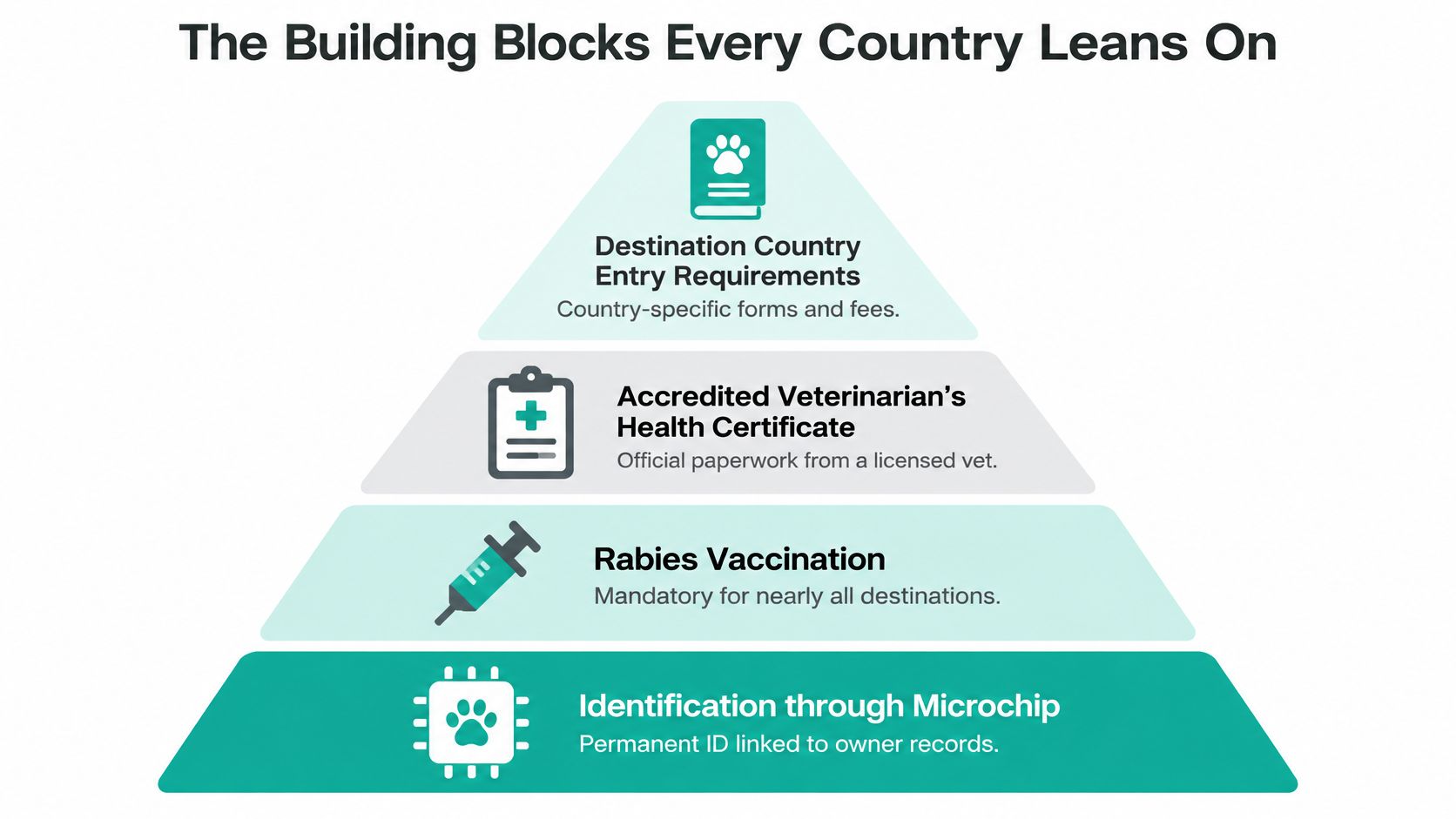
The base is identification, usually a microchip. It's your pet's ID number, and it links your pet to every later record. If that number is wrong on one form, the rest of the paperwork can look like it belongs to a different animal.
Next comes rabies vaccination. Think of it as a health clearance that countries use to protect people and animals from a serious disease. The date matters, and so does the order. A vaccine given before your pet can be properly identified may not count the way you hope.
The signed letter and the official stamp
Health certificate: A signed medical letter from a vet who has examined your pet and recorded the key details.
Government endorsement: An official stamp that helps another country trust that letter.
Destination forms: Extra entry papers, permits, or fees that change from place to place.
You can read more about how an international pet health certificate works in practice to see how these pieces fit together. The key point is simple. The certificate says your pet was checked, and the endorsement helps officials abroad accept who signed it.
One well known model shows this pattern clearly. Under Regulation (EU) No. 576/2013, adopted on June 12, 2013 and applied from December 29, 2014, an animal needed to be identifiable through a microchip or qualifying tattoo, vaccinated against rabies, and accompanied by an authorized vet issued pet passport. Different places use different words, but you'll see that same pattern again and again.
How Regional Rules Ripple Around the Globe
When one large region agrees on a shared system, travelers start to expect that system everywhere. The European Union is a good example. Its pet passport approach gave many countries a shared way to record identity, rabies shots, and travel history, so pets could move between member states with less guesswork.
That shared approach also made timing easier to explain. A vet, an airline agent, and a border officer could all look at the same kind of record and understand what they were seeing. That doesn't make every rule identical, but it does give people a common language.
Why order matters so much
For travel within the EU, Your Europe guidance on traveling with pets and other animals explains that dogs, cats, and ferrets must be identified with a microchip before the rabies vaccination is given. After a first or primary rabies vaccination, the owner must wait at least 21 days before travel.
The order makes sense once you see the reason. The microchip proves which animal got the shot. If the shot comes first and can't be linked clearly to that chip, officials may not be able to trust the record. It's a small detail, but it's the kind of detail that can stop a trip.
Chip first: The ID is in place before health records start to build on it.
Vaccine second: The shot is tied to the right animal from day one.
Wait after a first shot: The body needs time, and the rules reflect that.
Other regions have their own systems, and some places add tests, permits, or waiting periods that the EU model doesn't use in the same way. That's why checking pet import regulations for your actual destination matters more than copying a friend's trip from last year. A rule that worked for one route can be the wrong rule for another, even for the same pet.
Use a familiar system to learn the pattern, then check the destination for the real rule.
Cabin, Cargo, or Ground, Choosing the Right Ride
This is often the decision people lose sleep over. Should your pet sit near you, travel in the hold, or go by road for a shorter cross border move? There's no single right answer, and that's not a failure of planning. It's the honest starting point.
Comparing Pet Transport Options at a Glance
Option | Best For | Key Consideration |
|---|---|---|
Cabin | Small pets that fit airline size and carrier rules | Space is limited and each airline sets its own policy |
Cargo or hold | Larger pets or routes where cabin travel isn't allowed | Crate size, weather, breed rules, and connections matter |
Ground | Shorter moves or pets who do better without flying | Travel time, border rules, and rest stops need planning |
Match the ride to the pet and the route
Cabin travel can feel comforting, but it's not open to every pet. Airlines decide who fits, and they can limit numbers on a flight. Cargo or hold travel sounds scarier to many owners, yet it's how many larger pets travel on long routes. Reading about how a cargo hold on a plane is used for animals can help you ask better questions about crates, loading, and timing.
Ground travel can be a good fit for shorter distances, especially if flying adds long waits for a short hop. Even then, you'll need to think about pickup and drop off timing, comfort breaks, and who is with your pet at each stage. If your own journey includes a car ride to or from the airport, it helps to understand what to expect from an airport transfer so human travel plans don't clash with pet check in times.
Be clear about legal status too. A trained service animal isn't the same as an ordinary pet, and an emotional support animal isn't treated the same way everywhere. On many routes, an emotional support animal may be handled as a pet, with the same fees and limits. Don't assume a letter or vest changes the rules.
The cheapest route isn't always the kindest one. A tight connection, hot weather, or a change of aircraft can add risk and stress. A direct route with a carrier that handles animals often may be the calmer choice, even if it isn't the lowest price. Choose for your pet, your route, and the season, not for a headline fare.
Your Backwards Countdown From Arrival Day
Experienced coordinators rarely plan forward from today. They start with arrival day and work backwards, because every step depends on the one before it. That one shift stops world wide pet transport from feeling like a pile of tasks and turns it into a chain you can follow.

Start by writing your hoped for arrival date at the top of a page. Under it, list the flight, then the vet exam and endorsement, then any lab test, then the rabies shot, then the microchip check. When you read it top to bottom, you'll see why a late start is hard to fix. You can't rush a waiting period just because a flight is on sale.
Where the tight windows sit
Some windows are long, and some are very short. USDA APHIS guidance on the pet travel process explains that most countries require a health certificate from an accredited vet, some require government endorsement, and the certificate may need to be completed within a set period before arrival. For example, the EU requires USDA endorsement within 10 days of arrival for non-commercial movement, while commercial shipments can require endorsement within 48 hours of issuance.
That means your final vet visit, the endorsement, and the flight must sit inside overlapping windows. Book the flight too early and the paper may expire. Book the vet too late and there's no room to fix a typo. Keeping an eye on common application deadlines and timing traps helps you spot the earliest expiring item first.
Some owners use a simple calendar, and some vets use Passpaw to track country tasks, dates, and documents in one workflow. Either way, the tool matters less than the habit. Check what's due next, and check what depends on it.
While you're planning health steps for your pet, don't forget your own. If illness in the household could delay a vet visit or a flight, general coronavirus advice and information can help you think about backup plans and timing. A sick owner, a closed office, or a missed appointment can ripple through the whole countdown, so leave breathing room where you can.
A Realistic Worked Example From the United States to Morocco
A real route makes the countdown easier to picture. This example isn't advice for your trip, and rules can change. It's a teaching example that shows how several short windows can stack on top of each other in the final days.
In the USDA APHIS example for travel from the US to Morocco, the health certificate must be issued by a USDA accredited vet within 5 business days of export and endorsed by USDA APHIS within 3 calendar days of export. It must be supported by a clinical examination within 24 hours of export, followed by a second and final inspection within 24 hours of departure.
How those windows overlap
Notice that these aren't four separate weeks. They're four clocks running at the same time.
Certificate clock: The accredited vet issues the certificate inside its window.
Endorsement clock: The government endorsement must follow inside a shorter window.
Exam clock: A clinical exam supports the certificate very close to export.
Final inspection clock: Your pet is seen again very close to departure.
If one appointment slips, the others may need to move too. If a flight is changed at the last minute, a paper that was fine yesterday may no longer fit the new date. That's not anyone being difficult. It's how a chain works when each link has its own expiry.
Practical rule: In the final stretch, protect your appointments the way you'd protect the flight itself.
Use examples like this to learn the pattern, not to copy the dates. Your destination may be simpler or more complex, and transit through another country may add its own rules. Confirm the current steps with your vet and the relevant authorities before you book anything you can't change.
Myths Worth Putting to Bed
Pet travel forums are full of confident advice, and some of it is wrong in a very friendly voice. Putting a few myths to bed can save you money, stress, and a hard conversation at check in.

Myth one, emotional support animals fly free everywhere. They don't get the same treatment in every place, and on many routes they're treated as ordinary pets. A trained service animal may be handled differently, but that status has its own meaning and checks. Don't plan your budget or your seat choice around a label you haven't confirmed with the airline.
Myth two, a kind agent can waive the rules on the day. Airline staff can be helpful, but they can't rewrite a country's entry rules at the desk. If a required test, stamp, or date is missing, a smile won't fix it. World wide pet transport is checked by more than one person, and each checker has a job to do.
The paperwork myths that cause the most tears
Myth three, a domestic health certificate works abroad. A form that works for travel inside one country may not meet another country's rules. Destinations set their own requirements, and they may want a specific vet, a specific form, or a government stamp.
Myth four, if the rabies shot is done, you're ready to fly. For some routes, there's another step. Under EU entry rules on rabies antibody testing, a pet from many non-EU countries must have a blood sample taken at least 30 days after rabies vaccination for a test by an approved lab, with the sample generally collected at least three months before the pet moves into the EU. That's why a last minute shot can't rescue some trips.
When you hear a bold claim online, ask where it came from. If you can't find it on an official page or hear it from your vet, treat it as a story, not a rule.
A Calm Checklist Before You Book the Flight
Before you pay for a flight you may not be able to change, run through this calm check. It won't replace advice from your vet, but it will help you ask the right questions in the right order.
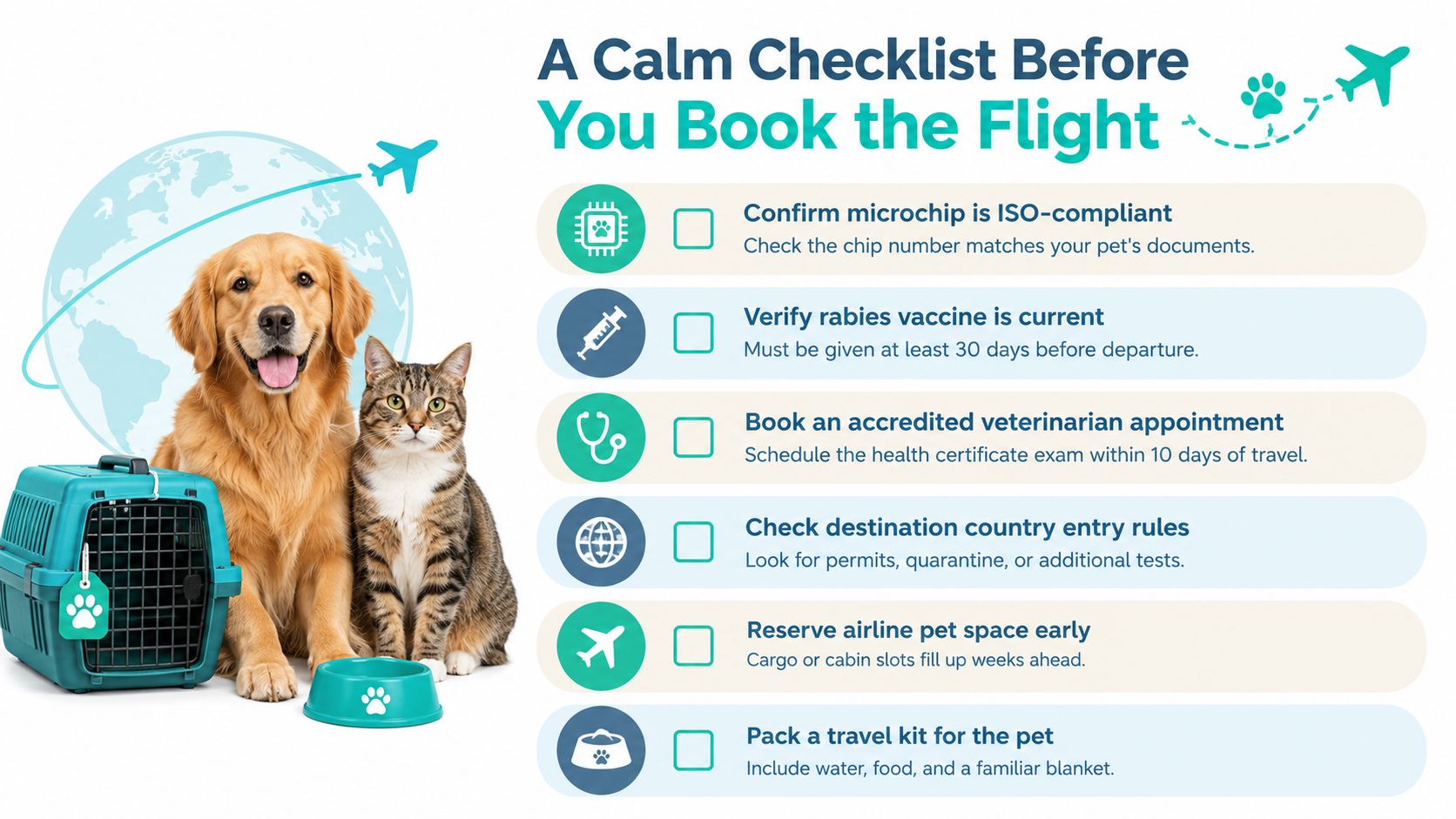
Confirm the chip: The number reads clearly and matches every record.
Check vaccine order and dates: The timing fits your destination, not just your calendar.
Ask about extra tests: You know if a lab step is needed and when it must happen.
Confirm certificate and endorsement windows: Your vet visit, stamp, and flight can sit inside them.
Check airline rules separately: Crate, size, breed, weather, and connection rules are clear.
Plan for transit: Any country you pass through has been checked too.
Pack a small kit for the final days as well. Familiar bedding, clear labels, copies of key papers, and basic first aid items can help you feel ready. If nail trims are part of your pre travel grooming, learning about styptic powder for pet nail care is a simple way to handle a small nick without panic.
A few last questions people ask
What if rules change after I book? Check again close to travel and keep your vet in the loop. A change may mean a new form or a new date, so flexible bookings can help.
Do papers travel with my pet? Often, yes, an endorsed original may need to travel with the animal even if parts were sent online. Ask your vet what should be printed, what should be attached, and what copy you should carry yourself.
What should I do first? Book a chat with your vet, share your destination and hoped for date, and build your backwards countdown together. That's a pawsitive first step, and it's one you can take today.
Passpaw helps vets and pet owners manage international health certificates, destination tasks, and time sensitive travel documents in one clear workflow, so the backwards countdown for world wide pet transport is easier to follow. If you're planning a move and want a calmer way to track each step with your veterinary team, visit Passpaw to see how the platform can support your pet's journey.

More articles
From regulatory changes to best practices for veterinarians and pet owners, our resources keep you ahead of the curve.