Are you a team member in a veterinary practice?
Are you a pet parent planning a trip with your furry pal?
Pet Import Regulations Made Simple for 2026
Your moving boxes are half packed, your flights are open in another browser tab, and your golden retriever is asleep beside a folder of vaccination records. Then you discover that having a rabies certificate might not be enough. Does the microchip date matter? What about the country you visited on holiday? And could changing your connection airport affect your dog's paperwork?
Pet import regulations are easier to understand when you start with your pet's story, not just your destination. Where your pet has been, where they were vaccinated, and how they'll arrive can all affect the next step. You don't need to become a border-control specialist, but you do need a plan that connects those details.
What Pet Import Regulations Actually Cover
For a family relocating with their golden retriever, the first instinct is usually to collect documents: vaccination record, health certificate, flight confirmation. That's understandable. Paperwork feels like something you can finish and put in a folder.
But a folder isn't the same as an entry plan. Pet import regulations connect the animal, its health records, and the journey, so officials can assess whether that particular pet meets the applicable conditions.

Think checkpoints, not one permission slip
Airport security offers a useful analogy. Your ticket, identity check, and baggage screening serve different purposes; completing one doesn't replace the others. Pet travel works similarly, with health preparation, supporting records, and checks at arrival.
Rabies vaccination addresses disease protection. Permanent identification connects the animal to its records, while a veterinary certificate communicates the relevant health information. The World Organisation for Animal Health's rabies framework connects these elements through identification, certification, vaccination, and, where applicable, laboratory evidence.
Start with the animal: A certificate should describe your pet's actual history, not simply contain the right-looking stamps.
The confusing part is that different authorities may ask different questions. A veterinarian reviews health information, border officials review entry eligibility, and your transport provider has its own booking process. Don't assume approval from one means everyone else has approved the journey.
If the border terminology feels unfamiliar, Matil's guide to understanding customs declarations offers useful background. Treat customs declarations and veterinary documents as separate parts of your travel folder, rather than interchangeable paperwork.
For our relocating family, the helpful question isn't “Have we collected enough documents?” It's “Does every document support the journey our dog is taking?” That change in perspective makes the process far less ruff.
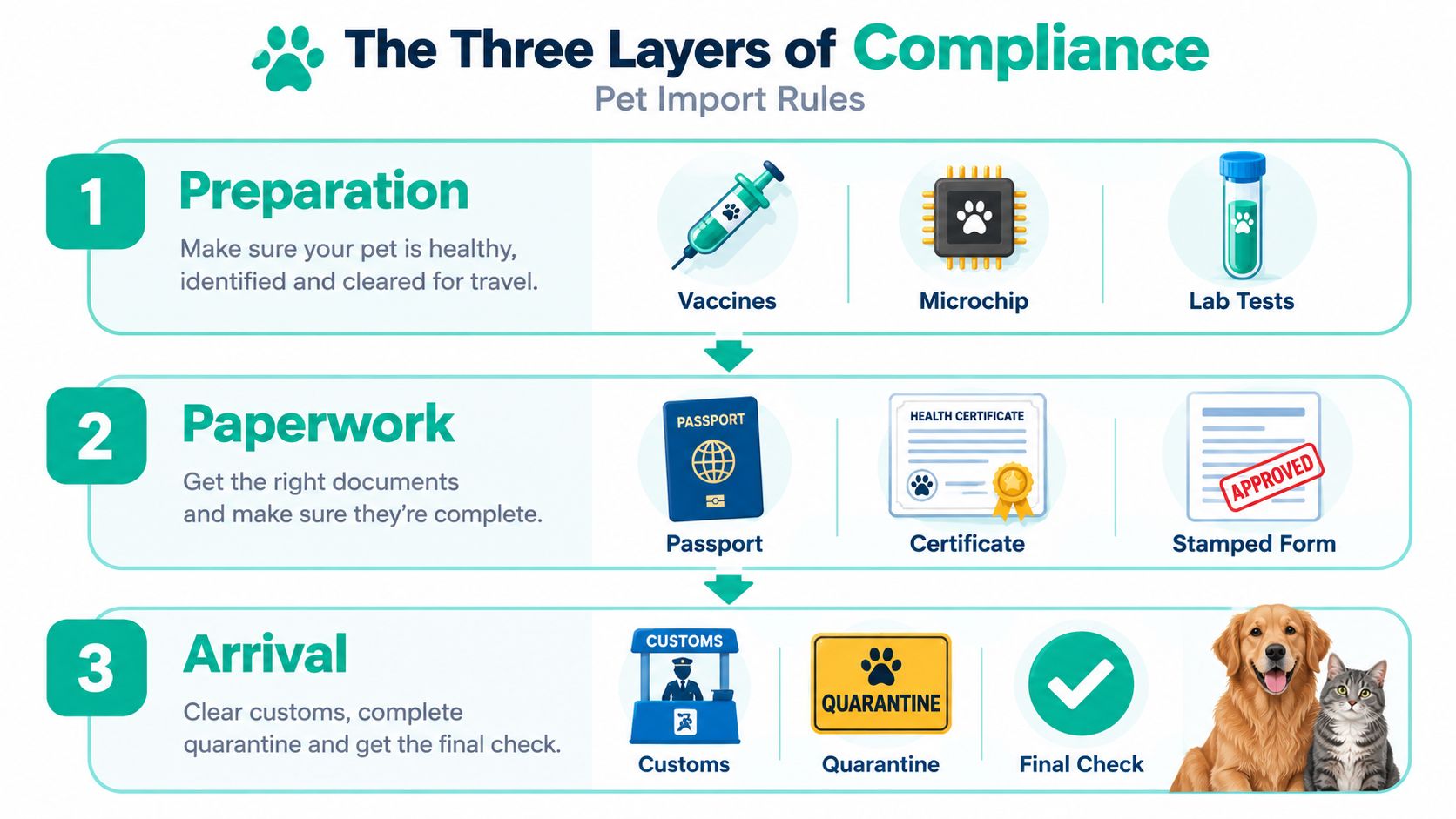
The Three Layers of Compliance
A practical way to organize pet import requirements is to sort them into preparation, paperwork, and arrival. This is a planning framework, not a universal government checklist. It helps you spot where one task depends on another.
Preparation establishes the evidence
Start with what has happened to the animal: identification, vaccinations, examinations, and any required blood tests. Your vet needs the original dates and records, not just your recollection that everything is current.
Under WOAH's framework, the animal's identification number must appear on the international veterinary certificate. Where vaccination plus serology is the applicable pathway, rabies antibody titration falls no earlier than 3 months and no later than 12 months before shipment, with a result of at least 0.5 IU/mL, as specified in the framework linked above.
Those are framework conditions, not a test schedule to apply automatically to every destination. Serology, often called a titer test, means measuring antibodies in blood; the destination's accepted test, laboratory, and timing still need checking.
Paperwork translates preparation into a record
Think of a health certificate as the formal account of completed preparation. Forms, certificates, and any applicable permits need to agree with that account.
Match the identifier: Compare the microchip number across vaccination records, laboratory reports, and certificates.
Check the sequence: Confirm that each medical step happened in the order the destination accepts.
Use the correct pathway: Ask which document applies to your pet's origin, travel purpose, and route.
A perfectly typed certificate can't repair an underlying timing problem. That's why it's better to review the records before booking the final certificate appointment.
Arrival completes the process
Entry controls may involve document checks, an examination, or required facility arrangements. These are distinct from the work your home veterinarian completes.
Also separate departure-side arrangements from destination conditions. Ask your vet what must be issued or endorsed before leaving, then ask who handles the arrival requirements. Read your plan as a dependency chain: identification supports vaccination records, those records support certification, and the accepted documents support entry review.
How Rules Branch by Travel History and Vaccine Origin
Consider two hypothetical dogs heading to the same U.S. city. One has stayed in low-risk countries throughout its recent travels; the other has visited a country classified as high risk for dog rabies and received its vaccination abroad. Their destination matches, but their entry pathways may not.
The CDC considers countries visited during the previous 6 months, alongside vaccination origin and route. Its dog-import FAQs explain travel-history branching, including why foreign-vaccinated dogs with recent high-risk-country exposure can't use a U.S. land port.
U.S. Dog Import Pathways at a Glance
The following comparison summarizes the distinction between baseline documentation and additional controls described in the CDC's guidance on traveling with pets and service animals. Exact documents should be confirmed for the individual itinerary.
Scenario | Forms Required | Vaccine Conditions | Post-Arrival Steps |
|---|---|---|---|
Recent travel limited to rabies-free or low-risk countries | CDC Dog Import Form receipt; check other applicable requirements | Confirm the conditions relevant to the itinerary | Follow applicable entry checks |
Recent high-risk-country travel with U.S. vaccination | CDC Dog Import Form receipt plus the accepted U.S.-vaccination documentation | Verify eligibility for the U.S.-vaccinated pathway | Confirm arrangements for that pathway |
Recent high-risk-country travel with foreign vaccination | CDC Dog Import Form receipt plus applicable vaccination and supporting records | Foreign vaccination doesn't replace required arrival revaccination | Approved-port entry and facility examination; acceptable titer or 28-day facility quarantine after revaccination |
Since August 1, 2024, foreign-vaccinated dogs arriving from high-risk countries must be revaccinated at a CDC-registered animal-care facility, regardless of the foreign vaccine received, according to the Congressional Research Service's explanation of the revised rule.
Give your vet the whole route
Don't leave out a connection because it seems too short to matter. Ask how the authorities treat that transit rather than assuming every layover counts, or none do.
Countries visited: Where has your dog been, and on which dates?
Vaccination origin: In which country was the rabies vaccine administered?
Arrival details: Which port and final state are planned?
Supporting evidence: Do you have vaccination records and any accepted laboratory report?
If your pathway involves antibody testing, this guide to the dog rabies titer test can help you prepare questions for your vet. The useful starting point is your dog's history, not another traveler's checklist.
Two Country Examples Worth Studying
Great Britain and the United States illustrate why copying someone else's preparation schedule can cause trouble. Both address animal-health risks, but they organize the steps differently. These examples focus mainly on dogs; don't transfer dog-specific conditions to another species.

Great Britain emphasizes sequence and arrival timing
Great Britain requires the microchip to be implanted before rabies vaccination. After a first vaccination, the usual wait is at least 21 full days, although the vaccine can affect the waiting period; applicable dog tapeworm treatment must be given no less than 24 hours and no more than 5 days before arrival, according to Great Britain's official pet-entry guidance, which also warns of refused entry or quarantine for up to 4 months when rules aren't followed.
The practical challenge is coordinating long-range preparation with an arrival-based treatment window. A vaccination appointment belongs early in the plan, while applicable tapeworm treatment needs to be aligned with the actual arrival time.
For example, if a flight is delayed, don't assume the treatment record remains suitable. Have your vet or travel coordinator reassess the timing against the revised arrival.
The United States adds a universal starting point
Dogs entering the United States generally must be at least 6 months old, have an ISO-compatible microchip, appear healthy, and meet travel-history-linked documentation requirements. The chip must precede any required rabies vaccination, as explained in the CDC's U.S. dog-entry requirements.
Age is easy to overlook when a puppy already has vaccination records. A completed vaccine appointment doesn't by itself establish eligibility for travel.
A familiar destination isn't necessarily a familiar pathway. Check the animal's eligibility before choosing the flight.
For another destination-specific planning example, the guide to moving to Australia with a pet offers a separate starting point. Use country guides to develop questions, then verify the answers against the official rules for your particular move.
Building a Realistic Timeline for Your Pet
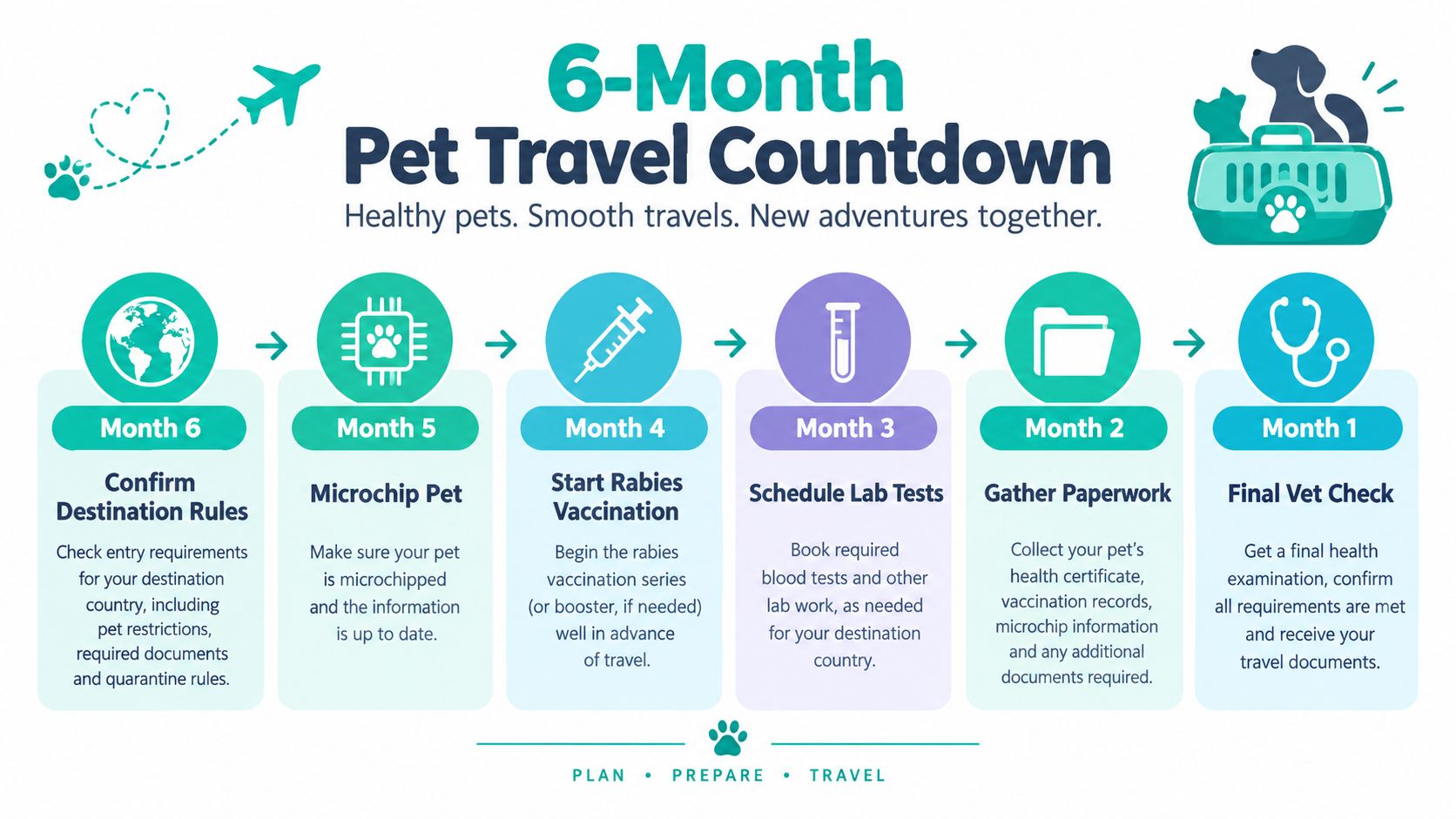
Work backward from arrival, rather than scheduling appointments whenever your calendar has space. Put fixed entry windows on the calendar first, then identify which earlier steps make those deadlines possible.
A six-month countdown can be a useful planning template, but it isn't a required preparation period or a guarantee of enough time. The illustration below is a reminder of task categories, not a medical schedule to follow unchanged.
Anchor the calendar to accepted dates
For U.S.-bound dogs with recent high-risk-country travel, the first accepted rabies vaccination must be given at 12 weeks, or 84 days, of age or later. A first vaccination, or vaccination after coverage has lapsed, generally needs to be given at least 28 days before arrival, according to the CDC's high-risk dog vaccination FAQs.
Your planning sequence can then look like this:
Early planning: Establish the route, review existing records, and identify missing preparation.
Before testing: Ask your vet which vaccination and blood-draw dates the destination accepts.
Before certification: Gather the supporting records and reserve the appropriate veterinary appointment.
Near departure: Complete time-sensitive forms, treatment, and endorsement arrangements where applicable.
Pretty Progress's travel planning timeline can help organize the wider move around those veterinary tasks. Keep the regulatory deadlines separate from flexible chores such as packing.
Leave room for corrections
Ask the laboratory and veterinary team about their current processing schedules instead of assuming a turnaround. If a USDA-accredited veterinarian and government endorsement are applicable, coordinate those appointments before the final window opens.
The guide to common application deadlines can help frame that conversation. A useful calendar records not only the due date, but who owns the task and what must be completed first.
Why Simplified Rules Can Still Trip You Up
A shorter document list feels reassuring. It can also tempt you to stop checking the conditions behind that list.
Since August 1, 2024, dogs entering or returning to the United States after being only in rabies-free or low-risk countries generally need only the CDC Dog Import Form for that CDC pathway. However, the underlying conditions still include the country-history assertion, a universally detectable microchip, the minimum-age requirement, and applicable USDA and destination-state rules, as explained in the CDC's rabies-free and low-risk-country guidance.
Less paperwork isn't less responsibility
Think of the simple form as the result of qualifying for a pathway, not permission to skip the eligibility review. Your task is to establish that the pathway fits before relying on its shorter document list.
Before accepting a flight change: Recheck the pet's route, not just the passenger's connection time.
A new stop can raise a question that wasn't present when you first completed the form. Keep the revised itinerary and ask whether that transit changes the applicable history assessment.
Old instructions can look convincing
The same CDC guidance explains that a transition for certain U.S.-vaccinated dogs ended July 31, 2025, after which older document pathways were no longer accepted in relevant cases. For travel in 2026, a saved checklist may therefore look complete while describing an outdated route through the paperwork.
Historical permit figures show the scale of document review: authorities approved 63,618 dog-import permits from August 2021 through April 2024, according to the CDC's report on imported dogs and vaccination concerns. That's historical context, not evidence that every traveler currently needs a permit.
Save the date you checked a rule alongside the rule itself. If your route changes, reopen the official guidance and ask your vet whether your completed documents still match the journey.
How Vets and Platforms Keep Paperwork Honest
Your veterinary team and your document-tracking tool should do different jobs. The vet assesses the animal and interprets its medical records; software helps organize information, flag inconsistencies, and keep administrative work visible.
For departure from the United States, ask whether your destination requires a USDA-accredited veterinarian and government endorsement. Where applicable, your team can coordinate the examination, certificate preparation, and submission process. Don't assume your usual wellness appointment includes that work.
Give the practice a complete intake
A useful intake includes the pet's identifier, vaccination records, laboratory results, countries visited, proposed route, and arrival date. Send readable records rather than scattered screenshots with missing dates.
Passpaw is one cloud-based option for managing international pet health-certificate workflows, alongside practice-managed checklists and specialist travel coordination. Its tools include real-time document validation, task prioritization based on travel dates and pet information, and client communication throughout the application process.
Those features can support the team's review, but they don't replace veterinary judgment or an authority's entry decision. When comparing tools or services, ask concrete questions:
History handling: Can the team record the full itinerary and flag a route change?
Record checking: Who resolves conflicting dates or microchip numbers?
Task ownership: Who submits documents, and who confirms receipt?
Escalation: Who contacts the relevant authority when a case doesn't fit the usual pathway?
Keep transport preparation on a separate track
The guide to documentation verification can help you understand what needs checking before a certificate is finalized. Ask for unresolved issues to be identified early, rather than discovering them at the last appointment.
Your carrier needs its own attention. Nandog Pet Gear's guide to how to pick an approved pet carrier is a useful starting point for that conversation, but confirm acceptance with the airline operating your flight.
Medical preparation, document tracking, and transport arrangements should meet in one shared plan. They shouldn't disappear into separate inboxes.
Your Pre-Travel Checklist and Final Thoughts
Before closing the travel folder, review it against the latest itinerary. The point isn't to admire a neat stack of papers; it's to confirm that the animal, records, and route still agree.
Check the details that affect the journey
Microchip confirmation: Have the chip scanned and compare the recorded identifier across the relevant documents.
Vaccination validity: Ask your vet to confirm the accepted vaccination sequence and coverage for travel.
Blood-test timing: If testing applies, confirm that the laboratory, result, and date meet the destination's conditions.
Certificate readiness: Have the correct certificate and required endorsement in hand where applicable.
Import forms: Check completion, receipts, and any supporting documentation for your pathway.
Arrival arrangements: Confirm the entry point and any required facility booking or treatment.
Contingency plan: Decide whom you'll contact if a flight, transit stop, or arrival date changes.
Make the final review a habit
Set yourself a reminder to verify requirements within 30 days of travel. That's a planning recommendation, not a universal legal deadline, and it doesn't replace an earlier review or a further check after an itinerary change.
Ask your vet to identify anything still uncertain. It's much easier to resolve a question while you're at home than while you're holding a lead at an arrivals desk.
Your pet's story determines the questions you need to ask. A destination name alone can't tell your veterinary team which records, dates, or route conditions matter. With that story written down and responsibilities clearly assigned, you can spend less time chasing paperwork and more time preparing your companion for the move.
The goal is a happy arrival together. A little organized paw-work helps you get there.
Passpaw offers tools for organizing international pet health-certificate documents, checking records, and keeping veterinary teams and pet parents informed. Visit Passpaw to explore how its workflow can help you turn your pet's travel history and departure plans into a coordinated preparation process.

More articles
From regulatory changes to best practices for veterinarians and pet owners, our resources keep you ahead of the curve.