Are you a team member in a veterinary practice?
Are you a pet parent planning a trip with your furry pal?
Your Guide to the International Pet Health Certificate
Thinking about taking your furry, feathered, or scaled best friend on an international adventure? If so, the single most important document you'll need is an international pet health certificate. This is your pet’s official passport and health clearance, proving they're fit to fly and meet all the rules of your destination country.
Your Pet's Passport to the World

Let's be honest: planning an overseas move is stressful enough. You've got boxes to pack and flights to book. The last thing you need is to get tangled in a web of confusing rules just to bring your pet along. The forms, the deadlines, the vet lingo—it can feel like a real headache.
That's where this guide comes in. We're here to untangle that leash and make getting an international pet health certificate as simple as possible. Think of this document as a golden ticket, making sure your companion can safely and smoothly join you. It's more than just paperwork; it’s peace of mind.
Why This Certificate Is So Important
At its core, the certificate does two big jobs. First, it's official proof that your pet is healthy and not carrying any contagious diseases. Second, it protects the destination country from foreign pests and illnesses that could harm its local animal population.
An international pet health certificate is a country's first line of defense against animal diseases. It helps ensure pets crossing borders are healthy, properly vaccinated, and free from parasites that could threaten native wildlife and livestock.
This isn’t just about ticking boxes. It’s a vital part of global animal welfare. Every country has a unique ecosystem, and these health rules are what protect it. For example, strict import rules are the reason some regions remain rabies-free.
Here’s a quick rundown of what to expect on the certificate itself.
Key Parts of Your Pet's Health Certificate
This table gives you a quick snapshot of the essential parts of an international pet health certificate so you know what to expect.
Component | What It Is | Why It Matters for Your Trip |
|---|---|---|
Pet & Owner Details | Your pet’s name, breed, age, and microchip number, plus your contact information. | This is the basic ID. Any mismatch can cause major delays at the border. |
Vaccination Records | Proof of all required shots, especially rabies, with dates and manufacturer details. | Countries have strict timelines. A shot given a day too early or late can invalidate the entire certificate. |
Parasite Treatments | Records of recent treatments for fleas, ticks, and internal parasites (like tapeworms). | Many island nations and rabies-free countries are extremely strict about this to protect their ecosystems. |
Health Examination | A statement from a USDA-accredited vet confirming your pet is healthy and fit for travel. | This exam must be done within a specific timeframe—often just 10 days before your flight. |
Government Endorsement | The official stamp and signature from the USDA (or your country's equivalent). | This is the final step that makes the document official for international travel. Without it, the certificate is just paper. |
Knowing these components helps you understand what your vet will be looking for and why every detail is so important.
What This Guide Will Cover
We'll walk you through every step, from the first vet visit to getting that final government stamp of approval. No stone—or dog biscuit—will be left unturned.
By the end of this guide, you’ll know:
What an international pet health certificate is and who can issue one.
How to find the exact travel requirements for your destination.
The step-by-step process for getting all the right documents.
Common mistakes that could derail your travel plans and how to avoid them.
Let's get this journey started on the right paw.
If you’re planning to take your pet on a trip overseas, you’ve probably come across the term international pet health certificate. So, what is it, exactly? It’s best to think of it not as a simple piece of paper, but as your pet’s official travel visa and a doctor’s note, all rolled into one.
This certificate is an official document signed by a specially accredited veterinarian. It’s their formal statement that your pet is healthy, free from any contagious diseases, and meets all the specific rules for the country you're visiting. In short, it’s the golden ticket for your pet’s international adventure.
And it’s a ticket more and more people need. The market for these certificates reached USD 1.14 billion in 2024, largely because so many of us now treat our pets as part of the family. As taking our furry friends along for the ride becomes the new normal, getting the paperwork right is more important than ever.
The Purpose Behind the Paperwork
So why all the fuss over one document? It all comes down to protecting public health and local wildlife. Every country has its own delicate ecosystem and strict rules to prevent foreign diseases or pests from getting in. A rabies-free island, for example, has to be absolutely certain that no visiting animal poses a threat.
The health certificate acts as a standardized, official record confirming your pet has had all the right vaccinations, treatments, and check-ups. It’s how your destination country gets the assurance it needs that your companion is safe to welcome. Without it, you could face your worst travel nightmare: your pet being denied entry, stuck in a long and costly quarantine, or even sent back home.
The international pet health certificate is like a universal language for vets and border officials. It translates your pet's health history into a format that every country can understand and trust, making the journey safer for everyone.
The Key Players in the Process
Getting this certificate isn't just a quick vet visit. It’s a team effort, and knowing who’s on the team makes the whole process feel less like a complicated maze.
There are three main people involved:
You, the Pet Owner: You’re the project manager. Your job is to research the destination country's requirements, keep all the paperwork organized, and schedule every appointment on time.
The USDA-Accredited Veterinarian: This isn't a job for just any vet. The certificate must be signed by a veterinarian who has gone through special training and is accredited by the United States Department of Agriculture (USDA). They perform the final exam and fill out the official forms.
Government Authorities (like USDA APHIS): The last step is getting the certificate endorsed—basically, an official government stamp of approval. In the U.S., this is handled by the USDA's Animal and Plant Health Inspection Service (APHIS). This endorsement is what makes the document official.
Understanding these roles is the first step toward a smooth trip. For a more detailed breakdown, check out our complete guide on getting a pet health certificate for travel. Knowing who to talk to and when will have you well on your way.
Understanding Country-Specific Pet Travel Rules
The first and most important rule of international pet travel is simple: there’s no such thing as a one-size-fits-all international pet health certificate. Every single country is the captain of its own ship, setting its own unique rules and regulations. This means the paperwork that gets your pet into Germany might be completely wrong for Japan.
Trying to use a generic approach is a surefire way to get into a hairy situation at the border. The requirements can range from straightforward to very complex. That's why digging into your specific destination’s rules is the most critical part of your travel planning.
Why Do the Rules Vary So Much?
Countries tailor their import rules based on their own animal health status. A nation that is rabies-free, like Australia or Japan, will have far stricter requirements than a country where rabies is already present. Their primary goal is to protect their local animal populations and ecosystems from foreign diseases and parasites.
Think of it like this: your pet’s health certificate is a customized key designed to unlock a specific country's border. A key for the European Union won't fit the lock for New Zealand. You need the right key for every single door you plan to open.
Each country's pet import regulations are a direct reflection of its unique public health and environmental priorities. Failing to meet these specific requirements can lead to quarantine, denied entry, or other serious outcomes for your pet.
Common Requirements You Will Encounter
While the fine print changes, several core requirements pop up in most countries' rulebooks. Getting familiar with these will give you a solid head start, no matter where you're headed.
These common elements often include:
An ISO-Compliant Microchip: This is a 15-digit microchip that acts as your pet's permanent ID. It generally must be implanted before the rabies vaccination is administered.
A Valid Rabies Vaccination: Nearly every country requires proof of a current rabies vaccination. The timing is crucial—it has to be given after the microchip is implanted and at least 21-30 days before travel, depending on the destination.
Specific Parasite Treatments: Many countries, especially island nations, require treatments for internal and external parasites (like tapeworms, fleas, and ticks). These must be given by a vet within a specific timeframe before you leave.
Getting these basic steps right is key to building a successful travel plan. You can explore more about these foundational steps by reviewing our guide to international pet travel requirements.
Comparing Pet Entry Rules for Popular Destinations
To give you a real-world picture of how much the rules can differ, let's look at a few popular destinations side-by-side. Notice how a simple microchip is standard, but the requirements quickly change from there.
Requirement | European Union (EU) | Australia | Japan |
|---|---|---|---|
Microchip | ISO-compliant, implanted before rabies vaccine | ISO-compliant, implanted before any procedures | ISO-compliant, implanted before any procedures |
Rabies Vaccine | Required, administered at least 21 days before arrival | Required, but pet must be from an approved country | Required, at least two doses after 91 days of age |
Rabies Titer Test | Required for pets from high-rabies countries | Required, with a specific waiting period after the test | Required, with a 180-day waiting period after the blood draw |
Parasite Treatment | Required for certain countries (e.g., UK, Finland, Ireland) | Required for internal and external parasites within specific timeframes | Required for internal and external parasites within specific timeframes |
Import Permit | Not typically required | Required, must be obtained in advance | Requires advance notification to Animal Quarantine Service |
As you can see, the path to entry for Australia or Japan involves much more time and testing than for most EU countries. This is why you can never assume the rules are the same.
Advanced Requirements for Stricter Countries
For some of the world's most biosecure countries, the list of requirements gets longer and a lot more complex. These nations often ask for additional tests and long waiting periods to make sure your pet poses zero risk.
One of the most common advanced requirements is the rabies antibody titer test. This is a blood test that shows the rabies vaccine has provided your pet with enough immunity. Countries like Japan, Australia, and even the European Union (for pets arriving from certain countries) require this test. The process involves drawing blood, sending it to an approved lab, and waiting for the results—a step that can easily add months to your preparation timeline.
Finding Official and Up-to-Date Information
With rules that can change without warning, where can you find reliable information? The absolute best source is always the official government authority of your destination country. This is usually the Ministry of Agriculture or a similar department. It's best to avoid relying on third-party blogs or forums for rules, as their information can quickly become outdated.
For U.S. pet owners, government bodies play a crucial role. International pet health certificates are carefully reviewed by authorities like USDA APHIS, which makes sure documents line up with the rules for over 200 destination countries. This process is important for preventing disease outbreaks that could harm local ecosystems. The USDA Form 7001 is often a key document for U.S. pet exports, requiring an accredited vet to certify the animal is healthy, often within a strict window as short as 10 days before departure.
A Step-By-Step Guide to Getting the Certificate
Feeling a bit overwhelmed by the process? Don't be. Getting an international pet health certificate might seem like a mountain of paperwork, but it’s entirely manageable when you break it down into a clear plan.
Let's walk through each step, turning a big task into a series of simple, doable items. We'll cover everything from the initial research to getting that final, crucial government stamp of approval.
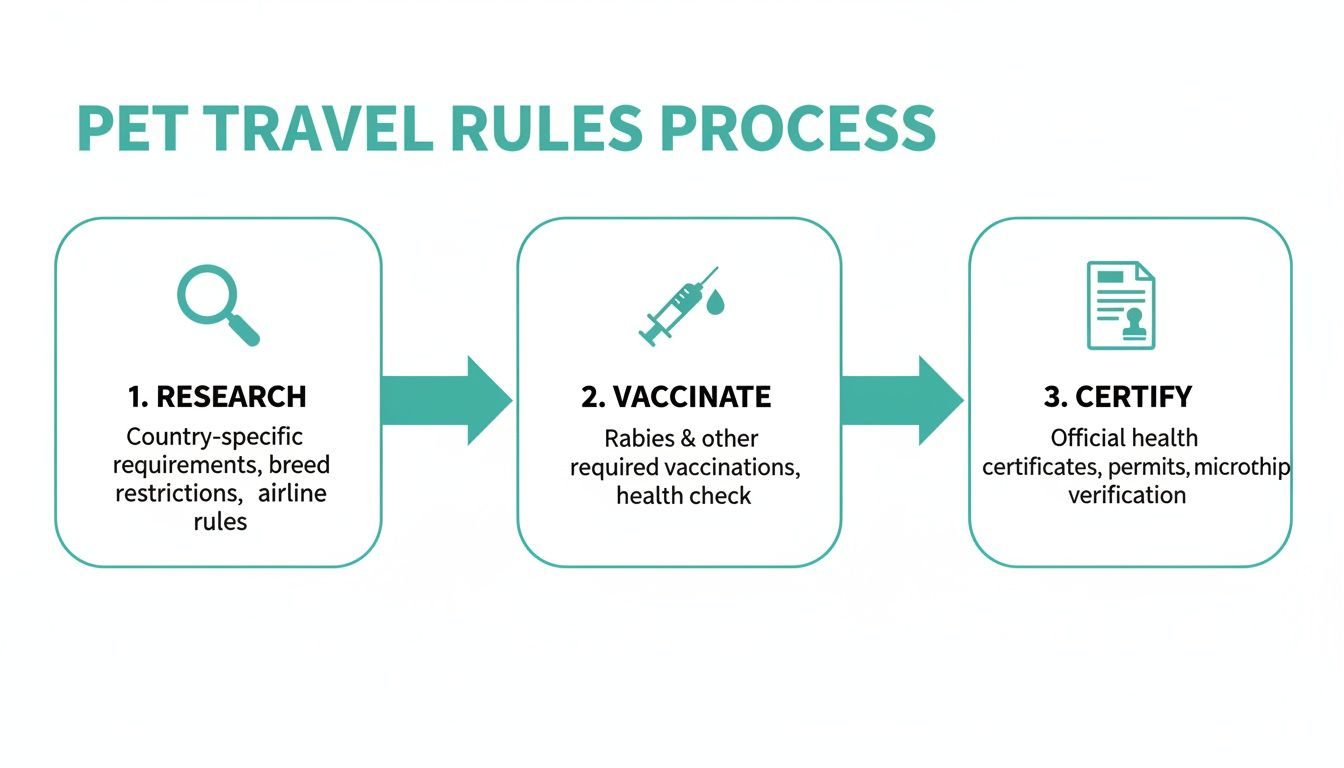
Think of it like building blocks—each step lays the foundation for the next. Following the process in order is the key to avoiding any last-minute surprises.
Step 1: Start Your Research Early
The golden rule of international pet travel is to start planning months in advance. We're not kidding. Every country plays by its own set of rules, and some requirements, like rabies titer tests, can take several months to complete from start to finish.
Your first move should be to find the official pet import requirements for your destination country. From there, your next step is finding the right veterinarian. You can't just go to your regular vet; you specifically need one who is USDA-accredited. These vets have completed specialized training and are authorized to sign federal documents like an international pet health certificate.
Step 2: Schedule Key Vet Appointments
With the rules in hand and an accredited vet on your team, it's time to get the necessary appointments on the calendar. This is where all the required health checks, vaccinations, and tests happen. Your vet will follow the timeline set by your destination country’s regulations.
Here are the typical milestones you'll need to hit:
Microchip Implantation: If your pet doesn't have an ISO-compliant microchip, this is the very first medical step. It generally must be done before the rabies vaccination is given.
Vaccinations: Your pet will need all required shots, with a special focus on rabies. Pay close attention to the timing here, as many countries require the vaccination to be given at least 21 to 30 days before travel.
Tests and Treatments: This could involve anything from a rabies titer blood test (which has to be sent to an approved lab) to specific treatments for parasites like tapeworms.
Step 3: Complete the Official Forms
When it comes to the paperwork, accuracy is everything. Your accredited veterinarian will help you fill out the correct health certificate forms for your destination. It's important to double-check every single detail, from your pet’s microchip number to your own contact information.
Even a single typo can cause major headaches at the border. Work closely with your vet's office to make sure all the information is correct and matches your pet's records perfectly.
Step 4: Secure the Government Endorsement
This is the final, must-do step that makes your document official. After your accredited veterinarian completes and signs the health certificate, it must be sent to the USDA's Animal and Plant Health Inspection Service (APHIS) for endorsement. Think of this as the government's official stamp of approval.
The government endorsement is what makes the international pet health certificate official. Without this final seal, border officials in your destination country may not accept the document, no matter how carefully it was filled out by your vet.
This final exam and endorsement process is extremely time-sensitive. Many countries and airlines have a strict "10-day window," which means the final vet exam and the USDA endorsement must both happen within 10 days of your departure. Missing this window can invalidate the entire certificate, so your timing has to be purr-fect.
For a deeper dive into this final step, you can learn how to get a USDA-endorsed pet health certificate in our detailed guide. Following these steps will help ensure you're not scrambling at the last minute.
Common Mistakes to Avoid When Traveling with Pets
Getting an international pet health certificate can feel like you're trying to solve a puzzle with half the pieces missing. One small misstep, and the whole plan can fall apart. Even the most organized pet owners get tripped up by the details, so let's walk through the most common pitfalls.
Think of this as your roadmap to a drama-free departure. Sidestepping these frequent errors will save you a world of stress, last-minute panic, and unexpected costs.
Waiting Until the Last Minute
If there's one enemy of international pet travel, it's putting things off. Too many pet owners think a quick vet visit a week before their flight will cover it. Honestly, that’s a recipe for disaster.
Some requirements, like a rabies titer test, can take a surprising three to four months just to get the results back from the lab. If your destination requires one, you need to start the clock at least six months ahead of your trip. Don't let the calendar sneak up on you.
Waiting too long is the single biggest reason travel plans get delayed or canceled. The best advice we can give? Start researching your destination’s rules the moment you know you’re going.
Using a Non-Accredited Veterinarian
Here’s a critical detail that’s surprisingly easy to miss: not just any veterinarian can sign an international pet health certificate. The vet signing the paperwork must be accredited by the USDA. These are vets who have taken specific training to navigate the tangled web of animal export regulations.
If your regular vet isn’t accredited, their signature won't be valid. The entire certificate may be rejected, and you’ll be back at square one. Before you do anything else, confirm your vet’s accreditation status. It’s a simple check that prevents a massive headache.
Misunderstanding Vaccination and Microchip Timelines
When it comes to microchips and vaccinations, the order of operations is everything. The rules are very strict, and there’s no wiggle room.
The Microchip Rule: Your pet's ISO-compliant microchip must be implanted before the rabies vaccination. If the vaccine is given first—even by a single day—it’s often considered invalid for travel purposes, and you may have to get your pet revaccinated.
The Vaccination Waiting Period: Most countries enforce a waiting period of 21 to 30 days after the primary rabies shot before a pet can travel. This helps ensure the vaccine has had enough time to become effective.
Getting this sequence wrong is a frequent and costly mistake. A UK survey, for instance, showed that 23% of dogs and 39% of cats aren't up-to-date on their boosters, a gap that could easily lead to a certificate denial. With millions of pets in major travel hubs like Germany and France, these small details have huge ripple effects. You can dig deeper into how these trends affect travel by exploring the latest insights on pet travel.
Forgetting the Final Government Endorsement
This is the final hurdle, the one that makes the whole document official, and it’s shocking how often it gets overlooked. After your accredited vet fills out the health certificate, it's not ready for travel yet. It has to be sent to the USDA APHIS for an official endorsement—a stamp and signature that says the U.S. government has validated everything.
Without that government seal, your certificate is just another piece of paper. Airlines and border officials may turn you away. Make sure you build in enough time to mail the documents to the APHIS office and get them back before you head to the airport.
How Technology Is Simplifying Pet Travel

Wrestling with stacks of forms and worrying about a single misplaced document can make any pet owner anxious. But the days of chasing paper trails are numbered. New tools are finally making the process of getting an international pet health certificate much smoother for everyone involved.
Government bodies are slowly catching up. The USDA's Veterinary Export Health Certification System (VEHCS) is a perfect example—it's a digital platform that lets accredited veterinarians submit health certificates online. This alone helps speed up the final endorsement, cutting down on the risk of mail delays messing up tight travel timelines.
A Central Hub for Pet Travel Documents
Beyond government portals, dedicated platforms are stepping in to manage the entire process from start to finish. Instead of juggling emails, calendar alerts, and paper checklists, these tools bring everything into one organized, digital space. Think of it as a central command center for both the vet clinic and the pet owner.
This approach offers some huge advantages:
Deadline Tracking: It automatically keeps an eye on crucial timelines for vaccinations, tests, and final exams so nothing falls through the cracks.
Error Reduction: It helps catch simple mistakes in forms before they turn into big problems at the border.
Clear Communication: It keeps everyone on the same page, from the vet's front desk to the pet owner, with clear updates and reminders.
An organized system transforms a complex puzzle into a clear, manageable project. If you're looking for a way to get ahead of the chaos, a dedicated pet travel planner can help you map out every single requirement.
The Future of the International Pet Health Certificate
While these advancements are a big step forward, the global adoption of fully digital certificates is still a work in progress. Despite a clear need for international standards, progress has been slow.
Right now, the global exchange of electronic pet health certificates is remarkably low. A mere 8% of surveyed OECD countries have adopted them. Most processes are still manual, creating delays for time-sensitive travel.
This bottleneck is a real issue, especially as millions of pets take to the skies every year. The ultimate goal is a seamless, paperless system that works across borders. We aren't there yet, but technology is paving the way. You can learn more about the push for global trade document digitization on digitalizetrade.org.
These innovations offer a hopeful glimpse into a future where traveling with your pet is a much less stressful experience for everyone.
Pet Health Certificate FAQs
Let's clear up some of the most common questions that pop up when planning a trip with your pet. Think of this as your quick-reference guide for those last-minute details.
How Long Is an International Health Certificate Valid For?
This is where timing becomes everything. For many countries, the health certificate has a very short shelf life—often it must be issued just 10 days before your flight.
That tight window means the final vet exam, all the paperwork, and the official government endorsement have to be perfectly coordinated. You'll need to double-check the exact validity period for your destination and your airline, as it can vary. Planning this final step with great precision isn't just a good idea; it's a must.
What's the Difference Between a Pet Passport and a Health Certificate?
It’s easy to mix these two up, but they have very different jobs. A pet passport is more like a long-term medical ID, while a health certificate is a single-use travel pass for a specific trip.
A Pet Passport, mainly used for travel within the EU, is a booklet that combines a pet's vaccination history and microchip info for easy movement between member countries. An International Health Certificate, however, is a one-time document created for a single journey to one particular country.
Most countries outside of the European Union won't accept the EU pet passport. Instead, they'll require their own specific, officially endorsed health certificate for your pet to enter.
Can My Regular Vet Issue the Certificate?
This is a huge point of confusion and a common reason for travel plans hitting a wall. The short answer is: only if they have a special credential. The vet who signs your international pet health certificate must be USDA-accredited.
Not every vet has this accreditation, which involves extra training on the complex rules of animal import and export. Before you even start the process, confirm that your veterinarian is accredited. If they aren't, you’ll have to find one who is, or your paperwork may be rejected.
What Happens if My Travel Dates Change?
This is a traveler's nightmare, especially with those strict validity windows. If your departure date shifts after the certificate has been issued and endorsed, you'll almost certainly have to start the entire process over again.
Since the certificate is only good for a short period (like that common 10-day window), even a small delay can make it expire before you land. If your flight gets moved, your first call should be to your accredited vet and the USDA APHIS office to figure out what you need to do to get a new certificate for your new itinerary.
Trying to manage the maze of international pet travel rules shouldn't feel like a solo mission. Passpaw brings everything together—deadlines, documents, and communication—into one clear platform for both veterinarians and pet owners. Take the guesswork out of your pet’s journey at https://passpaw.com.

More articles
From regulatory changes to best practices for veterinarians and pet owners, our resources keep you ahead of the curve.