Are you a team member in a veterinary practice?
Are you a pet parent planning a trip with your furry pal?
Cargo Hold Plane Guide: What Pet Owners Need to Know
You're at the check-in counter, one hand on the leash, the other on the crate handle, while your dog gives you the look that says this is a very bad idea. The agent weighs the kennel, prints the tag, and suddenly your pet is no longer just a passenger, they're part of the airline's moving puzzle. That nervous handoff is where most cargo hold questions begin, and it's also where the plane's hidden freight space stops feeling abstract.
A cargo hold plane guide should make that moment less mysterious. The hold under the cabin floor isn't a spare closet, it's part of the aircraft's working supply chain, and the World Economic Forum notes that around 40% of annual global air cargo typically travels in the bellyhold of passenger aircraft, alongside checked bags and time-sensitive shipments like pharmaceuticals, mail, electronics, seafood, and flowers (World Economic Forum). If you're planning a trip and trying to decide whether your pet belongs there, a practical starting point is a route-specific checklist, like the one in Approved Experiences Traveler Hawaii flight guide, which helps you think about the trip as a whole instead of only the airport handoff.
Passpaw's airline-by-airline dog cargo guide is useful if you want to compare policies before you start packing the kennel, because the phrase “cargo hold” covers more than one experience. That's the first thing pet parents usually miss. The second is that not every hold on every aircraft works the same way.
Picture the Belly of the Plane
At the airport, the story starts with a small crate, a paper tag, and a human being who has to decide whether everything matches up. Your pet disappears through a service door, while the aircraft's lower deck takes over as the cargo side of the trip. On many passenger jets, that space sits below the cabin floor and carries both baggage and freight, which is why it matters so much to airlines and shippers alike.
That lower deck is not just a storage bin. It's a pressurized compartment built into the aircraft so it can carry goods that benefit from speed and regular flight schedules. The same belly space that carries luggage can also carry commercial cargo, and on wide-body jets it may even hold cargo containers beneath the cabin floor, turning the passenger aircraft into a dual-purpose transport asset.
Why that matters for pet travel
For a pet owner, this means the hold is part of the animal's journey, not an afterthought. Your pet is handed off to airline staff, loaded with other freight, and then stowed in a compartment designed for transport, not companionship. That's why the word “cargo” can feel cold, even when the aircraft itself is doing exactly what it was built to do.
If you fly often, you may already think in terms of route length, connections, and arrival windows. A pet-friendly trip adds another layer, because the aircraft type, the hold type, and the airline's loading process all affect what happens once the kennel goes out of sight. For a route-specific planning example, the American Airlines pet cargo overview is a helpful reference point for how airlines describe these arrangements in real life.
Practical rule: if you can't explain where the pet will be loaded, who handles the crate, and how the kennel moves from counter to aircraft, you don't yet have a complete picture.
What the Hold Is Actually Like
A pet in the hold is riding in a part of the airplane that is built to stay inside the aircraft's controlled environment, but that does not mean every hold behaves the same way. Some compartments sit behind a pressure bulkhead, which helps the cabin and lower deck share the same pressurized system. That is why “pressurized” sounds reassuring, yet still leaves the bigger questions unanswered.
Pressurization is only one part of the picture
A pressurized hold can still leave important gaps for pet travel. Temperature, ventilation, and crew access each shape what the space is really like, and none of them should be assumed just because the aircraft has a cargo area. A hold can sound comfortable in one sentence and still be a poor match for an animal if the other conditions are weak.
The size of the space can be misleading too. The International Civil Aviation Organization reported that scheduled freight carried reached 57.4 million tonnes in 2023, up 4.0% from 2022 and close to the pre-pandemic 2019 level of 58.0 million tonnes (ICAO facts and figures). That is the broad cargo picture, but at the aircraft level the usable space still changes once luggage and freight are loaded. A wide-body belly can look generous from the outside and still feel tight once the day's bags are in place, which is why the hold should be judged by the specific aircraft and loading plan, not by the word “cargo” alone.
Three loading limits that determine what fits
Limit Type | What It Measures | Why It Matters |
|---|---|---|
Compartment limit | The total weight a section can take | A hold can be full by weight before it looks full by volume |
Linear load | Weight along a strip of floor space | Dense items can overload one area even if the hold has room |
Floor load or piece limit | Weight under a single item or crate | A heavy kennel may be rejected even when the total weight seems fine |
One fleet document lists a forward cargo hold with a 7,846 lb compartment limit, a 198 to 240 lb per linear inch limit, and a maximum piece weight of 250 lb (fleet specifications). That is why a crate can be turned away even when the hold still looks open. The bottleneck may be the floor, not the volume.
The Airbus A380 example shows this clearly. One aviation analysis said the aircraft has about 5,814 cubic feet of belly volume, but after passenger luggage is loaded, only about 1,071 cubic feet remains for commercial cargo, or roughly 8,500 pounds (American Airlines pet cargo overview). The belly sounds enormous, yet the usable room can shrink fast once the passenger bags are on board. That is the practical reason pet parents should ask sharper questions about access, fire-zone design, and last-minute loading decisions, especially if the itinerary involves an aircraft swap or a tight connection.
Pet Safety Factors Inside the Hold
Pet safety in the hold comes down to four variables, and pressurization is only one of them. The others are temperature, ventilation, and crew access. If one of those weakens, the whole picture changes, even if the hold sounds comfortable on paper.
Why access matters as much as air
A lot of pet travel advice stops at “the hold is pressurized,” but that skips the harder question. Can the crew get to the animal in flight if something goes wrong, or is the compartment a sealed Class-C fire zone with little or no in-flight access? Pilot and crew discussions note that many passenger aircraft cargo compartments are sealed in this way, which means the hold may be pressurized yet still not designed for direct intervention during the flight.
That matters because a sealed, pressurized compartment is not the same thing as a monitored pet room. Some holds are aft of the pressure bulkhead and may be unpressurized, while others are pressurized but still inaccessible. So the phrase “cargo hold” hides important differences that pet parents should ask about before booking, especially on aircraft swaps or connecting itineraries.
The questions worth asking the airline
You don't need to become an aircraft systems expert, but you do need sharper questions than “Is it pressurized?” Try these instead.
Good question to ask: is this hold accessible in flight, or is it sealed once the door closes?
Another useful question: is the hold temperature-controlled for live animals, or just pressurized for baggage?
Those questions are more useful than a vague reassurance, because they focus on the actual risk picture. If you want a plain-language contrast between control and access, the discussion around dog sedative for travel is a reminder that calm behavior, crate fit, and the flight environment all interact, and none of them should be guessed at.
Crate Standards and Travel Documents
Once the aircraft environment makes sense, the kennel becomes the next big decision. A good crate is not just a box. It's the pet's seat, barrier, and travel container all at once, so the details matter more than most owners expect.
What a compliant crate usually needs
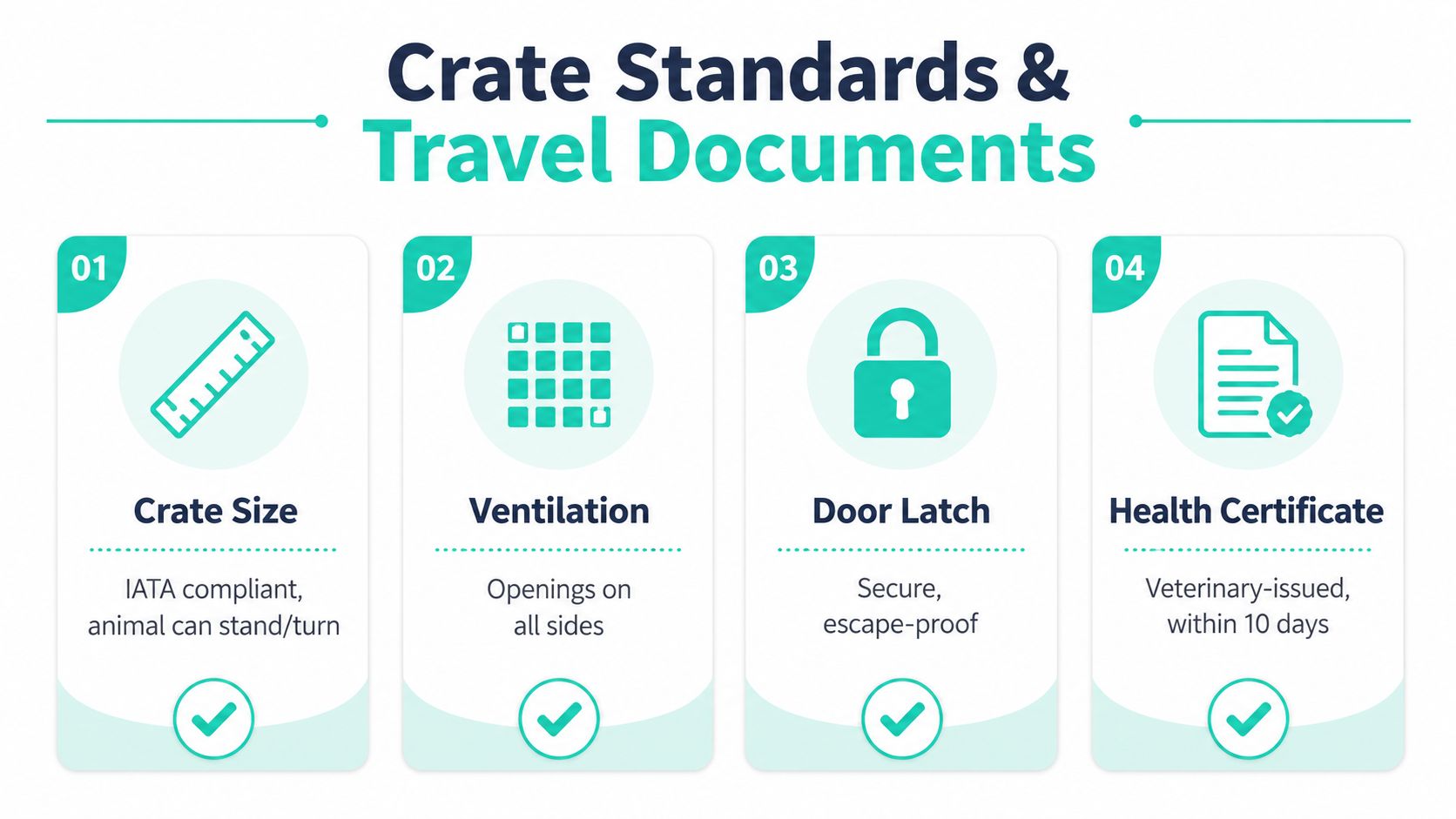
The familiar checklist starts with size, ventilation, door security, and a leak-proof base. The animal should be able to stand and turn, the openings should allow airflow on all sides, and the latch should be secure enough to prevent escape while handlers move the crate through the airport. If the base can't contain accidents, the crate isn't ready for a real trip.
The paper side matters just as much. Owners usually need a health certificate, vaccination records, microchip proof, import permits where required, and any airline-specific forms. That stack can feel tedious, but it's really one unified file, because one missing page can stop the whole trip before the animal ever reaches the aircraft.
The crate itself can also create a loading problem. An aircraft-cargo dimension discussion based on an Air China document says the LD3 container is 162.6 cm high, the cargo hold is about 171 cm high, and the front and aft cargo-hold doors are listed at 170 cm and 168 cm respectively (aircraft cargo dimensions discussion). That's a good reminder that the door can be the limiting factor, not the space inside.
A simple prep list before the appointment
Measure the crate first: don't assume the hold will “probably fit.”
Ask the vet for timing details: paperwork dates matter as much as the form itself.
Label the kennel clearly: name, destination contact, and handling notes should be easy to see.
Keep copies together: one folder for the airline, one for the vet, one for you.
The pet crate for travel guide is a useful companion read if you're comparing crate shapes and trying to avoid a last-minute scramble at the pet store. A lot of stress disappears when the kennel is chosen before the booking gets urgent.
Cabin, Manifest Cargo, or Freight Hold
Not every pet belongs in the hold, and the best choice depends on size, route, and airline policy. Small pets often travel in the cabin, while bigger or less flexible itineraries may push owners toward the hold. The key is to separate where the pet travels from how it's booked, because those are not always the same thing.
Three different ways a pet can travel
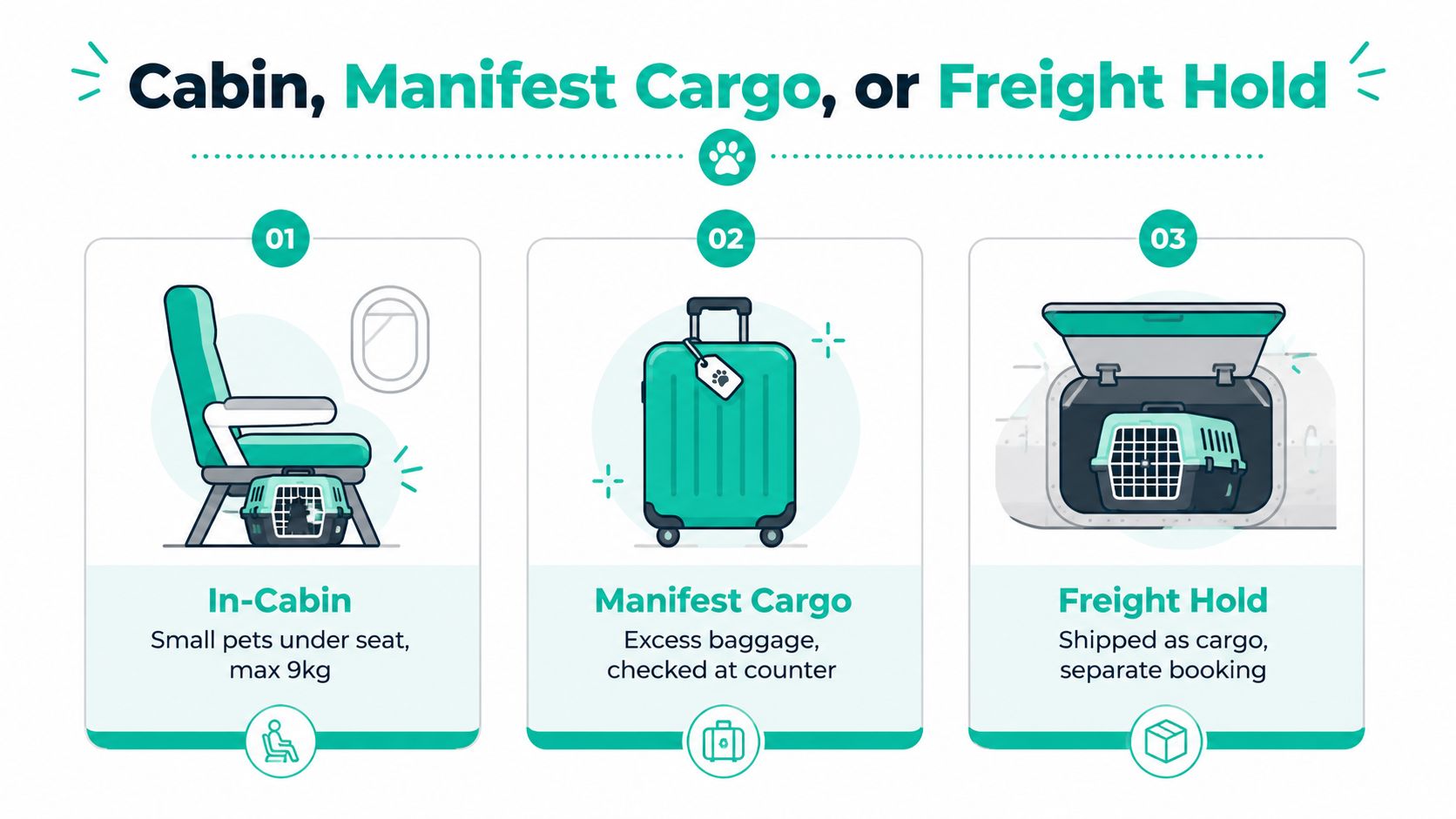
In-cabin travel is the simplest to picture. The pet rides under the seat, stays close to the owner, and usually fits only if the animal and carrier are small enough for the airline's rules. That option is usually the least disruptive, but it isn't available for every route or every pet.
Manifest cargo is different. The pet travels as checked animal cargo or excess baggage, but still in the aircraft's pressurized system rather than with the passengers. This route often feels less personal because the pet is handed over at the counter and retrieved later, yet it can be the practical middle ground when cabin travel isn't possible.
Freight hold arrangements are the most separated from the passenger journey. The animal is shipped as commercial cargo with its own booking flow, which can add documentation steps but may better suit larger animals, special routes, or specialized handling.
The differences matter even beyond the airport. If you're weighing whether to move by road or air, comparing ground and air pet travel is a smart way to think about comfort, timing, and logistics together instead of treating flight as the only option. Sometimes the best pet trip is the one with the fewest handoffs.
Bottom line: the phrase “cargo hold” is broad, but the experience can range from a checked-animal journey to a full freight booking.
Preparing Pets and People for Flight Day
The best flight day prep starts before the airline ever sees the crate. A pet that has already spent time near the kennel, hearing the door latch, and resting in it for short periods is usually less thrown off than one who meets the crate at departure time. That practice matters because travel feels less like punishment when the box is familiar.
A calm routine beats a rushed one
Food and water timing should be handled with the vet's guidance, not improvised at the counter. Labels should be attached before you leave home, and the documents should travel in a folder that doesn't get buried under receipts, treats, and human panic. The small comforts matter too, as long as they don't create a safety issue or violate airline rules.
The silent risk is what happens when the itinerary changes at the last minute. An aircraft swap can shift the pet from one hold configuration to another, and a weather reroute can create a new handoff or a new layover. If the loading plan changes but the paperwork doesn't, the drift between what's planned and what's on the aircraft becomes the core problem.
One family's easier travel day can turn complicated fast. A kennel is accepted for one aircraft, then the gate changes and the new plane has a different hold layout or a tighter door opening. The owner has the right crate, but the wrong assumptions, and the pet's travel plan gets squeezed by the new logistics.
A quick handoff checklist
Confirm the final aircraft: swaps happen, so don't rely on yesterday's plan.
Match paperwork to the route: transits and connections can change the required forms.
Ask who handles the crate at each step: counter, ramp, transfer, and arrival may involve different staff.
Keep a phone handy: if the airline needs a fast decision, you don't want a delay caused by silence.
For general arrival planning, planning your flight check-in time can help you think through the day like a sequence of handoffs instead of a single dash to the terminal. Pets travel better when the humans aren't improvising every five minutes.
How Passpaw Keeps the Workflow Honest
Travel paperwork is where good intentions often go sideways. Health certificates, timing windows, destination rules, and client messages all need to stay aligned, and that gets harder when airline requirements shift or a trip date moves. A workflow tool helps because it keeps the moving pieces visible instead of scattered across emails and sticky notes.
Passpaw fits into that gap by helping veterinary teams manage health certificates, track destination-specific requirements, prioritize tasks by travel date, and keep pet owners informed as the plan changes. The benefit is not just speed, it's consistency, because real-time document validation catches errors before they become airport problems. For vets and owners, that's the difference between a tidy departure and a frantic rework.
A static checklist can't update itself when a rule changes. A live workflow can, and that matters most when travel plans shift close to departure or a client needs a quick answer from the clinic. The airplane may still be the same, but the paperwork almost never is.
Your Take-Home Checklist Before Booking
Before you book, ask the airline exactly which hold your pet will use, because “pressurized” alone doesn't tell you enough. Then match the crate to the airline's dimensions, confirm the paperwork list with your vet, and double-check whether your pet should fly in cabin, as manifest cargo, or as freight. If the plan changes, make sure the documents and the loading plan change with it, not after it.
A calm pet trip usually comes from boring details handled early. That's good news, because the boring part is where the safety lives.
If you're helping a pet travel soon, Passpaw gives veterinary teams a cleaner way to manage health certificates, track requirements, and keep owners updated when airline or destination rules shift. Visit Passpaw to see how a real workflow can make cargo hold planning less stressful for everyone involved.
More articles
From regulatory changes to best practices for veterinarians and pet owners, our resources keep you ahead of the curve.