Are you a team member in a veterinary practice?
Are you a pet parent planning a trip with your furry pal?
How to Build Veterinary Email Lists That Actually Convert
Jamie opened the bounce report expecting a few bad addresses, then saw enough failed sends to make the whole list feel suspect. The reminders had gone out, the front desk had done its job, and still the inbox trail looked messy, which is exactly where a lot of clinics land with veterinary email lists. The fix usually isn't “send more.” It's a tighter loop between where contacts come from, how they're checked, how they're segmented, and how the practice keeps them fresh.
Veterinary email works, but it only works when the list matches real clinic workflows. That matters even more for time-sensitive uses like vaccine reminders, follow-ups, and pet travel compliance, where stale data doesn't just waste a send, it can cost the clinic the right client at the right moment.
Why Veterinary Email Lists Deserve More Attention
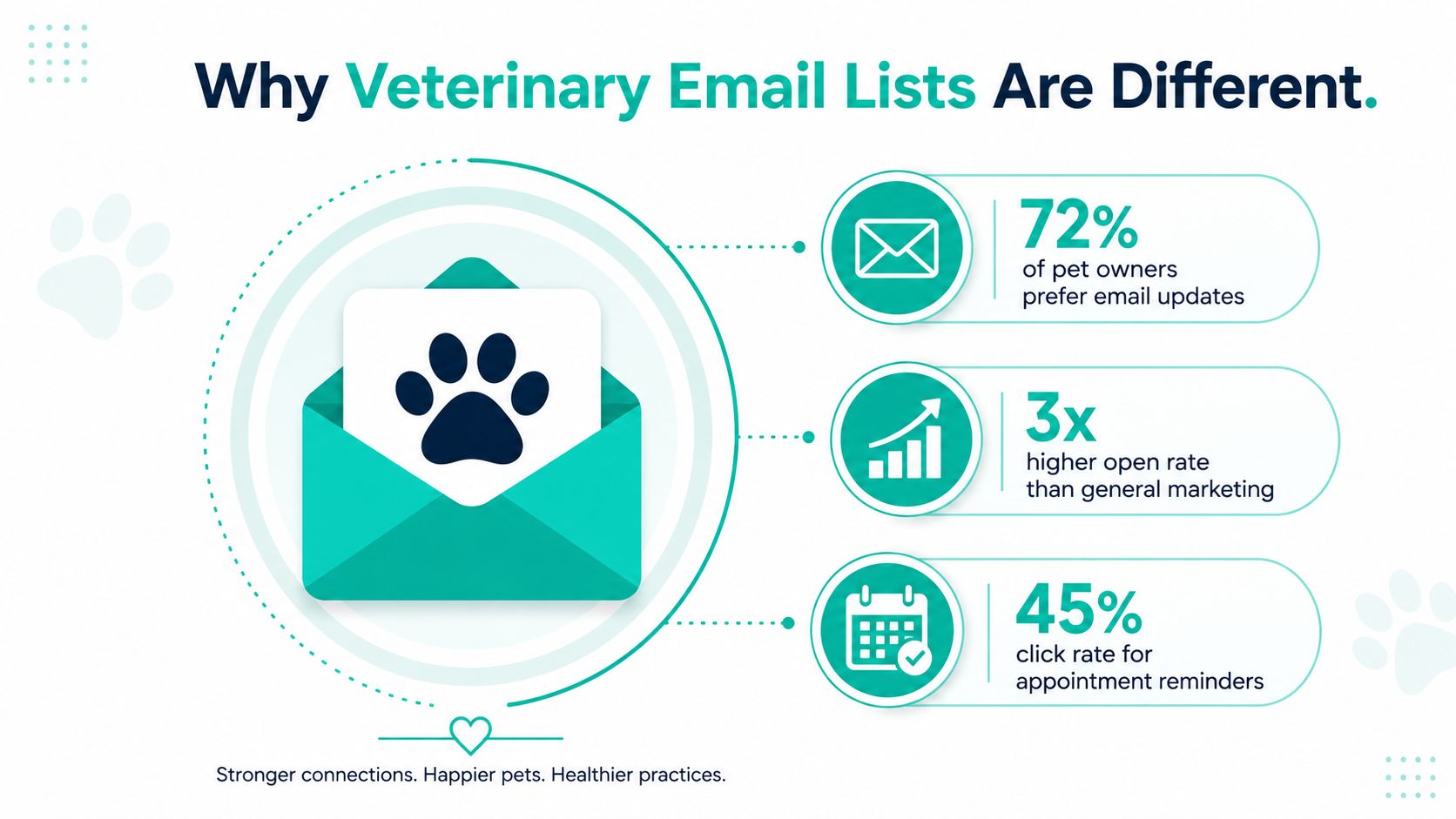
Jamie's frustration is common because the channel itself usually performs well, yet many practices still treat it like an afterthought. Veterinary-specific benchmarks in one 2026 summary show open rates of 38.4% to 45.8%, with a veterinary benchmark of 42.47% and an animal and vet niche benchmark of 45.84%, compared with a cross-industry average of 21.5%. The same source says only 33% of veterinary clinics use email marketing regularly, even though 48% of pet owners respond to reminder emails, which is a pretty obvious gap between opportunity and habit. Webtonic's veterinary email marketing statistics make that gap hard to ignore.
List size is not the real story
A bigger list can look impressive and still underperform if half the addresses are stale, badly segmented, or irrelevant to the workflow. One vendor's U.S. breakdown of 16,446 veterinary hospitals, 17,107 veterinary clinics, and 38,579 veterinary offices shows why this market isn't one generic contact pool. The global counts of 23,189, 25,727, and 48,766 reinforce the same point, practice type and geography matter as much as raw volume. The practical takeaway is simple, veterinary email lists should be built around who someone is, where they work, and why you're contacting them.
Practical rule: if a list can't support a specific workflow, it's too broad.
That's why a travel-compliance reminder, a referral campaign, and a supplier outreach sequence should never rely on the same undifferentiated file. A list that looks “large enough” on paper can still waste time, especially when reminders bounce or land in the wrong inbox. For broader context on clinic marketing habits, see Passpaw's veterinary practice marketing guidance.
Where Veterinary Email Contacts Actually Come From
The cleanest source is always opt-in data from your own website, patient portal, and front desk. It grows slower than anything else, but it's the easiest to defend operationally because the contact already knows the practice. That's why onboarding matters too, and why a smooth intake flow can do more for list quality than a flashy campaign, a point that pairs well with client onboarding best practices.
Partnerships with pet-related businesses can add reach without the same level of risk, especially when the audience already shares a likely need. Think groomers, trainers, rescue groups, pet transport partners, and other adjacent services. The trade-off is control, because you're borrowing trust rather than earning it directly.
Events and conferences sit in the middle. They can produce highly relevant leads, but only if the handoff is disciplined and the follow-up is fast. A quick thank-you and a clear reason to stay in touch beats a vague “nice to meet you” note every time.
Third-party vendors give the fastest scale, but they're the most likely to raise consent and deliverability questions. That's not always a deal-breaker for B2B outreach to clinics, hospitals, or offices, but it does mean the list needs validation before it becomes useful.
A large vendor database also shows why the category is broader than most buyers realize. One source advertises 35,074 records, another 76,401+ U.S. veterinary contacts and 91,681+ global clinic, hospital, and office contacts, while another claims 51K+ U.S. and 62K+ global veterinarian contacts. That spread tells you the answer to “how big is a veterinary email list?” depends on scope, not just headcount.
Buying Lists Versus Building Your Own
The best choice comes down to the job you're trying to do. If you need speed and breadth for B2B outreach, purchased data can make sense. If you're communicating with pet owners or existing clients, an opt-in-first build usually gives you better trust, better relevance, and fewer headaches later.
The trade-off is easy to summarize.
Speed versus quality: vendor lists are faster, but you'll spend more time checking whether they're current and usable.
Breadth versus relevance: broad lists can cover many practices, but not all of them need the same message.
Cost versus risk: a cheaper file can become expensive once you factor in bounce cleanup, suppression work, and sender reputation problems.
If you want a blunt overview of what can go wrong, the risks of buying an email list are worth reading before you make the purchase.
A list that nobody recognizes tends to behave like a cold crowd, not a warm audience.
That's the hidden cost most buyers miss. People who don't know you are less likely to open, more likely to ignore, and more likely to flag the message as unwanted. On the other hand, a practice list built from real client touchpoints usually needs less explanation and creates fewer deliverability surprises.
A smart pattern is to buy only when the use case needs reach beyond your current base, then validate aggressively before sending. Build your own when the goal is relationship-based messaging, appointment reminders, or anything where familiarity matters. In other words, choose the source that fits the workflow, not the one that looks biggest in a sales deck.
Validating and Cleaning Your Contacts
A list ages whether you touch it or not. In veterinary databases, stale records can quickly turn into bounced mail, missed outreach, and wasted staff time, so contact hygiene needs a routine, not a rescue mission. Scrap.io's veterinary email list guide makes the same point from a prospecting angle, validation keeps a list usable long after the first send.
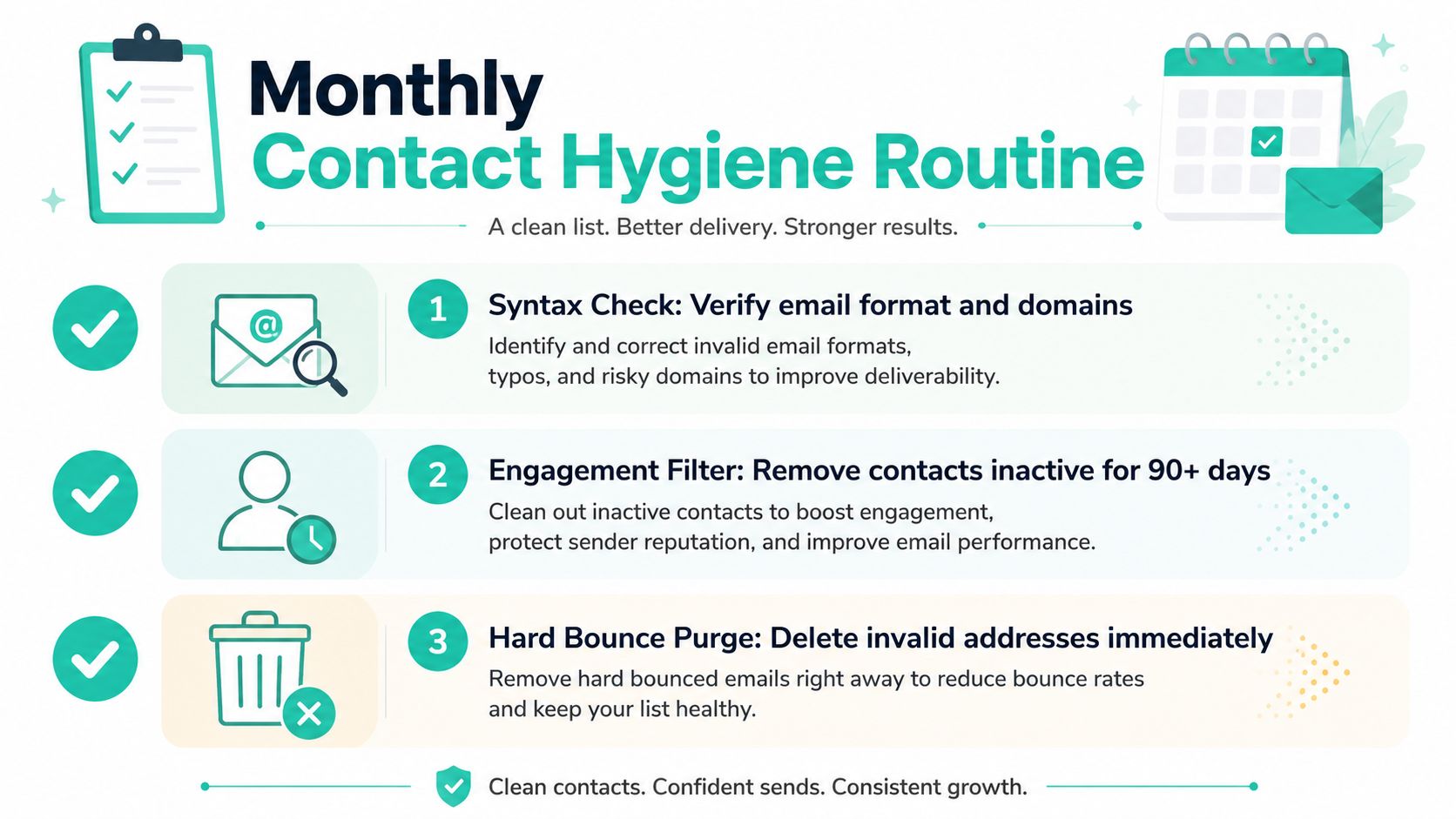
Use three passes every time
Start with syntax and format. Bad spellings, missing symbols, and malformed domains are easy to catch and easy to remove before they reach the sending stage. Then verify the domain and mailbox where your tools allow it, because an address can look legitimate and still reject mail. Finish by suppressing inactive contacts so you stop mailing people who have gone cold.
A clean workflow looks like this:
Syntax check: catch obvious formatting errors before any send.
Domain verification: confirm the address can plausibly receive mail.
Engagement suppression: stop mailing contacts who have gone cold.
Removal should not depend on a single quiet email. Chronic non-engagement, repeated hard bounces, and unsubscribes all belong in a suppression list so you do not re-email people who already opted out.
Keep the list tied to a real workflow
Validation is not only about deliverability. It also needs to match the contact to a real use case. A travel-compliance segment should include clients who asked about international health certificates, not every pet owner in the practice, because relevance falls apart fast when the message reaches the wrong household at the wrong time. That kind of mismatch is one of the fastest ways to waste a list.
Align list maintenance with your practice's record-keeping standards to ensure compliance during audits. veterinary record keeping requirements are a useful reference point here, because if a record supports care delivery or outreach, it needs to stay current enough to trust.
A separate piece of operational hygiene belongs here too. If you are sending reminders, travel follow-ups, or reactivation campaigns, pair the list with a simple client communication process so staff know who updates records, who suppresses contacts, and who checks for stale entries before a send. That keeps the database usable instead of letting it drift until someone has to clean it under pressure.
One practical test helps more than theory. Before any campaign, ask whether the contact can still be acted on today. If the answer is no, the record probably belongs in a cleanup pass instead of the active list. For a more detailed example of how that communication layer fits into practice operations, see this guide to veterinary client communication.
Segmenting Your List for Real-World Vet Workflows
Segmentation is where veterinary email lists stop acting like spreadsheets and start acting like tools. The most useful splits usually mirror how the practice already thinks about patients and clients, by pet type, service history, appointment recency, and client value. That's more useful than a giant menu of filters nobody has time to maintain.
A good segment is one you can explain in one sentence and act on without extra cleanup. For example, “dogs due for annual vaccines,” “cats that haven't been seen in 14 months,” or “clients who asked about travel certificates.” Those groups are clear, repeatable, and easy to message without overcomplicating the database.
Good segmentation feels boring in the best way, because the practice already knows what to do with it.
That's also where many list-building guides stay too generic. If you want a broader primer on list construction itself, What Is Email List Building can be useful background, but veterinary workflows need a more practical filter.
Segments worth keeping
By species and life stage: puppy, adult, senior.
By service history: wellness, dental, surgery, travel, referral interest.
By appointment recency: active clients versus lapsed ones.
By value: multi-pet households, repeat visitors, or higher-frequency clients.
One segment that pays off quickly is travel-prep. Build it from clients who have asked about international health certificates, mentioned a destination date, or sent a travel-related question through your intake form. The message can then focus on documents, timing, and next steps, instead of a generic clinic update.
For client-facing messaging discipline, the practices that succeed usually pair segmentation with a clear communication plan. Veterinary client communication is the wider habit that makes segmentation useful instead of decorative.
Staying on the Right Side of Compliance
A clinic can have the right contacts and still create a compliance problem if the mailing process is sloppy. The practical standard is straightforward, clear sender identity, a working unsubscribe link, fast opt-out handling, and a clean split between contacts you can email and contacts who need a higher consent threshold. In the U.S., CAN-SPAM makes a valid physical address and unsubscribe handling part of normal commercial email practice, while Canada's CASL is generally stricter about consent. For European contacts, Superdocu's GDPR checklist for 2025 is a useful operational reference for the record-keeping gaps teams often miss.
Keep the technical basics quiet and solid
SPF, DKIM, and DMARC are deliverability basics, not marketing extras. Your IT partner or email platform should handle the setup with you, because a message that lands in spam never gets a chance to work. List hygiene matters for the same reason, since a healthy sender reputation protects every future send.
A good working rule for the team is simple, email only people who would reasonably expect to hear from the practice, and make opting out easy when they do not. That is not just courtesy. It keeps the channel usable and reduces friction for everyone who wants the updates.
The same problem shows up in veterinary data quality more broadly. Research on barriers to accessible veterinary care points to uneven access and geographic concentration in some markets, which means directory-style lists can lean toward better-served areas and age badly when people move, practices close, or coverage shifts. This PMC paper on barriers to accessible veterinary care is a useful reminder that stale data is often a symptom of churn, not just careless administration.
Two simple sequences that work
A reminder sequence should stay short and easy to follow. Send the first email when a pet is due, send a second message a few days later if there is no response, and use a third as the final nudge. Each note should keep one clear action in view, such as booking the visit or calling the front desk.
A travel-prep sequence needs tighter timing. The first message can confirm the request and the next steps, the second can ask for missing documents or dates, and the third can remind the client what still needs attention before travel. That workflow is where a travel-compliance platform earns its place, because the contact, the deadline, and the document trail stay aligned instead of living in three different places.
For a cleaner operational view of how records should support these workflows, veterinary record keeping requirements are worth keeping in mind. The more complete the record, the less guesswork goes into the email sequence.
Metrics, Testing, and a Weekly List-Care Routine
You don't need a dashboard full of vanity numbers. You need a short list of signals that tell you whether the list is healthy. For veterinary campaigns, that usually means bounce rate, open rate, click-through rate, and unsubscribe rate.
The technical ceiling matters too. One guidance source says veterinary benchmarks for open rates typically cluster around 18–22% with click-through rates of 2.5–4%, and it warns that weak results usually point to list hygiene, deliverability, or subject lines rather than the topic itself. Another source notes that cold outreach in markets like the UK often lands around 0.5–2% response, or roughly 5–20 replies per 1,000 emails sent, which helps prevent unrealistic expectations on brand-new lists. RD Marketing's vet email response guide is useful for calibrating that.
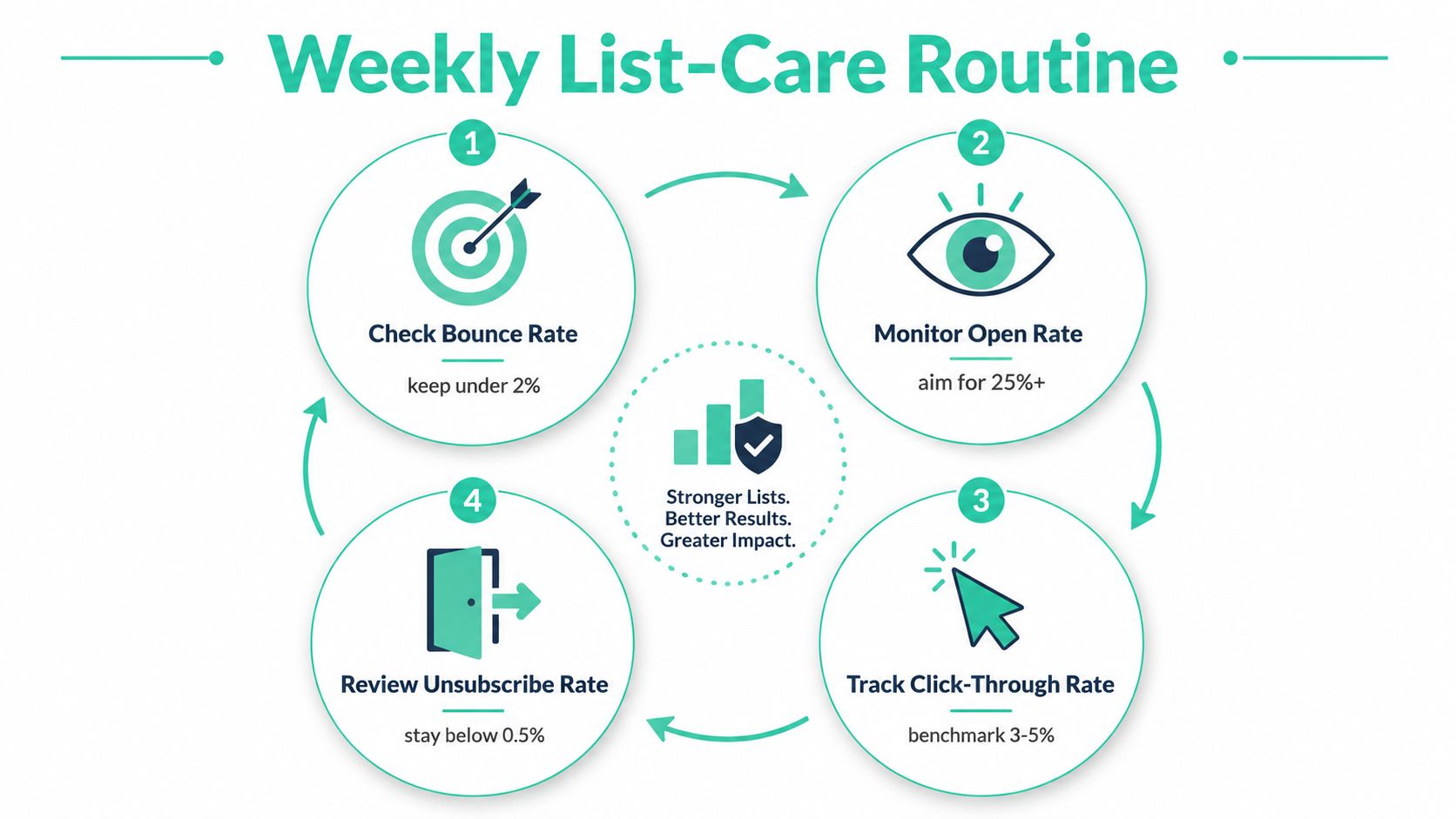
A simple weekly routine
Check bounce rate: keep it low and watch for spikes.
Monitor open rate: use it as a signal for subject line and sender trust.
Track click-through rate: this shows whether the message moved people.
Review unsubscribe rate: a small amount of churn is normal, but sudden jumps need attention.
A/B testing doesn't need to be fancy. Test one subject line against another, or one send time against another, and keep the version that gives you the cleaner result. If bounces jump while opens stay flat, that usually points to data quality. If opens are fine but clicks are weak, the content probably needs work.
Weekly rule: clean a little, test a little, and never let the list sit untouched.
A 30-minute maintenance habit is enough for teams to keep their list clean. Review last week's metrics, suppress inactive contacts, refresh a small batch of records, and queue the next send. That's the boring part of the job, and it's also the part that keeps the channel useful for years instead of months.
If your practice wants veterinary email lists that support reminders, referral growth, and travel-related workflows without turning into a cleanup project, Passpaw can help you organize the contact side of that process more intelligently. Visit Passpaw to see how a travel-focused workflow can keep the right clients moving at the right time, with less manual chasing and fewer stale contacts.

More articles
From regulatory changes to best practices for veterinarians and pet owners, our resources keep you ahead of the curve.