Are you a team member in a veterinary practice?
Are you a pet parent planning a trip with your furry pal?
Veterinary Client Communication That Builds Trust & Revenue
A client walks out of the room confident they understand the plan. By dinner, they are giving the medication on the wrong schedule, the front desk is buried in calls, and your team is piecing together what was said. The medical issue can often be corrected. The trust gap is harder to repair.
Poor veterinary client communication shows up first in small, ordinary moments. A discharge summary that does not match the verbal instructions. A technician who explains the next step one way and a doctor who phrases it another way. A callback that comes after the client has already searched online and assumed the worst. Those misses create more than awkward follow-up. They affect compliance, increase staff workload, slow the day down, and push some clients to look elsewhere.
The clinics that do this well are not relying on personality. They use repeatable systems. They standardize estimates, document care plans clearly, confirm client understanding before the pet leaves, and tighten handoffs between the exam room and the front desk. Clear documentation matters even more when the case moves beyond a routine appointment, which is why strong processes around veterinary record keeping requirements support communication as much as medical consistency.
That structure matters at every level of care. A wellness visit needs clarity and follow-through. A same-day sick visit needs speed without mixed messages. International pet travel raises the stakes even further, because one unclear instruction, one missing document, or one misunderstood timeline can derail an entire trip. Practices that communicate well in those high-pressure moments do more than prevent complaints. They turn a stressful service into a trust-building one.
The payoff is practical. Fewer avoidable callbacks. Less friction at checkout. Better follow-through at home. Stronger retention. A team that spends more time caring for patients and less time cleaning up confusion.
The True Cost of a Miscommunication
A client arrives for what should be a straightforward visit. By checkout, they are unsure about the estimate, unclear on the treatment plan, and embarrassed to ask one more question while the lobby is full. Nobody had a major blowup. The clinic still created doubt.
That is the cost of poor communication. It does not show up only in complaints. It shows up in delayed approvals, missed rechecks, lower acceptance of recommendations, extra calls, longer checkout times, and staff frustration that carries into the next appointment. As noted earlier, weak communication is one of the main reasons clients leave a practice. Owners feel that loss in recurring revenue long before they see it in a monthly report.
The expensive part is usually the cleanup.
When a plan is not explained clearly, the team repeats it by phone, email, and at the front desk. When fees feel like a surprise, appointments end with tension instead of trust. When lab results are delivered without context, clients search online, assume the worst, and call back more anxious than before. In a busy hospital, those extra touches eat the schedule alive.
I use a simple rule with teams: if the client has to call back to understand the plan, the conversation was incomplete.
There is also a patient-care cost. Owners who feel rushed or judged often stop admitting what is happening at home. They may not say they skipped doses, could not pill the cat, never scheduled the referral, or decided against the diagnostic workup after talking it over with family. Practices often file that under non-compliance. A fair share of it starts as preventable confusion.
The problem gets sharper in complex services. Routine wellness communication matters, but the bigger revenue and loyalty risk often sits in high-stakes situations like surgery, chronic disease, and international pet travel. Travel cases are a perfect example. One unclear vaccine deadline, one missing signature, or one email with a vague subject line can create a scramble that burns team hours and puts the client in panic mode. Even small details, like following subject line capitalization best practices, can make travel instructions easier to scan and less likely to be missed in a crowded inbox.
Strong clinics treat communication as an operating system, not a personality trait.
That usually means three things:
Clear ownership of each handoff, from estimate to discharge to follow-up
One version of the plan across doctor, technician, and client service team
Written instructions that make sense to a tired pet owner at home
Good records support all three. Clinics that tighten their veterinary record keeping requirements and documentation standards usually get more consistent communication at the same time, because the team is working from the same facts, the same timeline, and the same next step.
The Four Paws of Great Communication
Many teams don't need more reminders to “be better communicators.” They need a framework they can use on a Monday morning when phones are ringing, the lobby is full, and a client is already annoyed before the exam begins.
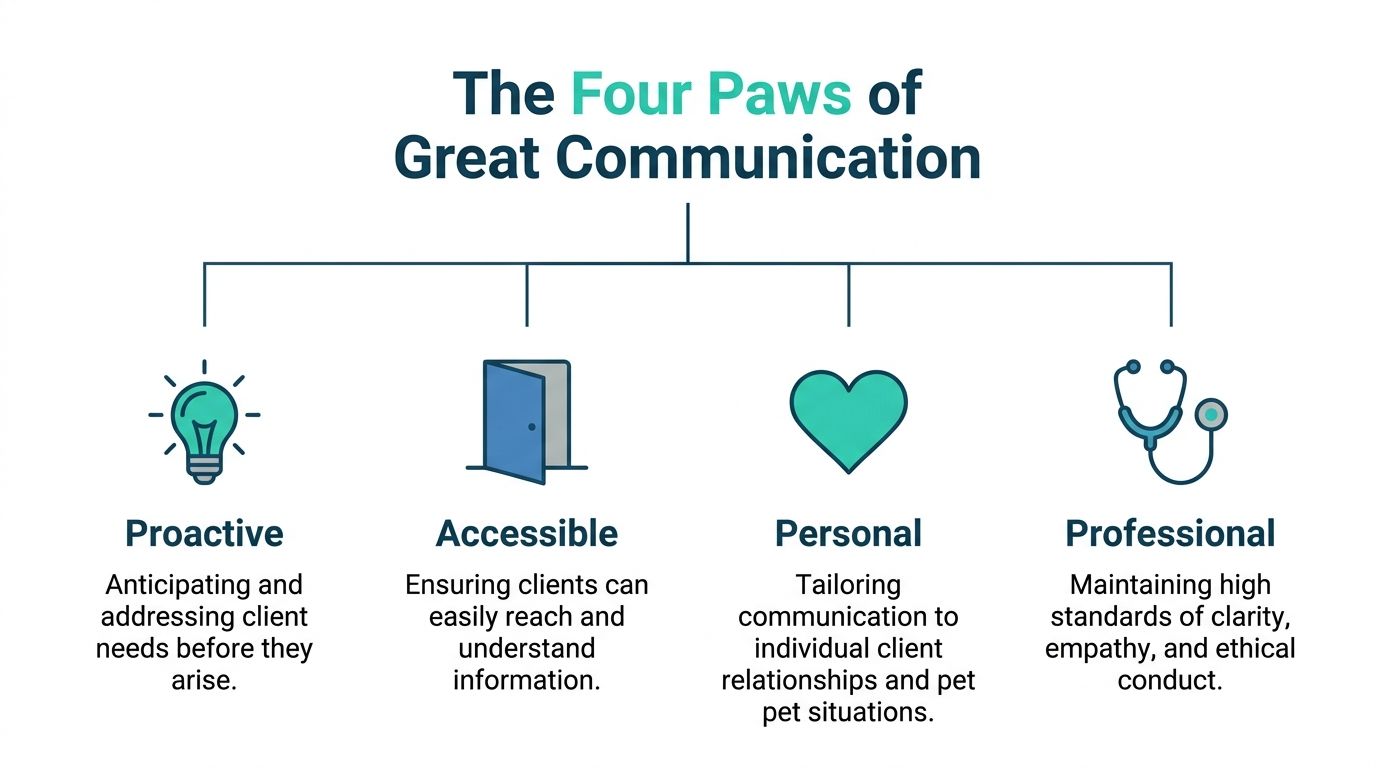
I teach it as the Four Paws of great communication: proactive, accessible, personal, and professional.
The framework matters because formal training is thinner than many clinic owners assume. Despite 98% of veterinarians agreeing that communication skills are as important as clinical knowledge, only 35% felt their school training prepared them well, as reported in this PubMed-indexed study on veterinary communication training. If you own or run a practice, you can't assume people learned this elsewhere.
Proactive
The best communicators answer the next question before the client has to ask it.
If you prescribe a new medication, don't stop at dose and frequency. Tell the owner what they might notice, what would count as a concern, and when they should expect improvement. If you're running behind, tell waiting clients before irritation starts to simmer. If a pet is staying for the day, send a short update before the owner wonders whether anyone remembers them.
Proactive communication also starts before the first appointment. Strong clinics build expectations into forms, reminder messages, and onboarding steps. That's one reason a clean client onboarding process for veterinary teams pays off so quickly.
Accessible
Clients don't need a lecture. They need a plan they can understand and act on.
That means plain language, short sentences, and fewer medical shortcuts. “This medicine helps reduce inflammation in the gut” lands better than “We're managing chronic enteropathy.” Email matters here too. Subject lines that are clear and easy to scan improve the odds that a client opens the message promptly, which is why it helps to follow subject line capitalization best practices when your team sends results, reminders, or post-op instructions.
A quick test works well: if a tired owner could repeat the plan to a spouse that evening, your wording was accessible enough.
Personal
Clients don't all need the same explanation.
A first-time puppy owner may want more detail and reassurance. A long-term client managing a chronic condition may prefer a brief update and the practical next step. The pet matters too. A travel certificate conversation, an end-of-life visit, and a routine vaccine appointment should not sound the same.
Good veterinary client communication feels specific. It sounds like the team knows this pet, this person, and this moment.
Personal communication is not about being overly chatty. It's about adjusting tone, detail, and pacing so the client feels met where they are.
Professional
Warmth without structure creates mistakes. Structure without warmth feels cold. Professional communication needs both.
That looks like:
Consistent terminology: The whole team uses the same words for diagnosis, plan, and next steps.
Clear written follow-up: Estimates, discharge notes, and reminders match what was said in the room.
Steady tone under pressure: Even when a client is frustrated, the team stays calm and clear.
A little polish goes a long way. Not fancy. Just dependable. That's what clients trust.
Choosing Your Channel for a Perfect Connection
Not every message belongs on every channel. Clinics get in trouble when they use the fastest option instead of the best one. A text may be efficient, but it's a poor choice for a complicated diagnosis. A phone call may feel personal, but it's clunky for sending a checklist or confirming a pickup time.
Good veterinary client communication means matching the message to the medium.
Use the phone when tone matters
Calls are best for sensitive results, treatment changes, emotional conversations, and anything likely to generate questions in real time. Owners can hear pacing, concern, and confidence. That matters when you're discussing bad news or a plan with trade-offs.
Phone calls are also useful when a client sounds confused in prior messages. If the team has gone back and forth twice, pick up the phone. Don't keep batting the tennis ball.
What to avoid by phone:
Long lists of instructions: Owners forget details once the call ends.
Fee breakdowns with many variables: Too easy to mishear or oversimplify.
Complex scheduling chains: Better sent in writing after the call.
Use text for quick reassurance and simple action
Texting works best for short, low-complexity updates. “Bella is awake and resting comfortably after her procedure.” “Your prescription is ready for pickup.” “Please reply YES to confirm tomorrow's visit.”
The danger is trying to force medical nuance into a tiny message. Text is not the place to explain pathology results, debate treatment options, or handle a complaint that's heating up.
Front-desk rule: If a text needs more than one follow-up text to explain, switch channels.
You also need a clear internal policy for who sends texts, what gets documented, and when the team moves the conversation to phone or email.
Use email when clients need something to refer back to
Email shines when the client needs a written record. Think prep instructions, estimates, post-op care notes, travel document lists, or a summary after a phone conversation. Clients can reread it, forward it, and search for it later.
The weakness of email is delay. People miss messages, skim them, or open them hours later. So email works best when the message is important but not urgent, or when it supports a conversation that already happened live.
For many clinics, the cleanest setup comes from using veterinary software that centralizes messages and records, so the team isn't hunting through inboxes, sticky notes, and personal recollections.
Use in-person conversations for judgment, empathy, and shared decisions
Face-to-face communication is still the gold standard for nuanced discussions. You can watch body language, pause when the client looks lost, and adjust your wording in the moment. It's where trust gets built fastest.
This is also the best setting for discharge confirmation. Using a “confirm understanding” protocol, where the client explains care steps back to the team, can reduce errors by up to 40% compared with handing over instructions, according to Demandforce's veterinary communication guidance.
Communication Channel Cheat Sheet
Channel | Best For | Avoid For |
|---|---|---|
Phone | Sensitive results, emotional updates, treatment decisions | Long discharge details, dense fee explanations |
SMS | Quick updates, reminders, simple confirmations | Complex medical explanations, complaints |
Written summaries, prep instructions, estimates, checklists | Urgent issues, emotionally loaded news | |
In-person | Shared decisions, empathy, demonstrations, discharge review | Messages that only require a quick logistical update |
A purr-fect system doesn't mean using every channel equally. It means using each one on purpose.
Navigating High-Stakes and Difficult Conversations
Every clinic has three conversations that test the team. Money. Bad news. Complaints. If you don't train for these moments, people improvise. Improvisation is where trust often goes to the dogs.
Talking about cost without sounding defensive
Clients usually handle cost better than surprise. The problem is not always the total. It's the moment they feel the clinic held something back.
A practical method is progressive fee disclosure. Start with the base estimate, explain what that covers, then add variable costs as facts become clear. This matters even more for services with moving parts. International pet travel certification can range from $200 to $800+, which makes staged explanation more realistic than pretending every case fits one tidy quote, as discussed in Weave's veterinary communication article.
A script that works:
Start with the base: “Here's the expected starting cost for the exam and initial paperwork.”
Name the variables: “The final amount can change based on destination rules, lab needs, and document requirements.”
Give the decision point: “Before we move into anything additional, we'll confirm those items with you.”
That approach feels honest because it is honest.
Delivering bad news with clarity
When the diagnosis is serious, many clinicians talk too much. They fill silence, pile on detail, and accidentally bury the action plan. Slow down instead.
Use a short sequence:
State the finding plainly
Pause
Explain what it means right now
Offer the next decision or next step
Avoid “why” questions that can sound blaming. “What changes have you noticed at home?” is more useful than “Why didn't you come in sooner?” That small wording shift keeps the client open instead of defensive.
“Your pet doesn't need a perfect speech from you. Your client needs a clear path through a hard moment.”
Handling complaints without feeding the fire
An upset client wants two things first. To be heard and to know someone owns the issue.
A simple de-escalation sequence helps:
Acknowledge the frustration: “I can hear that this has been upsetting.”
Clarify the concern: “Let me make sure I understand what happened from your side.”
State the next action: “Here's what I'm going to review and when you'll hear from me.”
Close the loop: Always follow up when promised.
What doesn't work is defending the clinic too early. The moment you start arguing facts before the client feels heard, the conversation hardens. You can correct details later. First, lower the emotional temperature.
A Playbook for Pet Travel Communication
Routine appointments are one thing. International pet travel is another animal entirely. The communication burden is heavier, the timing is tighter, and the client's stress level is usually sky-high.
That's why this service deserves its own workflow. The communication around pet travel is often overlooked, even though the 2–4 week pre-travel window is where clients most need proactive updates on changing rules and document status to reduce the risk of travel denial, as noted in this discussion of veterinary communication during pet travel preparation.
Start with a reality-based intake
The first call should reset expectations. Not scare the client. Ground them.
Ask for destination, travel date, species, age, vaccine history, and whether the owner has already booked transport. Then say clearly that pet travel is not just paperwork. It is a medical and timing-sensitive process. Owners often assume the certificate is the whole job when it's only one step in a chain.
A short intake survey helps gather the essentials before the team commits to a timeline. A tool like a pet travel survey workflow gives the clinic cleaner information upfront and cuts down on the usual back-and-forth.
Turn the timeline into milestones
Travel clients don't need one giant information dump. They need milestones.
Break the process into stages such as:
Initial eligibility review: Confirm destination requirements and identify missing items
Medical preparation: Vaccines, microchip checks, testing, or timing-sensitive tasks
Document assembly: Forms, signatures, endorsements, and supporting records
Final verification: Review details against travel date and destination rules
That structure changes the tone of the service. Instead of reacting to anxious calls, the clinic guides the owner through checkpoints.
Operational cue: In pet travel cases, silence feels like danger to the client. If nothing has changed, say that nothing has changed.
Communicate like a risk manager, not just an information source
Many practices stumble by giving instructions once and assuming the client will carry the process from there. For international travel, that's too fragile.
Clients need updates such as:
What has been completed
What is still pending
Which deadline matters next
What could still change
If the owner is also working with a shipper or relocation company, align communication early. For clients who need help understanding the broader logistics side, a service like Precious Pets Transport for global relocation can help them see where the veterinary piece fits inside the bigger move.
Handled well, pet travel becomes a loyalty-builder. The clinic takes one of the most stressful services it offers and makes it feel organized, calm, and dependable. Clients remember that.
Measuring Success and Scaling with Technology
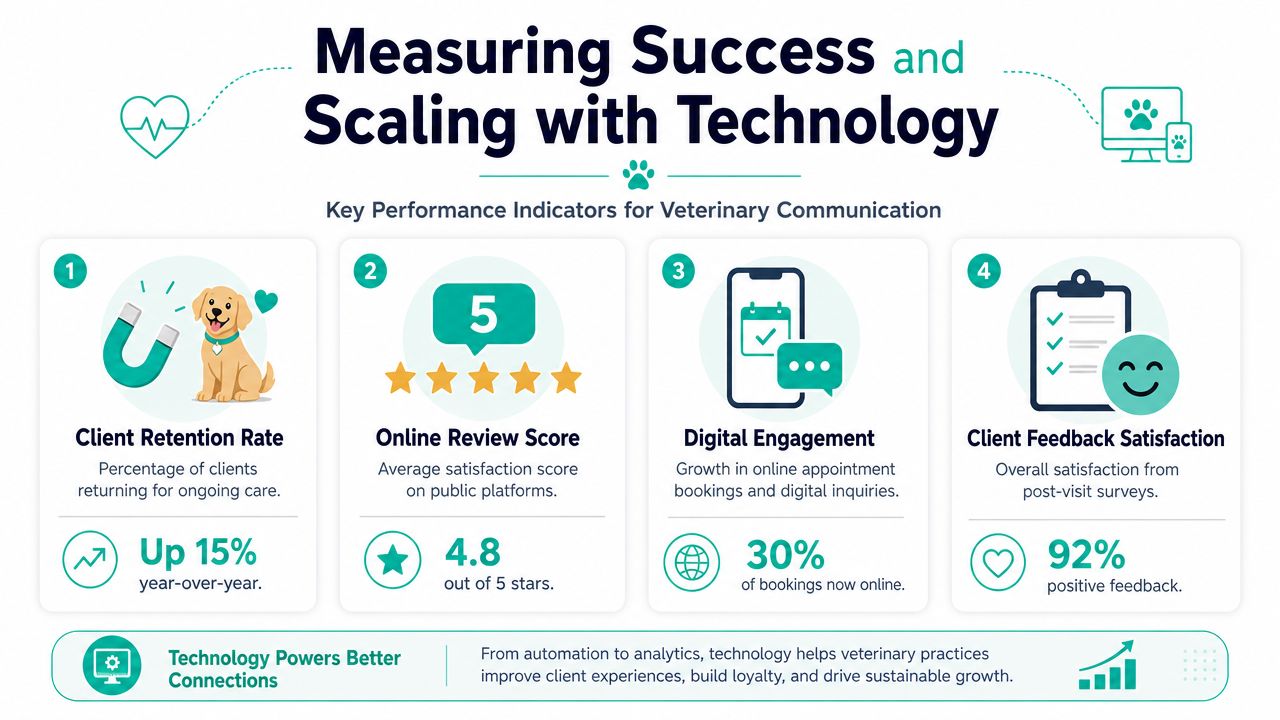
Communication improves when clinics stop judging it by gut feel alone. “The team seems friendlier” isn't enough. You need signals that show whether the work is reducing friction, improving retention, and freeing staff time.
Look at trends your team can influence. Fewer confused follow-up calls after discharge. Fewer missed handoffs between the exam room and front desk. More positive reviews that mention clarity, kindness, or responsiveness. Stronger retention among new clients after their first visit. Those are practical markers that your communication system is improving.
Pick a small scorecard
A simple clinic scorecard might include:
Retention trends: Are more clients returning for ongoing care?
Message response patterns: Are urgent issues getting answered quickly and routed correctly?
Review themes: Do clients mention clear explanations and feeling heard?
Repeat-question volume: Is the team answering fewer “what do I do now?” calls after appointments?
If you want ideas for structuring service KPIs, some of the thinking used in customer support metrics for B2B SaaS transfers well. Not the industry specifics, but the discipline of tracking response quality, resolution patterns, and team workload.
Use technology to reduce inconsistency
Technology won't make a cold clinic warm. It will make a good system more reliable.
The most useful tools usually do four things well:
Automate routine reminders so staff don't spend the day sending the same message manually.
Store communication in one place so the doctor, technician, and receptionist can see the same history.
Support templates for common updates without making them sound robotic.
Flag open loops so no one forgets the callback, recheck, or pending document.
Run short team huddles around communication too. Review one complaint, one compliment, and one process miss each week. Keep it practical. Good veterinary client communication is learned, coached, and tightened over time. The clinics that treat it like an operational skill usually see the biggest lift in trust and the least avoidable chaos.
If your practice handles pet travel cases, Passpaw can help you bring more order to one of the most communication-heavy workflows in the clinic. It gives veterinary teams a structured way to manage international health certificate requirements, track document progress, prioritize tasks by travel date, and keep clients informed throughout the process. That means fewer anxious status calls, fewer preventable errors, and a smoother experience for both your staff and the pet owners counting on you.

More articles
From regulatory changes to best practices for veterinarians and pet owners, our resources keep you ahead of the curve.