Are you a team member in a veterinary practice?
Are you a pet parent planning a trip with your furry pal?
How an International Pet Shipping Service Actually Works
You've accepted a job overseas, found a place to live, and booked your own flight. Then you look at your dog asleep by the door and realize you have no idea how she gets there. That moment is where most international moves get tense, not because people don't care, but because a pet can't travel on a simple ticket and good intentions.
An international pet shipping service helps line up the vet visits, papers, airline checks, and dates that sit behind that one flight. Once you see how those parts connect, the process feels much less mysterious.
Why Moving a Pet Across Borders Is Trickier Than It Looks
A family I picture often is moving for work with a calm, healthy dog. They've got a rabies record, they've bought a crate, and they assume the airline desk will sort the rest. A week before departure, they learn the health certificate needs a separate government stamp, and their chosen flight stops in a country with its own transit rules.
Nothing is seriously wrong with the dog. The problem is that three different groups each need to say yes, and they don't check the same things. The country you're leaving cares about who signed the certificate. The country you're entering cares about shots, tests, and entry dates. The airline cares about the crate, the weather, and whether it can accept that animal on that plane.

A coordination job, not a parcel job
Think of the move as a small project with a furry passenger at the center. Your pet isn't freight you drop off and forget. Each step depends on the one before it, so a late blood test or a wrong date can push everything else back.
Different rules: Every destination sets its own entry steps.
Timing: Some steps only count inside a set window.
Paperwork: Certificates often need review or a stamp.
Travel day: Airlines can refuse a crate that doesn't fit their rules.
Good starting question: Who needs to approve this trip besides my regular vet?
Busy teams in other fields solve similar handoff problems by keeping messages in one place, which is why some coordinators look at tools like SignalZen for industrial customer care as an example of keeping service questions organized. For a pet move, that habit matters too. One shared list of dates, names, and open tasks stops the classic mix up where everyone thinks someone else booked the final vet visit. It's a very ruff way to learn, and it's also very avoidable.
Who Does What in a Pet Shipping Project
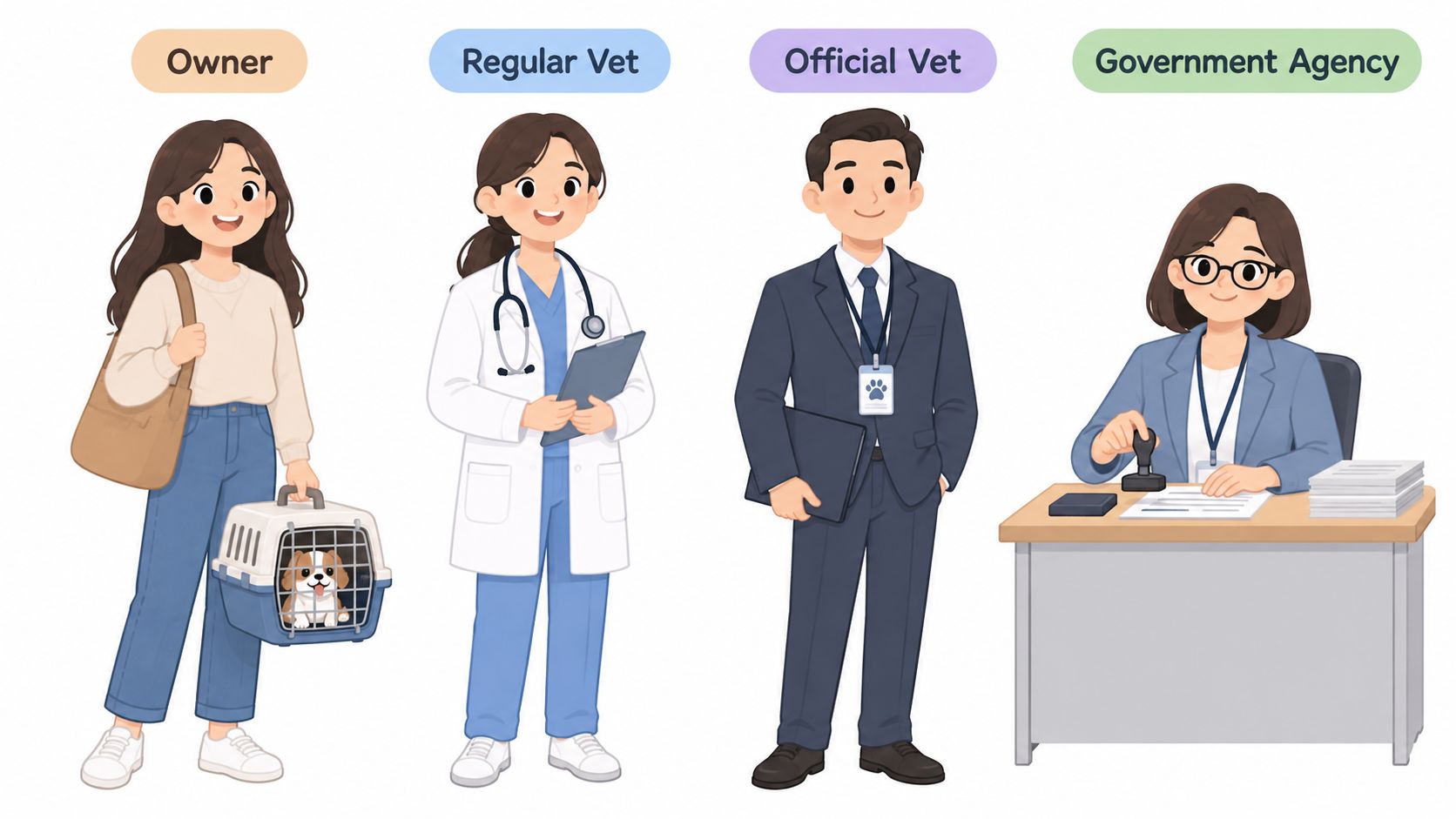
You, the owner, handle the basics only you can provide. You confirm where you're going, when you hope to fly, and your pet's age, breed, weight, and past shots. You also do the crate training at home, which sounds small but makes travel day calmer.
Your regular vet knows your pet's health history. That vet may give shots, place a microchip, run tests, and do the exam. But not every vet can sign every travel form, and that's where first timers often get confused.
The people behind the scenes
An accredited or official vet is approved to issue certain travel certificates. That person checks that the microchip number, shot dates, and exam findings all match. If a date is out of order, they may have to send you back a step instead of signing.
A government office then reviews or stamps the certificate for many routes. This step is called endorsement, which is a plain way of saying the office confirms the form looks complete for that destination. The airline or cargo team is separate again. They check space on the plane, crate size, labels, and weather limits.
Some families also hire a pet travel agent or customs broker. That person books cargo space, prepares arrival steps, and helps with checks at the other end. Ground help works in a similar way in human travel, and Jasumo's Japan travel agent support is one example of local partners helping agents handle details far from home.
No single person owns the whole trip. The handoff is usually where things slip. A vet can issue a neat certificate, but if the chip was placed after the rabies shot, the reviewing office may not accept that shot. Knowing who to call for each part keeps you from barking up the wrong tree when time is tight.
The Three Rule Systems That Have to Agree
Most guides give you one long checklist. That's helpful, but it hides the true shape of the problem. You're dealing with three rule systems at once, and passing one doesn't mean you've passed the others.
Air travel is now a major route for these moves, and IATA has been reported as estimating more than 4 million pets travel by air each year, with nearly 200,000 live animal consignments in 2024, a scale described in APHIS guidance on international animal movement. With that much movement, airlines and governments rely on set checks rather than case by case favors. Your pet's trip has to fit those checks cleanly.

Layer one and layer two
Origin rules cover how a certificate is issued and approved where your trip starts. For pets leaving the United States, that often means a USDA accredited vet signs the form and an APHIS office endorses it. The form may also need to travel as a paper original with your pet.
Destination rules decide whether your pet can enter at all. That country sets the list for chips, rabies shots, blood tests, other treatments, permits, and sometimes quarantine. A transit country can add its own rules too, even if your pet never leaves the airport.
Layer three, the airline
Airline rules are the layer people forget. A carrier can ask for a health certificate even for a pet in the cabin. It can also set crate, breed, temperature, and check in rules that are stricter than the government's list.
Say you're moving a dog from the United States to a country in the European Union. Your certificate is signed and stamped, and the entry papers look right. At cargo check in, staff find the crate door doesn't lock the way that airline requires, or the day is too hot for loading. The papers didn't fail. The flight still can't take your dog.
A trip is ready only when the origin stamp, the entry rules, and the airline checks all fit the same date.
That's why a good international pet shipping service doesn't just collect forms. It checks each form against the full route, including stops, and it rechecks everything if the flight changes. One new connection can create a whole new set of tasks.
Documents Most International Pet Moves Require
The paper stack looks scary until you learn what each page proves. Most routes use the same core items, even if the exact form changes by country. Once you know the job of each one, you can spot gaps early.
For travel from most non EU countries into the European Union, a dog, cat, or ferret generally needs a microchip, a valid rabies vaccination, and in many cases a rabies antibody blood test, with the chip placed before the rabies shot for that shot to count under EU guidance on traveling with pets. Order matters here. It's not enough to have both items on file.
What each document proves
Microchip record: Proves your pet's identity and ties every other record to one animal.
Rabies certificate: Shows the shot date, product, and when it expires.
Health certificate: Shows a vet examined your pet close to travel and found them fit to fly.
Lab result: Shows a blood sample met the level the destination asks for, when a test is needed.
Treatment record: Covers steps like tapeworm medicine for dogs on certain routes.
Import permit: Shows the destination agreed in advance to receive your pet, where that's required.
If you're gathering the core list for your route, this overview of travel documents needed for international pet trips helps you name each item before you start chasing signatures. Keep clear copies as you go. Some offices still ask for forms to be sent in older ways, so a complete guide to overseas fax delivery can be handy if a clinic or broker requests a faxed copy while the original is in transit.
Here's the small error I warn everyone about. A dog gets a rabies shot on Monday and a chip on Tuesday. The shot is real, the vet did good work, and the dog is protected. But on routes that require the chip first, that shot may not count for travel, so the clock may need to restart. One day in the wrong order can turn into weeks of delay. Checking dates early is the cheapest save in the whole move.
Building a Backward Timeline From the Flight Date
Start with the day you want to fly, then work backward. That one habit turns a pile of rules into a clear plan. You're not asking what to do first in the abstract. You're asking what must already be true by the time the plane leaves.
Some routes need about six months of preparation, including Australia in the examples given in CDC pet travel guidance. Wait, that's a number I should state carefully. Long lead routes usually involve a blood test and a set wait after the sample. Shorter routes may need only a chip check, a current shot, an exam, and a stamp, so the work fits into a much smaller window.

Two timelines, same method
For a long lead move, your early steps are the chip, the rabies shot, the wait that follows, and the blood test. Only after the lab result comes back can you set firm flight plans with much confidence. The final exam and certificate still happen near the end, because those forms don't stay valid for long.
For a tighter route, the pressure sits at the back end. For U.S. origin pets, certain destinations allow only about 30 days for endorsement and travel after the vet signs, and the original endorsed hard copy may need to travel with the animal, as noted in USDA answers on pet travel certificates. If your flight slips past that window, you may need a new exam and a new form. That's nobody's fault. It's just how the dates work.
Milestones to place on your calendar
Confirm the route: Destination, transit stops, and airline.
Check the chip: Scan it and match the number to old records.
Fix the shot order: Make sure rabies dates follow the chip date.
Book lab work: Leave room for results and any set wait.
Set the final exam: Place it inside the certificate window.
Send for endorsement: Track the paper until it's back in hand.
Recheck the flight: Confirm crate, check in time, and weather limits.
If deadline math is the part that stresses you out, these notes on common pet travel application deadlines show how the windows stack up in practice. Put the strictest date in red. Everything else gets planned around it, not the other way around.
What International Pet Shipping Actually Costs
People often ask for one price, but there isn't a single fair number for every route. The bill is really a stack of smaller bills. Once you see the stack, you can tell which parts you can plan tightly and which parts depend on the destination.
Vet fees cover the exam, chip, shots, and any treatments. Lab fees cover blood tests if your route needs them. Government fees may apply when an office reviews or stamps your certificate. None of those prices stay the same forever, so treat any quote as a snapshot, not a promise.
Fixed costs and route based costs
Cost bucket | What drives it |
|---|---|
Crate | Your pet's size and the airline's crate rules |
Airline or cargo charge | Route, pet size, and cabin versus cargo |
Lab work and permits | The destination's entry list |
Agent or broker help | How much booking and arrival help you want |
A chip and a standard crate are fairly fixed once you know your pet's size. Lab work, permits, longer prep, and cargo charges change much more by route. That's why two dogs on the same street can face very different totals if one is going to a nearby country and the other is going somewhere with strict entry steps. For a fuller breakdown of those buckets, see this guide to the cost of shipping a pet.
Don't forget the cost of fixing a mistake. Rebooking a flight, repeating a test after a missed window, or paying for extra boarding during a delay can add up fast. That hidden risk is often the main reason families hire help. They're not just paying for forms. They're paying to lower the chance of doing the same step twice. A little planning up front can keep the budget from going to the dogs.
Going Beyond Compliance to Pet Welfare and Service Quality
Passing the paper checks is the floor, not the finish line. Your pet still has to live through the actual trip. A move can be fully approved and still be a poor fit if the route is too long, the crate is wrong, or nobody has a plan for a delay.
The scale of modern pet flights shows why these questions matter. Emirates SkyCargo reported transporting more than 14,600 pets globally in 2025, averaging roughly 40 per day, in Air Cargo Week reporting on its animal transport year. High volume means some carriers now run dedicated animal areas and trained teams. It doesn't prove every route gives your pet the same level of care.
Questions worth asking any shipper
Delay plan: Who checks on my pet if a flight is missed or held?
Transit care: Is there a climate controlled animal area at the stop?
Crate fit: Can my pet stand, turn, and lie down with ease?
Food and medicine: What can be given during a long layover, and by whom?
Weather limits: At what point will you refuse to load my pet?
Updates: How will I hear from you if the plan changes?
If you're unsure how the cargo area itself works, this plain guide to pets in the cargo hold of a plane explains what that space is and what it isn't. Use it to ask better questions, not to scare yourself. Many pets fly this way, and the details of the route matter more than the label.
Be careful with easy labels like pet friendly. Ask for proof instead. A good shipper can explain crate checks, staff training, and what happens during extreme heat without getting vague. Also ask about sedation, because that's a health call for your vet, not a sales point. Breed, age, coat, and health all change the risk picture. If a provider waves those questions off, treat that as useful information.
Tying It All Together and Common First-Time Questions
The clean moves I've seen share one trait. Somebody kept the chip date, shot records, lab results, certificate window, and flight plan in one place, and checked them against each other after every change. That's the value of an international pet shipping service. It's not magic. It's steady cross checking before small gaps become big ones.
That pattern has deep roots. International pet movement became more standardized in the European Union through Regulation (EC) No. 998/2003, adopted on 26 May 2003, which set shared health rules for dogs, cats, and ferrets as described in the EU summary of rules on pet movement. Since then, travel has leaned more and more on documented steps tied to the destination. Tools built for health certificates, such as Passpaw, reflect that shift by helping vet teams track tasks and check records against destination needs.
Quick answers for first timers
Can my pet fly in the cabin? Sometimes, if the airline allows it and your pet fits its size and carrier rules. Long international routes often use cargo instead, and the entry papers are still required either way.
What if my flight date changes after the stamp? Tell your vet and shipper right away. A new date can push you outside a certificate window or change a transit rule, so the whole plan may need a fresh check.
Do transit stops really matter? Yes. A stop can add its own forms or limits, even on a short layover. Always plan for the full route, not just the first and last cities.
Are puppies and kittens treated differently? Often, yes. Young animals may not be old enough for a rabies shot to count for travel, and some routes set age limits. Ask about age early, before you book anything.
Start with the route, build the dates backward, and keep one clear record of every step. Do that, and the process stops feeling like a maze. It becomes a series of small, checkable tasks with your pet's comfort kept in view. That's a much better way to travel, for both of you.
If your clinic or travel team is juggling chips, shot dates, and endorsement windows across several pets at once, Passpaw helps you track each case against its destination rules and keep owners updated along the way. Visit Passpaw to see how its document checks and task tracking can support your next international pet move.

More articles
From regulatory changes to best practices for veterinarians and pet owners, our resources keep you ahead of the curve.