Are you a team member in a veterinary practice?
Are you a pet parent planning a trip with your furry pal?
9 International Travel Documents Needed for Pets
Most international pet trips require identity, health, vaccination, destination, ownership, airline, and storage records, but the exact set and timing depend on the destination and itinerary. For dogs, cats, and ferrets entering the EU from a non-EU country, the pack includes an animal health certificate, microchip proof, rabies details, and, where relevant, treatment against Echinococcus multilocularis.
You've booked the flight, chosen the carrier, and started planning the exciting parts of the trip. Then a closer look reveals that your pet's health certificate must be issued within a narrow window, a rabies record needs to match the microchip, or a destination-specific test and import permit must be completed before departure. A folder full of forms won't solve the problem if one document is missing, outdated, incomplete, or prepared in the wrong order.
The international travel documents needed for pets are not one universal form. They're a planning sequence shaped by your pet, destination, route, transit countries, airline, and departure date. Current official destination guidance and advice from a veterinarian should guide every step.
The safest checklist is built around the destination and timing, not a generic folder of forms.
For veterinary practices, Passpaw can help track requirements, prioritize tasks by travel date, validate documents, and keep clients informed. Practices may also use identity document extraction to help organize information from identity documents, while the pet-specific workflow remains tied to official requirements and veterinary review.
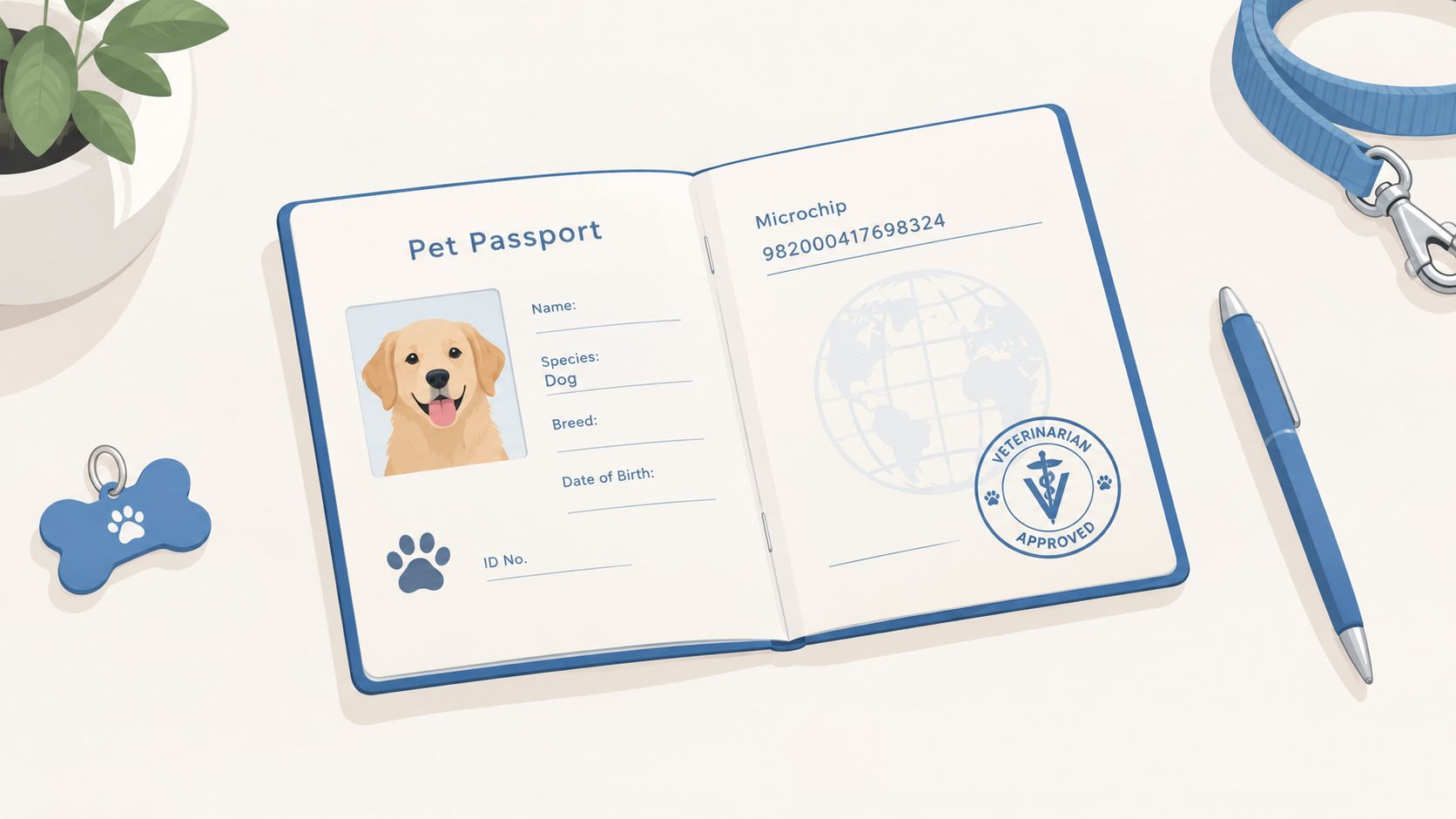
1. Valid Passport or Pet Travel Document
Your pet's official travel document gives the rest of the paperwork a clear identity anchor. Depending on the route, it may be a European pet passport, an official animal health certificate, or another document issued or endorsed by a veterinary authority. The document may record the pet's microchip number, vaccination history, ownership details, and other identifying information.
The correct document depends on where your pet starts and where it's going. EU guidance says pets moving from an EU country or Northern Ireland to another EU country or Northern Ireland need a valid European pet passport. Pets arriving from a non-EU country need a valid EU animal health certificate, according to EU travel guidance.
Match the document to the route
A pet passport that works for movement within a regional travel system may not replace an export health certificate for entry from outside that system. A United States traveler may also need a government-endorsed certificate, while a pet entering Great Britain follows the requirements of the UK Pet Travel Scheme.
Before booking the veterinary appointment, write down:
Country of departure: Include the place where the pet begins the journey.
Final destination: Check the destination's current government requirements.
Transit points: A connection may introduce another document or approval.
Return route: Re-entry requirements may differ from those for the outbound trip.
The Passpaw guide to getting a pet passport can help owners understand the basic process, but it shouldn't replace official destination guidance. Keep the original document secure, scan it, and check that every name, date, and microchip number is consistent. A tidy passport is a good first paw forward.
2. Microchip Registration and Documentation
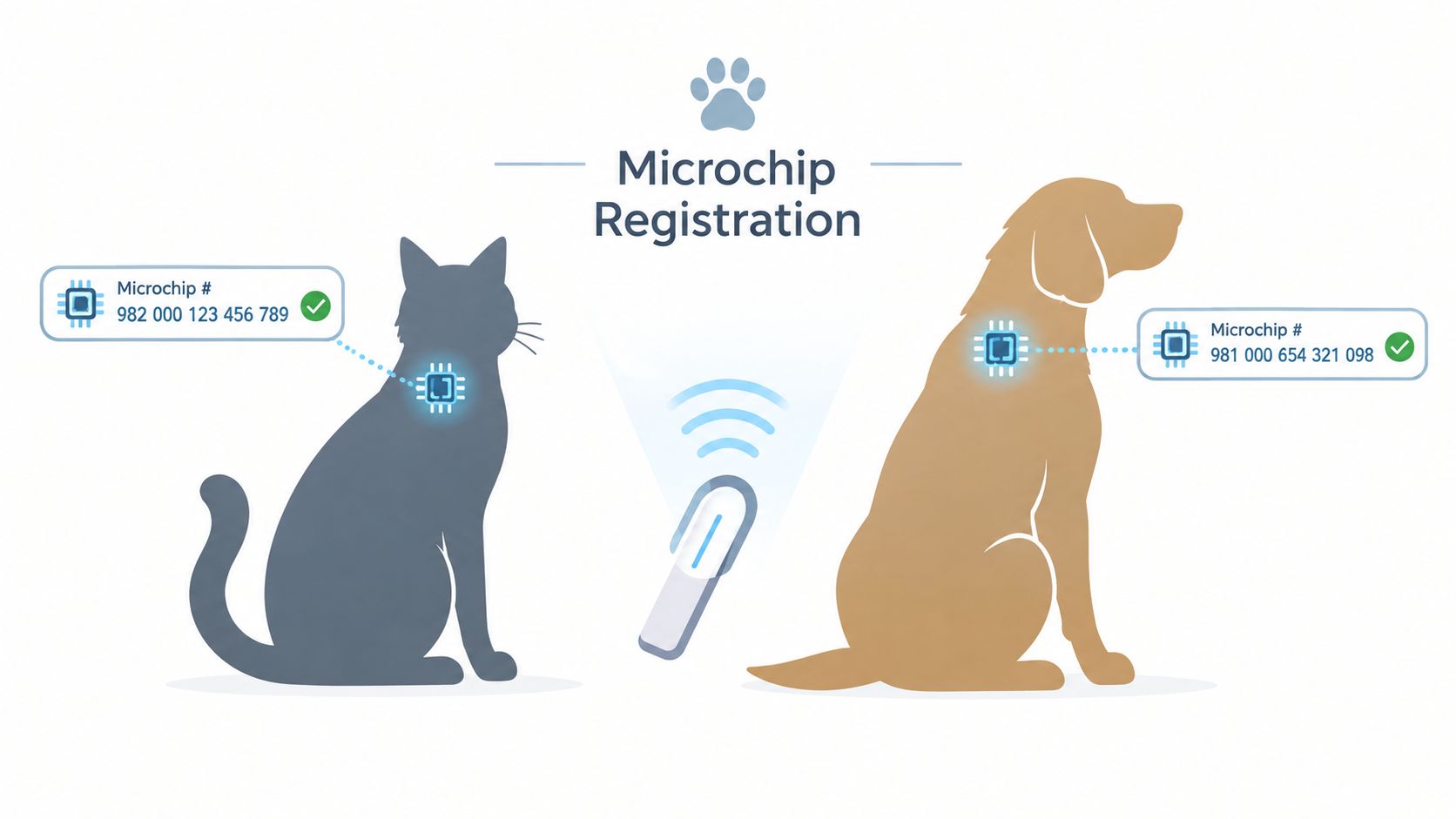
A microchip links the paperwork to the animal standing in front of the border or airline official. It's a small identification device read by a scanner, but its number must appear accurately on the relevant travel documents. If the scanner result and the certificate disagree, the pet's identity may need extra checking.
The European Commission's rules for pets entering the EU from a non-EU country require an ISO-compliant microchip, along with rabies vaccination and other route-dependent records. The EU animal movement guidance also identifies proof of the microchip code as part of the travel pack for dogs, cats, and ferrets.
Verify the number before other paperwork
Ask the veterinarian to scan the pet and compare the result with the microchip certificate, passport, vaccination record, and health certificate. Check the registration account separately, especially after moving or changing a phone number. Registration databases such as HomeAgain, AKC Reunite, PetLink, and European databases may use different records, so keep the owner's contact information current wherever the chip is registered.
The microchip must also be placed in the correct sequence relative to rabies vaccination. Official pet travel guidance states that the chip must be implanted before the rabies vaccination used for travel, and many destinations, including the EU, require at least 21 days after the primary rabies vaccination before travel can begin. See the microchip and rabies timing guidance when building the schedule.
Keep the implantation record and scanner confirmation with the travel file. A clear number can prevent a small identification issue from becoming a big airport problem. For practices, ISO-compliant microchip guidance offers a useful reference point when reviewing a pet's records.
3. Current Health Certificate
A health certificate records the veterinarian's examination and confirms the information needed for the route. It may include the pet's identity, physical findings, vaccination details, parasite treatments, and the veterinarian's certification. The certificate is often the document with the tightest relationship to the departure date.
For dogs, cats, and ferrets entering the EU from a non-EU country, the animal health certificate must be issued by an official state veterinarian no more than 10 days before arrival. It remains valid for travel between EU countries for 6 months, or until the rabies vaccination expires, whichever comes first, under the EU's pet travel rules.
Treat the certificate as a timed document
A certificate prepared too early may expire before the pet reaches the entry point. A certificate prepared too late may leave no time to fix a missing signature, incorrect microchip number, translation issue, or incomplete field. The travel date, arrival date, entry point, and any transit stop should be visible to the veterinary team before the appointment.
U.S. travelers should also check whether a federally accredited veterinarian, USDA endorsement, or certified translation is required for the route. The U.S. Department of State's pet travel guidance explains that many countries require an accredited veterinarian, a health certificate, and USDA endorsement, while some certificates need a certified translation.
Bring the destination instructions to the appointment and ask the practice which sections it can complete, endorse, or submit. The international pet health certificate guide can help practices and owners prepare for the certificate process. Keep the signed original accessible during travel, not buried in checked luggage.
4. Vaccination Records and Certificates
A vaccination record is one piece of the entry puzzle. Rabies usually receives the closest review, while some destinations request additional vaccination or health details. The record should identify the pet, vaccine, administration date, product information, veterinarian, and required validity period.
Build the timeline before booking the appointment. Many destinations, including the EU, require at least 21 days after a primary rabies vaccination before travel can begin. The microchip must be implanted before the vaccination used for travel, so the chip date and vaccine date need to be checked together.
Match the record to the route
Start with the destination's current rules, then ask the veterinarian to review the complete vaccination history. A booster, primary vaccination, antibody titration test, and certificate renewal can each create different timing requirements. The country of origin and transit route may also affect whether a laboratory test is needed.
Use the proof of rabies vaccination resource to understand what clear rabies evidence should show. Keep the vaccination certificate with the health certificate, but treat them as separate documents. One records immunization; the other confirms the pet's health for the journey.
Before the final certificate appointment, review these points:
Identity match: Compare the pet's name, species, breed, and microchip number across every record.
Date sequence: Check that microchip, vaccination, test, and certificate dates follow the required order.
Validity: Confirm that the vaccine remains accepted on both travel and arrival dates.
Signature and format: Ask whether the destination accepts the clinic's document or requires an official form.
If any entry is unclear, request a corrected record early. A veterinary team can then assemble the certificate without chasing missing details at the last minute. Passpaw can help owners and practices keep these documents connected in a travel workflow, so the paperwork stays as orderly as a well-trained pup.
5. Import and Export Permits
Some destinations require a government permit before a pet travels. The permit may depend on the animal's origin, vaccination history, health certificate, laboratory results, transport purpose, or route. It can also include instructions about entry ports, quarantine, inspections, or approved transport arrangements.
The permit is separate from the health certificate. A healthy pet with accurate vaccination records may still need prior authorization from the destination authority. The UK, Australia, the United States, and other destinations can apply different procedures, so owners should contact the destination's agriculture department, embassy, or official import authority before finalizing the document plan.
Start with the longest lead time
Permit applications often rely on information that appears in other records. That creates a dependency chain. The practice may need the microchip number before the vaccination record can be reviewed, the vaccination record before a test can be ordered, and the test result before an import application can be completed.
Create a dated record of every submission, email, approval, and condition. If an authority changes the requested format, save the updated instruction with the application file. Don't rely on memory or a single inbox search.
A permit review should answer:
Who issues it: Identify the government authority, not just a private travel company.
When it must be obtained: Record the application and approval timing.
What it covers: Check whether it applies to entry, transit, quarantine, or all three.
What must travel with the pet: Print the permit and keep a digital backup if permitted.
6. Proof of Pet Ownership and Identification Records
Ownership records show who has authority to travel with the animal. Adoption papers, breeder records, local registration, veterinary files, and purchase documents can connect the pet with the traveler. They become especially helpful when the owner's name differs between records or another person will accompany the pet.
Treat the file like a name-and-identity check. The owner's name should match across the booking, veterinary paperwork, and identification records. Different spellings do not automatically stop a trip, but they can create questions at check-in or inspection and give the veterinary team another discrepancy to resolve.
Assemble the ownership file before the appointment
Collect original documents and scan them before paperwork begins. For an adopted pet, include shelter or rescue records. For a pet purchased from a breeder, retain the registration or purchase document. Local licensing records can support the owner's current details.
Add a brief cover sheet with:
Owner name: Use one spelling throughout the travel file.
Pet identity: List the name, species, breed, and microchip number.
Contact details: Include a phone number and email available during travel.
Authorized traveler: Identify the person handling the pet if they are not the owner.
A changed ownership record needs extra attention. Ask the veterinarian or destination authority whether the transfer requires an authorization letter, transfer document, or another record. Requirements may differ by destination type, so resolve this before the health certificate and airline paperwork are finalized.
Keep ownership evidence separate from medical documents, while storing both in the same accessible folder. A Passpaw-supported workflow can help owners and veterinary teams check names, identity details, and supporting files together, then keep copies ready for inspection. That small paperwork check can prevent a last-minute identity mix-up.
7. Travel Itinerary and Airline Documentation
Treat the itinerary as the timeline for the document file. A health certificate may cover departure but expire before arrival, a transit stop, or the return journey. Airline paperwork follows a separate track and may include a reservation, crate details, pet acceptance confirmation, or carrier forms.
Send the veterinary practice the full route before documents are prepared: flight numbers, travel dates, airports, connections, and return plans. A direct flight can raise different questions from a route with a lengthy international connection. Transit-country rules may apply even if the pet remains inside the airport.
Build the airline file alongside the veterinary file
Airline policies vary by carrier, aircraft, route, cabin or cargo arrangement, and weather restrictions. Delta, United, American Airlines, and international carriers may set different conditions for reservations, carriers, forms, and health documents. A ground transfer between airports can add another set of requirements.
Request written confirmation of these points:
Pet reservation: Confirm that the pet's space is booked, not only requested.
Carrier requirements: Check dimensions, ventilation, labels, and identification details.
Document submission: Ask when certificates and forms must be provided.
Transit handling: Confirm how the pet moves between travel legs.
Return travel: Verify whether the documents remain valid for the trip home.
Store the confirmed itinerary beside the document set, and notify the veterinary practice about any date or route change. A change can affect the health certificate, laboratory work, permit, or treatment window. Passpaw can help owners and veterinary teams keep the route, airline confirmations, and supporting files together, so the paperwork stays aligned with the pet's journey. It is a small but useful final check before takeoff.
8. Destination-Specific Requirements and Regulations
There's no reliable universal list of international travel documents needed for every pet trip. Destination rules can change based on the country of origin, the pet's species, the route, the purpose of travel, and the countries crossed in transit. They may also include special forms, local-language documents, import permits, quarantine approvals, or disease-control steps.
The EU illustrates how much detail can sit behind a simple trip. Pets entering from non-EU countries may need an animal health certificate, microchip proof, rabies information, and, where relevant, tapeworm treatment against Echinococcus multilocularis. The EU also requires an official state veterinarian to issue the certificate within the stated arrival window.
Read the route, not just the destination
The UK uses different document sets depending on whether the origin is a part 1 listed country, a part 2 listed country, or an unlisted country. Great Britain travelers going to the EU should also account for the animal health certificate's separate validity periods, including 10 days for EU entry, 6 months for onward travel within the EU after entry, and 6 months for re-entry to Great Britain, as stated in official UK pet travel guidance.
Rules can change quickly. A 2025 EU and Northern Ireland regulation added specific fields to the pet travel document and declaration and applied from 4 June 2025, according to the published EU update. Check official government pages close to travel and ask the veterinarian to review the route.
Write down the source, date checked, required document, and responsible person. That simple record turns research into a manageable workflow.
9. Organized Document Storage and Backup System
A complete document set needs a retrieval plan. At the airport, border crossing, veterinary clinic, or airline counter, different people may request different pages. If the original is buried in checked luggage or the only scan sits on one phone, a minor disruption can delay the next step.
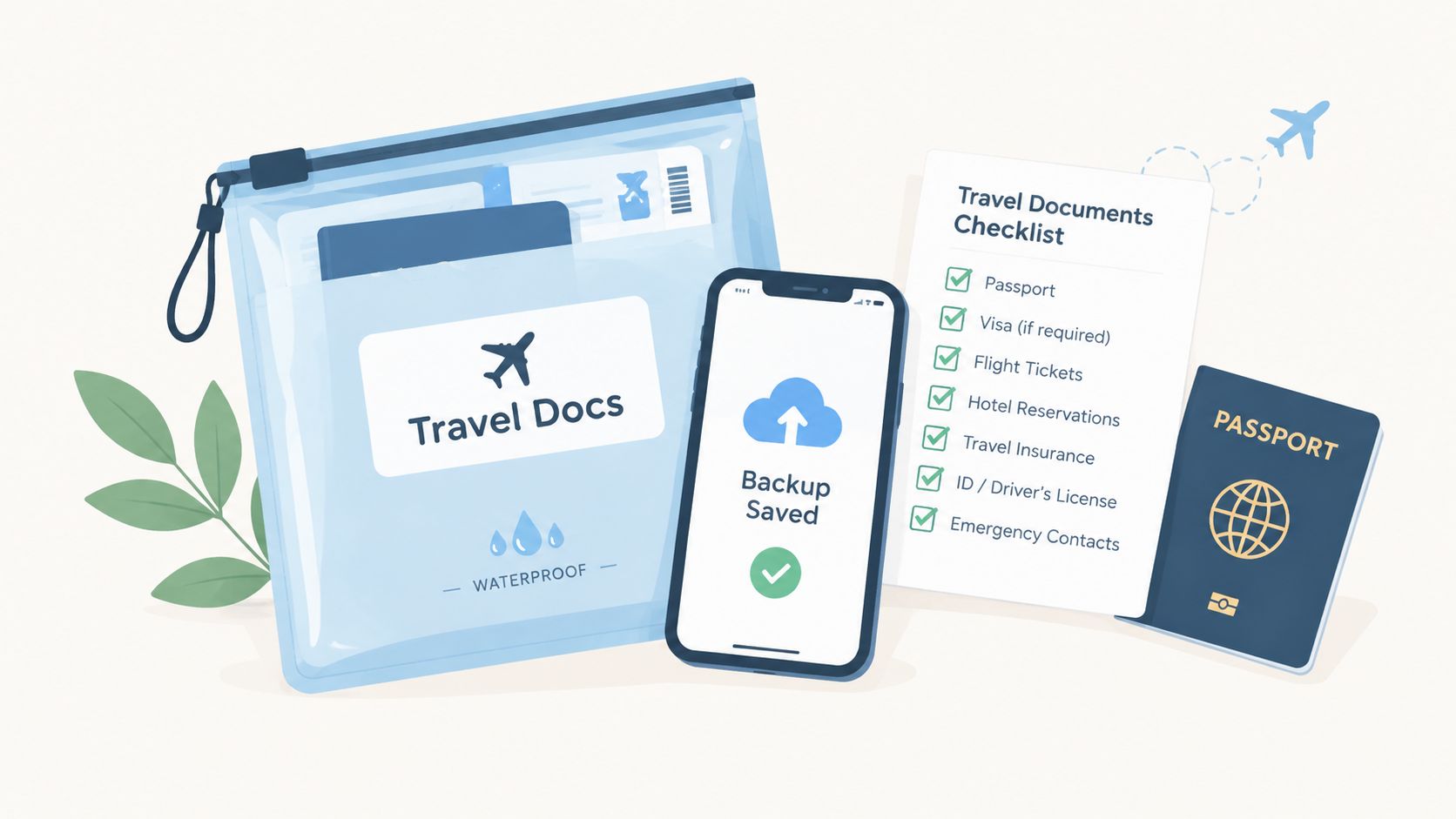
Build two matching folders, one physical and one digital. Keep originals and required printed forms in a waterproof sleeve that stays accessible during travel. Store scans, permits, correspondence, itinerary details, microchip proof, vaccination records, and a dated master checklist in the digital folder.
Use names that answer three questions at a glance: which pet, which document, and which date. A filename such as a pet's name, rabies record, and issue date helps a veterinary team locate the right file without opening multiple attachments. Give appropriate access to the owner, veterinary practice, travel companion, or emergency contact, rather than depending on one person's account.
A practical handoff looks like this:
Originals: Carry required originals in hand luggage or another accessible place.
Printed copies: Keep paper copies separately, so one misplaced bag does not remove every backup.
Cloud backups: Save scans in more than one approved location.
Version control: Label current files clearly and archive or remove outdated drafts.
Calendar reminders: Record renewal, treatment, permit, and certificate dates.
Test the system before departure. Open the shared folder from another device, confirm that scans are readable, and check that each file matches the checklist. That quick rehearsal can prevent a document hunt when the pet, owner, and airline are already under time pressure.
The aim is quick retrieval, not a decorative folder. Passpaw can help veterinary practices track uploaded records, destination requirements, tasks, and client updates in one workflow.
9-Point Comparison: International Pet Travel Documents
Document / Item | Implementation Complexity 🔄 | Resource Requirements ⚡ | Expected Outcomes ⭐ / Impact 📊 | Ideal Use Cases 💡 | Key Advantages ⭐ |
|---|---|---|---|---|---|
Valid Passport or Pet Travel Document | 🔄🔄 Moderate, application + vet verification | ⚡⚡ Moderate, vet authority, photo, fees | ⭐ High compliance; 📊 smoother border processing | 💡 Multi-country travel, re-entry | ⭐ Internationally recognized ID; reduces delays |
Microchip Registration and Documentation | 🔄🔄 Low–Moderate, implantation + registration | ⚡ Low, one vet visit, database fees | ⭐ Permanent ID; 📊 enables cross-border identification | 💡 Required compliance, lost-pet recovery | ⭐ Hard to lose; works across databases |
Current Health Certificate | 🔄🔄 Low–Moderate, vet exam within timeframe | ⚡⚡ Moderate, vet visit(s), possible tests | ⭐ Confirms fitness; 📊 lowers disease concerns at border | 💡 Short-term travel within certificate validity | ⭐ Official, fast-to-update health verification |
Vaccination Records and Certificates | 🔄🔄 Moderate, scheduling and timing rules | ⚡⚡ Moderate, vaccines, record-keeping | ⭐ Protects public health; 📊 may reduce quarantine | 💡 Destinations with strict vaccine timelines (rabies) | ⭐ Proof of immunity; long-term documentation |
Import and Export Permits | 🔄🔄🔄 High, government approvals, complex forms | ⚡⚡⚡ High, fees, lead time, supporting docs | ⭐ Legal clearance; 📊 prevents entry denial | 💡 Countries with strict import controls (Australia, UK) | ⭐ Official authorization; clarifies requirements |
Proof of Pet Ownership & Identification Records | 🔄🔄 Low–Moderate, gather/adapt documents | ⚡ Low, existing papers, possible notarization | ⭐ Establishes legal ownership; 📊 resolves disputes | 💡 Border checks, ownership challenges, adoptions | ⭐ Prevents trafficking concerns; supports recovery |
Travel Itinerary & Airline Documentation | 🔄🔄 Moderate, align bookings with rules | ⚡ Low–Moderate, confirmations, airline forms | ⭐ Ensures date alignment; 📊 avoids last-minute issues | 💡 Flights with layovers or differing carrier policies | ⭐ Confirms airline compliance; timing clarity |
Destination-Specific Requirements & Regulations | 🔄🔄🔄 High, tailored research and updates | ⚡⚡⚡ High, translations, extra tests, consultations | ⭐ Ensures full compliance; 📊 reduces refusal risk | 💡 Travel to countries with unique rules (Japan, NZ) | ⭐ Prevents surprises; allows timely preparation |
Organized Document Storage & Backup System | 🔄 Low, initial setup and maintenance | ⚡ Low, cloud storage, physical folder, apps | ⭐ Immediate access; 📊 reduces travel-day stress | 💡 Any trip, especially multi-document journeys | ⭐ Fast access, redundancy, easy sharing |
Make the Checklist Work for Your Pet's Route
The nine documents work best as one destination-first workflow, not nine unrelated errands. Start by identifying the country of departure, final destination, every transit point, the airline, the pet's species, and the intended travel date. Then check current official requirements for that exact route.
Next, map each requirement to its timing window. Put the longest-lead item first, which may be an import permit, a laboratory test, a quarantine approval, or a vaccination sequence. Then schedule the microchip review, vaccination work, health examination, endorsement, treatment, and document collection in the order the destination requires.
The timing chain deserves special attention. A microchip may need to precede the rabies vaccination used for travel. A rabies vaccination may need a waiting period before travel begins. An EU animal health certificate for entry from a non-EU country must be issued by an official state veterinarian no more than 10 days before arrival, and the certificate pack must match the pet's identity and route.
Airline coordination belongs in the same plan. Confirm the pet reservation, carrier, cabin or cargo arrangement, document submission process, transit handling, and return journey. If the itinerary changes, send the new dates to the veterinary practice before assuming the existing paperwork still works.
Official sources and veterinary guidance remain important because requirements vary by country, pet, origin, and itinerary. A destination may ask for a translation, a different certificate version, an import permit, or a treatment completed within a particular window. A generic checklist can help you start, but it can't decide which route-specific requirements apply.
Passpaw can help veterinary practices manage this work by organizing destination-specific tasks, validating uploaded documents against pet information, prioritizing actions around departure dates, tracking progress, and communicating with owners. Its cloud-based workflow can also help practices adjust task plans when requirements change and reduce manual copying between records.
For owners, the practical takeaway is simple. Start with the requirement that takes the longest, then create a dated checklist that assigns each task to the right person. Keep official instructions, veterinary records, airline confirmations, originals, and backups together so every document is ready before travel day, not while you're standing at the airport with your pet's leash in one hand and a half-finished form in the other.
Passpaw helps veterinary practices manage international pet health certificates, destination-specific requirements, document validation, task priorities, and client communication in one cloud-based workflow. Visit Passpaw to organize your pet travel process and help keep every document on track for the planned route.

More articles
From regulatory changes to best practices for veterinarians and pet owners, our resources keep you ahead of the curve.