Are you a team member in a veterinary practice?
Are you a pet parent planning a trip with your furry pal?
Dog Kennel Size Chart for Travel and Home Use
A dog kennel size chart can give you a useful starting point, but the popular advice to “choose by weight” is the wrong place to stop, especially when your dog will fly. A compact, broad dog and a tall, narrow dog can weigh the same while needing very different kennel dimensions. Air travel sizing depends on the dog's body measurements, not a breed label or scale reading alone.
For home use, a retail chart may help you narrow the options. For domestic or international air transport, measure your dog, apply the airline's formula, check the kennel's external dimensions, and account for bedding, bowls, door hardware, and any carrier weight limit. That extra care can prevent a kennel that looks right in the shop from becoming a last-minute travel problem.
Why Weight-Based Charts Lead You Astray
A weight-based kennel chart can point you toward a product, but it cannot confirm an airline-ready fit. One commercial guide lists Extra Small crates at about 18 to 22 inches long for dogs up to 12 pounds, Small crates at 24 inches for dogs weighing 11 to 25 pounds, Medium at 30 inches for 26 to 40 pounds, Large at 36 inches for 41 to 70 pounds, and Extra Large at 42 inches for 71 to 90 pounds. These categories suit general shopping, not a complete travel assessment. (Critterville's dog crate size guide)
Body shape creates the mismatch. A long-backed dog needs more length, while a broad-chested dog needs more width. A dog with an erect head and ears may require extra height even when its weight sits neatly within the recommended band. Brachycephalic breeds, senior dogs, and pets with unusual proportions make weight-only selection less dependable.
Practical rule: Weight narrows the search. Body measurements decide whether the kennel fits.
Airline and cargo guidance relies on measurements because the dog must be able to stand, turn around, and lie down comfortably during transport. The usual calculation considers nose-to-tail-root length, elbow height, body width, and standing height. Applying those dimensions gives you a repeatable starting point for kennel selection instead of relying on a retail label.
The kennel's external dimensions and usable interior space also matter. Door hardware, bedding, bowls, and carrier weight limits can reduce the practical fit or affect whether the kennel meets the airline's requirements. A model that suits a dog at home may leave too little room once travel equipment is installed.
Weight charts still help with a home crate when a dog has a typical build for its category. They become risky for air travel, international transport, or dogs whose proportions differ from the breed example. For a small dog run at home, the guide to a dog run for small dogs from Modern Yard Landscapes Austin offers useful ideas about movement and safe space, but an airline kennel demands a stricter measurement check.
How to Measure Your Dog for a Kennel
Measure on a firm, level surface while your dog stands naturally on all four paws. Don't pull the neck upward, tuck the tail, or press the body into a preferred pose. A helper can offer a treat while you hold the tape, and taking each measurement more than once helps catch a wiggly-dog error.
Four measurements that matter
Nose to tail-root length, A: Place the tape at the tip of the nose and run it along the dog's body to the base of the tail, not the end of the tail. Keep the tape reasonably straight without forcing the spine into a rigid position. This measurement represents the dog's basic front-to-back space.
Ground to elbow height, B: Find the elbow joint on the front leg and measure from the floor directly up to that point. Don't measure to the shoulder. The airline formula uses half of this elbow-to-ground height as part of the required kennel length, so confusing the elbow with the shoulder can distort the result.
Widest body width, C: Measure across the broadest part of the dog, usually the chest or shoulders. Keep the tape level from one side to the other. Fur can hide the true outline, so measure without compressing the coat.
Standing height, D: Measure from the floor to the highest point of the standing dog. Include the top of the head, and include erect ears when they're higher. Keep in mind that bedding depth can reduce usable interior height, and some airline rules add extra clearance.
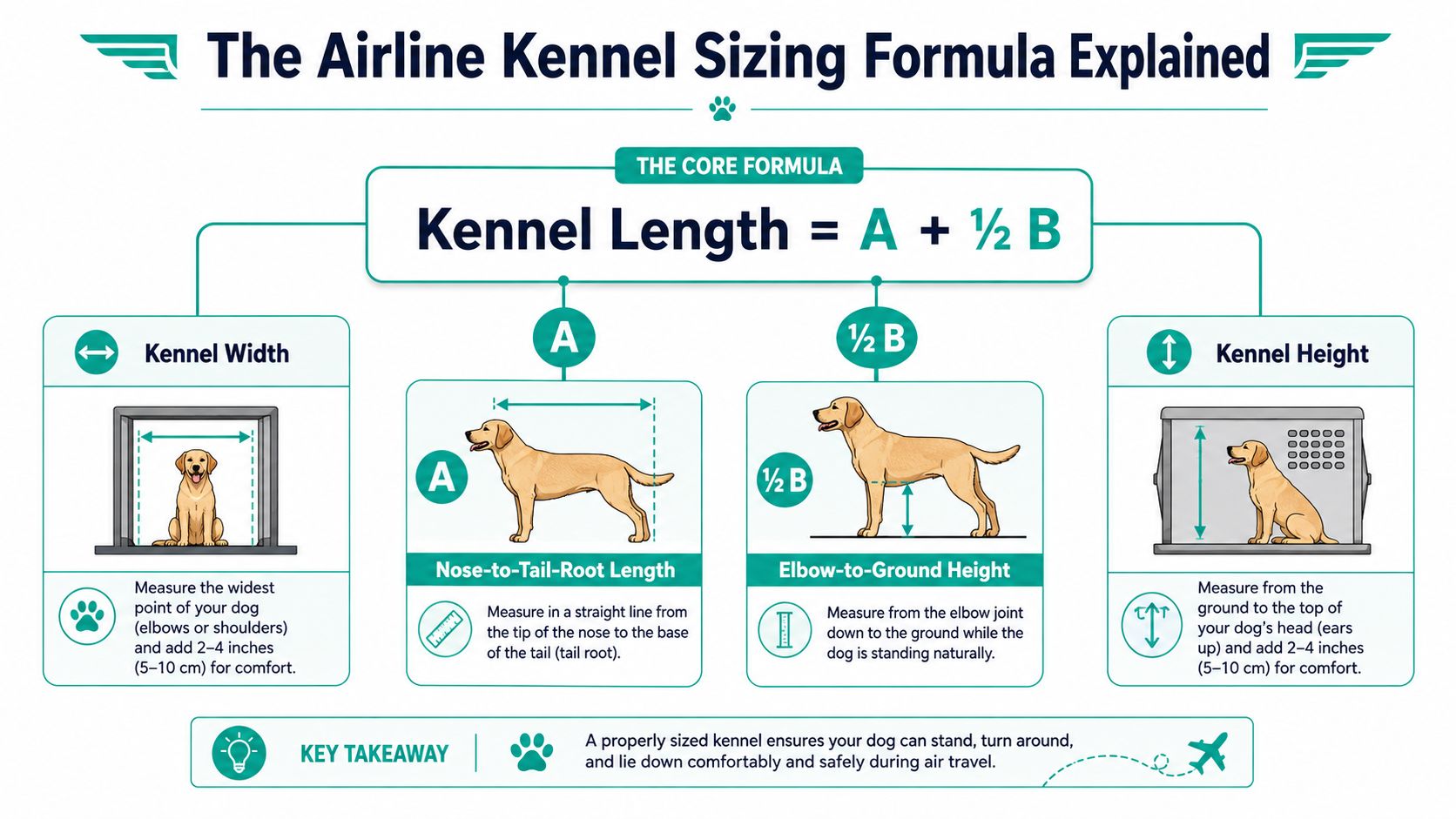
Write the four results down in the same units used by the kennel chart. If your dog won't stand still, measure during a calm period, use a second person, or mark the floor and wall with removable tape. A practical kennel size guide from Van Dyke Outdoors can help you compare general crate categories, while this pet crate travel guide adds useful preparation context.
The Airline Kennel Sizing Formula Explained
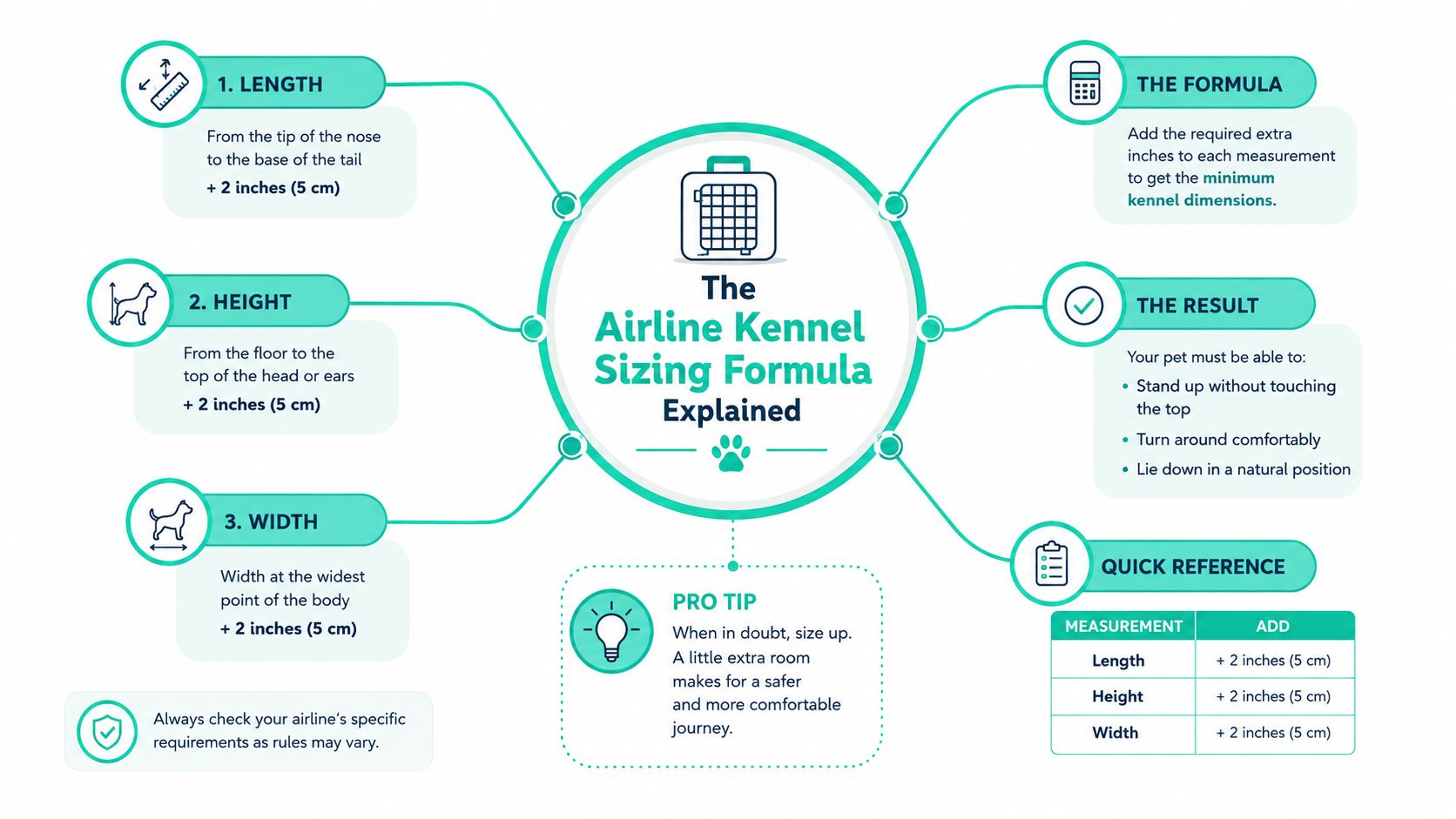
Airline-style kennel sizing commonly uses three measurements in a simple formula:
Length = A + ½ B
Width = C × 2
Height = D, or D + 3 inches, depending on the carrier or published rule
Here, A is the dog's nose-to-tail-root length, B is the elbow-to-ground height, C is the widest body width, and D is standing height. The length allowance helps give the dog room to reposition, while the width calculation supports turning. The height requirement protects natural standing posture, with some operators asking for extra clearance. (DryFur's airline crate measurement guide)
A simple calculation
Suppose a small terrier measures 14 inches from nose to tail root and 6 inches from the ground to the elbow. The length calculation is 14 plus half of 6, which produces a 17-inch minimum calculated length. That result is not automatically the kennel's marketed length, because you still need to compare the calculation with the kennel's internal space and the carrier's accepted external dimensions.
For a larger shepherd, the process is identical. Measure the dog instead of relying on the breed name, calculate each minimum dimension, then select a kennel that provides the required internal fit without exceeding the carrier's size or weight conditions. A breed example can point you toward a product family, but it can't replace the tape measure.
The important distinction is minimum fit versus product dimensions. Retail listings often show external dimensions, while the dog needs sufficient internal room. Wall thickness, a raised floor, the door frame, and bedding can reduce usable space. Before buying, compare the measurements with the carrier's current rules and review this airline pet travel carrier guide for practical planning considerations.
Standard Crate Series and Breed Examples
Airline-aligned kennel sizing commonly follows a series of 100, 200, 300, 400, 500, and 700. The published external dimensions are Small 100 at 21 × 16 × 15 inches, Medium 200 at 27 × 20 × 19 inches, Intermediate 300 at 33 × 22 × 23 inches, Large 400 at 36 × 24 × 26 inches, Extra Large 500 at 40 × 27 × 30 inches, and Giant 700 at 48 × 32 × 35 inches. (Starwood Pet's airline carrier measurement guide)
Series | Dimensions (in) | Weight Band (lb) | Example Breeds |
|---|---|---|---|
100, Small | 21 × 16 × 15 | Roughly 10 to 20 | Small dogs, depending on body measurements |
200, Medium | 27 × 20 × 19 | Roughly 21 to 30 | Medium dogs with a suitable build |
300, Intermediate | 33 × 22 × 23 | Not assigned in the provided series data | Longer-bodied medium dogs |
400, Large | 36 × 24 × 26 | Roughly 51 to 70 | Large dogs, depending on length and width |
500, Extra Large | 40 × 27 × 30 | Not assigned in the provided series data | Tall or substantial large dogs |
700, Giant | 48 × 32 × 35 | Roughly 91 to 125 | Giant dogs requiring generous dimensions |
Treat the weight bands as rough sorting labels, not approval rules. A retail chart may place a Bernese Mountain Dog, German Shepherd, or Rottweiler in a 48 × 30 × 32 inch crate at around 90 to 110 pounds, yet that recommendation still depends on the individual dog's length, shoulder width, and standing height. Retail categories such as Small, Medium, Large, and Extra Large also vary by manufacturer.
A series number narrows the search. Your dog's measurements determine the fit.
Large and giant breeds show why breed names and weight cannot settle the choice. Use body length, width, and height to compare the dog with the kennel's internal measurements. The PetCostEngine giant breed page offers general breed context, but it should remain a starting reference rather than a substitute for measuring the dog.
For a large dog that will fly, inspect airline-approved kennels for large dogs, then compare the selected model's internal space with the airline's current external-size requirements. A kennel can match a retail chart and still fail the travel plan if its shell, door frame, or design leaves insufficient usable room. The series helps identify candidates. The final decision comes from the dog's dimensions and the carrier's acceptance rules.
Accounting for Bedding and Hardware in Your Fit
A kennel can fit your dog on paper and still become a poor travel setup once you add the contents. Bedding reduces effective interior height, particularly when a thick cushion lifts the dog's standing position. A dog that clears the roof without bedding may brush it after a plush bed is installed.
Choose comfort without filling the kennel with avoidable bulk. A thin absorbent pad can provide a stable surface while preserving headroom. Avoid loose, oversized bedding that bunches under the dog or blocks ventilation openings. For a dog that needs more padding, test the actual pad inside the kennel while the dog stands, turns, and lies down.
Check the parts that steal space
Bowls and drinkers: A bolt-on bowl can reduce usable width near the door or shoulder area. Mount it where the dog can reach it without losing turning space.
Door hardware: Latches, bolts, and reinforced frames may narrow the entry or project into the interior. Inspect the inside edge, not just the outside shell.
Flooring: Raised floors and molded bases can reduce the vertical room available above the kennel floor.
Accessories: Every item should be checked for secure attachment, safe edges, and interference with movement.
The empty kennel also matters. Some carriers specify tare-weight limits by kennel size class, meaning the kennel itself, before adding the dog or travel items, must stay within the operator's limit. The carrier may also review the combined setup, so check the current rules for the exact route and kennel model.
Packing principle: Preserve the dog's usable space first, then add only the equipment the carrier accepts and the dog genuinely needs.
Use the kennel's internal dimensions for fit and its external dimensions for airline comparison. Those figures are not interchangeable, and overlooking that difference is an easy way to get a kennel that's comfortable at home but awkward at the airport.
Fine-Tuning Fit with Dividers and Acclimation
A divider helps a puppy use an adult-sized home kennel without turning one end into a sleeping area and the other into a toilet area. Set the panel so the puppy can stand, turn, lie down, and stretch, then move it as the dog grows. Don't use a divider to make an airline kennel artificially small for a flight. Air travel requires the dog to have the measured space needed for the journey.
Bedding needs the same adjustment. A thick bed may feel cozy but reduce headroom, while a thin pad may preserve the correct posture and provide a more stable surface. Watch the dog inside the actual setup, not an empty shell.
Build comfort before departure
Start with the kennel open and place treats or meals inside. Once the dog enters willingly, close the door briefly while you remain nearby. Increase the closed-door period gradually, then practice ordinary household activity around the kennel so the dog learns that the door closing isn't an alarming event.
After calm short sessions, try longer rests and an overnight practice run at home. A dog that accepts the kennel during daily life is better prepared for the unfamiliar sounds and handling that accompany travel. This travel crate guide for dogs can complement the measurement work, but the dog's observed comfort should guide your final bedding and divider choices.
Domestic Versus International Airline Kennel Rules
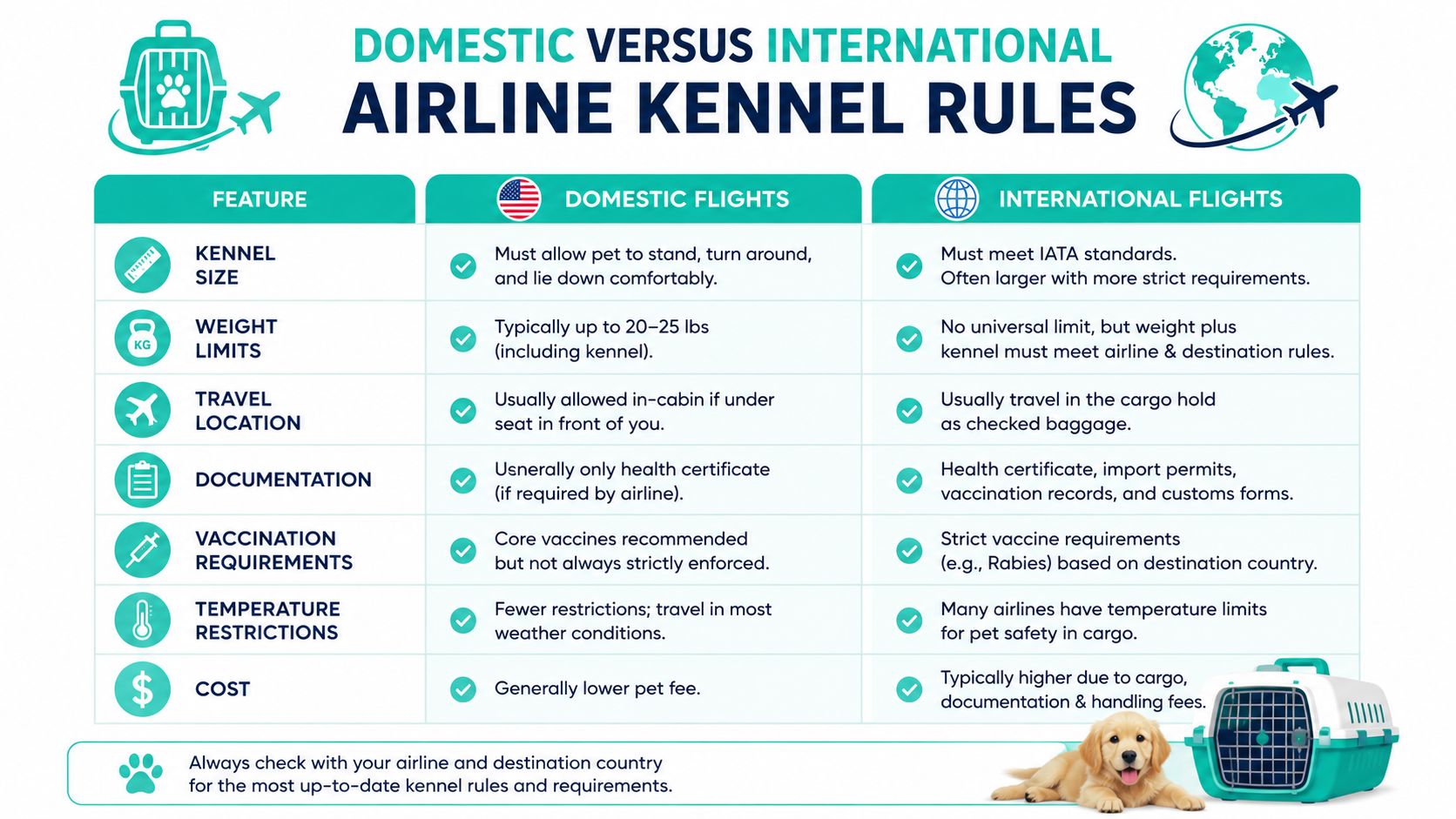
A kennel that works for a domestic flight may need another review before an international journey. Carriers and destinations can differ on accepted kennel materials, ventilation design, door-latch construction, external dimensions, minimum accepted sizes, and kennel weight limits. Even when two operators use similar series names, their conditions may not be identical.
For domestic travel, begin with the airline's published kennel table and the route's operating carrier. A connecting flight can introduce another set of conditions, particularly when a partner airline handles one leg. Confirm the kennel model, external dimensions, and empty weight before buying rather than assuming that a retailer's “airline approved” label applies everywhere.
International travel adds destination-specific planning. The airline may accept an IATA-style plastic kennel, while the destination process may also require veterinary documents, timing rules, or an approved model description. Those are separate checks from body fit. A kennel can satisfy the dog's measured space and still need review against the carrier and destination requirements.
Verify the complete travel setup
Use the operator's current information to confirm:
External size: Check the full outside dimensions, including handles, wheels, door frames, and other fixed parts.
Kennel weight: Confirm whether the carrier lists a maximum kennel weight or a limit by size class.
Construction: Review the permitted shell, ventilation, fasteners, and door style.
Minimum size: Check whether the operator requires a minimum kennel even when a smaller unit appears to fit the dog.
Connections: Ask which airline's rules apply if the itinerary includes multiple carriers.
The safest process is route-specific. Review the airline, destination, and connection requirements well before travel day, then have the dog's measurements and kennel specifications ready for a veterinary or pet travel consultation.
Common Sizing Mistakes and How to Avoid Them
A breed name can point you toward a likely crate family, but it can't account for every dog's proportions. A German Shepherd with a long body may need a different length from another German Shepherd at a similar weight. Measure the individual dog, then use the breed example only as a secondary reference.
Four scenarios that catch owners
The erect-ear mistake: An owner measures to the top of the skull and buys a kennel that looks tall enough. The ears reach higher when the dog stands naturally. Correction: Include erect ears in standing height and test the dog inside the finished bedding setup.
The “more room is always better” mistake: A home crate is selected much larger than necessary because extra space seems kinder. The dog may have trouble settling, and a puppy may use a distant corner as a toilet area. Correction: Provide enough room to stand, turn, lie down, and stretch without creating an oversized living area.
The seasonal coat mistake: A dog fits a bare kennel during a short-coated season, then has less usable room after its coat thickens or a bulky pad is added. Correction: Measure the dog as it will travel and test the actual bedding.
The breed-and-weight shortcut: A retailer's chart places the dog in a familiar size, but the dog has a wide chest or long back. Correction: Apply the airline formula and compare internal fit with the carrier's external limits.
The same rushed choice can create returns, replacement purchases, or a stressful airport conversation. A few careful measurements are cheaper and calmer than discovering the mismatch when the trip is already underway.
Quick-Reference Kennel Sizing Checklist
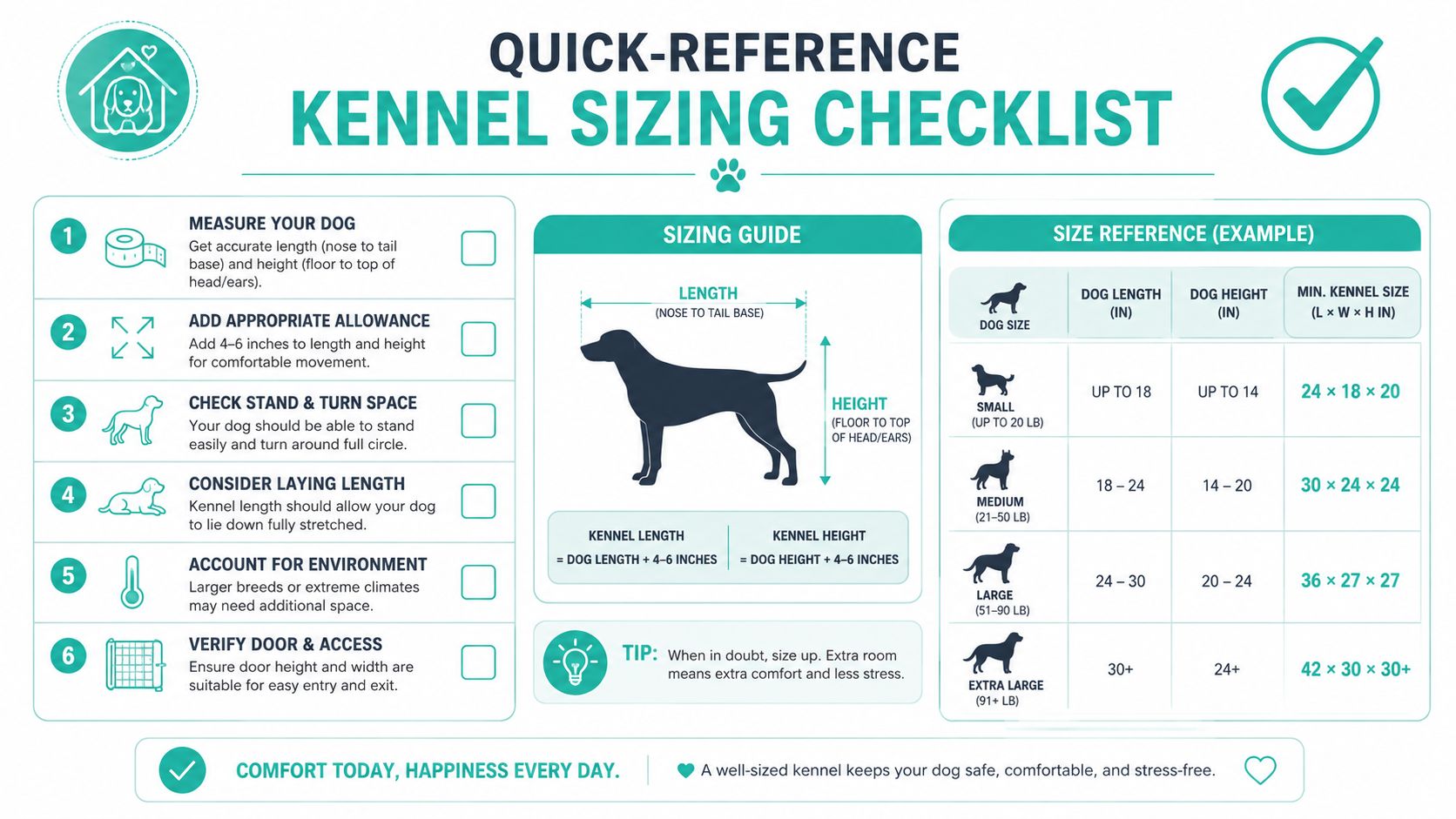
Use this checklist beside the kennel listing, not after you've bought the crate. A pass means the measurement, product detail, or travel rule has been verified.
Measure length: Record nose-to-tail-root length while the dog stands naturally.
Measure elbow height: Record the ground-to-elbow measurement, not shoulder height.
Measure width: Measure the widest part of the chest or shoulders without compressing the coat.
Measure standing height: Include the highest point of the head and erect ears.
Apply the formula: Confirm that length meets A + ½ B, width meets C × 2, and height meets the carrier's stated version of D or D + 3 inches, using the published airline guidance. (PetTravel's airline crate requirements)
Check the series: Compare your result with the 100, 200, 300, 400, 500, or 700 series dimensions, then verify the kennel's internal space.
Separate dimensions: Use internal measurements for the dog's fit and external measurements for the airline's size check.
Add the contents: Place the intended pad, bowl, and hardware in the kennel and confirm that standing height and turning space remain adequate.
Check weight limits: Confirm the empty kennel and accessories stay within the carrier's published allowance.
Confirm the route: Review every operating carrier, connection, destination requirement, accepted construction detail, and minimum size before travel.
Practice at home: Complete open-door meals, short closed-door sessions, longer rests, and an overnight trial before departure.
Keep records: Save the dog's measurements, kennel model, external dimensions, and carrier guidance for your travel consultation.
Passpaw helps veterinary practices and pet owners organize international health certificates, destination requirements, document validation, travel-date tasks, and client communication in one cloud-based workflow. If you're preparing a dog for international travel, visit Passpaw to make the kennel check part of a more organized, destination-ready travel plan.

More articles
From regulatory changes to best practices for veterinarians and pet owners, our resources keep you ahead of the curve.