Are you a team member in a veterinary practice?
Are you a pet parent planning a trip with your furry pal?
Airline Approved Kennels for Large Dogs: A Complete Guide
You're probably sitting with three tabs open, one airline page that feels vague, one crate listing that says “airline approved,” and one photo of your dog that makes the whole plan seem impossible. The under-seat carrier photos look easy when the pet is tiny. They're not much help when your travel buddy is a Labrador, Shepherd, Retriever, or bigger.
That's where most travel day problems start. Not with a bad owner, and not with a difficult dog. They start with mixed messages. One page talks about weight. Another talks about kennel dimensions. A third says a crate is “approved” without saying approved for which airline, which aircraft, or which country.
In practice, airline approved kennels for large dogs are less about shopping and more about matching. You're matching your dog's actual measurements to airline rules, then matching that kennel to a route, and then matching the paperwork to the destination. If any one piece is off, the whole plan can go sideways fast.
A calm, workable trip comes from getting the boring details right. That's the good news. This process is detailed, but it's not mysterious. Once you know where owners usually get tripped up, you can avoid the most common snags and keep your dog's journey from becoming a tailspin.
Your Guide to Flying with a Large Dog
A lot of owners begin in the same place. They call the airline, hear that pets are allowed, and assume the rest is just buying a big enough crate. Then they discover “pets are allowed” can mean cabin, checked baggage, or cargo, and those aren't the same thing at all. By then, the flight date is close, the kennel has already arrived, and stress starts barking louder than the dog.
Large-dog travel works better when you think like a coordinator, not a shopper. Start with the route. Then measure the dog. Then choose the kennel. Then prepare the labels and documents. Last, prepare the dog. That order matters more than people expect.
Here's the practical truth I give nervous owners: the kennel itself usually isn't the hardest part. The hard part is avoiding assumptions. “Airline approved” on a product page isn't a universal pass. A kennel can be acceptable for one airline, too large for another, and wrong for a specific destination even on the same carrier.
Practical rule: Buy the kennel only after you confirm the route rules and your dog's measurements. Buying first is how people end up with an expensive plastic box that never leaves the garage.
The owners who have the smoothest travel days usually do three things well:
They measure the dog, not the breed. A tall Golden Retriever and a stockier Labrador can need very different setups.
They verify the route, not just the airline. One destination can have stricter kennel limits than another.
They kennel-train early. A perfect crate still won't help much if the dog thinks it's a trap.
You don't need to become an airline policy expert overnight. You just need a clear process and a little patience. Once that's in place, the path gets much easier to follow.
Decoding Airline Pet Travel Rules
A common travel-day problem starts like this: the kennel arrives, the product page says "airline approved," and check-in staff still refuse it. The issue usually is not the kennel alone. It is the mismatch between the airline, the aircraft on that route, and the destination country's import rules.
For large dogs, cabin travel is rarely the workable option. Under-seat space is limited, and the airline's pet page can sound broader than the space under the seat allows. If you are comparing options, review this route-specific list of airlines that take dogs in cargo before you buy anything.
The rule stack matters more than the marketing label.
IATA guidance sets the baseline for container safety and fit. The airline then adds its own limits for kennel dimensions, hardware, seasonal embargoes, breed restrictions, and whether the pet travels as checked baggage or manifest cargo. The route can add another layer, especially on connections or international arrivals. A kennel that passes on one itinerary can fail on another with the same dog and the same carrier.
Rule layer | What it controls | Why owners get tripped up |
|---|---|---|
IATA guidance | Basic kennel sizing and construction standards | Many shoppers stop here and assume the trip is cleared |
Airline policy | Carrier-specific size, weight, and hardware rules | One airline may reject a kennel another airline accepts |
Route and destination | Aircraft limits, weather embargoes, and country entry requirements | This is where many last-minute refusals happen |
The part many owners miss is the route. Wide-body and narrow-body aircraft do not always have the same hold capacity. Some airports restrict pet acceptance during hot months. Some destination countries require specific document timing, feeder bowls attached to the kennel door, or crate features that are easy to overlook during a quick online order.
Cabin claims deserve extra skepticism with large dogs. A dog can be light for its size and still be too tall to fit safely under the seat. A product label that says "airline approved" does not answer the core question, which is whether your dog can stand and turn as required in the travel setup your booking uses.
Construction rules matter too. Airlines commonly require a rigid, leak-resistant, non-collapsible kennel with secure metal hardware, and many place added restrictions on short-nosed breeds because of heat and breathing risk, as summarized in Companion Pet Travel's airline cargo crate guide. For a home-use sizing reference, this dog kennel guide for homeowners can help explain how kennel proportions differ by dog build, though airline acceptance still depends on the carrier and route.
The practical approach is simple. Confirm the exact flight, service type, and destination requirements first. Then match the kennel to that booking. Owners who reverse that order are the ones standing at check-in with a perfectly good crate that is wrong for that trip.
Getting the Measure of Your Dog
This is the part where the tape measure comes out and your dog suddenly becomes very interested in walking away. Use treats. Use patience. Measure when your dog is calm, standing naturally, and not trying to turn the process into a game.
For cargo travel, the kennel size has to come from your dog's body, not from a crate label like “Large” or “XL.” According to Starwood Pet's measurement guideline for an airline pet carrier, the internal kennel length equals the nose-to-tail-root length (A) plus half the elbow height (½B), the internal width equals twice the shoulder width (C × 2), and the internal height equals the standing height from floor to head or ear tip (D) plus 3 inches.
A visual makes this much easier to follow.
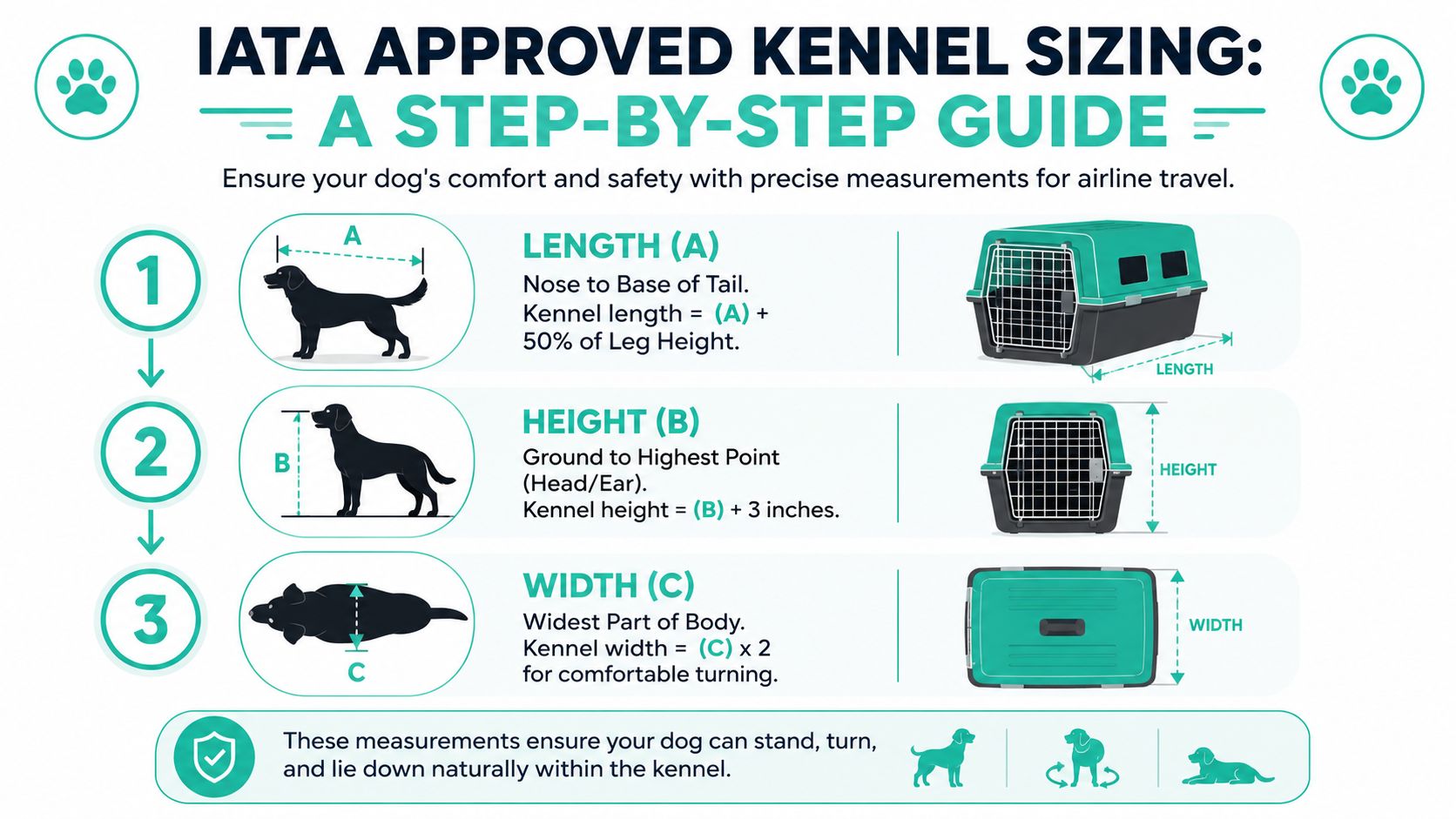
How to take the measurements correctly
Use a soft tape measure if your dog is cooperative. If not, a string and ruler can work.
Length first
Measure from the tip of the nose to the root of the tail, not the tail tip. Then add half the elbow height.Height next
Measure from the floor to the highest point of the head or ear tip when your dog is standing naturally.Width last
Measure across the widest part of the shoulders or chest, then double it.
A common mistake is measuring while the dog is sitting. Another is measuring the kennel exterior instead of the kennel interior. Airlines care about the usable internal space, because that's what determines whether your dog can stand, turn, and lie down comfortably.
The comfort test that beats guesswork
After the formula, use a plain common-sense check. Your dog should be able to stand without crouching, turn without getting wedged, and lie down without pressing awkwardly against the walls.
Quick check: If your dog has to duck, twist tightly, or brace against the door to turn, the kennel isn't right, even if the product listing says it's approved.
That's why breed charts are only a starting point. If you want a broader home-use comparison before narrowing down travel sizing, a practical dog kennel guide for homeowners can help you think through proportions and fit. For travel planning, I'd still rely on actual body measurements every time. Owners who want a breed-based reference point can also compare those measurements with a dog crate size by breed guide.
Pitfalls that cause same-day denials
The most common problems aren't dramatic. They're small errors that stack up.
Measuring the tail tip instead of the tail root. That can distort length selection.
Ignoring the ears. For some dogs, ear height changes the kennel requirement.
Choosing by marketing size. “XL” means different things across brands.
Skipping a trial fit. If the dog can't settle in the kennel at home, the airport won't improve the situation.
One more practical note. If your dog is still growing, don't guess what size they'll be by travel day. Re-measure close enough to the booking process that your kennel choice reflects the dog in front of you, not the puppy you had two months ago.
The Anatomy of an Approved Large Dog Kennel
You can do everything else right and still get stopped at check-in because the kennel itself fails inspection. I see this happen with large dogs more than any other pet travel problem. The owner bought a crate labeled airline approved, the dog technically fits, and the airline staff still says no.
A home crate is built for rest and routine. A flight kennel has to survive handling, loading equipment, temperature checks, and route-specific acceptance rules. That difference matters.
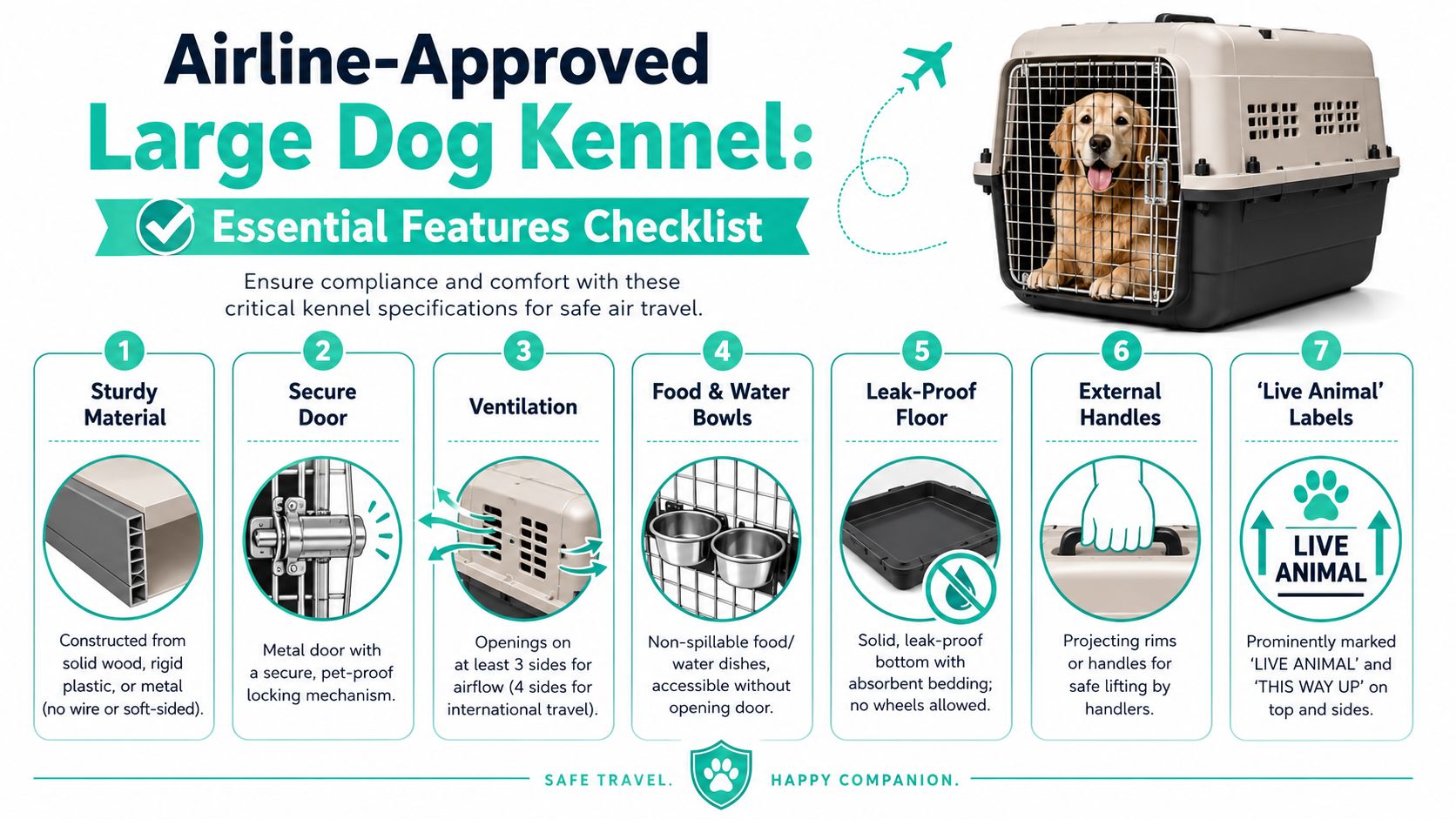
What the kennel must physically do
Airlines and ground handlers inspect the kennel as a piece of transport equipment, not a pet product. The shell needs to stay rigid under pressure. The door has to hold if a stressed dog pushes forward. The floor has to contain waste. Ventilation has to be adequate for the route, and very large kennels may need handling features such as spacers so staff can move them safely. PetTravel summarizes these common airline crate standards, including IATA-based sizing principles, four-side ventilation expectations on some international itineraries, and special handling requirements for heavier kennels in its guide to airline pet crate requirements.
That is why a kennel can look sturdy in your garage and still fail at the airport.
Buyer checklist that matters at the counter
Before you buy, inspect the kennel the way an acceptance agent will.
Rigid plastic or similar hard shell: The kennel should not collapse, bow, or flex easily.
Metal nuts and bolts: Many denials start with plastic fasteners or snap-together panels.
Secure metal door: It should latch cleanly and stay aligned when pressure is applied from inside.
Leak-resistant base: The bottom should hold accidents without dripping onto belts or cargo surfaces.
Ventilation in the right places: Some routes expect airflow on all four sides, not just the door and side panels.
Safe handling design: A kennel for a large dog needs structure that can be gripped and moved without the body warping.
Practical attachment points: Staff need clear places for water bowls, labels, and travel instructions.
If you're comparing general crate styles with flight-specific models, this guide to choosing a pet crate for travel is a useful starting point.
One detail owners miss is assembly quality. Even a good kennel can be rejected if it is put together poorly. Loose bolts, a misaligned door, cracked ventilation slots, or missing hardware create the kind of doubt airlines do not ignore on travel day.
The trade-off owners run into
For large dogs, the challenge is rarely just finding the biggest kennel on the shelf. The kennel has to do two jobs at once. It must fit the dog correctly, and it must meet the airline's acceptance rules for that exact booking.
What owners often check first | What airline staff also check |
|---|---|
Dog can stand and turn | Kennel build meets cargo handling standards |
Product says airline approved | Airline, route, and destination accept that setup |
Crate looks heavy-duty online | Actual hardware, ventilation, and assembly pass inspection |
That is the practical meaning of airline approved for large dogs. It is not a universal label. It depends on the airline, the aircraft on your route, and sometimes the destination country's import conditions.
For repeated trips, some owners also add durable identification plates using asset labelling solutions in Australia so contact details stay readable after rough handling and weather exposure. That does not make a kennel acceptable on its own, but it does solve a common weak point on longer itineraries.
Proper Kennel Labeling and Documentation
At check-in, staff often decide in seconds whether a kennel looks ready to travel. If labels are missing, hard to read, or taped on loosely, you can end up answering basic questions under pressure while your dog is already stressed. Good labeling reduces that friction and helps the kennel move through handling points without avoidable delays.
What to attach to the kennel
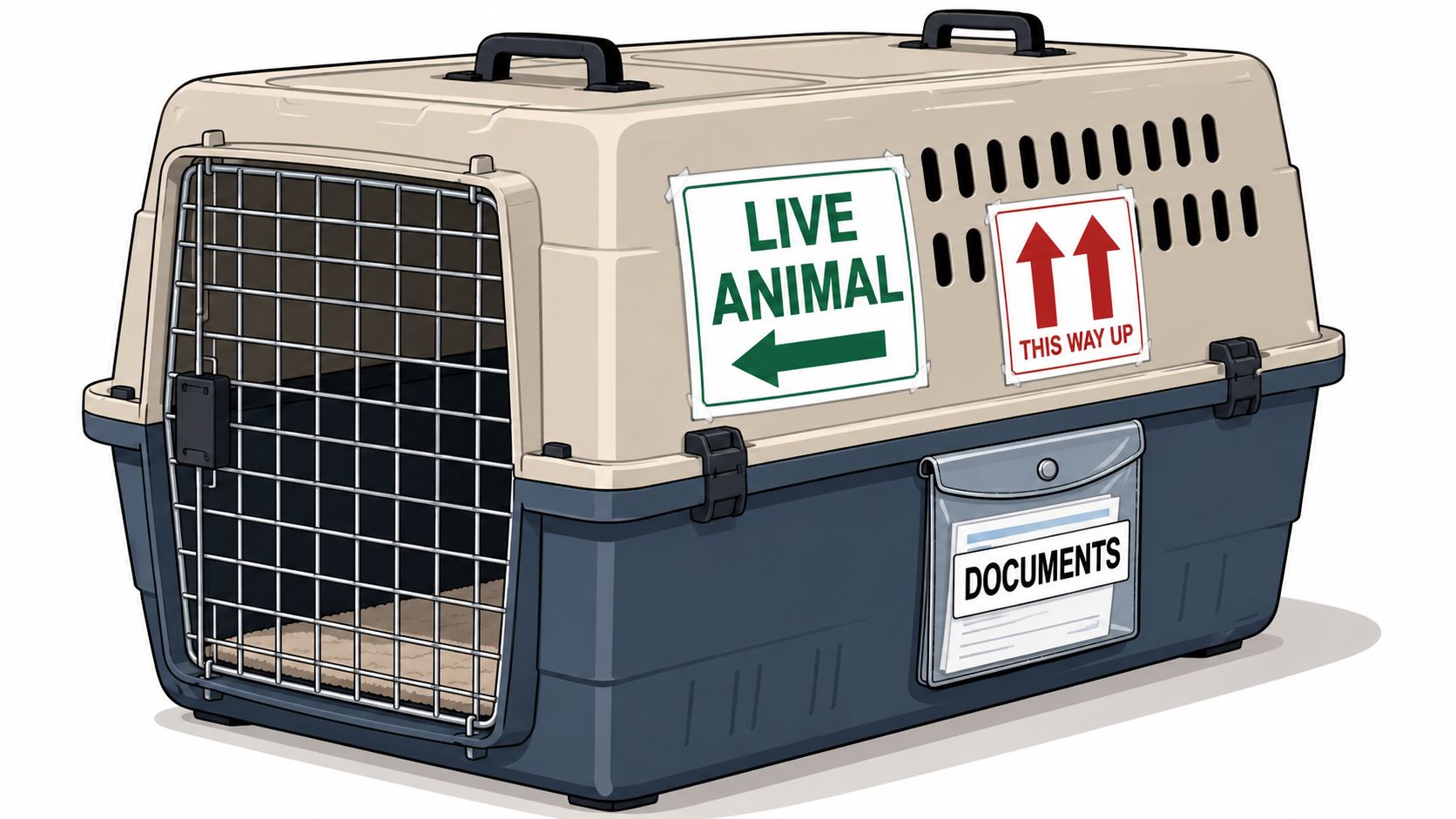
Keep the outside of the kennel clear, readable, and weather-resistant. I advise owners to attach the dog's name, the owner's full name, a mobile number that will work on travel day, and the destination address when the itinerary or import process makes that useful. A recent photo of the dog also helps, especially if staff need to confirm identity during a transfer or inspection.
Paperwork should go in a waterproof document sleeve fixed securely to the kennel. Include copies of health paperwork, booking details, feeding or watering instructions if the airline asks for them, and any route-specific documents. For U.S. formatting and labeling basics, this USDA shipping label guide for pet air travel is a practical reference when you are putting the packet together.
For repeat flyers, durability matters. Printed labels can smear, tear, or peel after rough handling, rain, or a long layover on the tarmac. Some owners solve that with industrial-style ID plates or tags such as these asset labelling solutions in Australia, which hold up better than standard adhesive labels.
Why paperwork mistakes cause kennel problems
This is one of the most common points of confusion. Owners treat the kennel as one task and the documents as another, but airlines do not. They look at the full setup together.
A kennel can be the right size and still be refused if the documents attached to it are incomplete, inconsistent, or out of step with the airline's instructions for that route. The reverse happens too. Owners arrive with correct certificates, but the kennel has no clear contact details, no feeding note where required, or no secure pouch for staff to review documents without opening the crate.
That is why “airline-approved” falls apart so often in real life. Approval depends on the airline, the route, and sometimes the destination country's import rules. Labels and paperwork have to match that exact trip, not a generic idea of pet cargo compliance.
A labeling setup that works well
This setup tends to hold up well on travel day:
Top and sides marked clearly: Add “Live Animal” and “This Way Up” where handlers can see them quickly.
Document sleeve attached firmly: Use a secure pouch or fastener. Tape by itself often fails.
Owner details easy to spot: Put contact information where staff do not have to hunt for it.
Dog photo placed beside the contact details: Keep identification together in one visible area.
Short care note only if needed: Clear feeding or watering instructions are easier to follow than a long page of notes.
A clean, readable kennel gives staff what they need fast. That matters more than decorative labels or extra paperwork stuffed into a sleeve.
Preparing Your Pet for a Smooth Journey
The kennel can be perfect and the paperwork spotless, but if your dog panics in confinement, the trip becomes much harder on everyone. This is why crate acclimation matters so much. Owners sometimes treat it like a final step. It's better handled as part of daily life well before the flight.
A dog who already naps in the kennel, eats in it, and settles in it has a huge practical advantage. The kennel becomes familiar territory instead of a strange plastic box that appears right before a noisy airport handoff. That familiarity won't make every dog relaxed, but it usually reduces confusion and stress.
What helps the most
Keep the kennel open at home and make it part of normal routines. Feed meals nearby or inside. Reward calm entry. Let the dog come out before they feel trapped. Build duration slowly. The best kennel training often looks boring from the outside, and that's exactly what you want.
A travel kennel should feel like a safe den, not a last-minute surprise.
Inside the kennel, less is usually better. A familiar-smelling shirt or light blanket can help if the airline allows it and it doesn't crowd the space. Bulky bedding can reduce usable room. Loose toys can create problems if they shift, break, or block movement. Keep the setup simple and sensible.
What owners often get wrong
Some mistakes come from kindness. Owners want to make the kennel cozy, so they overpack it. They add thick bedding, several toys, and extra items that make the space feel smaller. For air travel, comfort comes from fit, familiarity, and calm preparation more than from stuffing the kennel like a doggy bedroom.
A few practical habits help:
Practice short kennel sessions at different times of day. Dogs handle novelty better when the kennel isn't tied to one routine only.
Use normal praise and rewards. Big emotional fuss can make nervous dogs more alert, not less.
Keep the dog's digestion steady. If your dog has a sensitive stomach during stress, some owners ask their vet about routine support options such as dog probiotics before travel. Keep any changes gradual and vet-guided.
The sedation issue
Sedation sounds tempting to worried owners. In practice, it often creates more uncertainty than comfort. Airlines and veterinarians commonly discourage it because a sedated dog may not balance, regulate, or respond normally during transport. If you're considering anything beyond your dog's normal routine, talk to your veterinarian well ahead of travel and follow their specific guidance.
Feeding and watering should also stay practical. Don't experiment with a new food right before departure. Don't create a giant pre-flight feast because you feel guilty. Calm routines usually serve dogs better than dramatic changes.
Your dog doesn't need to love flying. Most don't. Your job is to make the kennel familiar, the routine predictable, and the handoff as low-drama as possible. That's what keeps the trip on an even leash.
Your Final Pre-Flight Checklist
By this point, the big pieces should line up. The kennel fits your dog by measurement, not guesswork. The hardware is sturdy. The labels are clear. The document copies are attached where staff can find them. Your dog has spent enough time in the kennel that it feels familiar, not suspicious.
Use a last review before travel:
Kennel fit: Your dog can stand, turn, and lie down naturally.
Construction check: Metal hardware, secure door, proper ventilation, and a leak-proof base.
Route confirmation: The kennel matches the airline, aircraft, and destination requirements.
Outside labeling: Contact details, dog identification, and handling markings are easy to read.
Document packet: Health paperwork and any route-specific forms are attached in a protective sleeve.
Dog readiness: The kennel is a known space, and the routine feels calm and familiar.
Traveling with a big dog takes more planning than flying with a carry-on and a coffee. Still, it's manageable when each detail supports the next one. That's the secret. Not a magic crate, just careful matching from dog to kennel to route.
If you're handling an international trip and want the paperwork side to be less stressful, Passpaw helps veterinary teams and pet owners manage pet travel documents with clearer workflows, fewer missed steps, and better visibility into destination requirements.
More articles
From regulatory changes to best practices for veterinarians and pet owners, our resources keep you ahead of the curve.