Are you a team member in a veterinary practice?
Are you a pet parent planning a trip with your furry pal?
Travel Crates for Dogs: A Guide to Safe and Happy Journeys
Getting your dog from point A to point B safely is the top priority for any trip. The right travel crate is your most important piece of gear—think of it as their personal, portable den. This mobile safe space helps them feel secure and comfortable, whether you're just driving across town or flying to a new continent.
Choosing the Best Crate for Your Dog's Journey
Finding the perfect crate isn’t about just grabbing one off the shelf. It’s about matching the crate to your travel plans and, just as importantly, to your dog’s specific needs. As more of us bring our dogs along on our adventures, the market for travel crates for dogs has exploded.
This isn’t just a trend; it’s a sign of how seriously we take our pets' safety. The global market for dog travel crates was recently valued at over USD 335 million and is expected to climb past USD 363 million by 2026. That’s a lot of pet owners investing in safe, reliable gear.
Different Crates for Different Adventures
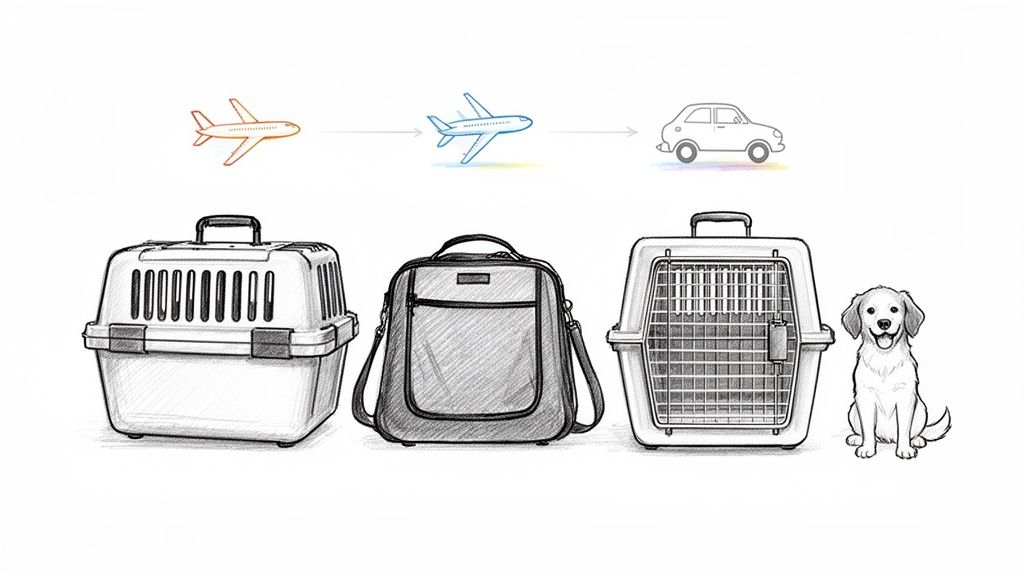
Not all travel crates are built the same, and the right one depends entirely on how you’re traveling and your dog's personality. Let's break down the main options you'll come across.
Hard-Sided Plastic Crates: These are the top dogs for air travel. They’re tough, secure, and what airlines and the International Air Transport Association (IATA) generally look for. Their solid build offers key protection, especially if your dog is traveling in the cargo hold.
Soft-Sided Carriers: Ideal for small dogs who are approved to fly in the cabin with you. These are lightweight, easy to carry, and can be squished down to fit under the seat. While they’re great for car rides and in-cabin flights, they are a definite no-go for cargo.
Wire Crates: We love these for home use and even for car trips, but they are almost never allowed for air travel. They can bend under pressure, and there’s a real risk of a dog’s paw or collar getting snagged. Best to leave them at home for flights.
Heavy-Duty and Collapsible Crates: If you have an anxious dog or are a frequent traveler, a heavy-duty crate made of aluminum can offer maximum security. Some of these are surprisingly collapsible, making them easier to store between trips without losing strength.
Key Takeaway: The first and most important question to ask is: "How am I traveling?" If flying is in your future, a hard-sided, airline-friendly crate is a must-have. For road trips, you have more flexibility.
Making the right choice from the get-go saves you from last-minute panic at the airport and helps your dog have a much better experience. Always check the specific rules for your airline, as many have very detailed guidelines for pet carriers. To get a head start, you can dive into our guide on airline-approved pet travel carriers. A little prep work here is the foundation for a smooth and stress-free journey.
Decoding Airline Rules for Pet Travel Crates
Figuring out the exact rules for your dog's travel crate can feel like a massive puzzle. But getting this piece right is key for a safe and smooth flight. A simple mistake here could get you turned away at check-in—a heartbreaking and stressful experience for everyone involved.
Most airlines build their pet travel policies around guidelines from the International Air Transport Association (IATA). This organization sets global standards for animal welfare during air travel. When you see a crate marketed as "IATA-compliant," it means it's built to meet these strict safety guidelines.
Let's break down what those guidelines generally mean for you and your dog.
Crate Construction: The Foundation of Safety
Airlines are very specific about what your dog's crate is made of, and for good reason. It has to be tough enough to handle the entire journey without failing.
Hard-Sided Plastic is King: For any dog traveling in the cargo hold, a rigid plastic or fiberglass crate is the gold standard. These materials are strong, durable, and won't bend or crack under pressure.
No Wire Crates Allowed: While great for potty training at home, wire crates are a firm "no" for air travel. They can collapse, and a dog's paws, nose, or collar can easily get caught, creating a serious safety risk.
Wood is a Rare Exception: You might see some airlines permit crates made of solid wood or plywood, but this is uncommon. To avoid any last-minute issues, it's often best to stick with high-quality plastic.
The industry's focus on plastic is no accident. Within the massive animal transport carriers market, dog crates make up a whopping 57.80% of the share. Of that, plastic represents 45.35% because it's tough, lightweight, and easy to clean—all essential qualities for meeting airline rules. You can find more details in this animal carrier market analysis.
Security and Ventilation: Must-Have Features
Your dog's crate needs to be a secure space, but it shouldn't feel like a prison. The right balance of security and airflow is key.
The door should be made of metal—never plastic—and feature a secure locking system that a clever dog can't nudge or paw open. Many approved crates use a single-motion spring lock that's easy for humans to open but tough for pets. As an extra precaution, airlines will often ask you to secure the door with zip ties at each corner after your dog is inside.
Ventilation is just as critical. IATA guidelines call for ventilation openings on at least three sides of the crate, though four is even better. These openings need to be small enough to prevent your dog from sticking their nose or paws through. Proper airflow is essential for keeping your dog comfortable and preventing overheating.
Pro Tip: Always look for a crate that uses metal bolts and nuts to connect the top and bottom halves. Airlines often reject crates with snap-on plastic latches because they can pop open during handling.
To help you out, we've put together a quick checklist to use when you're shopping for a crate.
IATA Dog Crate Guideline Checklist
This table gives you a quick reference to ensure any crate you're considering meets the core IATA guidelines for air travel.
Feature | Guideline | Why It Matters |
|---|---|---|
Material | Hard-sided plastic or fiberglass. | Provides durability and strength to protect your dog during transit. |
Hardware | Metal bolts and nuts connecting top and bottom halves. | Prevents the crate from accidentally coming apart during handling. |
Door | Solid metal with a secure, spring-loaded lock. | Ensures the door cannot be bent or pawed open by your dog. |
Ventilation | Openings on at least 3 sides (4 is preferred). | Guarantees good airflow to prevent overheating and distress. |
Sizing | Dog can stand, sit, and turn around comfortably. | Prevents cramping and allows for natural movement during the flight. |
Wheels | Must be removed or taped up so they cannot roll. | Stops the crate from rolling around in the cargo hold or on the tarmac. |
Interior | Smooth, with no sharp edges or things sticking out. | Protects your dog from injury inside the crate. |
Having a crate that checks all these boxes is the first major step toward a stress-free travel day.
Interior Comfort and Required Accessories
The inside of the crate should be a comfortable space for your dog, but it also needs to meet airline standards for feeding and cleanliness.
Airlines usually require food and water dishes to be attached to the inside of the crate door. This design allows airline staff to give your dog food or water from the outside without having to open the door, which is an important safety feature.
Here’s a final checklist for the crate's interior and exterior setup:
Food and Water Bowls: Make sure they are empty for check-in but clipped securely to the door.
Absorbent Lining: The bottom of the crate should be lined with something absorbent, like a puppy pad or a thin blanket that smells like home.
"Live Animal" Stickers: Your crate should be clearly labeled with "Live Animal" stickers and arrows indicating which way is up. Most airline-approved crates come with a set of these.
Your Contact Information: Your name, address, phone number, and your dog’s name should be written clearly on the outside of the crate.
Keep in mind that the rules for flying with your dog in the cabin are completely different. Those trips typically involve soft-sided carriers that have to fit under the seat in front of you. If your dog is small enough, it’s definitely worth seeing which airlines will let them fly with you. We've put together a helpful resource on this, so check out our guide on which airlines allow pets to fly in-cabin.
Following these crate rules isn't just about ticking boxes for the airline; it's about making sure your furry family member has the safest and most comfortable journey possible.
Finding the Perfect Fit for Your Pup
Now that we’ve gone over the key safety features airlines require, let’s talk about getting the right size travel crate. Sizing isn't just about your dog’s comfort—it's a critical safety issue. A crate that’s too small is stressful, but a crate that’s too big won't keep your dog secure if the flight hits turbulence.
The goal is to find that "just right" Goldilocks fit. Getting the measurements correct from the start gives you peace of mind and helps your dog have a safe den for their journey. Thankfully, measuring your pup for their travel crate is a lot easier than you might think.
How to Measure Your Dog for a Travel Crate
To get the right fit, you’ll need three simple measurements. Grab a soft measuring tape and ask a friend to help keep your dog standing still—a few tasty treats can make the process much smoother. It's really important to get these numbers right, as they connect directly to airline and IATA guidelines.
Length (A): Measure from the tip of your dog's nose to the base of their tail. Don't include the tail itself in this measurement.
Height (B): With your dog standing tall, measure from the floor to the top of their head or the tip of their ears, whichever point is higher. This makes sure they have enough headroom.
Width (C): While not always part of the formula, it’s a good practice to measure the widest part of your dog, which is usually across the shoulders.
With these numbers, it’s time for a little bit of math. Airlines follow IATA standards, which use specific formulas to help ensure every dog has enough room to stand up, turn around, and lie down naturally.
The Golden Rule for Sizing: Your dog must be able to stand up without their head touching the top of the crate and be able to turn around and lie down in a natural position. If they can’t do these things, the crate is too small and will likely be rejected by the airline.
Calculating the Final Crate Dimensions
Once you have your dog's measurements, you can figure out the minimum internal dimensions needed for their travel crate. Airlines expect to see a few extra inches of room for both safety and comfort.
Crate Length: Take your dog's length (A) and add 4-6 inches. This gives them enough space to stretch out without feeling cramped. For short-nosed breeds like Pugs or French Bulldogs, adding an extra inch or two is a good idea.
Crate Height: Take your dog's standing height (B) and add 3-5 inches. This provides the needed headspace so their head or ears don't scrape the ceiling.
Crate Width: A good rule is that the crate should be at least twice your dog's shoulder width (C). This ensures they have plenty of room to turn around easily.
This flowchart breaks down the essential IATA rules for crate materials, security features, and proper ventilation.
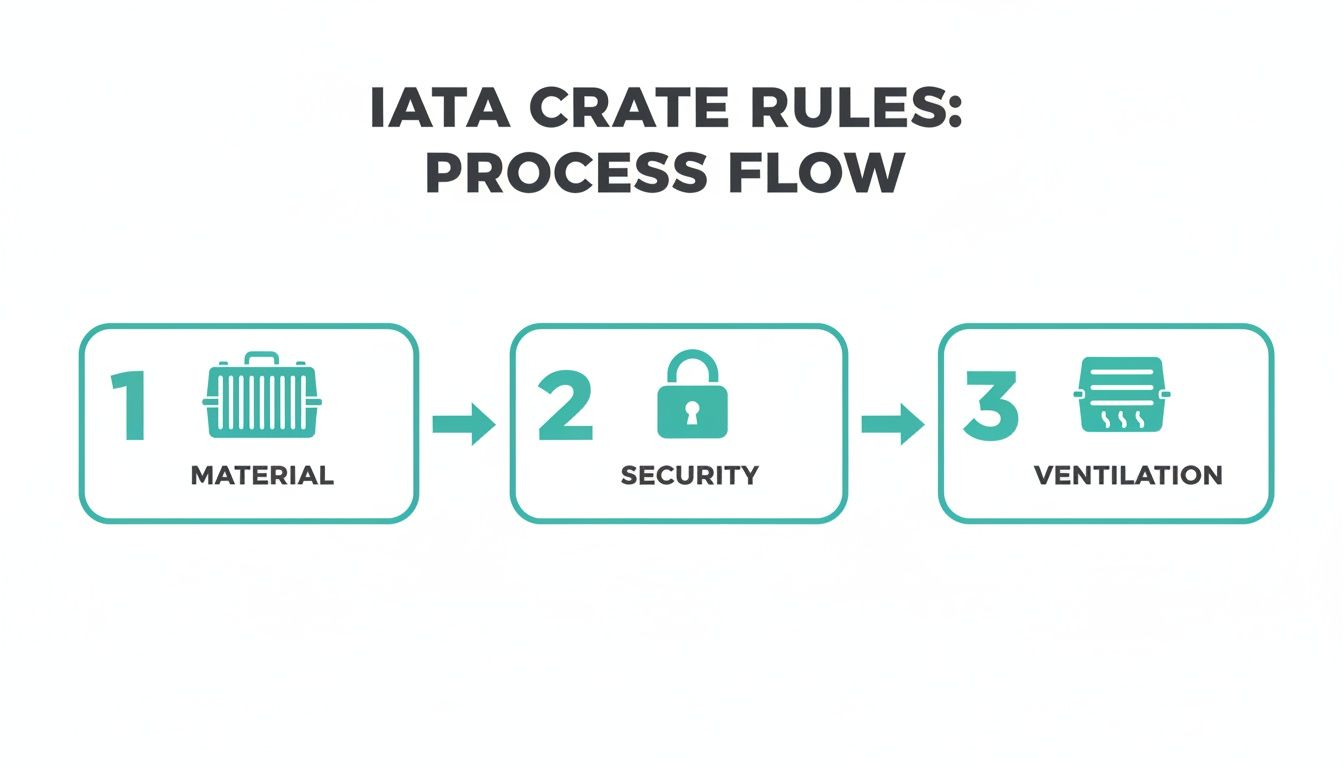
As the guide shows, a suitable crate is a combination of strong material, a secure lock, and good airflow. All three are essential for air travel and are the first things airline staff will check.
When in doubt, it's often better to size up. A little extra room is far better than a crate that's too tight. An airline can deny boarding if they feel the crate is too small. Proper sizing isn't a suggestion; it’s a firm guideline. For more in-depth examples, you can also explore our guide on pet airline travel carriers.
From Crate-Shy to Crate-Ready
You’ve done the hard part—you found the perfect, airline-friendly crate. It’s sized correctly, built tough, and ready for your trip. There’s just one hiccup: your dog treats it like a scary monster that just landed in the living room. Don't worry, this is a completely normal reaction.
The real goal here isn’t just to get your dog inside. It's to help them see the crate as their own safe space, their personal travel den. Rushing this process can lead to anxiety, so give yourself plenty of time. Ideally, you should start this training several weeks, or even months, before you plan to fly.
Building a Pawsitive First Impression
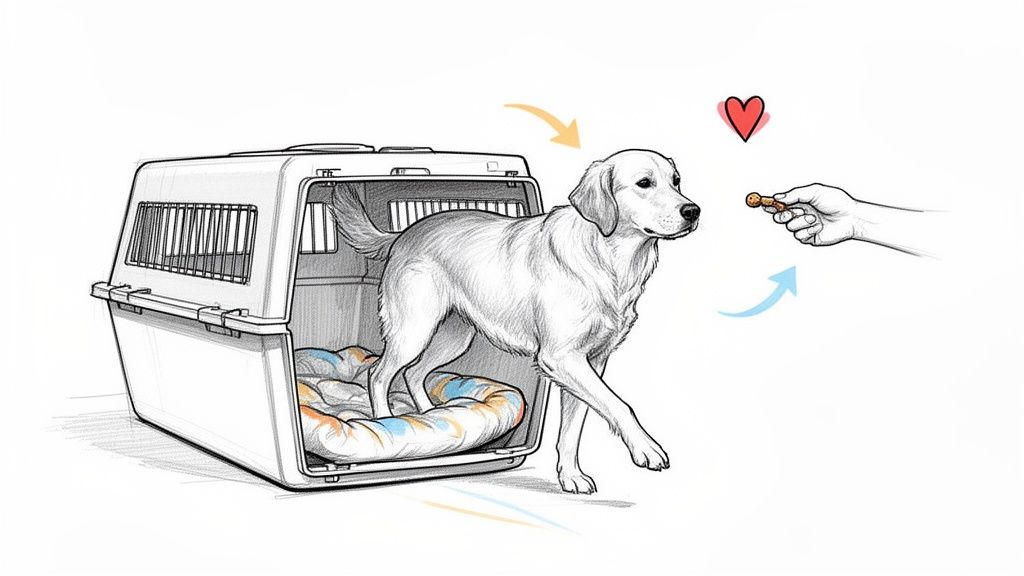
Your first job is to introduce the travel crate in a friendly, low-pressure way. Start by just placing it in a busy part of your home, like the living room, and leave the door wide open. For the first few days, you might even take the door off completely.
Let your dog explore it on their own time. To make it more inviting, toss in their favorite blanket or an old t-shirt that smells like you. That familiar scent works wonders. The key is to never force them inside; your role is to make the crate so appealing they can't help but check it out.
Start tossing tasty treats near the crate. Once they’re comfortable with that, toss them just inside the door, and eventually, all the way to the back. This turns the crate into a treasure chest where amazing things appear.
Making the Crate a Destination
Once your dog is happily darting in and out for treats, it's time to build up the time they spend inside. The easiest way to do this is by feeding them their meals in the crate.
Start with the food bowl right at the entrance, so they barely have to step inside to eat. As they get more confident, gradually push the bowl further to the back. This teaches them that good things happen while they are in the crate. If your dog loves a special chew toy, like a Kong stuffed with peanut butter, make it a crate-only reward.
Pro Tip: Settle on a verbal cue like “Crate time!” or “Kennel up!” Say it every time you toss a treat or place a meal inside. Paired with a reward, this cue quickly becomes a command your dog will happily associate with something good.
Playing Crate Games to Build Confidence
Training should be fun, not a chore. Turning it into a game can make all the difference and strengthens your bond along the way.
Here are a few simple games we recommend:
The In-and-Out Game: Say your cue, toss a treat inside the crate, and praise them enthusiastically when they go in. Then, immediately toss another treat just outside the crate so they come back out. Repeat for a few minutes every day.
Find It: Hide one of their favorite toys at the very back of the crate. Encourage them to "go find it!" and make a big deal of it when they succeed.
The Closing Door: Once your dog is happy eating or chewing a toy inside, start closing the door for just a second or two. Open it before they have a chance to get worried, praise them, and let them come out. Slowly increase the time, always ending the session on a positive note.
The entire process should feel like a choice your dog is making, not a punishment. With patience and consistency, that scary monster will transform into their cozy den—making travel day far less stressful for everyone involved.
Your Pre-Travel Checklist and Packing Guide
You've picked out the perfect travel crate and your dog is getting used to it. Now we’re in the home stretch. The last few weeks before your trip are just as important as the day you fly.
Getting everything organized now saves you from that last-minute panic. A solid pre-travel routine makes sure nothing gets missed, from the bolts on the crate to the paperwork in your bag. This is how you help ensure your dog’s journey is as smooth as possible.
Final Crate Inspection and Setup
A few weeks before you fly, give your dog’s crate one last, very thorough inspection. Even the sturdiest crates can arrive with a loose screw or a tricky latch right out of the box.
Hardware Check: Go over every single metal bolt and nut holding the crate together. Tighten any that feel loose. If your crate came with plastic pegs, we strongly recommend replacing them with metal hardware. Many airlines look for this, and it's simply safer.
Door Security: Open and close the latch a dozen times. Does it lock securely without any wiggle? The metal grid door should be perfectly straight, with no bent bars.
Interior Scan: Run your bare hand along every interior surface. You're feeling for sharp plastic edges or bits left over from the manufacturing process—anything that could poke or scrape your dog in transit.
This is also the time to get all your labels in order. Put the "LIVE ANIMAL" and "This Way Up" arrow stickers on all four sides of the crate. Use a permanent marker to clearly write your name, phone number, destination address, and your dog's name on the outside.
Essential Items to Pack for the Crate
Inside the crate, your goal is a careful balance between your dog's comfort and the airline's strict rules.
Here’s what you’ll need to pack inside:
Absorbent Bedding: Lay down an absorbent puppy pad or a disposable crate liner first. On top, add a thin blanket or an old t-shirt that smells like you. Avoid big, fluffy beds—they can make it too hot and take up valuable headroom.
Clip-On Food and Water Bowls: These are non-negotiable for most flights. They must be the kind that attach to the inside of the crate door, allowing airline staff to give your dog food and water without opening it.
A Familiar Toy (If Allowed): Always check your airline’s policy first. Some permit one hard, chew-proof toy (like a Nylabone), while others don't allow toys at all. Never pack anything that can be torn apart and become a choking risk.
Don't forget to pack a small, sealed bag of your dog’s regular kibble and tape it securely to the top of the crate. Include simple feeding instructions. And while you're focused on your pet, you can find specialty pet lover luggage to keep your own gear organized.
Organizing Your Dog’s Travel Documents
The physical crate is just one part of the puzzle. The other, equally critical part is your dog’s paperwork. The International Health Certificate, rabies records, and import permits should be complete and easy to access.
This is where having a digital command center makes a world of difference.
A platform like Passpaw is designed to manage these moving parts. It connects your veterinarian's work directly to your travel timeline, catching potential errors and helping make sure every form is filled out correctly and submitted on time. This is your best defense against a paperwork problem derailing your trip at the check-in counter.
Keep in mind that rules can vary. The Asia-Pacific region, for example, is the fastest-growing market for dog crates with a projected CAGR of 9.1%. Meanwhile, growth in Europe is slower, partly because EU animal welfare laws often call for higher-quality, ergonomic crate designs. It’s a good reminder that you always need to check the specific rules for your destination.
Expert Tip: Always have two complete sets of your dog's travel documents. Keep one physical copy in a waterproof folder in your carry-on. Save a digital backup to your phone and a cloud service like Google Drive. If one gets lost or damaged, you'll have a backup ready.
Having all your paperwork organized in one place, like with Passpaw, just makes the entire process less stressful. For a more detailed breakdown, check out our guide on the most important travel documents for pets. With your crate ready and documents in order, you’re all set for the final countdown.
Your Top Questions About Dog Travel Crates, Answered
When it comes to flying with your dog, the travel crate is often the biggest source of questions and worry. Getting the details right is about more than just following rules; it's about your best friend's safety and comfort. We get these questions all the time, so we’ve put together answers to help you prepare with confidence.
Can I Just Use My Dog's Wire Crate for the Flight?
This is one of the first questions we hear, and the answer is a firm no, at least not for traveling in the cargo hold. While your wire crate is probably great for around the house, it’s not built for the challenges of air travel.
Airlines and IATA have rules against wire crates for a simple reason: safety. They can bend or even collapse under the weight of other cargo. More importantly, a dog could easily get a paw, their nose, or even their collar caught in the wide gaps, leading to a serious risk of injury. For any flight, you have to use a sturdy, hard-sided plastic or fiberglass crate with a secure metal door and good ventilation.
Should I Give My Dog a Sedative Before We Fly?
It's completely understandable to think about medication, especially if you have an anxious dog. However, both veterinarians and airlines strongly advise against sedating pets for air travel.
Sedatives can dangerously affect a dog's ability to control their breathing and body temperature, especially with air pressure changes at high altitudes. A far better and safer approach is to start positive crate training weeks, or even months, before your trip. If you’re truly worried about your dog’s anxiety, talk with your vet about non-sedating, travel-safe alternatives like calming supplements. Never give your pet any medication without a vet's direct guidance.
Key Insight: A dog that's comfortable with their crate is a calm dog. The time you invest in crate training pays off far more than any sedative and helps your dog travel with confidence, not confusion.
What's the Best Bedding to Put Inside the Crate?
The goal for bedding is to strike a balance between comfort and practicality. You want your dog to be cozy, but you also need to prepare for any potential messes.
Lay Down an Absorbent Base: The bottom layer should always be absorbent. A simple unfolded puppy training pad or a special disposable crate liner works perfectly.
Add a Scent of Home: On top of that absorbent layer, place a thin blanket or an old t-shirt that smells like you. That familiar scent can be incredibly calming in a new and strange environment.
Skip the Bulky Beds: Stay away from thick, cushioned dog beds. They take up too much space inside the crate, making it hard for your dog to stand and turn around. They can also cause your dog to overheat.
You're aiming to create a space that feels safe and smells familiar without getting in the way of safety or space requirements.
How Do I Attach the Food and Water Bowls?
This is a very common airline requirement. Food and water bowls must be attached to the inside of the crate door, where airline staff can access them from the outside without opening the crate. This is an important safety measure.
Most airline-approved crates come with the correct clip-on bowls. If your crate didn’t include them, you can buy them separately online or at most pet stores. For food, just pack a serving in a sealed plastic bag and tape it securely to the top of the crate with clear instructions.
Here’s a fantastic pro-tip for water: The night before your flight, fill the water bowl and freeze it. This creates a solid block of ice that melts slowly throughout the journey, giving your dog a steady source of water without the risk of major spills during loading and takeoff. It’s a great way to keep them hydrated without soaking their bedding.
Planning a trip with your furry co-pilot shouldn't feel ruff. At Passpaw, we manage the complex world of pet travel documents so you can focus on the adventure ahead. Our platform helps you and your veterinarian get everything right the first time, from health certificates to destination-specific forms.
More articles
From regulatory changes to best practices for veterinarians and pet owners, our resources keep you ahead of the curve.