Are you a team member in a veterinary practice?
Are you a pet parent planning a trip with your furry pal?
Crate Pet Travel Done Right: Sizing and Airline Rules
You're standing at the check-in counter with your pet, your documents, and a crate that looked perfect online. The airline agent checks the dimensions, tests the door, looks at the ventilation, and asks whether the crate has been approved for this route. Suddenly, “airline-friendly” doesn't feel very reassuring.
That moment is avoidable. Crate pet travel is a live compliance check, not a shopping decision. The right crate must fit your pet, match the travel mode, survive handling, and satisfy the airline operating the specific flight. Use the guidance below to move that inspection out of the terminal and into your planning.
Why the Crate Is the Hardest Part of Pet Travel
At check-in, the crate stops being living-room furniture and becomes a compliance test. Airline staff assess whether it gives your pet enough room, protects handlers, supports loading, and matches the operating carrier's rules.
That is why a crate can look perfect at home and still fail at the counter. “Airline-friendly” and “IATA-compliant” are useful marketing labels, not universal approval. An airline may impose separate limits for dimensions, pet size, breed, aircraft, weather, or route.
Practical rule: Treat every crate as unapproved until the airline confirms that exact crate for that exact booking.
The standards behind these checks are established and detailed. The first edition of the IATA Live Animals Regulations appeared in 1969, alongside the creation of IATA's Live Animals and Perishables Board. The manual had 66 pages in 1970 and later grew to more than 570 pages, covering container design, labeling, species-specific handling, and weather conditions. CITES recognized the regulations in 1983, and an industry source reports recognition by around 65 countries, including European Union member states and Council of Europe members.
That history explains why airline crate rules follow an international framework rather than a counter agent's personal preference. It does not remove the airline's final operational authority at acceptance. For a practical comparison between everyday options and aviation requirements, review this guide to travel crates for dogs.
Air transport handles a large volume of live animals. IATA-linked industry reporting indicates that more than 4 million pets and live animals travel by air each year. That scale helps explain the inspection process. U.S. Department of Transportation reporting cited 12 pet-related air-travel incidents in 2024, including 4 injuries and 8 deaths.
Use those figures as a reason to plan early, not as a reason to panic. Measure your pet before buying, select the right crate class, and obtain confirmation from the airline before travel day. A crate choice is complete only when the carrier accepts it for your specific itinerary.
Measuring Your Pet for the Right Crate Size
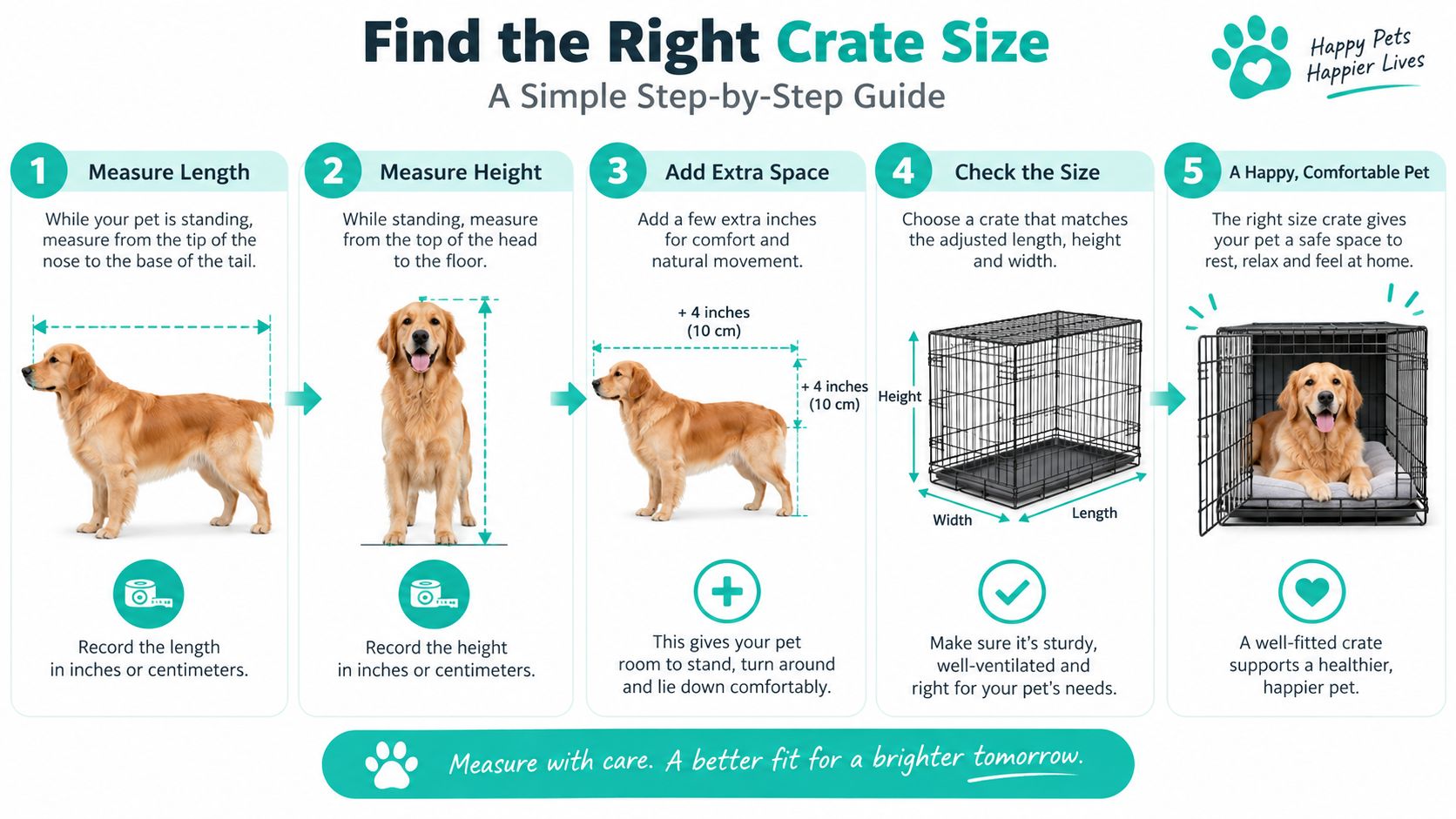
At check-in, a crate marked “IATA-compliant” can still fail if its internal space does not fit your pet or the airline's route-specific rules. Measure the animal first, then verify the crate's usable interior. A compliant crate must let the pet stand, sit erect, turn around normally, and lie in a natural position without touching the walls, ceiling, or door.
IATA's single-animal formula uses four measurements:
A, length: Nose to the base of the tail.
B, elbow height: Ground to the elbow joint.
C, width: Shoulder width or the widest part of the body.
D, standing height: Floor to the top of the head or the highest ear tip.
The required internal dimensions are length A + half of B, width C × 2, and height D + bedding, according to IATA pet container guidance. Measure with the pet standing naturally. Keep the neck in its normal position, and do not compress the coat.
A simple example
Suppose a medium-size dog measures:
A: 70 cm
B: 20 cm
C: 25 cm
D: 55 cm
Bedding: 2 cm
The minimum internal length is 70 cm plus half of 20 cm, or 80 cm. The minimum internal width is 25 cm multiplied by two, or 50 cm. The minimum internal height is 55 cm plus 2 cm of bedding, or 57 cm.
These are internal measurements, not the exterior dimensions printed on the crate. Wall thickness, door framing, and raised flooring can reduce usable room. Check the inside yourself if the product listing gives only external dimensions.
Adjustments that can change the answer
Snub-nosed breeds require extra airflow. IATA states that their crate should be about 10% larger (IATA container requirements PDF). Apply that adjustment to the usable interior, not just the outside shell. A short muzzle changes how the animal uses the available air space.
Up to two adult animals of comparable size, each under 14 kg, may share a container when they are compatible and accustomed to living together (IATA pet guidance). Shared travel needs additional floor space and airline confirmation. Two pets fitting through the door does not make one crate acceptable.
For breed-specific measurement guidance, review dog crate size by breed. Before purchase, test the final interior against the animal's posture: it should brace naturally, shift position, and rest its head without crouching. If it folds around the door or ceiling, reject the crate, regardless of the marketing label.
Cabin Carrier or Cargo Crate
The airline's route decides the crate category before the shopping cart does. A soft-sided carrier that fits under a seat is not a smaller cargo kennel, while a rigid cargo crate usually fails cabin requirements. Treat every “IATA-compliant” label as a starting claim, not approval for your specific flight.
Feature | Cabin Carrier | Cargo Crate |
|---|---|---|
Typical construction | Soft-sided, flexible, with a leak-resistant base and ventilation panels | Rigid plastic or welded metal, built for handling and containment |
Where it travels | Under the seat in front of you | In an approved hold or cargo-handling area |
Main inspection | Under-seat fit, carrier dimensions, ventilation, and pet weight limits | Internal size, rigidity, door security, ventilation, labeling, and handling features |
Common failure | Too large for the seat, too rigid, poor ventilation, or pet over the airline's limit | Weak door, unsuitable material, insufficient ventilation, or missing food and water setup |
Best decision lens | Small pet traveling beside you | Larger pet or route requiring hold transport |
For cabin travel, the carrier must fit completely under the seat and stay stowed during taxi, takeoff, and landing, as described in the FAA guidance. Airlines may also set a combined pet-and-carrier weight limit. One major airline example uses a limit of around 18 pounds including the pet, but that figure belongs to that airline's policy, not yours. Check the operating carrier's current rule before buying.
Review the pet carrier rules for airlines for practical cabin checks, then confirm the dimensions with the airline. A rigid body, missing top mesh, or pet just over the stated limit can turn a sensible cabin plan into a refusal at check-in. The pet carrier carry-on guide covers under-seat setup, but the airline's written approval for your route remains decisive.
Cargo travel requires a different build. Choose a rigid, leak-proof crate with ventilation and enough strength for loading, tie-down, and nearby equipment. Top-only ventilation is a poor choice. Reject doors that rely on a simple clip or flex when the pet pushes against them. Handlers may also check that food and water bowls are attached and refillable.
Ground transport and rail can blur the categories. A carrier accepted on a train may fail an airline's hold inspection, while a cargo kennel can be too large for a cabin. Verify the exact transport provider, route, and booking class before purchase. The correct crate is the one accepted on that itinerary, not merely the one carrying a reassuring label.
Ventilation, Build Quality, and Labels That Actually Matter
Inspect the crate like a ramp agent, not like a shopper. Start at the pet's nose level, then work around the shell, door, floor, hardware, and labels.
IATA guidance says a pet container needs ventilation on at least three sides, with most openings in the upper portion of the crate (IATA live-animal container summary). Another IATA-style benchmark calls for openings on all four sides covering at least 16% of the total surface area, positioned in the upper two-thirds of the side and rear panels (aviation container guidance). For snub-nosed and brachycephalic breeds, plan for the stricter four-sided approach and confirm the airline's breed rules.
The openings need to provide airflow without creating an escape route. IATA guidance says openings may need mesh or suitably small spacing, and the crate should include food and water troughs fixed inside or attached so staff can refill them. Don't place a vent where the pet's nose meets a solid panel while standing.
What the shell should survive
A cargo crate should be rigid and made from suitable, non-toxic materials. The inside must be free of sharp edges, exposed fasteners, and protrusions that could catch a paw, collar, or tooth. A leak-proof or waterproof floor protects handlers and keeps bedding from becoming a soggy little disaster.
Check the door latch by pushing against it from inside and outside. A latch that looks secure but flexes under pressure deserves replacement. If the crate has wheels, ask whether the airline requires removal or immobilization, and confirm that any brake holds during movement.
Labels are part of the handling system
Use visible “LIVE ANIMAL” labels on the top and one side, upright arrows on at least two sides, the owner's contact details, and the destination airport code. Keep every label clear of ventilation openings. A sticker covering a vent can create an immediate inspection problem because it reduces airflow and signals careless preparation.
For printable examples of handling and warning labels, this resource on printable warning labels for packaging offers a useful starting point. Print labels before the final packing session, then attach them without blocking vents, handles, door hardware, or identification panels.
A large-dog crate still needs its own inspection. Use this guide to airline-approved crates for large dogs, then ask the airline to approve the exact model and dimensions for your route.
Preparing the Crate Before Travel Day
A crate should be familiar before it becomes transport equipment. Start well before departure by placing it open in a room where your pet already relaxes. Put meals inside, leave the door open at first, and let the animal investigate without being pushed in.
Once the pet enters calmly, close the door for short sessions. Gradually extend the time, then add a quiet car ride so the crate stops feeling like a strange object that only appears before stressful events. If your dog paws, pants, or repeatedly throws itself at the door, reduce the session and rebuild the routine.
Build the working setup
The crate needs to function, not merely look complete. Run through the moving parts:
Test the door. The latch should click fully and resist pressure from inside.
Lock the wheels. If wheels are allowed for your route, confirm the brakes hold. If they aren't allowed, remove or disable them according to the airline's instructions.
Attach the bowls. Food and water containers should be secured inside or attached so they don't slide across the floor.
Pack spare hardware. Keep approved tie-straps, fasteners, and attachment pieces available, not buried in checked luggage.
The IATA questions and answers for shipping live animals emphasizes suitable construction, safe handling, and protection from sharp or protruding parts. Use that standard as a practical inspection lens, then apply the airline's own requirements.
Make the interior stable
Line the floor with absorbent bedding. Secure it so your pet can't push it into a corner and expose the hard surface. A thin, stable layer is usually easier for the animal to stand on than loose bedding that bunches under its paws.
Freeze water in the bowl before departure so it melts gradually rather than spilling during loading. Confirm that this method is permitted by the airline, and don't add loose items that could become hazards.
Place a labeled pouch on top of the crate with veterinary records, identification, an emergency contact, and a leash. Keep the pouch attached securely and make sure the crate's labels are already in place. The last-minute glue-on-sticker scramble is exactly how vents get covered and crates get bounced.
Verifying Acceptance for Your Route and Airline
The only question that matters is blunt: will this specific crate, for this specific pet, be accepted on this specific route today?
An “IATA-compliant” badge doesn't answer that. Acceptance can differ by airline, aircraft, route, ventilation design, materials, breed, weather, and handling arrangements. Operator discretion still matters, and a crate that traveled successfully before may not pass a later inspection.
Build the verification stack
Start with the airline's current pet policy page. Check the exact aircraft type assigned to the flight, not just the airline brand. Hold conditions, size limits, and acceptance procedures can vary by aircraft and route.
Then check restrictions that can stop the booking even when the crate is sound. Look for seasonal embargoes, snub-nosed breed rules, and temperature limitations for routes exposed to severe heat or cold. Ask whether the airline accepts the pet in the cabin, as checked baggage, or only through cargo for that itinerary.
Call the airline's cargo or live-animals desk where possible. The general call center may know the broad pet policy but not the acceptance details for an oversized crate, connecting flight, or specific aircraft. Ask the desk to confirm the crate's internal dimensions, external dimensions, total weight, construction, ventilation, labeling, and food-and-water setup against your booking.
Finally, re-check the destination country's import paperwork window. Health certificates, identification records, and other documents can have timing rules that don't match your crate preparation schedule.
Checkpoint | Where to Verify | Common Pitfall |
|---|---|---|
Aircraft and crate limits | Airline pet policy and cargo desk | Assuming every aircraft accepts the same crate dimensions |
Breed eligibility | Airline policy and live-animals desk | Buying a crate before checking snub-nosed restrictions |
Weather and embargoes | Airline route notices and cargo desk | Treating a confirmed booking as a guarantee of acceptance in extreme conditions |
Labels and attachments | Airline cargo instructions | Applying labels over vents or leaving bowls loose |
Destination documents | Official destination requirements and your veterinary travel workflow | Checking paperwork after the document window has passed |
Request confirmation in writing if the airline provides it. Keep the message with your booking records and bring a printed copy. That won't eliminate every airport decision, but it gives you a clear record of what the airline reviewed before you arrived.
Wrapping Up With a Calm Travel Day Mindset
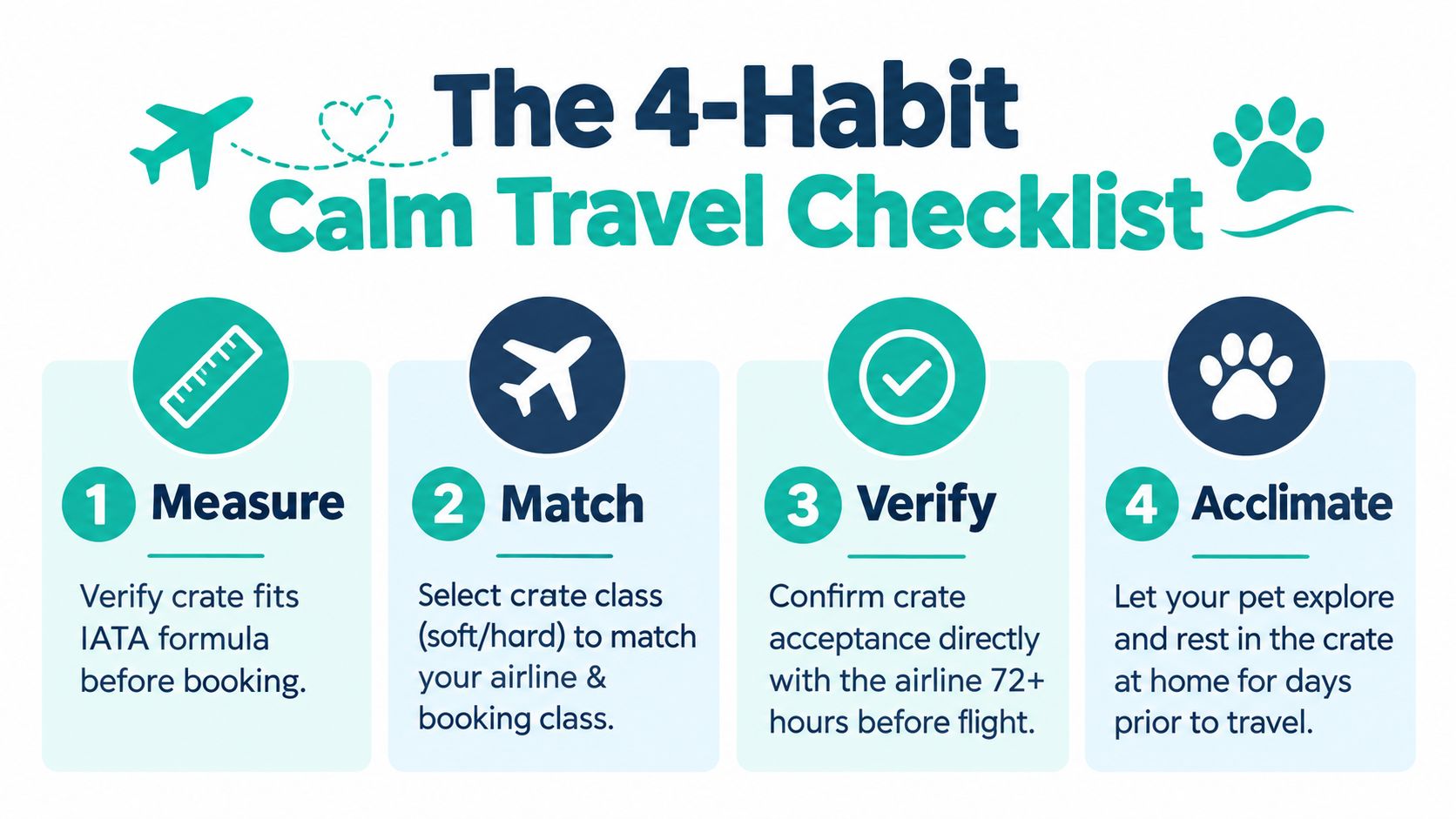
Successful crate pet travel comes down to four habits, repeated on every trip:
Measure first. Use the IATA formula and calculate the crate's internal usable space, including bedding.
Match the crate class. Choose a soft carrier for an approved under-seat booking and a rigid cargo crate when the pet travels in the hold.
Verify before payment. Ask the airline to confirm the exact crate, pet, aircraft, and route.
Acclimate early. Let the pet eat, rest, and travel short distances in the crate before departure.
These habits turn a tense airport inspection into a confirmation of work you've already completed. Your pet gets a familiar space, handlers get a crate they can safely manage, and you avoid discovering a problem beside the check-in queue, where solutions are scarce and patience is thinner than a cat's interest in your carefully chosen carrier.
Passpaw helps veterinary practices and pet travel professionals manage international health certificates, document validation, travel-date tasks, and client communication. Visit Passpaw to organize the paperwork alongside your crate acceptance plan, so your pet's travel arrangements are ready to go before you reach the airport.

More articles
From regulatory changes to best practices for veterinarians and pet owners, our resources keep you ahead of the curve.