Are you a team member in a veterinary practice?
Are you a pet parent planning a trip with your furry pal?
Airline Approved Crates for Large Dogs: A Practical Guide
You've found a crate that looks sturdy, measured your dog against the outside dimensions, and booked the flight. Then the cargo desk asks for the internal crate measurements, ventilation details, combined weight, and paperwork. Suddenly, “airline approved” sounds less like a product label and more like a checklist.
That's the right way to think about it. For a large dog, the crate is part of a wider travel plan involving the dog's posture, the carrier's aircraft limits, handling requirements, and health documents. A calm start is simple: measure first, compare the airline's current rules, and coordinate the veterinary paperwork before travel day.
Why Large-Dog Crate Rules Matter Before You Book
A large-dog owner may reasonably assume that any hard kennel with a strong door will work. The surprise often comes at cargo acceptance, where staff check details that a retail product page may barely mention. A crate can look enormous from the outside and still be too short for the dog to stand naturally, or it may have a secure-looking door that doesn't meet the carrier's hardware requirements.
Airlines commonly handle dogs above cabin limits through cargo procedures, rather than the rules used for small pets traveling under a passenger seat. That changes the equipment, booking process, and inspection questions. The crate must protect the dog during loading, movement, and unloading, while also allowing staff to handle the shipment safely.
The crate is travel equipment
International air transport has long used standardized live-animal procedures. The IATA guidance for transporting pets states that animals over 14 kg must be crated individually. A maximum of two adult animals can share one container only when each weighs up to 14 kg, the animals are compatible, and they already cohabit.
That rule prevents a common mistake: treating two large dogs as though they can share a giant kennel just because there appears to be enough floor space. For heavier dogs, each animal needs its own approved container, subject to the carrier's own acceptance policy.
Practical rule: Don't shop by breed name alone. Shop by your dog's actual internal-space needs, then confirm that the route can accept the finished crate.
Book the route before buying the biggest crate
Large crates create practical limits beyond the dog's comfort. The empty crate adds to the shipment weight, and its length, width, and height must fit the aircraft and handling system used for the route. A kennel that works on one itinerary may not work on another, even when both flights follow the same broad international standards.
Your first call should therefore cover three questions: Does the airline accept large dogs as cargo on this route? What are the maximum crate dimensions and combined weight? Which documents and booking deadlines apply? Getting those answers before you buy keeps the whole plan from going barking mad.
How IATA Standards Shape Every Crate Decision
The IATA Live Animals Regulations provide the central reference for airline pet cargo handling. Airlines may add their own aircraft, route, and acceptance limits, but IATA's approach gives you the language needed to discuss the crate with a carrier, veterinarian, or pet shipper.
Start with the dog, not the kennel label. The dog must be able to stand without crouching, turn around without pressing against the walls, and lie down in a natural position. Sitting erect also matters when the dog's body shape requires additional headroom.
Use internal measurements
IATA-aligned sizing relies on the usable space inside the crate. The length is commonly calculated as body length plus half the height to the elbow joint, rather than by matching a breed to a retail size category. This helps explain why two dogs described as “large” may need very different kennels.
For example, if a dog's body length is 90 cm and its elbow height is 55 cm, the length calculation is 90 cm + 27.5 cm, producing a calculated internal length of 117.5 cm. That result should be compared with the manufacturer's internal length, not its exterior marketing dimensions.
The crate's width and height still need their own checks. A dog that fits the length may not be able to turn comfortably if the interior is narrow, and a tall dog may brush the roof while standing.
Common size classes
These are common IATA-aligned size classes listed in airline container guidance. They're useful reference points, not automatic approval.
Size Class | Internal Length (cm) | Internal Width (cm) | Internal Height (cm) |
|---|---|---|---|
Medium | 69 | 51 | 48 |
Large | 91 | 61 | 66 |
Extra large | 102 | 69 | 76 |
Giant | 122 | 81 | 89 |
The pet crate travel sizing guide can help you compare the dog's measurements with the crate's internal dimensions. Remember that bedding takes up usable height, so don't treat a thick pad as an afterthought.
Two dogs over 14 kg can't share one container under the IATA condition described above. Each needs an individual crate, and the airline may still apply additional route-specific rules.
Materials, Ventilation, and Closures That Pass Inspection
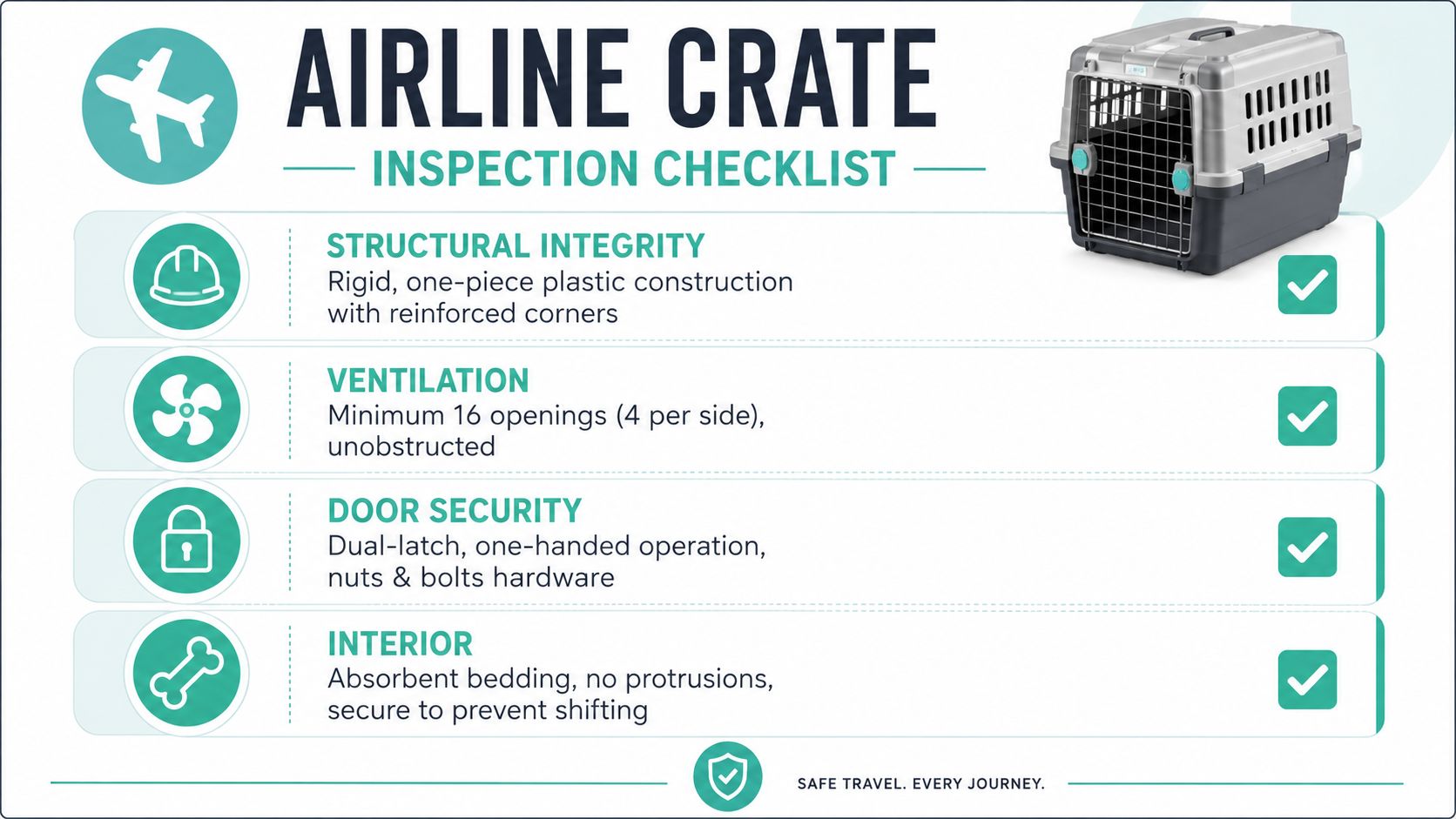
A crate becomes airline-ready through its construction, not its color or brand badge. IATA-aligned guidance points toward rigid construction, ventilation on all four sides, and secure closures fastened with metal hardware for plastic crates. These features help the crate remain stable during handling and keep airflow available from different directions.
Choose structure over convenience
Soft-sided crates and ordinary wire crates may work for home use or some ground journeys, but cargo handling calls for a rigid enclosure. A hard plastic shell with reinforced edges is easier for staff to move and less likely to collapse if another item presses against it.
The floor should be solid and leak-resistant, with absorbent bedding that won't shift under the dog. Avoid loose objects, sharp projections, or accessories that could break away during handling. Water equipment also needs to remain accessible to staff without requiring them to open the crate.
The door deserves a close inspection. Look for a secure metal-fastened closure that locks firmly and can't be pushed open by a strong dog. Wheels may create handling problems, so ask the airline whether they must be removed or made inoperable for your specific crate.
Calculate the finished weight
The relevant figure is the dog plus the crate, not the dog alone. Independent 2026 guidance notes that large-dog cargo limits often sit around 150 lb including the crate, while some airlines allow about 165 lb. These figures come from large-dog cargo guidance for air travel, but your carrier's current rule controls the booking decision.
A giant crate can solve a height problem while creating a weight problem. Weigh the assembled crate, including approved fittings and bedding, then add your dog's current travel weight. Send that combined figure to the airline before purchasing a kennel that leaves no margin.
Buyer's checklist
Must have:
Rigid shell: The crate should hold its shape during movement.
Four-sided ventilation: Openings must remain unobstructed.
Secure closure: Metal-fastened hardware is preferable for plastic crates.
Solid floor: Add absorbent bedding that stays in place.
Correct internal size: Your dog must stand, turn, and lie naturally.
Helpful extras:
External water access: Staff can refill the bowl without opening the door.
Reinforced handling points: Useful for a heavy crate, if accepted by the carrier.
Clear labels: Place them only where the airline directs.
For a broader look at travel kennel features, see this guide to travel crates for dogs.
Measuring Your Dog the Way Airlines Actually Do
A tape measure and a patient helper are more useful than a breed chart. Measure your dog while they're standing naturally on a level surface, because a stretched-out pose can make the crate seem suitable when the dog won't have that same space inside the kennel.
Take the core measurements
Measure body length from the front of the chest to the base of the tail. Don't measure to the end of the tail, and don't follow the curve of a fluffy coat. The measurement should represent the dog's body, not the fur that may compress under normal contact.
Next, measure height from the floor to the elbow joint. This is the height used in the length calculation described by IATA-aligned guidance. Also check standing height to the top of the head or ears, whichever is higher when the ears stand naturally.
A second person can steady the tape while you keep the dog relaxed. Use a treat, let the dog stand beside a wall, and take each measurement more than once if the first attempt looks doubtful.
Apply the length calculation
Suppose your dog measures 90 cm from chest to rump and 55 cm from the floor to the elbow. Half of the elbow height is 27.5 cm, so the calculated internal crate length is 117.5 cm.
That number isn't a suggestion to squeeze the dog into the nearest product category. It's a starting point for comparing the kennel's internal length, while the width and height checks confirm that the dog can turn and stand comfortably.
Avoid the common traps
Don't compare your measurements with exterior dimensions. Shell thickness, door construction, and the shape of the interior can reduce usable room. Bedding also affects the dog's standing height, so allow for the material you'll use on the journey.
A dog may crouch briefly while entering the crate, but the travel space needs to support natural posture. The dog kennel size chart offers a useful way to organize measurements, but the airline's acceptance team should have the final say for a cargo booking.
How Major Airlines Differ on Large-Dog Acceptance
IATA provides a shared foundation, but airlines still control the routes, aircraft, crate limits, and booking process they offer. That's why the phrase airline approved crates for large dogs can mislead shoppers. A kennel may meet the broad construction standard and still be unsuitable for a particular aircraft or itinerary.
Compare the acceptance questions
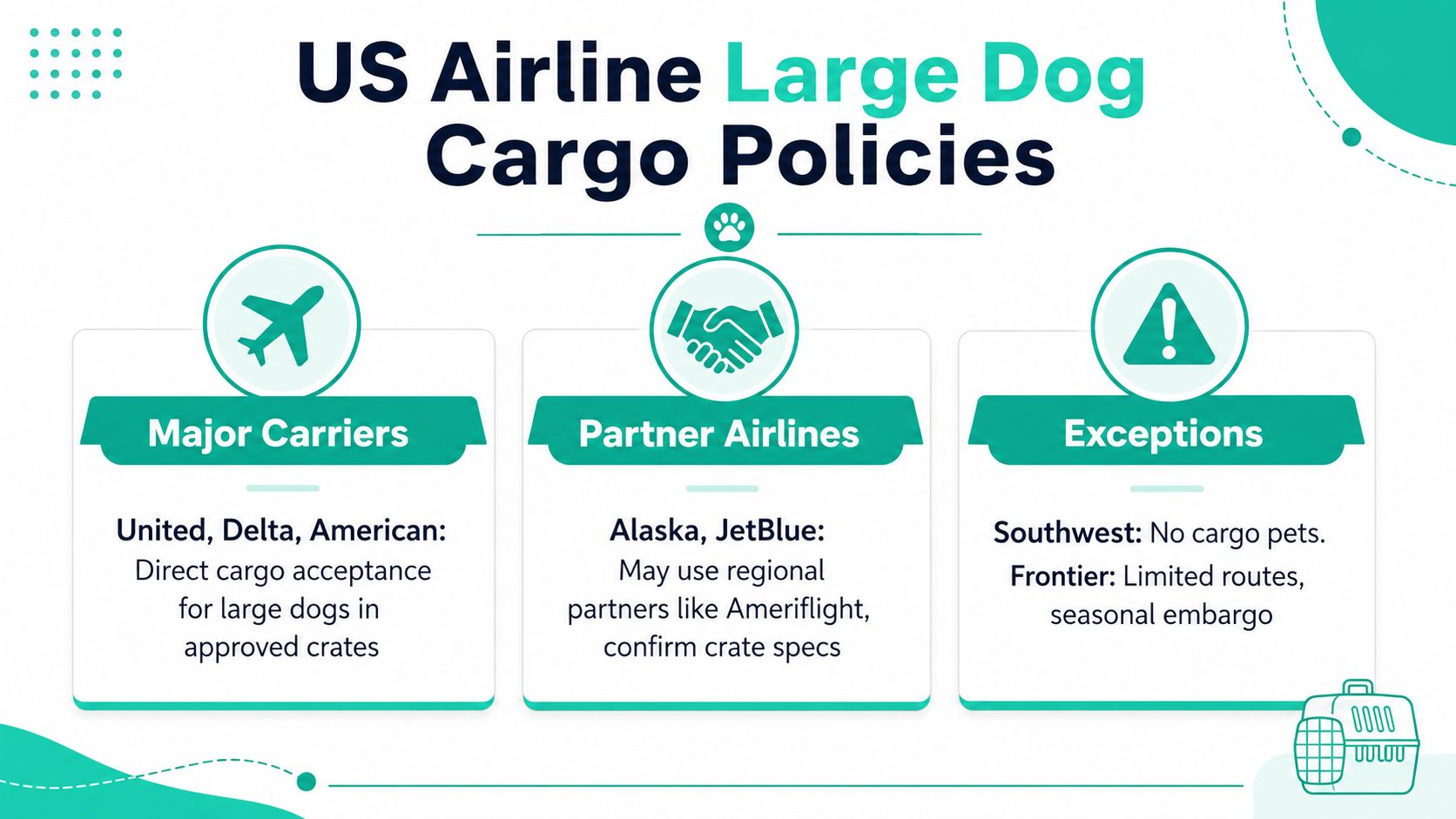
Major US carriers can differ in whether they accept large dogs directly through cargo, use a cargo partner, or restrict the service to certain routes. Seasonal conditions can also affect acceptance, particularly during periods of extreme heat or cold.
Ask the carrier these questions in plain language:
Route availability: Can this airline accept a large dog as cargo on every flight segment?
Aircraft clearance: Will the assembled crate fit the aircraft assigned to this route?
Weight limit: Does the carrier calculate weight using the dog, crate, bedding, and fittings together?
Seasonal restrictions: Is there an embargo or temperature-related restriction for the travel date?
Breed policy: Does the carrier apply additional rules to particular dog types?
Documentation: Which health certificate and airline forms must accompany the shipment?
Booking timing: How far ahead must cargo space be reserved?
United, Delta, and American are commonly listed as major carriers with direct cargo acceptance for large dogs in approved crates, while Alaska and JetBlue may use regional partners such as Ameriflight. The American Airlines pet cargo guidance is a useful example of why the airline's own details must be checked rather than inferred from IATA alone.
Treat the route as part of the crate choice
A giant kennel can fit the dog perfectly and still fail the route because the aircraft cargo door or handling system can't accept its dimensions. A partner airline may also have different instructions from the carrier that sold the ticket.
Southwest doesn't offer cargo pets, and Frontier has limited routes with seasonal embargoes, as summarized in the infographic above. Policies can change, so confirm the exact itinerary close to booking and ask for written confirmation of the crate dimensions and combined weight.
Health Certificates and Crate Prep Working Together
The crate and the paperwork follow parallel timelines. A dog can be physically ready but missing a required health certificate, or have perfect documents while refusing to settle inside an unfamiliar kennel. Coordinating both tracks gives your veterinarian and the shipper time to identify problems before the airport appointment.
Start by asking the airline and destination authority which documents apply. When a USDA-endorsed health certificate is required, the certificate may be valid only within a narrow period before departure. A veterinary visit scheduled too early can mean another examination and new paperwork closer to the flight.
Build one shared schedule
Use the travel date as the anchor, then work backward:
Crate acclimation: Introduce the kennel early, leaving time for calm practice and gradual door closing.
Measurement check: Recheck the dog after grooming, coat changes, or any meaningful change in body condition.
Veterinary appointment: Book the examination inside the certificate's allowed window.
Airline review: Confirm the final crate size, combined weight, route, and document list.
Departure packet: Keep printed documents with the shipment and retain copies for the owner and clinic.
Exercise and feeding also belong in the plan. Your veterinarian can advise on a suitable pre-travel routine, while the airline can explain its handling instructions. Don't give sedatives for air travel unless your veterinarian specifically directs you, since medication decisions are clinical and individual.
Passpaw is one workflow option for veterinary practices and pet shippers. Its platform helps manage international health-certificate applications, validate documents, prioritize tasks around travel dates and pet information, and communicate with clients while the crate and paperwork are being prepared.
Troubleshooting Common Rejection Scenarios
Most rejection problems are visible before departure if someone performs a real inspection. Walk around the assembled crate with the dog's measurements, the airline's instructions, and the document packet beside you. A quick check at home is far less stressful than discovering a problem at cargo acceptance.
Run the failure check
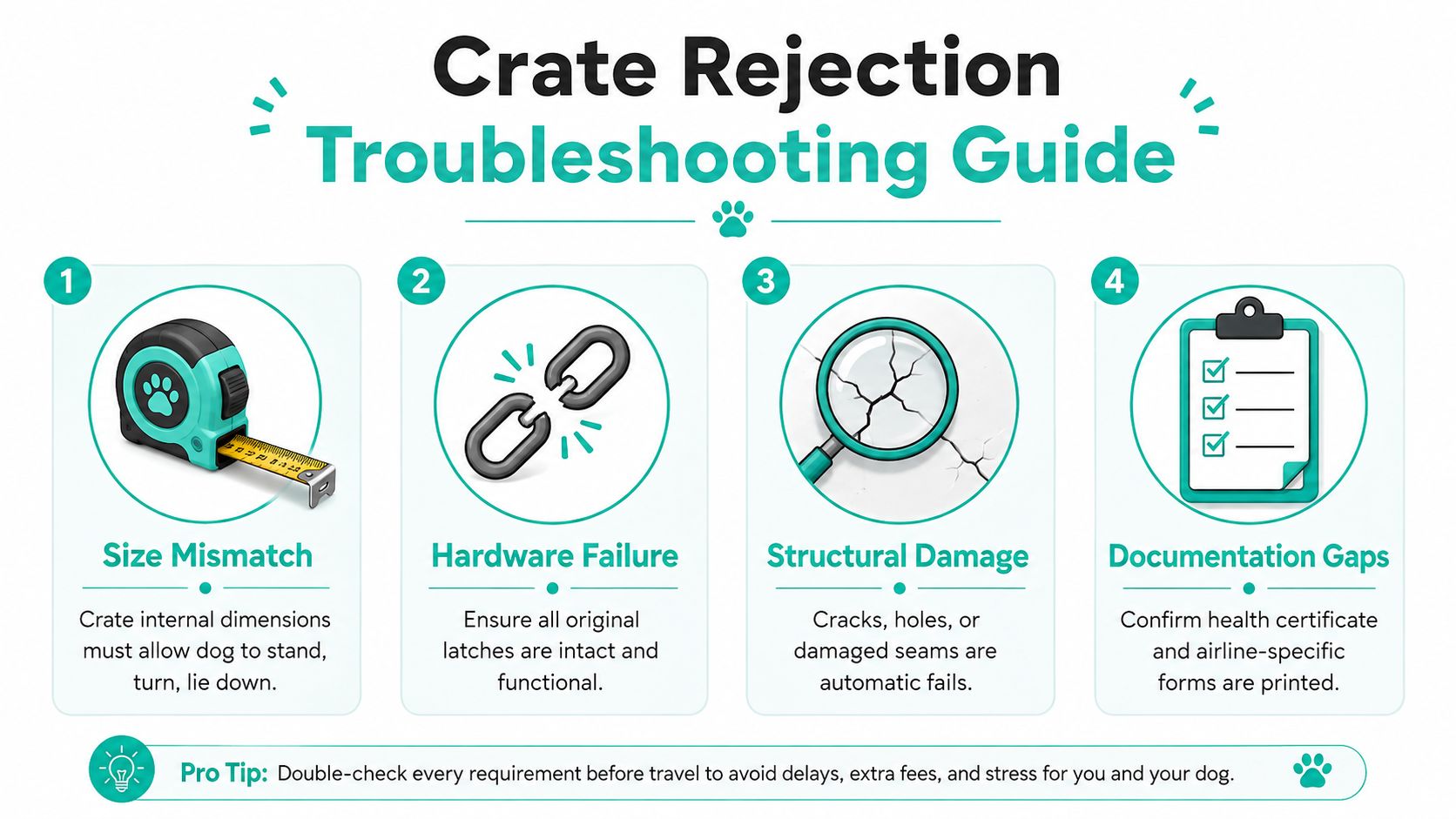
Size mismatch: Recheck internal length, width, and height. Your dog must stand, turn, and lie naturally.
Weak hardware: Replace damaged parts and confirm the original latches function correctly. Don't rely on improvised ties as the main closure.
Structural damage: Reject any crate with cracks, holes, or damaged seams. A repair may not satisfy the carrier.
Ventilation problems: Inspect all sides and remove anything blocking the openings.
Interior hazards: Remove protrusions and secure bedding so it can't bunch under the dog.
Documentation gaps: Confirm the health certificate and airline-specific forms are complete, printed, and packed as directed.
Call the airline when the question involves route acceptance, aircraft dimensions, weight, seasonal restrictions, or labels. Call the veterinarian for health certificates, fitness questions, feeding guidance, and clinical concerns.
A phone call two days before departure can settle a detail faster than a long email chain, but don't wait until then to discover a major mismatch. Ask the airline representative to confirm the final crate dimensions, combined weight, water setup, and document requirements for the exact itinerary.
Putting It All Together for a Smoother Trip
Flying a large dog is a genuine logistics project, but the decisions are manageable when handled in the right order. Measure the dog using internal-space logic, choose a rigid crate with suitable ventilation and closures, and confirm the airline's route and weight rules before purchase.
Keep the health certificate schedule alongside crate acclimation and cargo booking. Your veterinarian should guide the clinical preparation, while the airline confirms its operational requirements. With those roles clear, you can replace last-minute guesswork with a plan that gives your dog the best chance of a steady travel day.
The crate may be big, but the process doesn't have to feel ruff.
Passpaw helps veterinary practices and pet shippers manage international health certificates, document validation, travel-date tasks, and client communication in one workflow. Visit Passpaw to organize the paperwork side of your large-dog travel plan while you confirm the crate and route with the airline.

More articles
From regulatory changes to best practices for veterinarians and pet owners, our resources keep you ahead of the curve.