Are you a team member in a veterinary practice?
Are you a pet parent planning a trip with your furry pal?
Dog Crate Size by Breed: The Ultimate Guide for 2026
Buying a crate often starts as a simple shopping task. Then you open a few tabs, see five different size charts, spot labels like small, medium, intermediate, airline approved, travel kennel, and suddenly the whole thing feels less like a quick errand and more like a game of fetch with the rules missing.
That confusion is more significant than often realized. The right crate size affects comfort at home, crate training success, road travel, and, for international trips, whether your dog can travel safely in the first place. A crate should feel like a secure den, not a tight squeeze and not a ballroom either.
Why Finding the Paw-fect Crate Size Matters
You book the international flight, line up the paperwork, and buy a crate based on a breed chart. Then check-in staff take one look at your dog standing inside and flag the kennel as too short or too narrow. That is the kind of expensive surprise good sizing prevents.
A crate is part comfort tool, part training tool, and part travel equipment. For home use, a slightly imperfect fit may lead to restless naps or slower crate training. For international air travel, the same sizing mistake can delay departure, trigger last-minute kennel replacement, or put your dog in a setup that is less safe than it should be.

Comfort comes first
At a basic level, the crate has to fit the dog you have. Breed and weight charts help narrow the field, but they do not account for body shape. A French Bulldog can be compact and broad. A Whippet can be light but leggy. A Corgi can need more interior length than buyers expect.
PetMD advises sizing from the dog's actual measurements rather than breed label alone, with enough room for the dog to sit, stand, turn, and rest comfortably. That practical standard holds up well in real life. If your dog has to duck to sit, brace to turn, or curl tighter than normal to lie down, the crate is too small.
Training works better when the space fits
A well-sized crate usually helps dogs settle faster because the space feels secure and predictable. That matters during crate training, especially with puppies and young dogs still learning bladder control.
Oversizing has its own trade-off. Too much empty space can make house-training harder, because some dogs start treating one end like a bedroom and the other like a bathroom. Many first-time owners get stuck here because labels like “medium” or “intermediate” sound precise, but they are only rough retail categories.
Travel raises the stakes
Airlines and pet shippers assess the kennel in front of them, not the marketing copy on the box. For international trips, your dog needs enough interior space to stand naturally, sit erect without the head touching the top, turn around, and lie in a normal resting position. Breed charts are a starting point. Compliance depends on measured dimensions, kennel design, and your dog's build.
This is also where breed-specific exceptions matter. Dogs with long backs, very deep chests, upright ears, heavy coats, or short-nosed conformation can fall outside the “standard” crate size their breed chart suggests. That is one reason I tell clients to treat breed charts as a first pass, then confirm the fit against airline rules and the kennel's interior dimensions. If your trip includes cargo travel, it also helps to review the difference between a home crate and a pet airline travel carrier for international flights.
The short version is simple. The right crate size keeps your dog more comfortable, makes training smoother, and protects your travel plans from preventable problems. In pet travel, close enough is rarely close enough.
How to Measure Your Dog for a Crate
If you do only one thing before buying a crate, do this. Measure your dog. It's the fastest way to cut through fuzzy breed advice and avoid buying a crate that's one size too optimistic.
A widely used standard from AKC is to measure from the top of the head to the floor and from the nose to the base of the tail, then add 3 to 4 inches to each dimension to choose crate height and length (AKC crate sizing advice)).
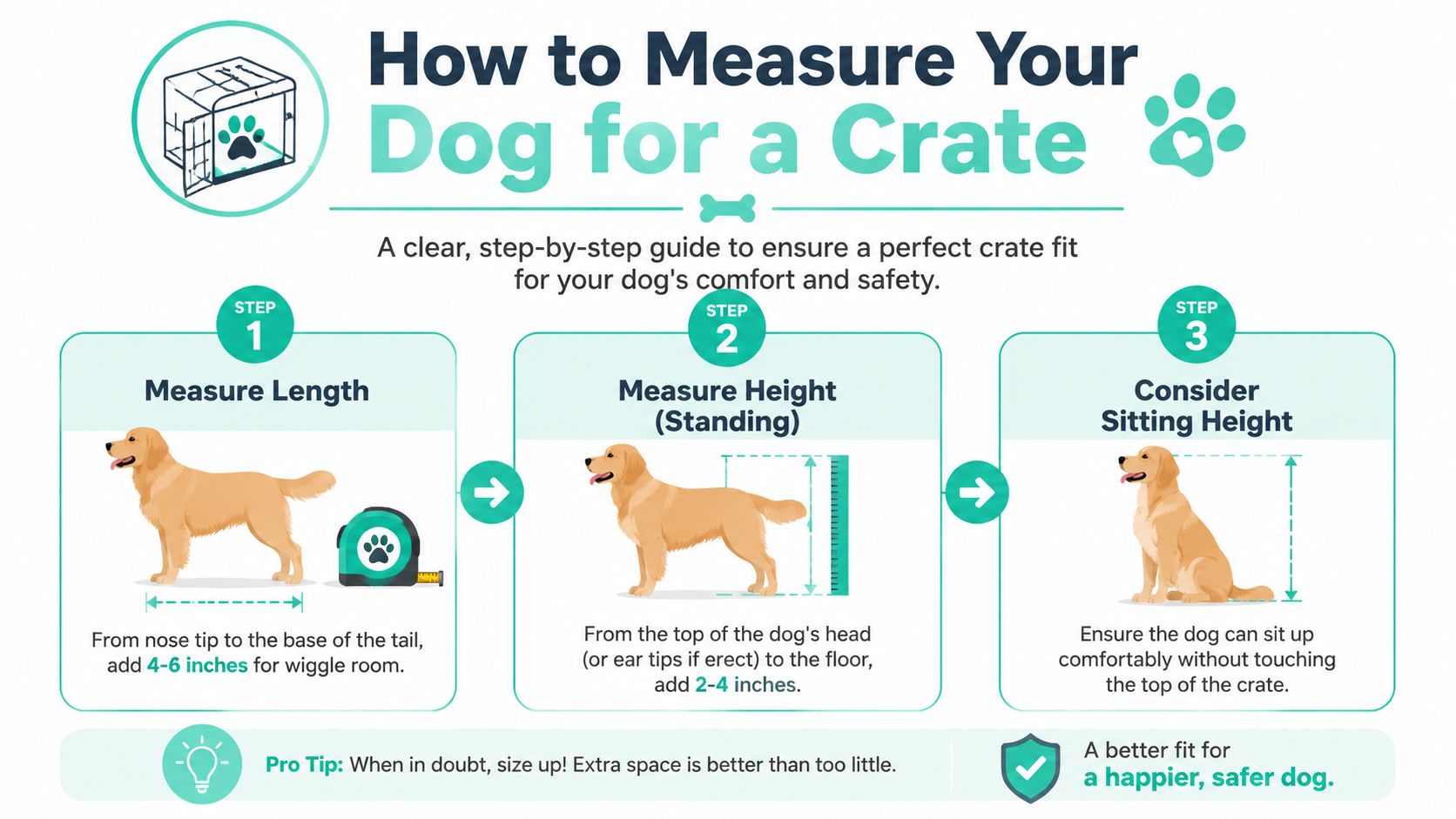
The two measurements that matter most
You don't need fancy tools. A soft tape measure works best, but a string and ruler can do the job too.
Measure length
Start at the tip of the nose and measure to the base of the tail. Don't include the tail itself. This tells you the minimum interior length your dog needs before adding extra clearance.Measure height
Measure from the floor to the top of the head. If your dog has upright ears that extend higher than the skull, account for that. Height gets overlooked all the time, especially with dogs that are slim but tall when sitting.Check natural posture
Look at how your dog rests and sits. Some dogs sprawl. Some curl. Some sit very upright. A technically correct measurement can still feel wrong if it ignores how your dog uses the space.
How much extra room to add
Once you have the raw measurements, add a little breathing room. The common benchmark is 3 to 4 inches added to height and length, as noted above in the AKC guidance. In practical shopping, many owners also compare that result against the crate's interior dimensions, not just the product name or outer size.
A few simple checks help:
Standing test: Your dog shouldn't need to crouch.
Turnaround test: Your dog should be able to rotate without awkward shuffling.
Lie-down test: Your dog should be able to rest comfortably without folding like an origami pup.
If you're choosing a carrier for a trip, this is also a good time to compare your measurements with airline-style carrier options and hard-sided kennel dimensions. A practical overview of travel carrier styles can help narrow the field before you buy, especially if you're deciding between home use and flight use in the same purchase. See this guide to a pet airline travel carrier.
Measure twice, buy once. The tape measure is more honest than the breed label.
Common measuring mistakes
A few errors come up again and again:
Using shoulder height instead of full head height
That can leave upright-sitting dogs with too little clearance.Measuring to the tail tip
That often pushes buyers toward a crate that's longer than necessary.Ignoring bedding
A pad or mat slightly reduces interior height. That matters most for borderline fits.Measuring a wiggly dog once
Take a couple of measurements and use the more realistic result.
If your dog is between crate sizes, don't guess based on the breed description alone. Compare the dog's actual dimensions to the interior crate dimensions and choose the one that preserves comfortable posture.
Dog Crate Size Chart by Breed and Weight
A breed chart helps narrow the field fast, especially when you are sorting through retail sizes and trying to match them to an airline-approved kennel for an overseas trip. The catch is simple. Store labels are built around common home-crate sizes, while international travel rules care about the dog's actual posture and clearance inside the crate.
Retail sizing still follows a predictable ladder. Lords & Labradors groups many dogs into 24, 30, 36, 42, and 48 inch crates, with examples such as Chihuahua, Jack Russell, and Shih Tzu in 24-inch crates, Beagle, French Bulldog, and Dachshund in 30-inch crates, Cockapoo and Springer Spaniel in 36-inch crates, Labrador and Dalmatian in 42-inch crates, and Golden Retriever, Greyhound, and Bernese Mountain Dog in 48-inch crates (Lords & Labradors crate size guide)).
That pattern is useful because most commercial crates are sold in those jumps. It is also why those looking for dog crate size by breed usually keep seeing the same crate lengths from one seller to the next.
Quick-reference breed and weight chart
Use this chart as a starting point for shopping. For international travel, treat it as a shortlist, then confirm the final kennel against your dog's measurements and the airline's pet rules. If you are still deciding between cabin, checked baggage, or manifest cargo, this guide on how to ship a dog internationally or domestically helps put crate choice in the right travel context.
Crate Size (Length) | Dog Weight Range | Typical Breeds |
|---|---|---|
18 to 24 inches | Up to about 25 lb | Chihuahua, Pomeranian, Yorkshire Terrier, Jack Russell, Shih Tzu |
30 to 36 inches | Around 25 to 40 lb | Beagle, French Bulldog, Dachshund, Cockapoo, Springer Spaniel |
36 to 42 inches | Around 40 to 70 lb | Labrador, Dalmatian, larger spaniels, some retrievers |
42 to 48 inches | Above 70 lb | Golden Retriever, Greyhound, Bernese Mountain Dog, large shepherd and retriever types |
How to read the chart without getting tripped up
Breed charts are strongest when the dog has a fairly average build for that breed. They get less reliable with dogs that are unusually long in the body, tall in the leg, broad in the chest, or heavy in the coat.
As noted earlier, standard crate sizing across the market tends to cluster into familiar weight bands and matching crate dimensions. That helps with browsing. It does not guarantee flight compliance.
For home use, a near match may be good enough if the dog is comfortable. For international air travel, near match is where problems start. A kennel can look right on paper and still fail because the dog's ears touch the top when sitting, the shoulders crowd the doorway, or the body length pushes the nose too close to the front wall. That is why breed charts are a starting line, not a final boarding pass.
Breed examples from major retail charts
Large retail charts point in the same general direction. PetSmart places Chihuahua, Pomeranian, and Yorkshire Terrier in XX small units rated to 10 lb, while German Shepherd, Golden Retriever, and Labrador Retriever are grouped into extra large units with a 90 lb+ limit (PetSmart sizing chart)).
A few practical patterns show up again and again:
Toy breeds usually fit the smallest category, but fluffy coats and upright sitting posture can change the height you need.
Compact medium breeds often land between two crate sizes. French Bulldogs and similar builds may fit the length of one crate but need the width of the next size up.
Large sporting and working breeds often sit close to the upper limit of a standard retail size. That matters much more for air travel than for den use at home.
Giant breeds can outgrow common retail assumptions quickly, especially once you account for travel bowls, absorbent bedding, and the interior space lost to heavy-duty kennel walls.
A breed chart gives you a ballpark. Your tape measure decides whether the dog can actually fly safely.
Ignore the product name first. Compare your dog's measurements to the crate's interior dimensions, then check whether the airline accepts that kennel style and size. That simple habit saves returns, avoids airport surprises, and keeps your travel plans from going to the dogs.
When Breed Charts Are Not Enough
Breed charts look tidy on paper. Real dogs rarely cooperate that neatly.
The biggest mistake I see is treating the breed label as the final answer. It isn't. Breed-based guidance is only a rough starting point, and sources such as Orvis and Diggs point out that individual measurements matter most, especially for outliers like short-legged Corgis who may struggle with standard crate designs (Orvis guidance on breed-chart limits).
Dogs that break the chart
Some body types need special handling even when the weight seems to match the chart.
Long-bodied dogs
Dachshunds and Corgis often need more crate length than their weight suggests. A crate chosen by pounds alone can leave them cramped from nose to rump.Short-legged dogs
Entry height matters. Some dogs can fit the interior dimensions but still struggle with a high lip at the doorway.Deep-chested or tall sitters
Lean, athletic dogs can surprise owners with how much vertical room they need when they sit upright.Stocky builds
Broad shoulders and thick chests can make a crate feel narrow even if the length looks correct.
Travel is where exceptions really matter
At home, a slightly awkward fit may just make the crate less inviting. In travel, especially cargo travel, body shape problems show up fast. A dog that can technically lie down but can't sit or turn comfortably is in the wrong kennel for the job.
This matters even more when owners assume a breed average covers unusual individuals. A petite Labrador and a tall, heavy-boned Labrador may land in different travel crates. Same breed. Different fit.
If your dog's shape falls outside the norm, it's smart to treat the breed chart as background information only. Then evaluate the actual crate opening, floor area, interior height, and how your dog moves in and out. For owners arranging transport rather than accompanying the pet, this guide on shipping a dog helps frame the broader logistics.
If your dog is an outlier for the breed, trust the tape measure over the breed stereotype.
A simple override rule
Ignore the breed chart when your dog has any of these traits:
Situation | Better approach |
|---|---|
Longer body than typical | Prioritize interior length |
Short legs or mobility quirks | Check entry lip and ease of access |
Tall sitting posture | Prioritize interior height |
Very broad chest or shoulders | Check usable interior width and door opening |
This is also the section where flat-faced breeds deserve a caution flag. Travel conditions can be less forgiving for dogs with airway-related challenges, so crate choice should focus on airflow, posture, and calm acclimation rather than squeezing into the smallest possible acceptable size.
Choosing the Right Type of Crate
Size is only half the decision. The other half is choosing the right crate style for the job.
Three common crate types
Crate type | Best use | Trade-offs |
|---|---|---|
Wire crate | Home training, daily use, good airflow | Bulky, less den-like, not the usual choice for cargo air travel |
Plastic flight kennel | Air travel, car travel, dogs that like a more enclosed feel | Heavier, less flexible at home, ventilation depends on design |
Soft-sided carrier | Small dogs, short trips, in-cabin travel when allowed | Not suitable for cargo, less durable for strong chewers or anxious dogs |
What works in real life
Wire crates are excellent for home routines. They're easy to clean, easy to see through, and many include divider panels for puppies. For house-training, they're practical and forgiving.
Plastic kennels are the workhorse for travel. If a dog will fly internationally in cargo, this is usually the category to focus on because it offers rigid structure and a more protected environment.
Soft-sided carriers are best for small dogs who'll stay with you in the cabin, assuming the airline allows that style and size. They're handy, but they're not the answer for every trip or every dog.
If you're comparing travel-specific features like ventilation, fasteners, and door construction, this guide on choosing a pet crate for travel is a useful companion.
The wrong type of crate creates headaches even when the measurements are right. A perfectly sized wire crate won't solve a cargo flight requirement, and a flight kennel may be overkill if you only need a calm sleeping space in the living room.
Airline Crate Requirements for International Travel
You measure your dog, match the numbers to a breed chart, buy the kennel, and feel ready. Then the airline says no at check-in because the crate is too short when your dog sits upright, the ventilation pattern does not meet its rule set, or the door hardware is not accepted for that route. International travel raises the stakes. A crate that works perfectly at home can still fail airport acceptance.
For overseas flights, sizing has to satisfy two jobs at once. Your dog needs enough room to stand naturally, sit without the head pressing into the top, turn normally, and lie down in a stable position. The kennel also has to meet the airline's construction standards, which can be stricter than a generic breed-size chart suggests.
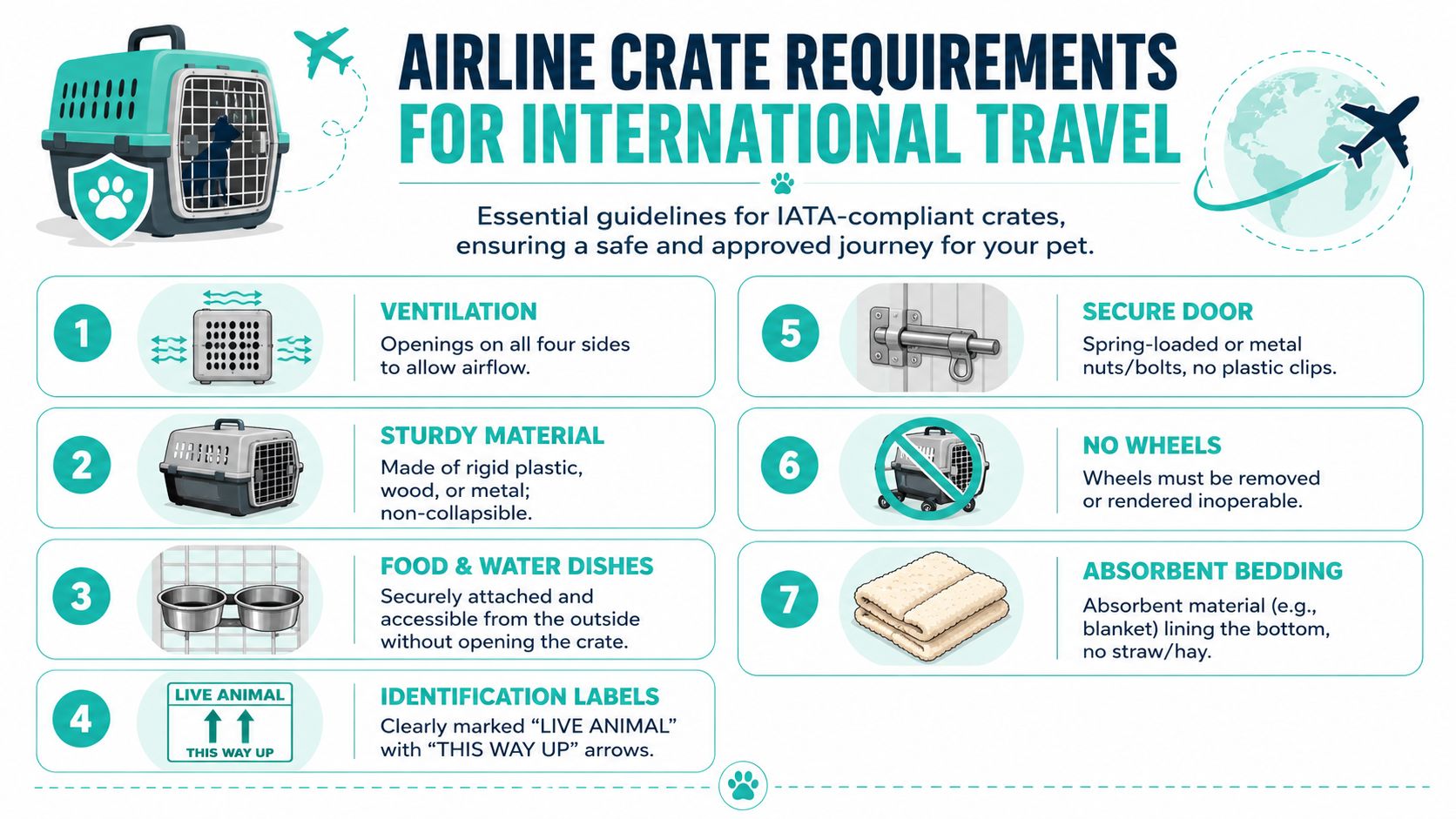
What airline staff usually check
Airline acceptance teams are not grading the crate on comfort alone. They are checking whether it is safe to load, secure in handling, and appropriate for the dog inside it.
Focus on these points:
Rigid, hard-sided construction
For cargo travel, a solid travel kennel is usually the right choice. Soft-sided carriers are generally for in-cabin use, not the cargo hold.Secure door and fastening hardware
The door should lock firmly and stay shut if the crate is bumped during handling. This is a common failure point on cheaper kennels with weak clips or light hardware.Ventilation on the required sides
Airflow matters, but so does kennel design. Some crates feel airy at home and still do not meet airline expectations for international transport.Attached food and water bowls
Bowls should be mounted so staff can access them as required without opening the kennel unnecessarily.No loose parts or travel extras that create risk
Wheels, detachable pieces, and unstable accessories often need to be removed before acceptance.
Where breed charts fall short
Breed charts are a starting point, not a boarding pass.
This matters most with dogs that fall outside the “average” build for their breed. Sighthounds, bully breeds, giant breeds, and dogs with long legs or deep chests often need a kennel that is larger or shaped differently than the chart would suggest. Brachycephalic dogs can face added airline restrictions altogether, so the question is not only crate size. It is whether the route, season, and carrier will accept the breed in the first place.
I see one mistake over and over. Owners buy the smallest crate their dog can technically fit into because it is easier to carry, easier to store, and easier to fit in the car. That shortcut can cause a denied check-in or a cramped trip for the dog. In air travel, “just fits” is a bad fit.
If you want a practical outside resource that covers trip planning from a pet owner's point of view, the Material Handling USA pet guide is a helpful read before you start comparing kennel specs.
How to choose with airline compliance in mind
Start with your dog's actual measurements, especially standing height, seated height, body length, and shoulder width. Then compare those numbers against the kennel's interior space, not the marketing label on the box. After that, confirm the airline's current requirements for the route you are flying. Some carriers follow general standards closely. Others add their own kennel rules, breed exclusions, or seasonal embargoes.
That order saves a lot of tail-chasing.
For a more travel-specific breakdown of acceptable kennel styles, sizing logic, and cargo versus cabin use, review this guide to dog cages for flights before you buy.
The right international crate is the one your dog fits safely and your airline will accept on departure day.
Your Pre-Travel Crate and Document Checklist
Good pet travel prep is mostly about sequencing. Owners run into trouble when they buy the crate first, read the destination rules second, and contact the airline third. Flip that order and the whole process gets smoother.
The checklist that prevents last-minute chaos
Confirm the destination country's pet entry rules
Start with the country, not the crate. Import rules affect timing, paperwork, and sometimes transport conditions.Verify the airline's current kennel rules
Airlines can interpret standards differently. Check accepted crate types, attachment rules, and any route-specific limitations.Measure your dog and match the kennel to the dog, not the breed tag
Keep your written measurements handy when comparing kennel interiors.Buy the crate early enough for practice
A crate shouldn't be brand new on travel day. Dogs do better when the kennel already feels familiar.Label and prep the crate thoughtfully
Identification, bowls, bedding, and secure fasteners should be checked well before departure.

What organized prep looks like
A clean workflow matters just as much as the crate. Veterinary teams and owners need a shared view of deadlines, health certificate steps, and destination-specific requirements. When those details live in scattered emails and screenshots, mistakes multiply fast.
A solid pre-travel plan usually includes:
A measurement record with your dog's length and height
A crate spec sheet or product page saved for reference
Airline confirmation on kennel acceptance
Document timeline tied to the travel date
A short acclimation plan so the crate becomes familiar before departure
Don't leave acclimation until the final week
Even a perfectly sized kennel can feel stressful if the dog only sees it right before the trip. Start by feeding meals near the crate, then inside it, then practicing short calm stays. That slow approach usually works better than trying to force a long session too soon.
For international trips, the crate is only one part of the puzzle. The paperwork side needs the same level of planning and accuracy.
Frequently Asked Questions About Crate Sizing
What size crate should I get for a puppy that will grow?
For home use, buy with the adult dog in mind if you have a reliable estimate of final size. A crate with a divider usually makes that easier, since you can limit extra space while your puppy is still learning good crate habits.
Air travel is different. Airlines and inspectors look at the dog in front of them on travel day, not the size you expect six months later. For an international flight, choose the kennel based on your puppy's current measured height and length at the time of the trip.
Is a bigger crate always better?
The right crate is the one that fits the job.
Too much extra space at home can make early training sloppier and can leave some dogs feeling less settled. For international travel, oversizing creates a different problem. A kennel that is much larger than necessary can be harder to handle, takes up more cargo space, and may still fail if the dog cannot brace comfortably during movement.
Aim for enough room to stand naturally, turn without crouching, and lie down in a normal resting position.
Can I choose a crate by breed alone if I'm in a hurry?
Use breed charts as a starting point, then verify with a tape measure. That is the safest shortcut.
Breed labels miss the dogs that cause the most trouble at check-in. Tall doodles, long-bodied dachshunds, broad-chested bulldogs, and lean working-line shepherds often need a crate that falls outside the usual breed chart guess. In international pet travel, those exceptions matter because airline compliance is based on actual dimensions and breed-specific build, not a generic category.
Can two small dogs share one crate for travel?
For international air travel, plan on one dog per crate unless the airline and route specifically permit a shared kennel. Even calm housemates can shift, block each other, or become stressed during loading and transit.
At home, bonded dogs may choose to curl up together. That does not make shared air transport a good plan.
What should go in the crate during travel?
Keep the setup simple and secure. An absorbent crate pad or liner usually works better than thick bedding that bunches up or interferes with footing. Attached water and food dishes should meet the airline's setup rules, and anything loose enough to slide around should stay out.
For airport waits, road transfers, and post-flight recovery, water planning matters just as much as crate planning. HYDAWAY's expert dog bottle guide is a useful reference if you are choosing a practical bottle for travel days.
My dog is between two crate sizes. Should I size up?
Usually, yes, if the smaller crate limits headroom or length in any normal posture. The deciding point is function, not the label on the box.
Check your dog's actual measurements against the kennel's interior dimensions, then consider the travel context. A crate that feels acceptable for a short drive may not pass airline review for an international route. This is especially common with breeds that have tall ears, heavy feathering, broad shoulders, or long backs. Those dogs often need the next size up even if the breed chart suggests otherwise.

More articles
From regulatory changes to best practices for veterinarians and pet owners, our resources keep you ahead of the curve.