Are you a team member in a veterinary practice?
Are you a pet parent planning a trip with your furry pal?
Pet Carrier Carry on: Fly Confidently in 2026
You're probably staring at an airline page with six tabs open, your pet at your feet, and a growing sense that something as simple as “bring the carrier and board the plane” has turned into a small research project.
That feeling is normal. Flying with a pet in the cabin mixes airline rules, security procedures, check-in habits, and travel documents into one process. Most owners don't get stuck on the big idea. They get stuck on the little things. Does the carrier count as a carry-on? What happens at security? Which measurements matter? When do health papers get checked, and by whom?
A good pet carrier carry on plan fixes those stress points before airport day. The goal isn't just getting past the counter. It's getting your pet through the trip with as little confusion and fuss as possible, while keeping your own packing and timing under control.
Your Guide to Flying with a Pet in the Cabin
Flying with a pet feels exciting right up until the details pile up. One airline says one thing, a travel blog says another, and your vet starts mentioning paperwork timelines you hadn't even considered. That's when a straightforward process matters.
Start with the basics. The carrier comes first, then the airline policy, then the documents, then the airport routine. Many travelers do it in the reverse order and end up buying the wrong bag or scrambling over a missing form. If you get the sequence right, the rest gets much easier.
What helps most is thinking about the trip in layers:
Your pet's fit: Can your pet stand, turn, and settle comfortably?
Your airline's rules: Does the carrier meet the cabin size and weight rules for that specific route?
Your documents: If you're crossing borders, are your health papers aligned with the destination's requirements and timing?
Your airport plan: Do you know what happens at check-in, security, and boarding?
A smooth airport day usually comes from boring prep, not luck.
That sounds less glamorous than buying a cute carrier and hoping for the best, but it works. The owners who move through the airport calmly usually aren't guessing. They've already weighed the carrier, practiced loading the pet, packed paperwork where they can reach it, and checked the airline's current pet page shortly before departure.
There are trade-offs. The most stylish carrier may not be the easiest one to compress under a seat. The roomiest option may be too structured. The quietest pet at home may still freeze at security if the carrier only appears on travel day. Getting this right means choosing what works in real life, not just what looks tidy online.
Choosing a Compliant Carrier for Size and Comfort
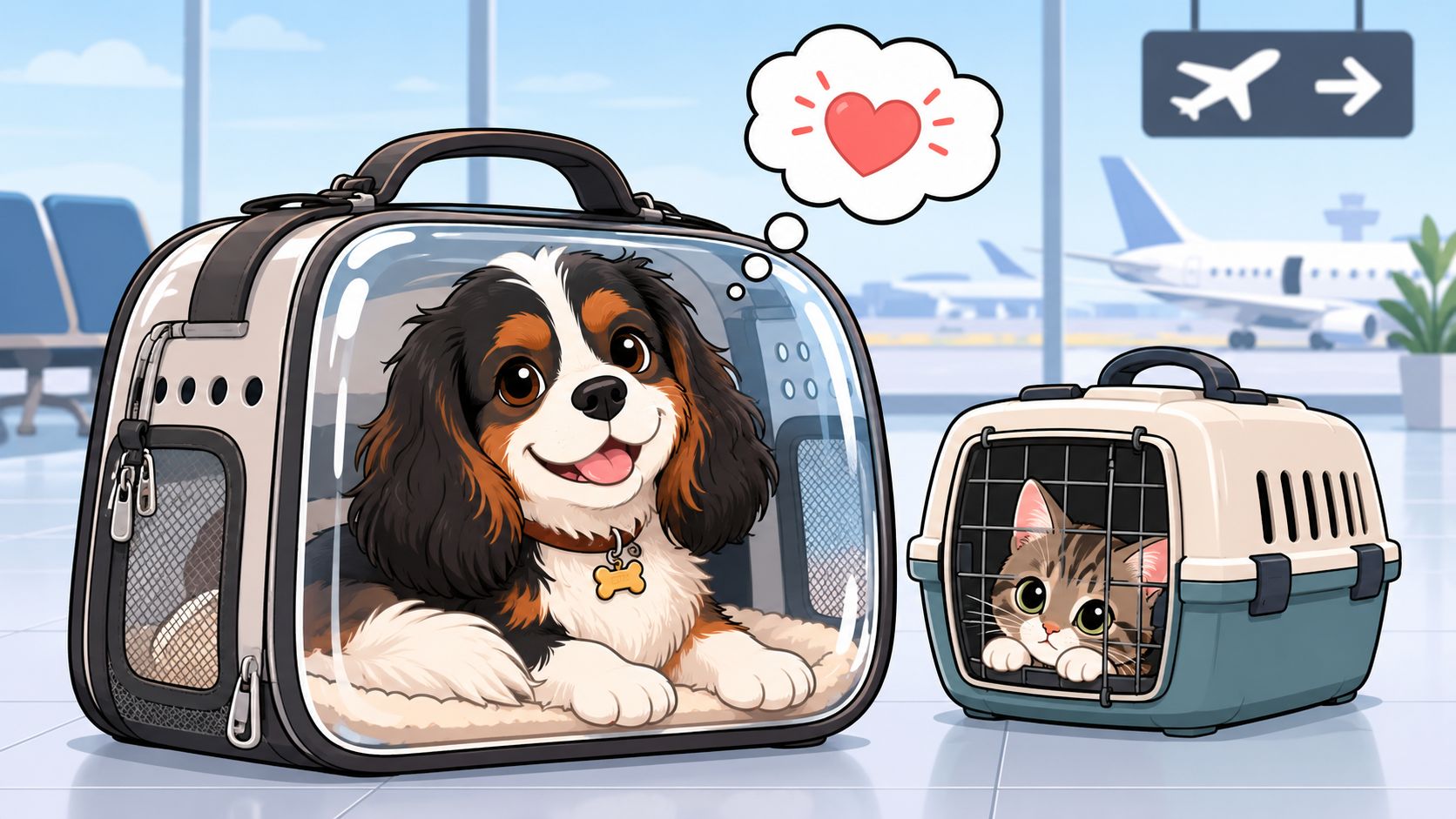
The carrier isn't just a container. It's your pet's seat, hiding place, and travel den for the whole trip. A good one keeps your pet comfortable and gives you a better shot at a smooth check-in.
Measure the pet before you shop
Many owners make a mistake. They buy the carrier first, then try to make the pet fit the product. For a pet carrier carry on setup, reverse that.
The measurement method that matters is simple and specific. Measure nose-to-tail base length (A) and head-to-ground height (B), then use this formula: Length = A + ½ leg length, Width = shoulder width × 2, Height = B + bedding thickness. A widely used benchmark for many EU airlines is 40×30×24 cm for a soft-sided carrier, and acceptance drops when carriers exceed that benchmark, as noted by Travel Ready Pets on airline pet carrier dimensions.
A few practical notes matter here:
Measure with your pet standing naturally: Not stretched out, not sitting.
Include bedding in the height calculation: Even a thin pad changes fit.
Check external dimensions, not just interior ones: Airline staff look at outside size.
If you want a good product comparison before buying, this roundup of secure pet carriers for air travel is useful because it focuses on travel-ready features rather than just style.
Why soft-sided usually wins
For in-cabin flying, soft-sided carriers usually give you the best balance of compliance and comfort. They flex slightly under the seat, which helps on aircraft with tighter under-seat space. Hard-sided carriers can work in some cases, but they leave less room for error.
What works well in practice:
Carrier feature | Why it helps on travel day |
|---|---|
Soft sides | Give you a bit of flexibility under the seat |
Good mesh ventilation | Helps airflow and lets you check your pet easily |
Secure zipper closures | Reduces escape risk at busy checkpoints |
Flat base | Prevents sagging and helps your pet settle |
Minimal exterior hardware | Makes handling simpler and cleaner |
What tends to work poorly:
Bulky pockets all around: Handy in theory, awkward under a seat.
Rigid decorative trim: Looks nice, reduces flexibility.
Heavy frames: Add weight before your pet is even inside.
Tall dome tops: Often the first thing that causes trouble.
Practical rule: Choose the smallest carrier your pet can travel comfortably in, not the largest carrier you hope the airline won't notice.
That doesn't mean cramming your pet in. It means avoiding oversized “just in case” choices that cause problems at the counter.
Comfort details that matter more than branding
Owners often focus on labels like “airline approved.” That phrase can be helpful, but it isn't enough by itself. Airline approval isn't universal, and the same carrier may fit one route and fail on another.
Look for these comfort details instead:
A stable floor so your pet doesn't feel like the bag is collapsing.
Ventilation on more than one side so air keeps moving while the carrier is under the seat.
A familiar liner or thin bedding that smells like home.
A quiet zipper and smooth entry so loading doesn't turn into a wrestling match.
You'll find more route-specific advice in this guide to airline pet travel carriers, especially if you're comparing cabin fit across airlines.
The best carrier is rarely the fanciest one. It's the one your pet accepts, you can carry comfortably, and the airline staff can look at without raising an eyebrow.
Understanding Airline and Airport Security Rules
You arrive at the checkpoint with a pet who was calm in the car and suddenly wants no part of the carrier door opening in a busy line. That is the moment many owners realize airline rules and security rules are related, but they are not the same process.
The airline side of the process
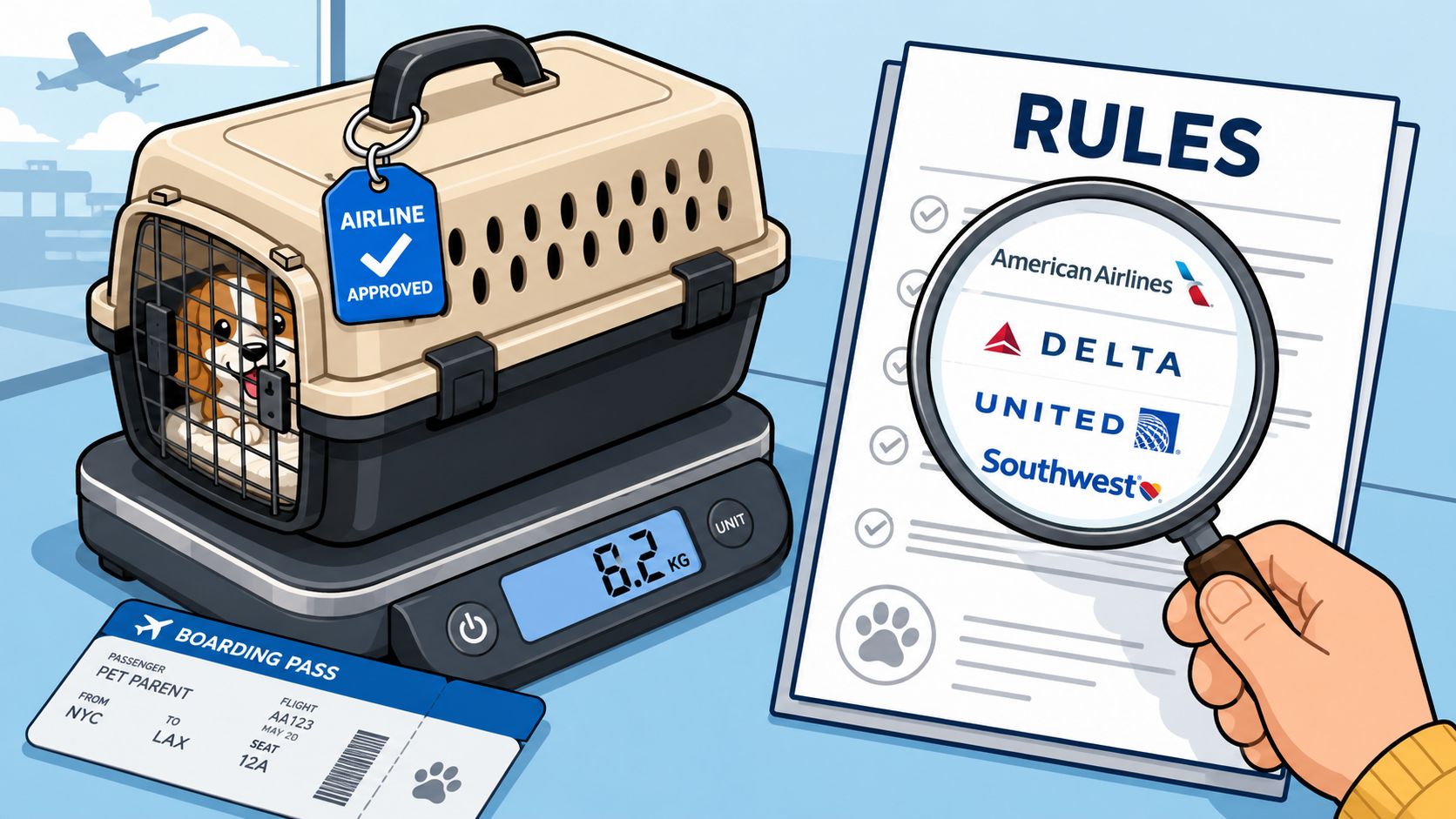
Airlines care about whether your pet can travel safely under the seat, whether the carrier fits the aircraft assigned to your route, and whether your reservation actually includes an in-cabin pet. Security officers care about screening. Gate staff care about boarding compliance. Those checkpoints happen one after another, and a setup that looks fine on paper can still get extra scrutiny at the airport.
Weight limits and under-seat fit are where owners usually get caught. A soft carrier that looked perfect online can become a problem if thick padding, decorative trim, or a stiff frame makes it sit taller than expected once your pet is inside. The practical takeaway is simple. Keep the carrier as light and flexible as you can without making it flimsy.
Bag allowance rules can also surprise people. On some airlines, the pet carrier affects what else you can bring into the cabin. On United, the details are worth checking carefully before travel, especially if you are already planning around a personal item or Basic Economy restrictions. This guide to pet carry-on rules for United Airlines lays out the part many travelers miss.
What actually happens at security
At the checkpoint, your pet comes out of the carrier. The carrier goes through the X-ray empty. You carry or walk your pet through screening, and a TSA officer may give you directions based on the lane setup and your pet's behavior. TSA explains the process on its traveling with pets page.
That sounds straightforward until you are doing it with shoes in one hand, documents in the other, and a nervous cat trying to reverse out of the opening.
A few steps make this easier:
Use a harness or secure collar before you enter the terminal, not while you are in line.
Keep the carrier zipper area clear so you can remove your pet without fighting through treats, blankets, or paperwork.
Tell the officer right away if your pet is likely to bolt or panic.
Build in extra time if your pet needs a private screening room.
That last point matters more than owners expect. If your pet is a flight risk, you can ask for a private room before removal. I recommend this often for cats, small rescue dogs, and any pet that startles easily around noise.
Labels help less than airport reality
“IATA-approved” and “airline approved” are shopping terms. Airport staff usually focus on what they can verify in front of them. Can the pet remain inside comfortably? Does the carrier hold its shape? Will it slide under the seat on this aircraft, not the aircraft you hoped to get?
That is why experienced travelers recheck the operating airline, aircraft type, and pet rules shortly before departure, especially on international routes or code-share bookings. It also helps explain why documentation belongs in your airport plan, even though the deeper paperwork details come later. If a route requires a health certificate or import paperwork, keep it somewhere you can reach without emptying the carrier at security or the gate.
The smoothest airport days usually come from boring choices. A plain carrier that fits, a pet that has practiced short periods inside it, and an owner who knows the order of events at check-in, security, and boarding. That combination gets you much farther than any approval label on the packaging.
Booking Fees and Essential Travel Documents
Once your carrier and airline fit look solid, the administrative part begins. Calm planning pays off at this point, because airport staff can work around many things. Missing or mismatched documents usually aren't one of them.

Reserve your pet spot early
A seat for you doesn't automatically mean a spot for your pet. Airlines often limit the number of in-cabin animals on each flight, so adding your pet to the booking should happen early and be confirmed directly with the airline.
A practical booking routine looks like this:
Book your own ticket first if needed.
Call or message the airline right away to add the pet.
Ask what they'll check at the airport, especially if you're on a connecting route.
Save the confirmation in more than one place, including offline access.
Don't assume the website flow tells the whole story. Some airlines make pet additions easy online. Others still rely on phone support or manual notes in the reservation.
Weight, fit, and the check-in reality
Check-in agents often verify the basics in a very hands-on way. They may look at how your pet sits inside the carrier. They may ask you to place the carrier on the scale. Some carriers pass every online checklist and still become a problem because the pet looks cramped or the bag appears bulky once packed.
American Airlines' pet guidance is often cited for two practical benchmarks. First, there should be 2 inches of clearance above the pet's head, which supports the standard that the pet should be able to stand and turn naturally. Second, airlines often calculate weight by weighing the owner holding the carrier and comparing that with the owner's weight alone. The same guidance notes that failure to use a travel scale results in approximately 30% of otherwise eligible pets being diverted to cargo, and that meeting the clearance requirement correlates with 95%+ acceptance rates in the referenced benchmark data on the American Airlines pet information page.
That's why the final home check matters. Don't estimate. Weigh the full setup you'll carry, including bedding.
A carrier that passed your living room test can fail its airport test once you add the liner, paperwork pouch, and travel pad.
Domestic paperwork versus international paperwork
Domestic travel is usually simpler. International travel is where many confident owners suddenly feel out of their depth.
For a domestic trip, the paperwork may be limited, depending on the route and airline. For an international trip, your documents often need to match the destination country's health requirements, timing rules, and certification format. That can include an International Health Certificate or related veterinary documentation prepared in a very specific way.
This is also where people underestimate the process. The challenge isn't only getting a certificate. It's getting the right certificate, completed at the right time, with supporting information that aligns with the destination's rules.
Here's the practical split:
Travel type | What usually matters most |
|---|---|
Domestic | Airline reservation, vaccine record if requested, basic pet identification |
International | Country-specific health paperwork, timing, vet review, matching destination requirements |
If you're sorting out the paperwork side, this overview of travel documents for pets gives a useful plain-language breakdown of what owners usually need to gather and verify.
How documents fit into airport day
Health documents don't always get checked in the same place. Sometimes they're reviewed at check-in. Sometimes they matter more on arrival or during border processing. That unpredictability is exactly why they should be easy to grab, cleanly organized, and backed up digitally if allowed.
Keep your paperwork in a slim folder with these basics:
Booking confirmation for the pet
Vaccination and veterinary records you've been told to carry
Any international certificate or endorsement paperwork
A printed copy of destination instructions or import guidance
Your vet's contact details
The main trap isn't usually “forgot the paper entirely.” It's “brought a pile of papers, but couldn't quickly show the one that matched the question.”
When owners tell me a travel day felt smooth, paperwork is almost always a reason why. Not because anyone loves forms, but because organized documents remove the slowest, most stressful kind of delay.
Preparing Your Pet for a Calm Journey
The most successful cabin travelers usually don't start acting calm at the airport. They've practiced calm at home for days or weeks. That part matters more than people expect.
A carrier should feel boring to your pet by travel day. Familiar. Safe. Not suspicious. If the bag only appears when something stressful is about to happen, your pet notices.
Turn the carrier into a normal place
The easiest wins come from simple repetition. Leave the carrier out where your pet already spends time. Put soft bedding inside. Drop treats in it. Feed nearby, then at the entrance, then just inside. Let the carrier become part of the furniture before it becomes part of the trip.
A gradual rhythm works well:
Leave the door open at first.
Reward curiosity, not just full entry.
Build up to short zipped sessions.
Add carrying practice around the house.
End with calm car rides if your pet tolerates them well.
For cats especially, consistent crate practice makes a huge difference. This guide to crate training for cats is a solid reference if your cat still sees the carrier as a betrayal box.
Pack for comfort, not clutter
Inside the carrier, less is usually more. You want comfort and familiarity without crowding the floor space your pet needs to settle.
What tends to work well:
An absorbent liner or pad in case of accidents
A familiar-smelling cloth from home
One quiet toy if your pet finds it soothing
A secure harness or collar that's easy to manage at security
What often backfires:
Big stuffed toys
Crunchy or noisy accessories
Thick bedding that steals headroom
Too many loose items shifting around
If your dog gets upset when separated from you, broader home training can help long before the flight. These practical steps to help your dog with separation anxiety are useful because they focus on confidence-building, not quick fixes.
The calmest travel pets usually know the carrier isn't punishment. It's just another place they rest.
Food, timing, and the owner's nerves
Owners often worry about the perfect feeding schedule. In practice, the key is moderation and familiarity. Don't use travel day to experiment with new treats, new supplements, or a heroic pre-flight meal.
Stick with your pet's normal routine as closely as the day allows. Offer water sensibly. Give a potty break before you go in. Keep your own energy steady. Pets pick up on frantic handling fast.
And if you're tempted to solve everything with a sedative, pause and speak with your veterinarian. For air travel, the general approach is caution. A pet that's slightly alert and familiar with the carrier usually handles the experience better than a pet who feels physically off balance or confused.
The goal isn't a silent pet. It's a pet who feels secure enough to settle, even if there's a little meowgic protest at the start.
Your Pre-Flight Checklist and Airport Game Plan
The hardest part of airport day usually happens before you leave the house. A carrier zipper sticks. The leash is buried in the wrong bag. The check-in desk asks for a document you meant to print the night before. Good prep prevents that chain reaction.
Before you leave home
Set everything out where you can see it. Travel day gets easier when the carrier, paperwork, and handling plan all match the same trip.
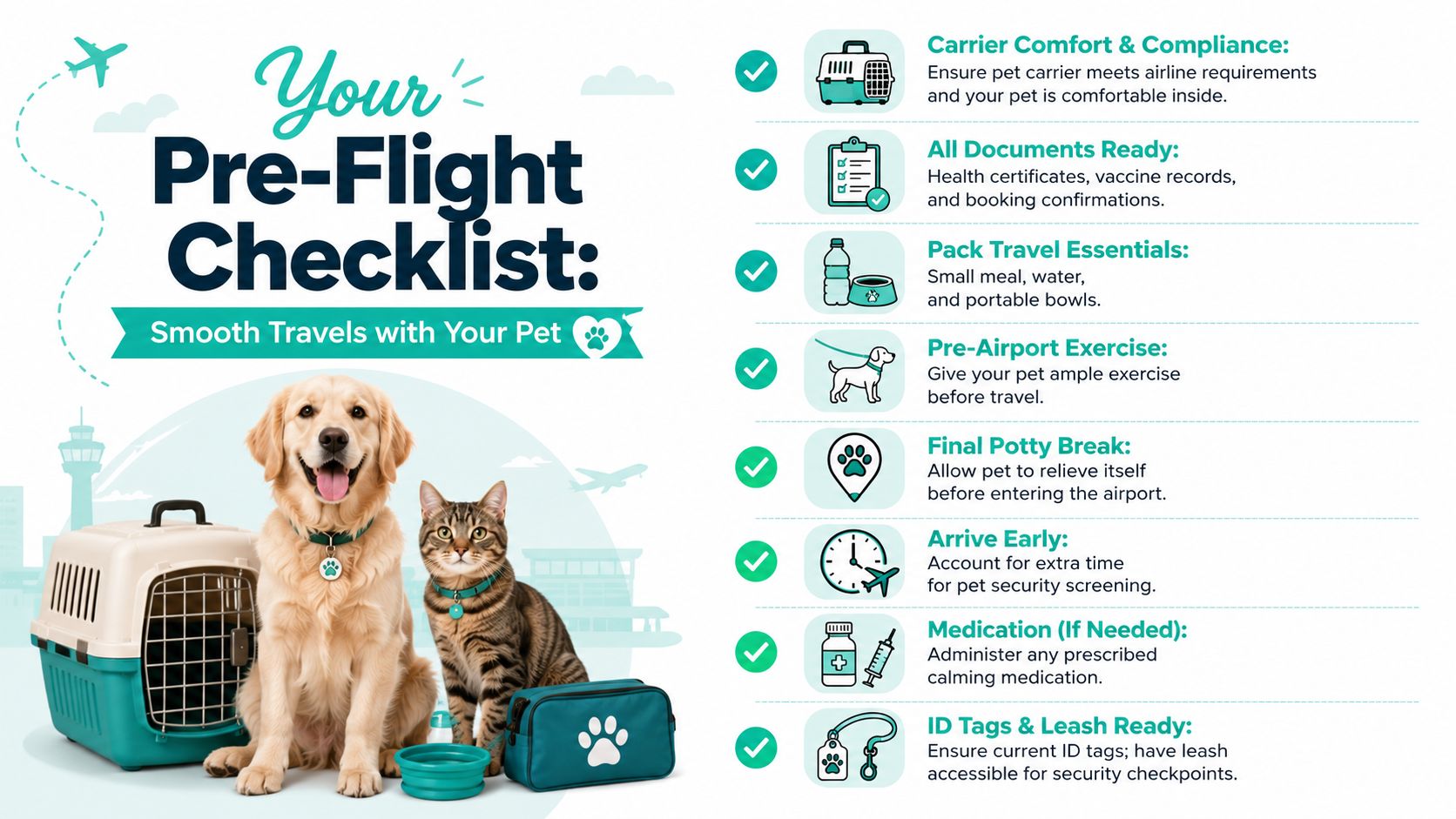
Run this final check:
Carrier ready: Clean, fully zipped, liner in place, ID tag attached
Documents packed: Booking confirmation, vaccination records, health certificate if required, and any destination entry paperwork
Leash or harness accessible: Ready for security, not packed at the bottom of a tote
Pet basics packed: Pads, wipes, a small water option, and one familiar comfort item
Timing realistic: Enough margin for check-in, document review, security, and a last potty break
Documentation is where nervous owners lose time. For domestic flights, staff may only want to confirm your pet reservation and basic compliance. For international travel, the paper trail matters more. The health certificate, supporting vaccine records, and destination-specific forms need to be consistent with each other, not just present. If names, dates, or microchip details do not match, the problem shows up at the airport, not at home where it is easy to fix.
Keep bedding simple. A thin liner or small blanket adds comfort without stealing usable space inside the carrier. This ultimate guide to pet blankets is a useful reference for soft, travel-friendly materials that will not bulk up a compact cabin setup.
At the airport
Start at check-in with a clear, calm heads-up that you are traveling with a pet in the cabin. Agents often want to confirm the pet booking, look at the carrier briefly, and in some cases review documents before you head to security. If you are flying internationally, keep your paperwork in one folder in the order it will likely be checked. Reservation first, then health documents, then destination forms. That saves fumbling at the counter.
Security is the part many owners worry about most, but the sequence is straightforward once you know it. Your pet comes out of the carrier. The empty carrier goes through screening. You carry or securely handle your pet while you pass through. I always tell clients to rehearse that handoff at home once or twice, especially with cats and small dogs that try to back out of a harness when stressed.
Expect a little waiting.
Shoes, laptop, pet, carrier, boarding pass, and your own nerves all compete for attention at the same time. A simple plan helps. Put the leash or harness on before you enter the line, keep one hand free, and avoid opening the carrier any more than necessary.
On board
Once you reach your seat, slide the carrier fully under the seat in front of you unless the crew gives different instructions. Then leave the setup alone as much as possible. Pets usually settle faster when the carrier stays level, covered by the seat space, and predictable.
A steady routine works better than constant soothing.
Moment | Best move |
|---|---|
Boarding | Keep the carrier level and close to your body |
Takeoff | Let your pet adjust without repeated opening or repositioning |
During flight | Reassure softly if needed, but keep the carrier closed and stable |
Landing | Wait for space in the aisle before handling leash, bags, and carrier together |
Good pet carrier carry on travel comes from fewer surprises. The owners who have the smoothest airport day are usually the ones who treated documents, security handling, and boarding setup as one connected process, not three separate tasks.
Passpaw helps veterinary teams and pet owners handle the paperwork side of international pet travel with less guesswork. If you need support with health certificate workflows, destination requirements, and cleaner document coordination, take a look at Passpaw.

More articles
From regulatory changes to best practices for veterinarians and pet owners, our resources keep you ahead of the curve.