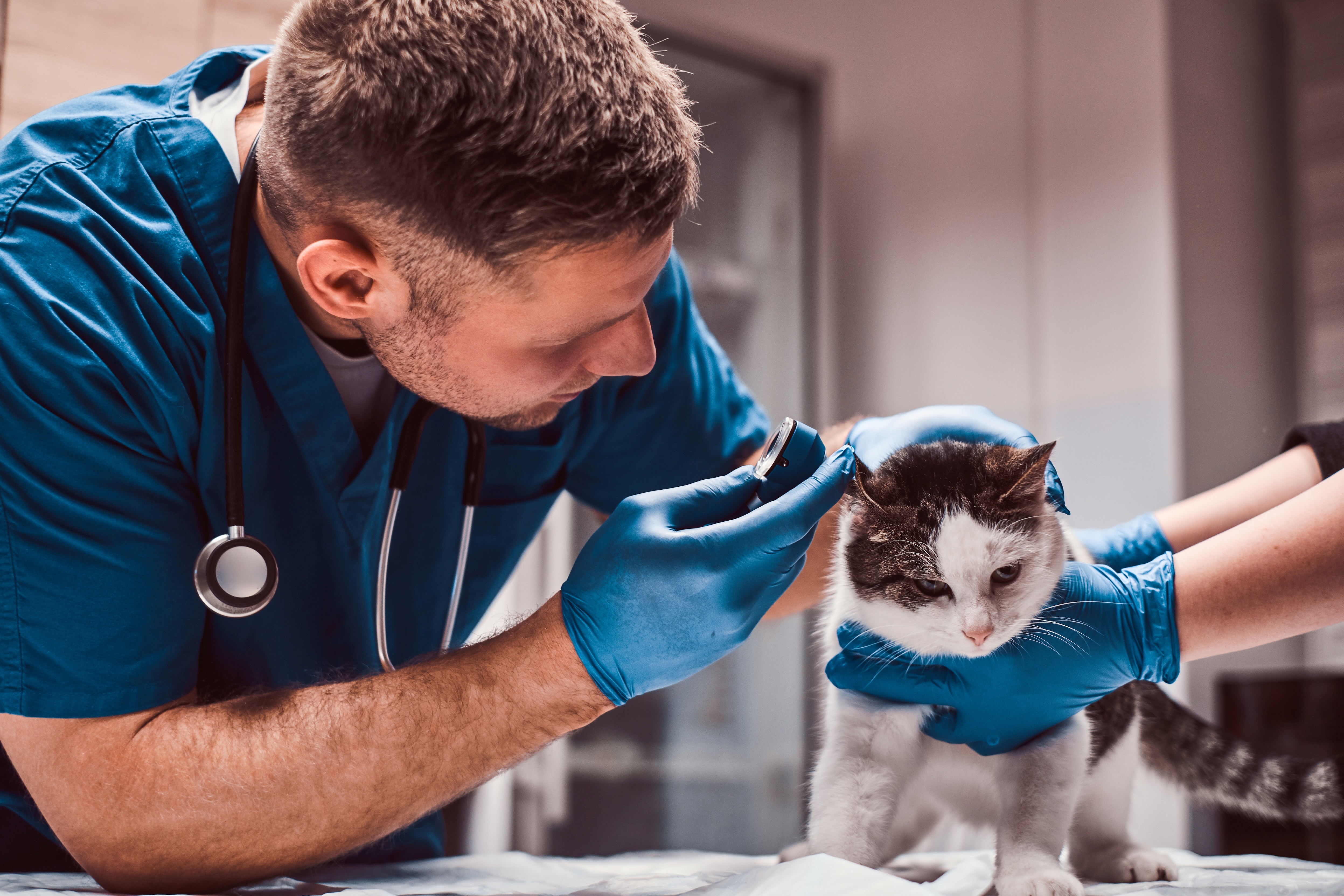
Are you a team member in a veterinary practice?
Are you a pet parent planning a trip with your furry pal?
Compliance Management Example: Pet Travel Workflows in 2026
A dog is due to fly in a few days, but the rabies vaccination date on the record doesn't match the date in the clinic system. The microchip number has one digit missing, and the veterinarian's signature hasn't been added to the certificate. The owner is calling repeatedly because nobody can say whether the application is ready.
That situation shows why the strongest compliance management example isn't just a rule or a document. It's a repeatable process that identifies the destination requirements, assigns each task, checks the work, keeps the owner informed, and records important decisions. A good workflow helps a veterinary practice spot problems while there's still time to fix them.
The eight examples below show how teams can connect document controls, staff actions, client communication, regulatory updates, and practical process measures. Pet travel rules can vary by country, route, airline, and date, so practices and owners should confirm current requirements through appropriate official sources and qualified professionals before travel.
1. Health Certificate Document Verification Systems
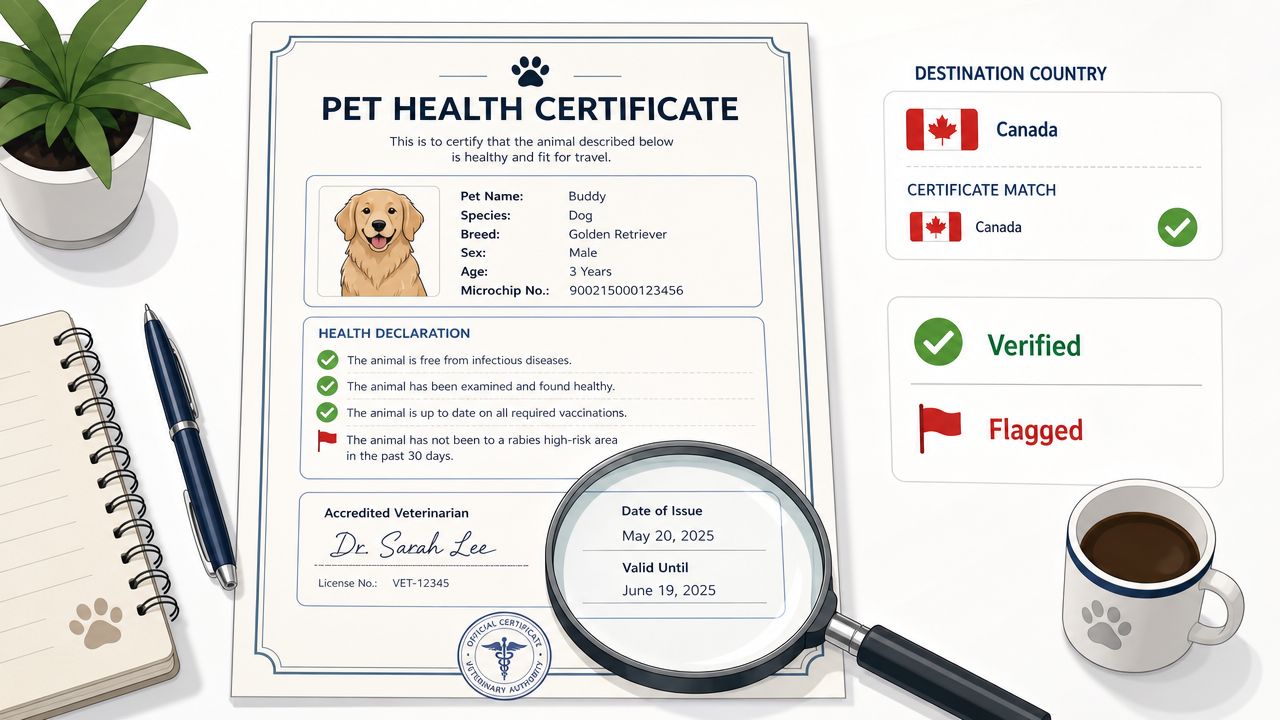
A health certificate verification system gives staff a consistent way to review every document before it reaches an airline, government authority, or border official. Instead of relying on memory, the team checks the certificate against the destination, the pet's records, the travel date, and the responsible veterinarian's credentials.
For pets traveling from Great Britain to the EU, an animal health certificate is required for entry and is valid for 10 days after it's issued. A new certificate is needed for each separate trip, while onward travel within the EU may continue for up to 6 months if the rabies vaccination remains valid, according to official Great Britain pet travel guidance. Those details make date control just as important as document completion.
A clinic might use this process before submission:
Confirm the destination: Select the correct country and route, not merely a general “international travel” template.
Match identity details: Compare the pet's name, species, owner information, and microchip number across every record.
Review dates: Check vaccination timing, certificate issue dates, travel dates, and any destination-specific waiting periods.
Verify signatures: Confirm that the required veterinarian signature, date, and professional information are present.
Record exceptions: Assign a named staff member to resolve every discrepancy before approval.
Practical rule: A document that looks complete may still be wrong for the destination. Validate it against the current requirement set, not against yesterday's case.
Create master templates for common routes, automatic reminders for vaccination renewals, and a reference guide that staff can update when rules change. A monthly review of frequently used destinations can help prevent stale instructions. Practices can also use this document verification approach for pet travel to organize checks before submission.
2. Client Communication and Status Update Protocols
A pet owner shouldn't have to guess whether a certificate is waiting for a document, under veterinary review, or ready for submission. A clear communication protocol turns an anxious process into a visible sequence of stages.
Consider a clinic handling several international cases at once. Each application can have a simple status such as information needed, documents received, veterinary review, authority review, or ready for travel. The status should show the next action, the person responsible, and the condition that moves the case forward.
A practical message might tell the owner that the clinic has received the rabies record, still needs confirmation of the microchip number, and will review the complete file after that information arrives. That's more useful than a vague note saying the application is “being processed.”
Build communication around decisions
Use email, SMS, or an in-app message according to the owner's preference, but keep the underlying record in one controlled system. Send updates at consistent intervals, and send an immediate alert when the owner must act.
Good messages usually include:
Current stage: Explain what the team has completed.
Next step: Say exactly what the clinic, owner, veterinarian, or authority must do next.
Required information: Name the missing record or correction in plain language.
Timing context: Explain how the travel date affects priority without promising approval.
Contact path: Give the owner one clear person or channel for questions.
A weekly update can work for a longer application, but a case close to departure may need more frequent contact. Practices should also set expectations about response times, especially when an external authority or airline must review the paperwork.
For more practical guidance on keeping owners informed, see this resource on veterinary client communication. Clear updates reduce repeated calls because the owner can see what's happening, what's missing, and what to do next.
3. Vaccination Record Management and Tracking
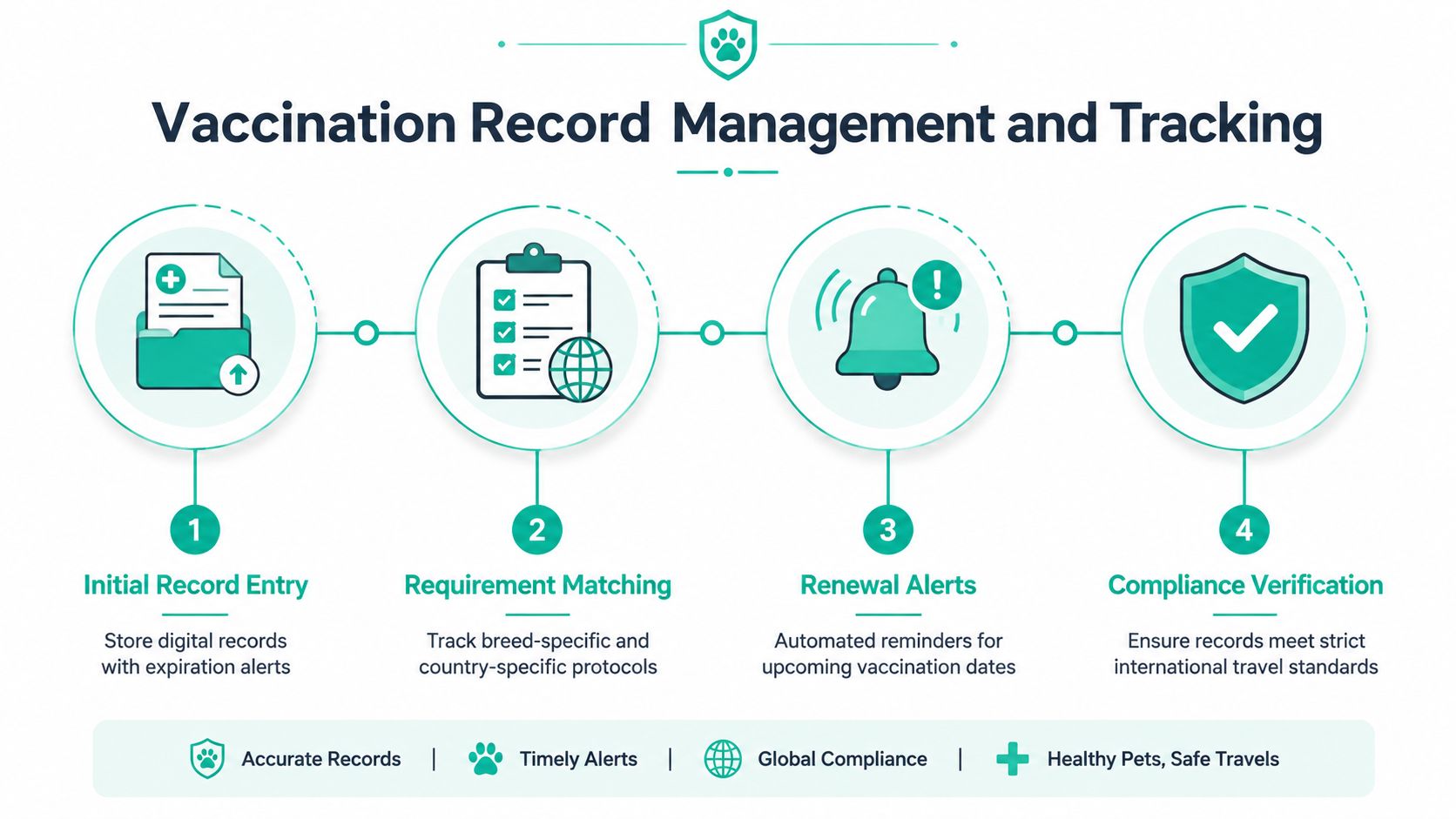
A vaccination record becomes useful for travel only when staff can interpret it quickly and connect it to the destination rule. Record the exact vaccine, administration date, expiry information, batch number, veterinarian's entry, and the requirement applied to the case. A simple “up to date” label leaves too many decisions unresolved.
For rabies, sequence and timing both matter. EU guidance requires the vaccination to follow microchip identification, and owners usually need to wait at least 21 days after a first rabies vaccination before travel. The EU pet travel guidance states that validity begins no fewer than 21 days after the primary vaccination is completed.
Build those checks into the case workflow. Staff first confirm the chip identification, then enter the vaccine details, calculate the earliest permitted travel date, and compare it with the planned journey. If the dates are too close, assign the case for review instead of leaving it in a general queue. Record who completed each step so a colleague can continue the file without repeating the work.
Make records readable and action-oriented
Color coding can help staff spot vaccine types or urgency levels, provided written dates and notes remain the controlling record. Rabies, DHPP, and FVRCP may require different handling based on the destination, animal, and professional assessment.
Use a short control list:
Early reminders: Alert the owner before expiry could affect travel planning.
Exact product records: Save the vaccine type, batch number, administration date, and veterinary entry.
Owner education: Explain why administration must fall within a particular window.
Backup records: Keep a secure physical or alternative digital copy if the main system is unavailable.
Destination matching: Link the vaccination record to the country requirement used for that case.
A puppy prepared for international relocation tests the process from start to finish. The practice must capture records from the beginning, identify the first eligible travel date, and check the destination rule rather than assuming a routine schedule qualifies. Reviewing dog health records can help practices refine their filing standards for travel cases, including feline files and other species with different documentation needs.
Track practical measures such as missing fields, late reminders, date corrections, and cases escalated before departure. Those results show whether the workflow is reducing rework and giving staff and owners clearer next steps.
4. Microchip Registration and Verification Compliance
A microchip number anchors the pet's identity across travel records. An unreadable scan, transcription error, or outdated owner profile can prevent staff from connecting the animal with the correct vaccination history and health certificate.
Build verification into the intake workflow for every travel case. Scan the animal, compare the result with the medical record and travel documents, check the relevant registry, and record who verified the number and when. If the owner's name, address, or contact details differ between systems, pause the file, assign an owner, and document the resolution before the certificate progresses.
The checks should match the route. A UK clinic preparing a pet for EU travel may need to confirm that the chip scans correctly, matches the certificate, and is registered under current owner details. A pet shipper relocating an animal to Japan may follow a similar process, while an Australian import case may require the veterinarian to confirm chip information while preparing the health certificate. Staff should record the route-specific action rather than treating every destination as identical.
Registration also needs review after a move, phone-number change, ownership transfer, or international adoption. Rescue organizations and breeders can include chip verification in each handoff, giving the receiving practice a clear starting record.
Use these controls within the case workflow:
Registry reference: Maintain the relevant international registry details for staff use.
Independent confirmation: Compare the chip number with another available source when appropriate.
Discrepancy flag: Mark conflicting owner or animal information for prompt review.
Verification note: Record the registry checked, date, staff member, and outcome.
Owner prompt: Ask the owner to confirm current contact details and explain how updates are made.
Practices can review guidance on ISO-compliant microchips, then adapt the scan, registry check, escalation path, and completion note to their records and veterinary procedures. Track unresolved mismatches, repeat scans, and cases completed without rework to identify process improvements.
5. Regulatory Requirement Database Management
A regulatory database turns route requirements into working instructions staff can use when a case opens. Each destination record should identify the documents to request, dates to calculate, authorities that may need to act, and questions requiring escalation.
Start with the routes the practice handles most often. A concise guide that staff trust can work better than a large file that is difficult to maintain. Include the destination, source date, required documents, vaccination conditions, microchip requirements, health certificate details, airline considerations, and the person responsible for the latest review.
Build a controlled update cycle
Assign ownership before adding more destinations. Regulations change, and different sources may cover separate parts of the journey. Staff can monitor appropriate official government updates and relevant professional veterinary organizations, while unclear requirements should be checked with an embassy or authority.
Use a review record with these fields:
Named ownership: Assign one staff member to review priority destinations regularly.
Change log: Record what changed, when it changed, and which cases may be affected.
Route flowcharts: Convert common journeys into simple decision paths.
Source tracking: Link each instruction to the official page or authority used.
Escalation notes: Record questions for a veterinarian, regulator, airline, or customs contact.
For example, Great Britain requires a pet health certificate for entry from a Part 2 listed or unlisted country. An official veterinarian must sign and date the certificate, and the pet must enter Great Britain within 10 days of issue. For sea travel, that period can extend by the duration of the sea journey, according to Great Britain's official certificate guidance.
Store that route-specific rule with its source, review date, and any internal handling note. The database should surface it when staff open a case, rather than leaving them to search old emails. It should also show when a review is overdue and when a case needs professional judgment. Track outdated entries, escalations, and cases delayed by missing or unclear requirements. Those measures show whether the database is improving the workflow, not merely becoming a larger file.
6. Workflow Automation and Error Reduction Processes
Automation works best when it supports a process that the practice already understands. It shouldn't be used to hide unclear ownership or replace professional review.
Start by mapping the current journey from intake to completion. Mark every handoff, repeated data entry, approval, delay, and correction. Then automate the predictable parts, such as routing a case by destination, requesting a missing record, prioritizing by travel date, and alerting staff when an application remains inactive.
A clinic might create a destination-based workflow that asks for the pet's identity details first, checks the vaccination record next, assigns a certificate task to the veterinarian, and sends the owner a message when the file moves forward. An international clinic could add a separate path for cases requiring extra authority review. The workflow should stop when information conflicts, rather than pushing an incomplete file toward submission.
Automation should remove repetitive chasing, not remove accountability. Every important decision needs a responsible human reviewer.
Design controls into the automation
Build quality checkpoints into each stage. Staff should be able to see why a task was created, which rule triggered it, and what evidence supports completion. Keep a manual fallback for outages, and train the team before launching the workflow across every route.
Review automation logs for stalled cases, repeated corrections, and tasks that staff routinely override. Those patterns can show that a rule is unclear, a form asks for the wrong information, or a handoff needs redesign.
Teams comparing workflow tools can also examine Fluidwave's automation examples, then decide which ideas fit their own systems and data controls.
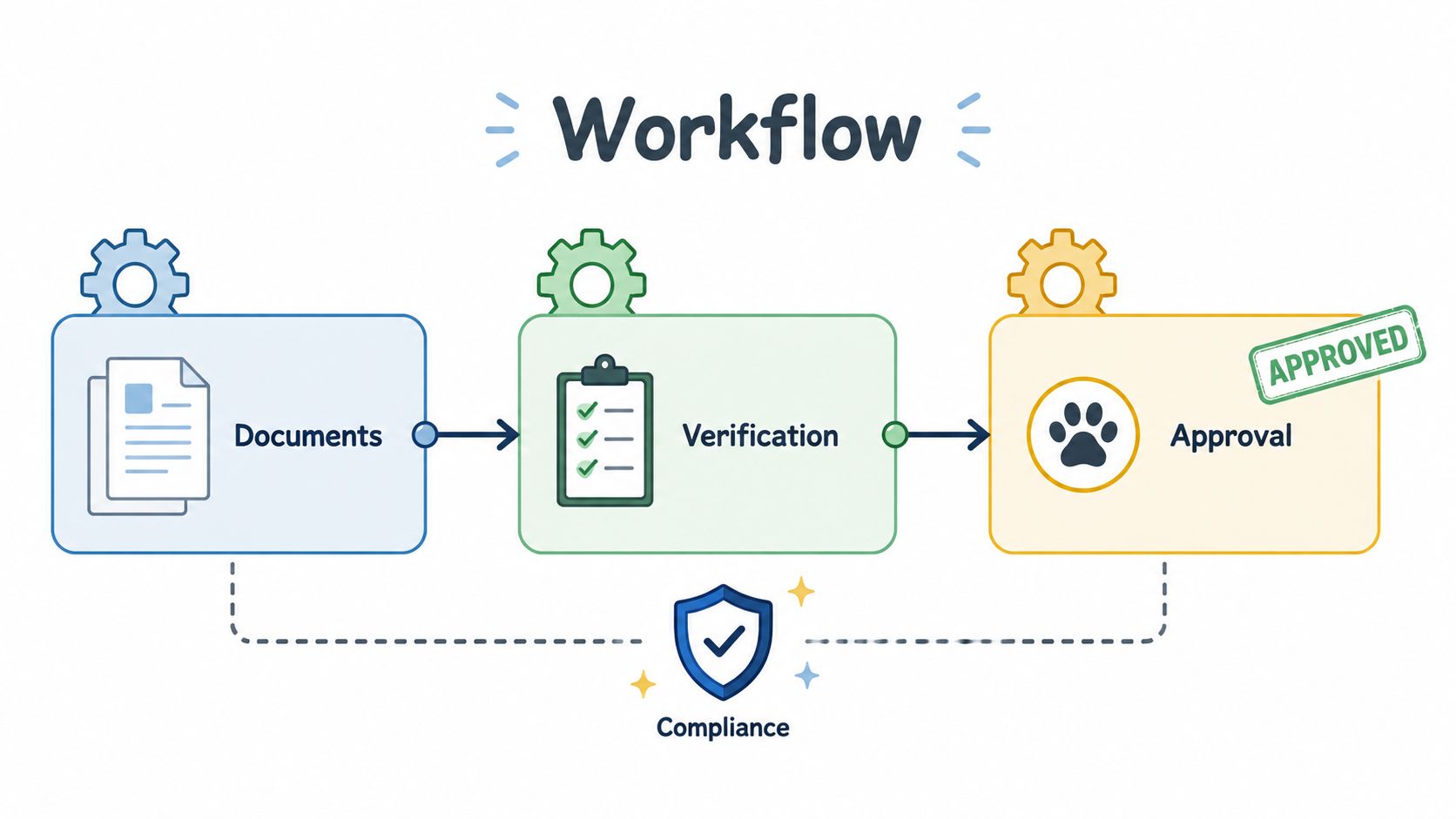
The best automation leaves a clear trail. It tells staff what happened, what still needs attention, and who owns the next move.
7. Compliance Audit Trails and Record Retention
An audit trail answers four practical questions: what happened, when did it happen, who handled it, and why was a decision made? In pet travel, that may include the record reviewed, the correction requested, the owner's response, the veterinarian's approval, and the date a document was submitted.
A digital file should capture more than the final certificate. It should preserve the supporting vaccination record, microchip verification, communication history, authority correspondence, and meaningful changes to the application. If a regulator, airline, owner, or internal reviewer asks about a decision later, the practice can reconstruct the case without depending on one employee's memory.
Keep records usable, not merely stored
Automatic timestamps are preferable to handwritten timing notes. Records should be searchable by pet, owner, destination, and travel date, with access limited to appropriate staff. Backups should use secure locations, and practices should consider how privacy, retention, and deletion obligations apply to their systems.
A practical retention policy should define:
Record categories: Separate certificates, medical records, messages, approvals, and authority responses.
Retention periods: Set a written schedule appropriate to the practice, jurisdiction, and professional obligations.
Decision notes: Explain unusual interpretations, exceptions, and escalation outcomes.
Access controls: Limit editing and viewing rights according to staff responsibilities.
Recovery steps: Test backups and maintain a manual process for system failure.
Independent compliance guidance recommends measuring indicators such as time-to-detect, self-reporting, training completion with knowledge checks, vendor re-screen changes, recurring incidents, reopened audit findings, regulatory inquiries, loss events, cost per control test, false-positive ratios, and issue-to-closure cycle time. For a veterinary practice, the list can be adapted to measures such as time to detect a missing field, correction requests, reopened cases, and time from issue to resolution. See compliance benchmark guidance for the broader measurement framework.
8. Cross-Border Regulatory Coordination and Liaison
Some pet travel questions don't fit neatly into a database field. A route may involve an unusual species, a transit country, a special airline condition, or wording that different authorities interpret differently. In those cases, direct coordination helps the practice identify the right question and document the answer.
A practice leader might maintain contacts at relevant veterinary authorities, customs offices, airlines, and professional associations for its main routes. A pet shipper may build relationships with customs agencies at major ports. A clinic handling unusual cases may consult the relevant government health agency before preparing the final paperwork.
The purpose isn't to replace official instructions. It's to clarify how those instructions apply to a particular case and to identify which authority has responsibility.
Turn conversations into controlled knowledge
When a regulator or agency provides clarification, record the date, contact, question, answer, and affected route. Request written confirmation when possible. If the answer changes a clinic procedure, update the requirement database, notify staff, and review open cases that may be affected.
Useful relationship-building actions include:
Contact mapping: List the authorities and agencies that matter for each main destination.
Professional participation: Join relevant associations and attend regulatory events.
Knowledge sharing: Discuss practical changes with trusted veterinary and shipping peers.
Quiet-period maintenance: Keep relationships active even when no urgent case is open.
Escalation discipline: Send specific questions with the pet's route, dates, and documents.
For logistics teams, live animal freight services offer a useful example of the operational coordination involved in moving animals through transport networks. A veterinary practice should still confirm the compliance requirements with the appropriate authorities and professionals for each case.
8-Point Compliance Management Comparison
Practice | Implementation Complexity 🔄 | Resource Requirements ⚡ | Expected Outcomes ⭐📊 | Ideal Use Cases | Key Advantages 💡 |
|---|---|---|---|---|---|
Health Certificate Document Verification Systems | Medium 🔄🔄, destination DB setup & maintenance | Moderate ⚡⚡, software + staff training | High ⭐⭐📊, fewer rejections; faster approvals | Clinics and shippers handling multi-country travel | Catches errors early; enforces destination-specific rules |
Client Communication and Status Update Protocols | Low–Medium 🔄🔄, templates & scheduling | Low–Moderate ⚡⚡, messaging tools, staff time | High ⭐⭐📊, reduced client anxiety & calls | Practices prioritizing client transparency | Improves trust; reduces manual follow-ups |
Vaccination Record Management and Tracking | Medium 🔄🔄, integration & timeline logic | Moderate ⚡⚡⚡, record systems + alerts | High ⭐⭐📊, prevents vaccination lapses | Practices with complex vaccine timelines (e.g., Australia) | Ensures timely renewals; documents compliance |
Microchip Registration and Verification Compliance | Low–Medium 🔄🔄, registry access & checks | Low ⚡⚡, registry subscriptions, lookup tools | Medium–High ⭐⭐📊, meets mandatory ID requirements | Any international travel requiring ISO chips | Verifies owner info; prevents travel denials |
Regulatory Requirement Database Management | High 🔄🔄🔄, continuous research & updates | High ⚡⚡⚡, dedicated staff or subscription services | High ⭐⭐📊, accurate, up-to-date guidance | Practices servicing many destination countries | Prevents mistakes from outdated rules; saves research time |
Workflow Automation and Error Reduction Processes | Medium–High 🔄🔄🔄, design, testing & exceptions | Moderate–High ⚡⚡⚡, automation platform + integrations | Very High ⭐⭐⭐📊, consistent processes; faster turnaround | High-volume clinics and shipping operations | Eliminates missed steps; standardizes cases |
Compliance Audit Trails and Record Retention | Medium 🔄🔄, logging & retention policies | High ⚡⚡⚡, secure storage & backups | High ⭐⭐📊, legal protection; audit readiness | Practices subject to regulatory audits | Provides accountability; supports dispute resolution |
Cross-Border Regulatory Coordination and Liaison | High 🔄🔄🔄, relationship building & follow-up | High ⚡⚡⚡, time, travel, multilingual support | High ⭐⭐📊, authoritative clarifications; faster fixes | Complex or ambiguous regulatory cases | Clarifies gray areas; speeds problem resolution |
Turn Good Intentions Into a Repeatable Travel Process
These examples work best as one connected operating model, not as eight unrelated projects. Start with the information that drives every later decision: the destination, route, travel date, pet identity, owner details, vaccination history, and microchip record. Then attach the applicable requirements and identify which tasks belong to the owner, veterinary team, official veterinarian, airline, shipper, or authority.
The first practical rollout can be deliberately small. Choose the routes your practice handles most often and create a controlled requirement guide for them. Add document templates, date checks, microchip verification, and a named owner for every open task. Once staff can follow that path consistently, add less common destinations and more complex transit arrangements.
Client communication should sit inside the workflow, not beside it. Owners need clear notices when the clinic receives a record, identifies a discrepancy, needs a signature, or reaches a review stage. A status tracker can reduce uncertainty, but it shouldn't imply that an authority or airline has approved a case before that approval exists.
Automation belongs after the basic process is clear. Use it to request information, route tasks, prioritize cases by travel date, flag conflicting data, and alert staff about stalled applications. Keep human review for professional decisions and exceptions. A trustworthy workflow should show what the system checked, what evidence it used, and who approved the next step.
Audit trails make improvement possible. Track processing time, correction requests, stalled applications, missed tasks, reopened reviews, and issue-to-closure cycle time. These measures help a practice see where work slows down and whether a process change is helping. They don't guarantee acceptance at a border or approval by an airline, so teams should use them as operational indicators rather than legal assurances.
The wider business context supports that discipline. A 2022 NBER study estimated that the average US firm spends between 1.3% and 3.3% of its total wage bill on compliance-related work. The study estimated national compliance wage costs at $79 billion to $239 billion in 2014, rising to as much as $289 billion when equipment is included, and found that aggregate compliance costs grew by about 1% per year from 2002 to 2014. Those figures appear in the Cato research brief discussing the NBER study. Even a small practice may benefit from reducing avoidable rework, although it should measure its own baseline rather than borrow a benchmark.
Review the workflow regularly, update destination rules through appropriate official sources, and keep a manual fallback for system failures. Passpaw can fit into this model where a practice needs document validation, task prioritization, client communication, and workflow support for pet travel applications. The process remains the responsibility of the practice and its qualified professionals, but the right tools can make each handoff easier to see and manage.
Passpaw helps veterinary teams organize destination requirements, validate pet travel documents, prioritize tasks, and keep owners informed as applications progress. Visit Passpaw to see how its workflow tools can support a more consistent pet travel compliance process.

More articles
From regulatory changes to best practices for veterinarians and pet owners, our resources keep you ahead of the curve.