Are you a team member in a veterinary practice?
Are you a pet parent planning a trip with your furry pal?
Cat Crate Training: A Stress-Free Travel Guide
Your cat sees the carrier come out of the closet and vanishes under the bed. You kneel on the floor with treats in one hand, apology in the other, already bracing for the wrestling match. If you're planning a move, a long drive, or international travel, that scene can feel even heavier because the carrier isn't just for one appointment. It becomes part of a much bigger process.
That stress is exactly why cat crate training matters. Done well, it doesn't teach a cat to “put up with” a box. It teaches them that the crate is familiar, predictable, and safe. For veterinary teams and pet owners dealing with travel paperwork, flight schedules, and health certificate timing, that comfort makes the whole trip easier to manage.
Why Crate Training Is a Gift to Your Cat (and You)
Most cats don't hate the carrier itself. They hate what the carrier predicts. If the only time it appears is before a vet visit, a move, or a noisy car ride, your cat learns fast. The crate becomes the opening act for something scary.
Cat crate training changes that pattern. Instead of using the crate as a trap, you turn it into a safe den. That shift matters at home, in the clinic, and during travel. A cat who can settle in a crate is easier to monitor after a procedure, easier to move during an emergency, and much less likely to arrive at the airport already frazzled.
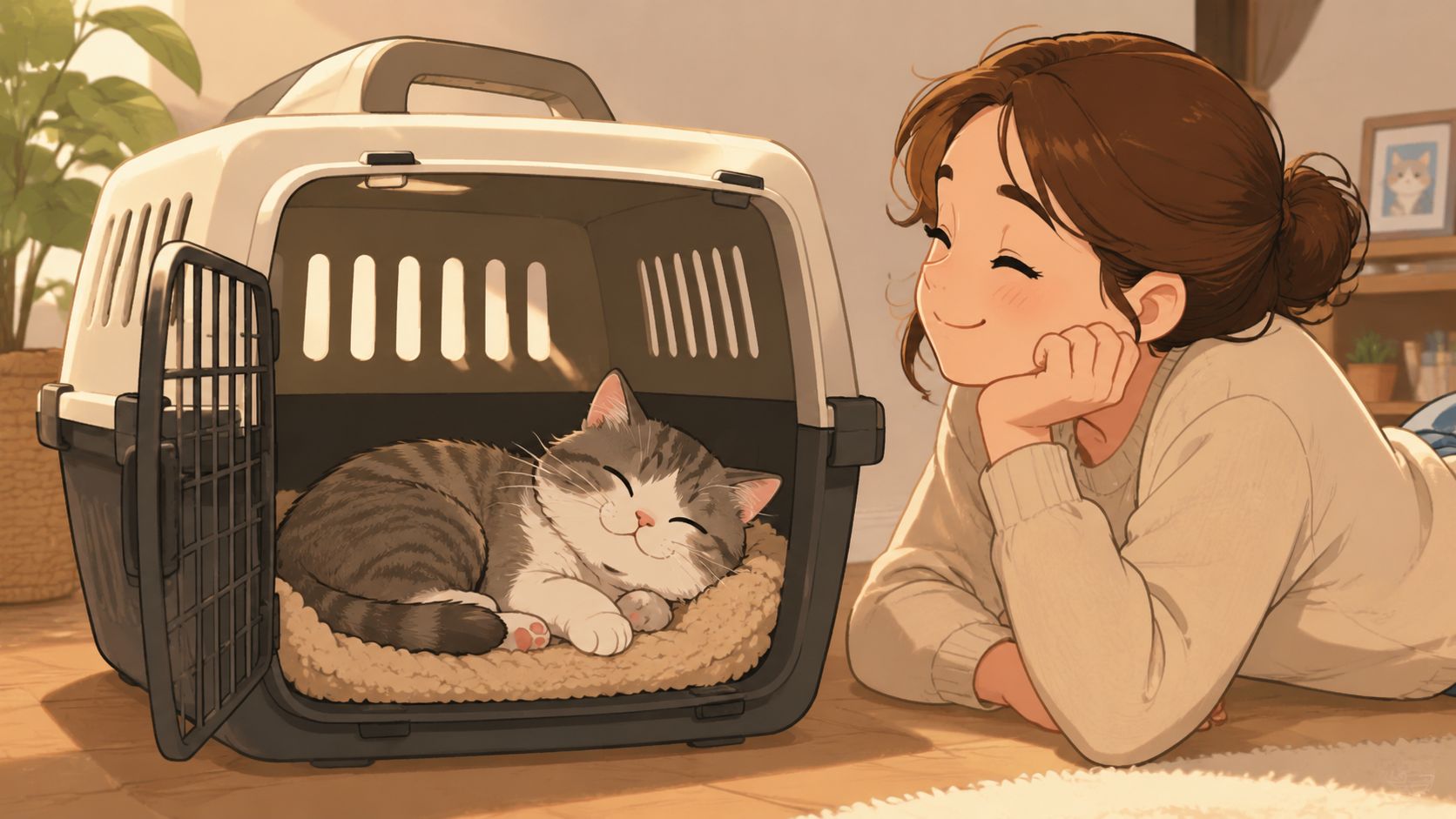
The real goal isn't obedience
Cats aren't dogs in small fancy coats. Pushing harder usually backfires. Good training works with feline habits. Cats like routine, control, and enclosed resting spots. A crate can meet all three needs if you introduce it slowly and keep the experience pleasant.
A useful reality check comes from Petfinder's cat crate training discussion. Data shows that 60% of cats exhibit acute stress during travel visits, yet only 15% of training guides recommend integrating the crate into daily home life for 2+ weeks prior to travel to build genuine positive association beyond food rewards. That gap is the problem. Many people focus on “getting the cat into the carrier today” instead of “helping the cat trust the carrier over time.”
A crate should feel like your cat's studio apartment, not a surprise elevator ride.
Why this matters even more for travel
International travel adds extra friction. There may be longer wait times, more handling, and unfamiliar sounds and smells. Even when every document is correct, a cat that panics inside the crate can make the day much harder for everyone involved.
That doesn't mean every cat will love travel. Some won't. But many can learn to tolerate it calmly when the crate already feels normal at home.
A few benefits show up quickly:
Less conflict at departure time: You don't have to chase, grab, and force.
Better recovery after stressful moments: Cats settle faster in a familiar enclosure.
Safer handling for veterinary staff: A calm cat in a known crate is easier to assess and transport.
More flexibility for owners: The crate can double as a resting space during hotel stays, moves, or temporary confinement.
For many cats, this isn't about making them adventurous. It's about making life less hiss-terical when plans change.
How to Choose the Right Cat Crate for Home and Travel
Buying the wrong crate creates problems before training even starts. A flimsy carrier for daily den work may feel cramped. A giant airline crate dropped into the living room without preparation may intimidate a cautious cat. Match the crate to the job.
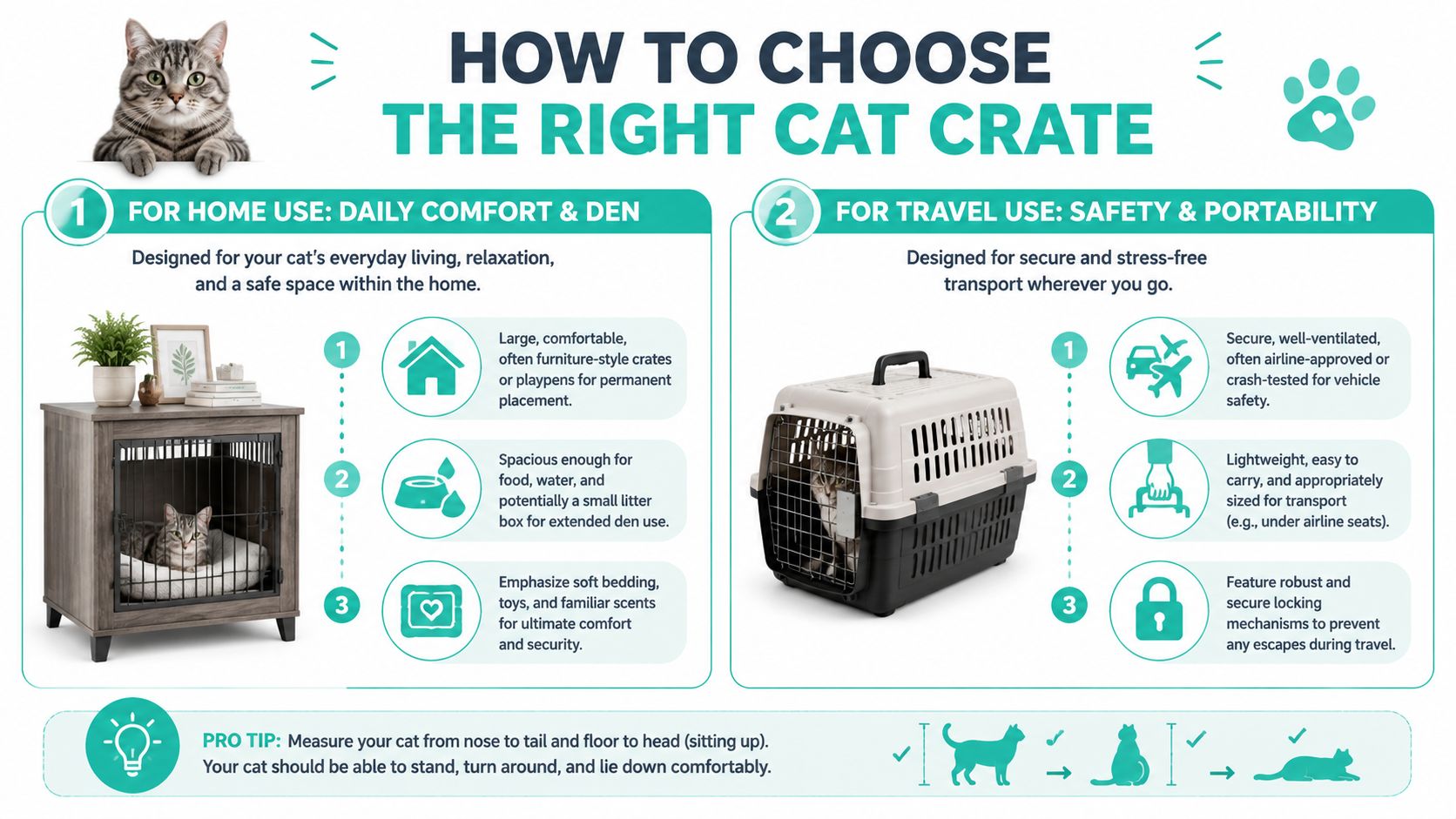
Two jobs, two crate styles
For home use, think comfort first. Your cat needs enough room to rest, turn, and settle without feeling exposed. If you're using the crate as a recovery space or long den-style setup, you'll also want room for basics like bedding and, in some situations, feeding or cleaning access.
For travel use, safety takes the lead. The crate needs stable walls, strong doors, good ventilation, and secure hardware. For car rides, that often means a sturdy carrier that won't collapse if jostled. For flights, especially international ones, hard-sided crates are often the practical choice because they handle transport demands better.
Soft-sided carrier or hard crate
A simple comparison helps:
Use case | Usually works best | Why |
|---|---|---|
Short local car trip | Soft-sided or sturdy small carrier | Easier to carry, lighter, often less bulky |
Vet visits | Hard-sided carrier with easy-open access | Better for safe handling and cleaning |
Home den training | Larger crate or playpen-style setup | More room for rest and gradual comfort |
Airline travel | Hard-sided airline-compliant crate | Better structure, ventilation, and lock security |
If you're sorting through options, Passpaw has a practical guide to cat travel crates for calm journeys that helps owners compare common travel setups.
What to check before you buy
Don't get distracted by color or cute branding. Focus on function.
Ventilation: Airflow matters at home and during transport.
Locking mechanism: Test the latch yourself. It should close securely without feeling flimsy.
Cleaning access: Accidents happen. Smooth surfaces and removable bedding save headaches.
Entry style: Top-loading access can be helpful for some clinic visits, while front-entry models often work better for routine training.
Floor stability: A sagging base makes nervous cats feel unsafe.
Practical rule: If the crate rattles, tips, or flexes too much when you pick it up empty, your cat will notice.
International travel needs more planning
Air travel changes the conversation. Larger crates can look and feel more threatening, especially if a cat has only ever seen a small home carrier. A travel industry article notes that existing content rarely distinguishes that 45% of US-bound pet air shipments now require cargo transport due to new airline breed restrictions, yet no major guide outlines the distinct 6-week desensitization protocol needed for the larger, more intimidating cargo crate dimensions in Pets in Transit's review of cat travel crate training.
That point is worth sitting with. A cat who accepts a soft carrier for a short drive isn't automatically ready for a large cargo crate. The size, sound, and visual openness are different. When a family is planning international relocation, I usually advise them to choose the travel crate early and train with that exact model whenever possible.
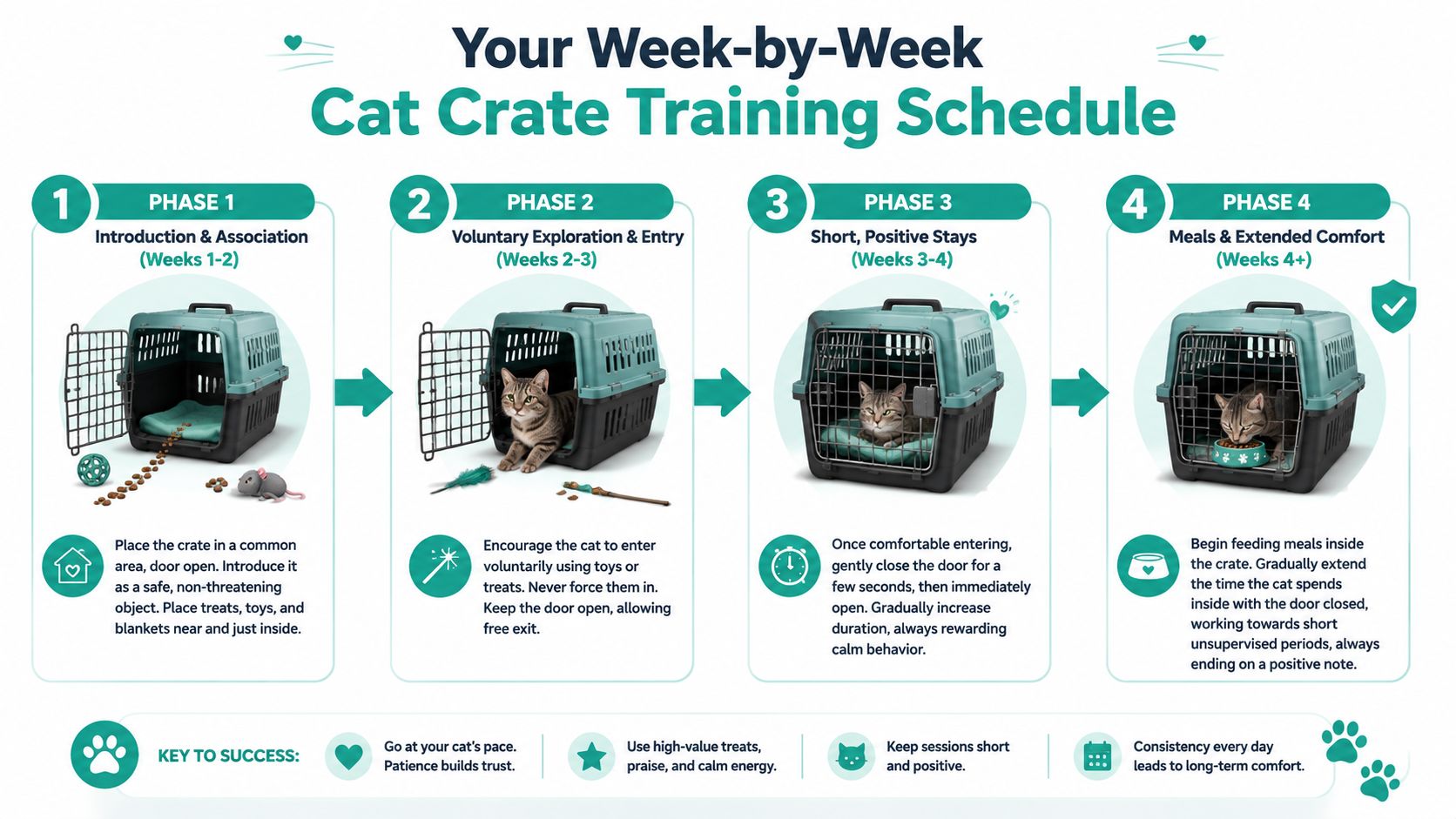
Your Week-by-Week Cat Crate Training Schedule
Good cat crate training is boring in the best way. It relies on repetition, predictable routines, and very small wins. Fast progress is nice, but calm progress is better.
The structure below follows a practical timeline used in cat training guidance. Catster's carrier training article advises that training sessions should be conducted at least once daily for a period of two weeks, with the specific goal of building the cat's tolerance until they can calmly stay inside the crate for more than 10 minutes before introducing movement or car travel.
Weeks 1 and 2 with the crate as home base
This is the hardest part for many owners because it asks for patience. Several structured protocols use a first two-week period where the crate becomes the cat's primary confinement space, with breaks only for feeding and cleaning, so the cat learns that the crate is normal territory rather than a temporary punishment. The early benchmark is simple. Your cat should be able to remain calm in the stationary crate before you ask for anything more.
If you're using this more formal approach, set the crate up thoughtfully:
Soft bedding: Use fabric your cat already sleeps on.
Familiar scent: A worn shirt or usual blanket often helps.
Low drama placement: Choose a quiet but not isolated room.
Predictable rewards: Offer treats, toys, or meals in relation to the crate, not after a struggle.
The first goal isn't “go in on cue.” The first goal is “nothing bad happens here.”
Start with an open-door routine
Leave the crate available. Let your cat investigate. Toss treats near the entrance, then just inside, then farther in. If your cat sniffs and backs away, that's still information. Don't shut the door just because they finally stepped in. That move teaches suspicion faster than almost anything else.
Use short daily sessions. End before your cat gets irritated. A minute of calm exploration is more useful than a long session that ends in protest.
If your cat is watching the crate without hiding from it, you're already making progress.
Build calm duration before movement
Once your cat enters willingly and stays for a moment, start asking for slightly longer settled behavior. This can be resting, sitting, or staying inside without trying to bolt. Reward quiet body language. If your cat is crouched, wide-eyed, or pawing the door, you've moved too fast.
A useful milestone from structured training guidance is 10 minutes of calm in a stationary crate before adding lifting, carrying, or driving. That target helps owners avoid the common mistake of testing the car too soon.
Week 3 with supervised room access
By the third week in a more formal schedule, many protocols allow the cat out of the crate only under supervision in a single room. This is a transition phase. The crate stays important, but the cat starts learning that entering and leaving it happens within a calm routine.
At this point, training becomes more interactive:
Invite entry before meals: Place food just inside, then deeper inside as comfort grows.
Practice short settled periods: Wait for calm, then reward.
Close the door briefly: Open it before your cat starts to panic.
Return to normal life: After each session, let the experience fade without fanfare.
This is also where many owners benefit from reading about how cats adjust to a new home, because the same themes apply. Routine, small territory, and predictability reduce stress.
Week 4 and beyond with everyday life around the crate
During the fourth week of the classic schedule, the cat can spend most of the day outside the crate under supervision, while still using the crate when the owner is absent or sleeping. That setup keeps the crate relevant instead of turning it back into a special-event box.
Try rotating these exercises through the week:
Exercise | What you do | What you're looking for |
|---|---|---|
Resting inside | Reward quiet time in the crate | Loose posture, calm breathing |
Door closed briefly | Close, wait, reopen before distress | No frantic scratching or vocalizing |
Lift and set down | Raise the crate, then place it back gently | Recovery within moments |
Carry room to room | Move through the house | Curiosity or neutrality, not panic |
Short car exposure | Sit in parked car or take brief drive | Cat remains settled enough to recover quickly |
What not to do
Owners often make excellent progress, then sabotage it with one rushed trip.
Avoid these common mistakes:
Don't force entry: If you have to stuff the cat in, training has paused. Go back a step later.
Don't save the crate only for stressful events: That recreates the old problem.
Don't chase a retreating cat with the carrier: Cats learn visual cues very quickly.
Don't increase difficulty all at once: New crate, closed door, lifted crate, and car ride should not happen in one session.
A good rule is simple. Change one variable at a time.
For international travel cats
Cats preparing for flights often need more proofing than cats who only ride to the local clinic. Practice with the exact crate, the sounds of movement, and longer periods of quiet confinement. If cargo travel may be required, begin much earlier than you think you need to. Bigger crates feel different. The cat has to learn that too.
Common Problems and How to Get Back on Track
Setbacks are normal. Cats don't train in a straight line, and many regress when owners start closing the door or picking up the crate. That's not failure. That's feedback.
The cat won't go in
This usually means the reward isn't worth the worry, or the crate still predicts something unpleasant. Move the goalposts back. Feed near the crate. Play near it. Place bedding your cat already loves inside it. If needed, remove the door for a short period so the setup looks less trap-like.
Cats with a bad history often need a fresh start. In practice, that means treating the crate like a new piece of furniture for a while. No transport. No surprise door closing. Just calm exposure.
The cat cries when the door closes
Slow down the timing. Hepper's crate training guidance recommends starting door-closing work at approximately 5 minutes, then increasing to 10 minutes, then 15 minutes, and only going longer once the cat remains calm and undistressed during those shorter periods.
That doesn't mean every cat is ready for the full interval on day one. It means you should use short, planned durations instead of guessing.
Try this progression:
First door sessions: Close the door, stay nearby, and reward calm body language.
If vocalizing starts early: Reopen sooner next time. Don't wait for a full meltdown.
If your cat settles quickly: Repeat the same interval again before increasing.
If crying escalates with each session: Go back to open-door work for a day or two.
Some vocalizing is protest. Frenzied clawing, panting, or panic tells you the step is too hard.
The cat was doing well, then suddenly refused
Look for a trigger. Did the carrier come out before a nail trim? Did you take a car ride that ended at the clinic? Did the crate get cleaned with a strong-smelling product? Cats connect dots that people miss.
When that happens, go back to the last easy success. That's often the fix. Not a new gadget. Not stricter handling. Just a simpler step repeated calmly.
The cat has to travel soon and training isn't finished
Don't try to “make up time” by forcing more crate time. That usually creates a bigger problem. Instead, make the trip as gentle as possible. Use familiar bedding, keep handling quiet, cover part of the crate if your cat finds visual motion stressful, and ask your veterinary team for travel-specific advice based on your cat's health and history.
Pheromone products and environmental changes may help some cats, but they work best as support tools. They don't replace training. Think of them as sidekicks, not superheroes.
From Crate Trained Cat to Confident Traveler
A calm cat at home still needs practice for experiences beyond the home. Travel adds movement, noise, waiting, and handling by unfamiliar people. The final step is helping the crate keep its “safe place” meaning outside the house.
A structured crate protocol from Our Companions describes the carrier as a safe, predictable territory rather than a transient travel device, with exceptions only for feeding and crate cleaning. That idea is especially useful before a flight. If the crate only reappears on travel day, its emotional value drops fast.
Practice the trip before the trip
Use low-stakes repetitions. Carry the crate to another room. Set it down. Offer a reward. Walk to the car and come back inside. Take a short drive that doesn't end at the veterinary hospital.
Those “nothing happened” outings are pure gold. They teach your cat that movement doesn't always lead to something unpleasant.
A few travel-day basics help:
Line the crate well: Use absorbent material under familiar bedding.
Pack familiar scent: A small blanket or shirt can be reassuring.
Keep the setup simple: Avoid overfilling the crate with toys that shift around.
Check access points: Make sure doors and fasteners are secure before leaving home.
Travel prep is behavior plus paperwork
International travel doesn't run on training alone. Even a beautifully crate-trained cat can be delayed by missing forms, wrong timing, or destination-specific rules. Owners often focus on the flight and forget the administrative side until the last minute.
For families planning air travel, it helps to review both the cat's behavior plan and the travel checklist together. That includes the crate, the route, and the documents. If you're sorting out airline steps, this guide on how to book a flight for a cat is a useful place to start.
Good travel prep feels a bit like preventive medicine. Quiet routines at home reduce stress on the cat. Organized paperwork reduces stress on the humans. Put together, they make the whole journey more manageable.
How Vets Can Support Clients with Crate Training
Veterinary teams are in a strong position to improve crate acceptance before it becomes a crisis. Most clients won't think about cat crate training until they need a trip, a surgery recovery plan, or an urgent move. By then, time is tight and emotions are high.
A short conversation during routine care can change that. Tell new cat owners to leave the carrier out. Ask whether the cat enters it voluntarily. Include one handout in kitten visits and adoption appointments. Small advice, given early, prevents a lot of exam-day drama.
Practical ways clinics can help

Clinic support doesn't need to be complicated.
Create a simple training sheet: Include home setup, reward ideas, and signs a cat is progressing too fast.
Use happy carrier visits: Let clients bring cats in for brief, low-stress visits that don't always end with procedures.
Coach the whole team: Receptionists, assistants, and technicians can all reinforce good carrier habits.
Ask travel questions early: If a client mentions relocation or international travel, start the crate conversation right away.
Clear communication matters here. Practices that want a smoother way to educate and update clients can also review tips on veterinary client communication.
Why this helps the clinic too
A cat who arrives calmer is easier to handle, easier to examine, and less likely to need rushed workaround strategies. Owners feel less guilty. Staff spend less time dealing with panic before the appointment even starts.
For travel cases, support is even more valuable. Document timing, destination rules, crate preparation, and client follow-through all affect the experience. Passpaw is one option practices can use to manage international pet travel documents and client communication in the same workflow, which helps when crate readiness is only one part of a larger travel plan.
Helping a cat feel safe in a crate is not extra fluff. It's part of good preventive care.
If you're helping clients prepare a cat for international travel, Passpaw provides a cloud-based system for managing pet travel documents, tracking destination requirements, and keeping communication organized between the practice and the pet owner. It can fit alongside your medical and behavior guidance so travel prep feels more coordinated and less overwhelming.

More articles
From regulatory changes to best practices for veterinarians and pet owners, our resources keep you ahead of the curve.