Are you a team member in a veterinary practice?
Are you a pet parent planning a trip with your furry pal?
Your Guide to The Best Cat Travel Crates for Calm Journeys
Traveling with your cat can feel like a huge undertaking, but it all starts with one crucial piece of equipment: the right cat travel crate. Whether you're heading to the vet down the street or flying across an ocean, a proper crate is your cat’s secure space for the entire journey.
Starting Your Cat's Travel Journey
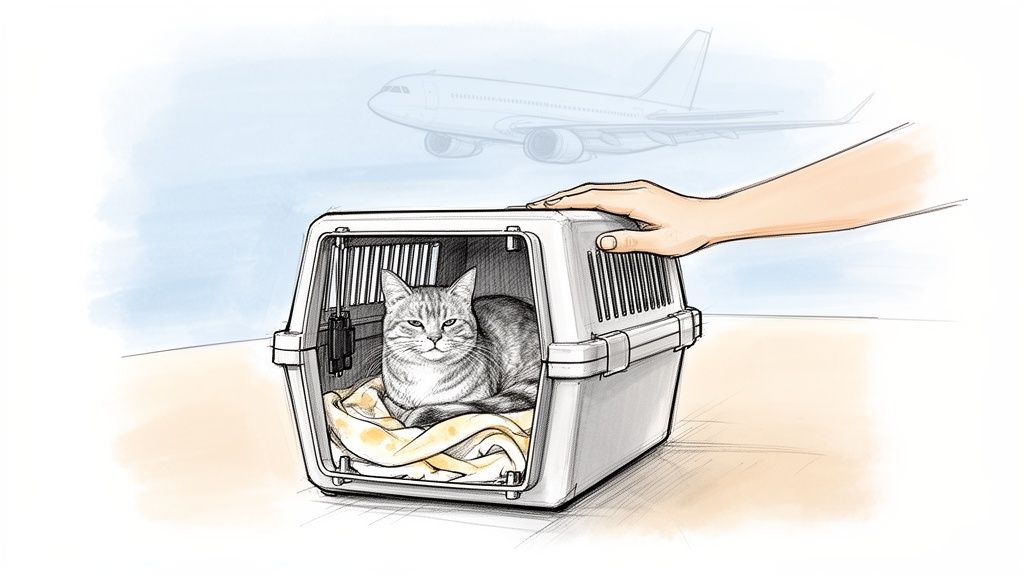
This guide is designed to walk you through everything you need to know for a smooth trip. We'll cover why a sturdy, well-chosen crate isn't just a recommendation—it's essential for your cat's safety and your own peace of mind. Getting the carrier right is the first, and arguably most important, step in preparing for any travel.
More and more, families are including their pets in their travel plans, and the industry has grown to reflect that. The global pet travel crate market was valued at around $1.5 billion in 2025 and is expected to grow by 7% each year through 2033. This shows just how many owners now see their pets as non-negotiable travel companions.
Why the Crate Is So Important
A cat travel crate is much more than a simple box. Think of it as a mobile safe zone—a familiar den that provides security in stressful, unfamiliar places like a loud airport or a moving car.
A well-chosen crate delivers on three key fronts:
Safety: It keeps your cat from escaping and getting lost or hurt during transit.
Suitability: Airlines and international borders have rules. The right crate helps ensure your cat won't be denied travel.
Comfort: The right size and features allow your cat to rest comfortably, which is key to reducing stress.
Of course, travel readiness goes beyond the crate. It's always a good idea to review general cat health tips to make sure your pet is in top shape for the journey. A healthy cat is a much happier traveler.
How to Begin Your Travel Plan
When it comes to pet travel, planning is everything. This guide will cover the different kinds of cat travel crates available, from hard-sided carriers needed for air cargo to soft-sided options for in-cabin flights. We'll also get into how to prepare your cat for the experience, so the crate becomes a positive space instead of something to fear.
A successful journey with your cat starts long before you leave the house. It begins with creating a solid plan, understanding the requirements, and prioritizing your pet’s well-being above all else.
Modern tools can help you manage the paperwork, ensuring you have a complete plan without the last-minute stress. After all, correct documentation is just as critical as the physical crate. For a bigger picture of what lies ahead, feel free to check out our comprehensive guide to pet travel: https://passpaw.com/blog/pet-travel.
Now, let's get you and your furry friend ready for the adventure.
Choosing the Purrfect Type of Cat Travel Crate
Finding the right cat travel crate can feel like a maze of options, but it really boils down to one simple question: how are you traveling? Your cat’s safety and comfort hinge entirely on matching the carrier to the journey.
Think of it like choosing your own travel gear. You wouldn’t pack a suitcase for a day hike, and you wouldn’t use a backpack for a two-week international trip. The same logic applies here. The carrier that’s perfect for a quick vet visit is often the wrong choice for a cross-country flight.
Comparison of Cat Travel Crate Types
To make sense of the options, let's break down the three main types of carriers. Each one has a specific job, and knowing the difference is key to a smooth trip.
Crate Type | Best For | Pros | Cons |
|---|---|---|---|
Hard-Sided | Air travel (cargo), long road trips, anxious cats | Maximum protection, airline-friendly, secure, easy to clean | Bulky, heavy, less portable for day-to-day use |
Soft-Sided | Air travel (in-cabin), car trips, vet visits | Lightweight, flexible, easy to store, fits under airplane seats | Less protection, not for cargo, can be harder to clean |
Backpack | Short walks, public transit, vet visits for small cats | Hands-free, good ventilation, some models are expandable | Limited space, not suitable for long-distance travel, less structured |
As you can see, the "best" crate is really the one that's best suited for the specific travel environment you'll be in.
Hard-Sided Crates: The Gold Standard for Air Travel
When your cat is flying, especially in the cargo hold, a hard-sided plastic crate is often the way to go. Many airlines and safety regulations suggest this type for cargo travel. These crates are the gold standard for a reason—they provide a rigid, protective shell that can handle the rigors of transit.
Airlines and the International Air Transport Association (IATA) have guidelines for crate construction for cargo travel. A suitable hard-sided crate usually has:
Solid Construction: Built from rigid, durable plastic.
Secure Fasteners: Assembled with metal nuts and bolts, not plastic clips or twist-locks that can fail under pressure.
Ample Ventilation: Openings on at least three sides (four is even better) to encourage good airflow.
A Single Metal Door: The door should be made of welded metal with a spring-lock latch that a cat can’t easily nudge open.
Failing to meet airline standards is one of the top reasons pets may be denied boarding at the last minute.
Soft-Sided Carriers: Flexibility for In-Cabin and Car Trips
A soft-sided carrier is a great choice for shorter trips or if your cat is small enough to fly with you in the cabin. They're lightweight, easy to carry, and can be collapsed for storage. Their biggest advantage is the flexibility to compress slightly to fit under an airplane seat—a must for in-cabin travel.
But it’s important to understand their limits. Soft carriers simply don't offer the structural protection needed for the cargo hold and will likely be rejected for that purpose. They’re ideal for car travel, trips to the groomer, or for that small cat flying at your feet. For a more detailed look, you can explore our guide on the best pet crates for travel to see how different styles measure up.
Making the Right Choice: A Tale of Two Trips
Let's put this into practice with a couple of real-world scenarios.
Scenario 1: A Cross-Country Flight
You’re moving from New York to California, and your cat is flying in the cargo hold. You'll likely need an airline-approved, hard-sided plastic crate. It should be bolted together with metal hardware and have proper ventilation. Anything else might be turned away by the airline.
Scenario 2: A Weekend Road Trip
You're driving a few hours to visit family. In this case, a soft-sided carrier works beautifully. It's comfortable for your cat, easy to secure with a seatbelt, and simple to carry inside once you arrive.
The right cat travel crate isn’t just about the crate itself; it's about how it performs in a specific travel environment. Always choose the crate that provides a high level of safety for your planned mode of transport.
The market for this kind of specialized pet gear is growing fast for this very reason. Sales of cat-specific travel carriers are projected to grow at a CAGR of 7.5% between 2024 and 2030 as owners look for safer, suitable solutions. Hard-sided crates are a dominant force, commanding 48.10% of the animal transport market, largely because they are a top choice for the 30-40% of pet journeys involving air travel.
Unfortunately, getting it wrong is common. Unsuitable crates are a major headache, causing up to 20% of all pet rejections at airport check-in. Understanding these rules isn't just about convenience—it's about helping ensure your cat gets on the plane.
Navigating Airline and International Travel Rules
Figuring out airline and international travel regulations can feel like herding cats, but it’s a lot simpler once you know the ground rules. When you’re flying a cat, especially overseas, the entire journey is often governed by a set of standards built around safety and welfare. Getting this part right is very important for a smooth trip.
The most important acronym you may see is IATA—the International Air Transport Association. This is an organization that sets standards for transporting live animals by air. When you see a cat travel crate labeled "IATA-compliant," it means the crate is built to meet certain requirements.
Decoding Airline Suggestions
So, what does an airline-friendly cat travel crate actually look like? It’s not just a slick marketing term; it's a checklist of features that airline staff will inspect closely. These rules are all about making sure your cat is secure and has plenty of air and space during the flight.
A suitable crate usually meets several key criteria:
Strong Construction: It should be made from rigid plastic, fiberglass, or wood. No part of the crate should be "soft" or collapsible for cargo travel.
Secure Hardware: The top and bottom halves should be fastened together with metal nuts and bolts. Plastic side clips or twist locks are often not permitted for air cargo, as they can break under pressure.
Single Metal Door: The door has to be made of welded metal and feature a secure, spring-locking mechanism that a cat can't push open from the inside.
Adequate Ventilation: The crate needs ventilation openings on at least three or four sides to encourage constant airflow.
The core principle behind airline rules is simple: the crate must be a secure enclosure that protects your cat while allowing them to breathe and move naturally. Think of it as your cat's personal, first-class safety pod for the skies.
This flowchart breaks down the basic choice between a hard and soft carrier for different types of travel.
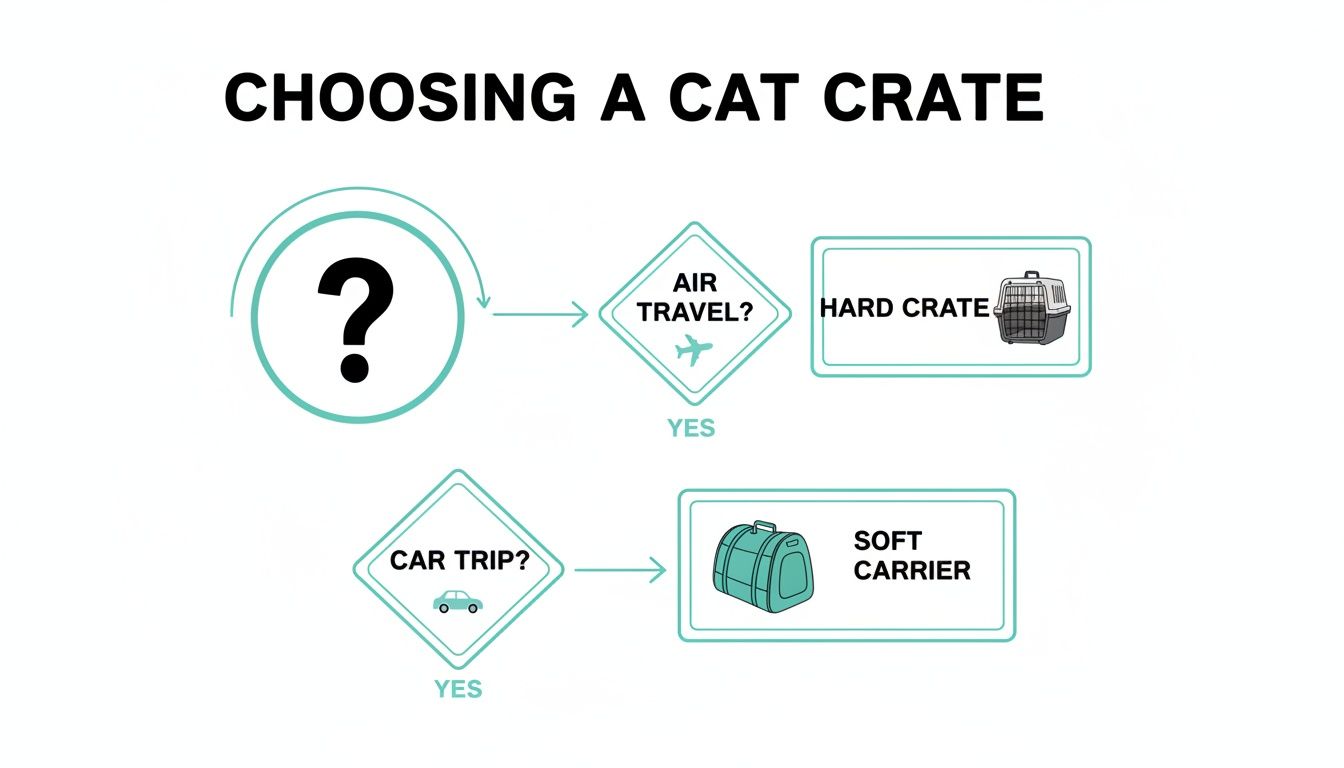
As you can see, the fundamental rule is clear: air travel, particularly in the cargo hold, often requires the rugged strength of a hard-sided crate. A simple road trip, on the other hand, allows for the flexibility of a soft carrier.
Cargo vs. In-Cabin Travel
The rules for cat travel crates change dramatically depending on whether your cat is flying in the cargo hold or with you in the cabin. In-cabin travel is typically reserved for very small cats who can fit comfortably in a soft-sided carrier under the seat in front of you.
For cargo travel, however, the standards are far more rigid. Hard-sided crates dominate the market for a reason, holding a 48.10% market share in North America because they're built to meet these strict cargo requirements. With an estimated 15 million pet flights originating from North America each year, suitability is a massive issue.
In fact, a staggering 60% of rejected pet transports are due to an improper crate. This mistake often costs pet owners over $500 in last-minute fees and rebooking charges.
Always Check With Your Airline
While IATA provides guidelines, individual airlines can—and often do—have their own specific rules. For example, an airline might require ventilation on all four sides. They may also have specific size-to-weight ratios or breed restrictions you need to be aware of.
Before you buy any travel crate, always follow these steps:
Contact Your Airline: Call the airline or check its website for the most current "Live Animal" transport policy. Don't rely on old information.
Confirm Crate Specs: Ask for their specific requirements on crate material, locking mechanisms, and ventilation.
Get It in Writing: If you can, get a printout or email confirmation of their rules. This can save you a world of trouble and misunderstanding on travel day.
For long-haul or international moves, it’s also important to understand the different transport methods available. For more specifics on that process, you’ll find our guide on flying with pets internationally very helpful.
Remember, a little extra preparation goes a long way in ensuring your cat's journey is a safe one.
How to Properly Size and Prepare the Crate
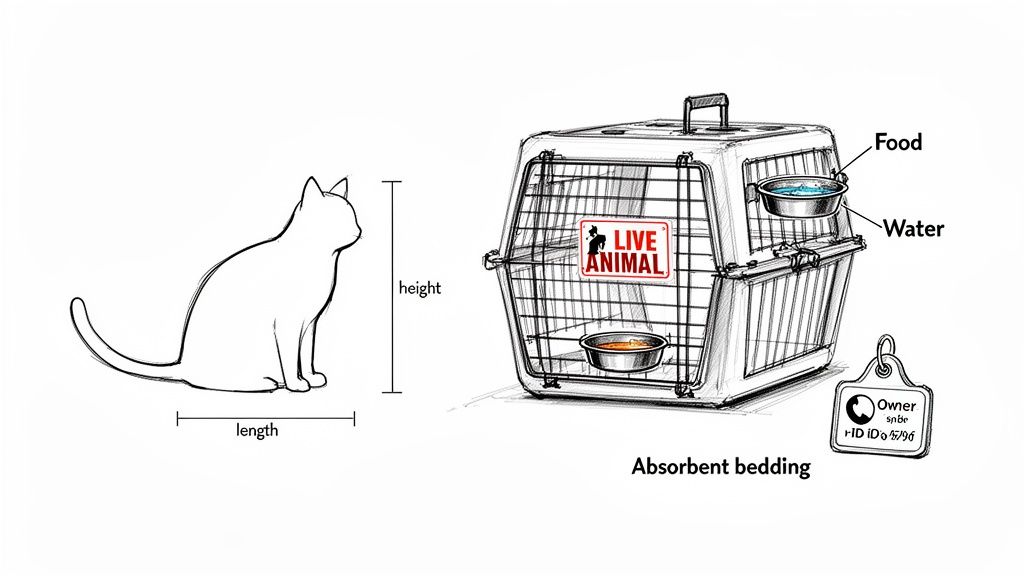
So you've chosen the right type of cat travel crate. Great! Now comes the part that trips up so many pet owners: getting the size and setup just right.
A crate that’s too big can be just as risky as one that’s too small, and a few forgotten details can lead to some serious stress—or worse, a travel denial at the check-in counter. This is one step where a little precision goes a very long way.
Getting the size correct is about more than just weight; it's all about their physical dimensions. This helps ensure your cat has enough space to be comfortable without getting tossed around if turbulence hits.
Measuring Your Cat for the Paw-fect Fit
To find the right crate, you'll need to grab a tape measure and get your cat's measurements. The best time to do this is when they're standing in a relaxed, natural pose. You don't need to be a tailor, but getting close is key.
Here’s how to do it:
Length (A): Measure from the tip of their nose to the base of their tail. Don't include the tail itself in this measurement.
Height (B): While they're standing, measure from the floor to the top of their head or the tips of their ears—whichever is taller.
With those two numbers, you can use the standard airline formula as a guide. The crate's interior length should be at least Length (A) + half the length of your cat's leg. The interior height should be at least Height (B) + a few inches. The goal is simple: your cat must be able to stand up, turn around, and lie down comfortably.
A common mistake is buying a huge crate, thinking you're giving your cat a first-class suite. But during travel, a crate that is too large offers no sense of security and actually increases the risk of injury from being jostled around. You're aiming for "snug and secure," not "spacious and sprawling."
Prepping the Crate for Takeoff
Once you've got the correctly sized cat travel crate, it's time to get it ready for the journey. This is more than just tossing your cat inside. Each item has a purpose, designed to keep them safe, comfortable, and accounted for from check-in to arrival.
Essential Crate Preparations:
Absorbent Bedding: Line the bottom of the crate with something soft and absorbent. A puppy pad with an old towel or a familiar blanket on top works perfectly. Accidents can happen, and this setup helps keep your cat dry.
Food and Water Bowls: This is a big one. The crate should have food and water bowls that attach to the inside of the door. This allows airline staff to provide food and water without opening the crate, which is an important safety measure.
"Live Animal" Stickers: Put "Live Animal" stickers on the top and sides. Most airlines have these at check-in, but it’s always smart to bring your own. These often include arrows to show which way is up.
Contact Information: Label the outside of the crate clearly with your name, phone number, and destination address. Adding your cat’s name is a nice touch, too.
What Goes Inside the Crate and What Stays Out
It’s tempting to pack the crate like a suitcase with all their favorite toys and a fluffy bed, but when flying, less is definitely more.
What to Include:
A Familiar Scent: A t-shirt or small blanket that smells like home (and you) can be a huge source of comfort and can help reduce their anxiety.
Absorbent Lining: As mentioned above, this is important for both hygiene and comfort.
What to Avoid:
Hard Toys or Bones: In turbulence, these can become dangerous. If you include a toy, make sure it’s soft.
Thick, Puffy Beds: They seem cozy, but overly plush bedding can reduce the crate's internal height enough to make it unsuitable for some airline rules. A simple towel or thin blanket is the way to go.
Sedatives: Vets and airlines strongly advise against sedating your cat for air travel. Sedation can affect their ability to regulate body temperature and maintain balance, which can be risky at high altitudes.
Getting the prep right makes all the difference in ensuring your cat’s journey is as smooth and safe as possible. If you want to take a deeper dive into the specific features airlines look for, check out our guide on what makes a great pet airline travel carrier.
Helping Your Cat Love Their Travel Crate
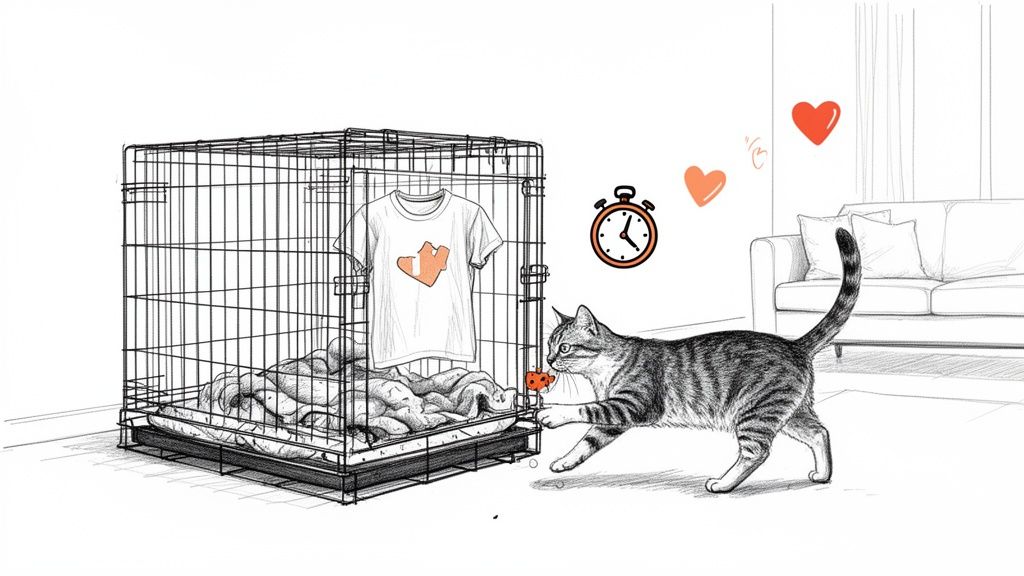
To a cat, a travel crate often looks like a scary plastic box that only shows up before a trip to the vet. Our job is to completely flip that script. The goal is to turn that strange object into a personal, safe den they actually want to be in.
This isn't about force; it's all about building positive associations, one small step at a time. The best advice is to start early—weeks before you travel, if you can. With a little patience, you can help your cat see their carrier not as a cage, but as their own private comfort zone.
Making the Crate a Happy Place
First things first, you need to introduce the crate in a completely low-pressure way. Don't just haul it out on travel day. Instead, take the crate apart (or just use the bottom half) and place it in a room where your cat already loves to hang out.
Leave the door off entirely, or at least secure it wide open so they can investigate on their own terms. Let their natural curiosity take over. The idea here is to make the crate a normal, boring part of the furniture.
To make it even more inviting, furnish it with a few key items:
A soft blanket or an old t-shirt that smells like you.
A few high-value treats or their favorite toys tossed inside for them to find.
A feline pheromone spray spritzed inside the crate about 30 minutes before you want your cat to go near it. This can work wonders for creating a sense of calm.
This whole approach is designed to make the crate a place where good things happen. It's a simple change, but it lays the groundwork for everything else.
From Feeding Station to Safe Haven
Once your cat is comfortable enough to wander in and out for treats, it's time to up the ante. Start feeding them their regular meals inside the crate. At first, just put the bowl right at the entrance. As they get more confident, you can gradually move it further toward the back.
After they’ve had a few successful meals in there, you can start the next phase: closing the door. Start incredibly small. While they are happily munching away, gently close the door for just a few seconds, then open it again long before they’re finished eating. It’s not about trapping them; it’s about showing them that a closed door is no big deal.
The key to successful crate training is to work at your cat’s pace. Each small, positive step builds trust and reduces fear. The goal is for your cat to remain calm and relaxed, making travel day significantly less stressful for both of you.
As they get used to the door being briefly closed, you can slowly increase how long it stays shut. Go from a few seconds to a minute, then five, then ten. Always reward them with praise or a small treat when you open the door. The important part is to not open the door when they're fussing, as that just teaches them that meowing gets them what they want.
Practice Makes Purrfect
The final step is to get them used to movement. Once your cat is calm inside the closed crate for several minutes, gently pick it up and carry it to another room. Set it down, wait a moment, and then let them out with a reward.
From there, you can try a very short car ride. A quick trip around the block is plenty to start. This helps your cat get used to the sounds and sensations of motion while safe and secure inside their den.
Key Crate Training Tips:
Stay Positive: Your cat picks up on your energy. Use a calm, happy voice whenever you're around the crate.
Be Patient: Every cat is different. Don't rush the process or you’ll set yourself back.
End on a High Note: Always end your training sessions with a reward and a positive experience.
By putting in this time upfront, you're doing more than just preparing for one trip. You're building a foundation of trust that will make all future travel—and even those routine vet visits—a much more peaceful experience for everyone involved.
Common Questions About Cat Travel Crates
Even with the most careful planning, a few nagging questions about cat travel crates always seem to pop up. That’s perfectly normal—when you’re planning a long journey for your cat, you want every single detail nailed down.
Think of this section as your quick problem-solver. We’ve covered the big picture, so now let’s iron out those last few wrinkles in your travel plan with some straightforward, practical answers.
Can I Use the Same Crate for Car Trips and Flights?
Not always, and getting this right is very important. While a hard-sided, airline-approved crate is generally safe for car travel, the reverse is definitely not true.
A soft-sided carrier meant for car trips or in-cabin flights is not safe or suitable for transport in the airline cargo hold. For cargo travel, you typically must use a rigid crate that meets airline standards, including solid metal hardware and a secure single-door lock. Always, always double-check your specific airline's rules before assuming your car carrier will fly.
How Do I Clean a Crate After a Long Trip?
A clean crate is a happy, stress-free space. Taking a few minutes to properly clean it after a journey makes it fresh and ready for the next trip, rather than a place that smells like a stressful experience.
For hard-sided plastic crates: Use a pet-safe disinfectant or a simple mix of mild soap and water. Give all the surfaces a good scrub, rinse it out completely, and let it air dry.
For soft-sided carriers: Check the manufacturer’s instructions first. Most have removable pads that can be machine washed on a gentle cycle with a pet-safe detergent. Just hang it up to air dry.
It’s a small bit of effort, but it makes a huge difference in how your cat sees the crate for future travel.
What if My Cat Has an Accident During Travel?
Accidents can and do happen, which is exactly why absorbent bedding is highly recommended for air travel. Your best defense is a high-quality puppy pad placed underneath a thin towel or a familiar blanket. This setup is designed to wick moisture away from your cat, keeping them as dry and comfortable as possible.
It's important to understand that for safety reasons, airline staff are generally not permitted to open a pet’s crate during transit. That absorbent bedding is the only tool available to manage messes mid-flight, making it very important for your cat's well-being.
Be ready with a small cleanup kit (wipes, a fresh towel) in your own carry-on. That way, you can tend to your cat and the crate as soon as you’re reunited. It isn't a glamorous part of travel, but being prepared makes the situation far less stressful for everyone.
Should I Put Toys or Blankets in the Crate?
Yes, but the key is to choose wisely. Your goal is to provide comfort without accidentally creating a hazard. A small, soft item that carries your scent—like a worn t-shirt—can be incredibly soothing for a cat in a strange, new environment.
On the other hand, you should never put hard toys, chew bones, or anything with small, detachable parts inside the crate. These items can become dangerous during turbulence or even just a bumpy car ride. When it comes to in-crate items, keep it simple, soft, and safe. A single comfort item is always better than a crate full of potential risks.
Navigating the complexities of pet travel documentation can be overwhelming. Passpaw offers a simple, centralized platform to help veterinary practices manage international health certificates, track requirements, and communicate clearly with clients. Ensure every feline traveler is fully prepared and ready for a safe journey by visiting https://passpaw.com to learn more.

More articles
From regulatory changes to best practices for veterinarians and pet owners, our resources keep you ahead of the curve.