Are you a team member in a veterinary practice?
Are you a pet parent planning a trip with your furry pal?
Cat Adjusting to New Home: A Smooth Transition Guide
You've got the carrier by the door, the food bowls washed, and a mix of excitement and nerves in your chest. Then your new cat arrives, takes one look around, and disappears under the bed like a furry little ghost. That's normal.
A cat adjusting to a new home rarely looks like the movies. Most cats don't stride in, claim the sofa, and start purring on cue. They assess, hide, sniff, listen, and decide whether this strange place is safe. Your job isn't to speed that up. Your job is to make it easier.
A smooth transition comes from doing the boring things well. Set up the space before arrival. Keep the first days quiet. Watch for simple signs like eating, litter box use, grooming, and curious exploration. If your cat has also gone through international travel, the process may need even more care because travel stress can stack on top of normal relocation stress.
Preparing for Your New Feline Friend
Before your cat's paws hit the floor, prepare the home like you're setting up a recovery room, not a party. New cat owners often focus on toys and treats first. Those are fine, but safety and predictability matter more on day one.
Start with the environment. Close off risky spaces you can't monitor well, secure loose cords, remove fragile items from ledges, and check every window and screen. Cats test boundaries fast once curiosity kicks in. If your screens are worn or loose, it's worth reviewing pet proof screen mesh solutions so your home is ready before your cat starts doing parkour at dawn.
Gather the essentials with purpose
You don't need a mountain of gear. You need the right basics in the right places.
Carrier: Choose one that opens easily and doesn't require wrestling the cat out.
Food and water bowls: Pick stable bowls that won't slide across the floor.
Litter box and litter: Use a simple box first. Don't get fancy while your cat is stressed.
Bed or soft blanket: Familiar textures help. Even a folded towel can work.
Scratcher: A cardboard scratch pad or sturdy post gives your cat an approved outlet.
Hide option: A covered bed, open carrier, or box lets the cat retreat without vanishing into unreachable places.
Practical rule: Don't buy five new things with five new smells if you can avoid it. A calm setup beats a fancy setup.
If your cat is coming from a shelter, breeder, or another home, ask what food they've been eating and what litter they've been using. Keeping those two things consistent removes avoidable stress. If travel is involved, it also helps to have records organized early, including vaccines and timing, which is why many owners find a guide to cat vaccination records helpful before move day.
Prepare your mindset too
The biggest mistake I see is expecting affection before trust. A cat may ignore you, hide from you, or seem “ungrateful” at first. That doesn't mean the placement is failing. It means the cat is being a cat.
A better mindset is simple:
What owners hope for | What often happens first |
|---|---|
Cuddles on day one | Hiding and watching |
Play right away | Eating little or not at first |
Exploring the whole house | Sticking to one safe corner |
Fast bonding | Slow, steady trust-building |
Patience is part of the setup. If you go in expecting progress to look small, you'll appreciate the wins. A first meal. A first litter box visit. A first slow blink. Those are not small to a cat. They're the start of everything.
Creating a Safe Base for the First Few Days
Your cat's first room should feel boring in the best possible way. Quiet, contained, predictable. Not the busiest room in the house. Not the room next to the barking dog. Not the room with kids popping in every ten minutes to “just say hi.”
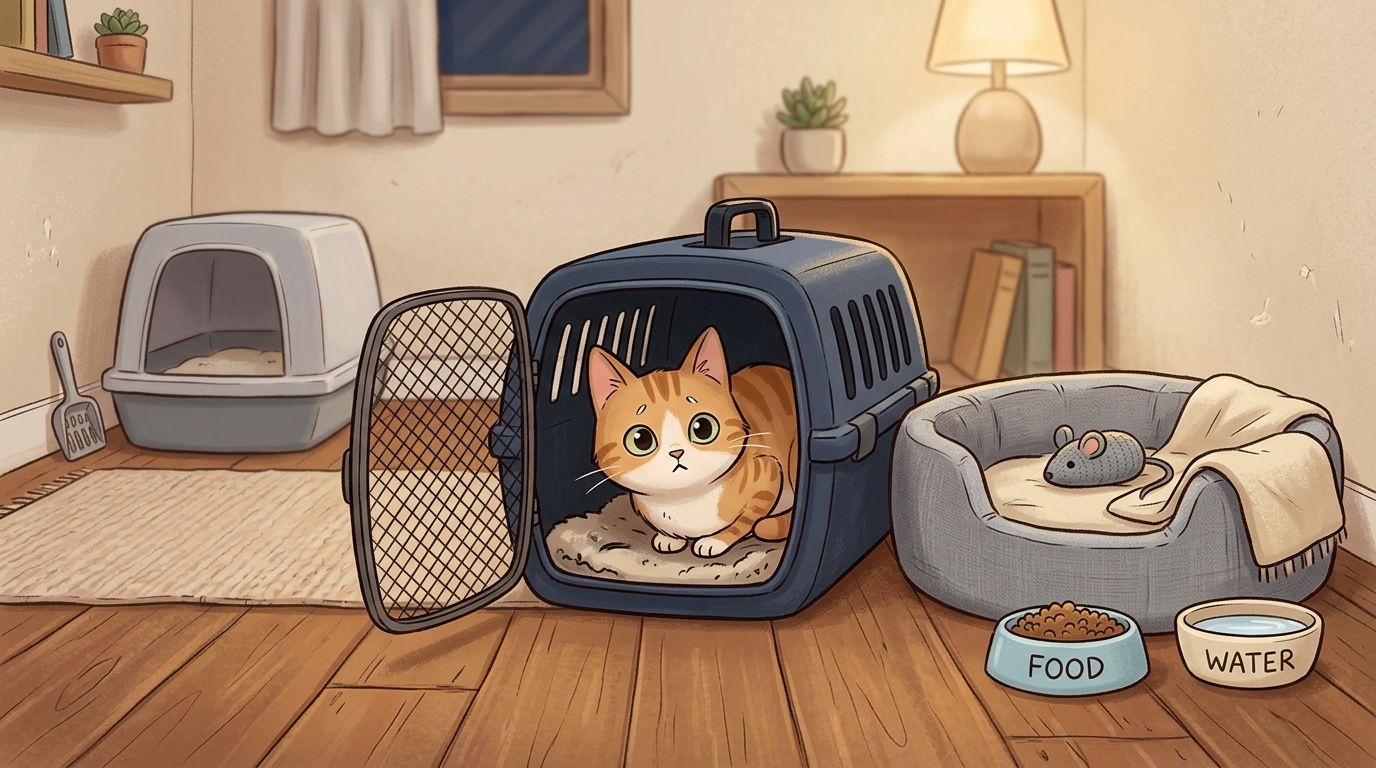
The expert-defined 3-3-3 Rule methodology mandates confining the cat to a single sanctuary room for days 1–3, only expanding access to an adjacent room on days 4–7 once the cat is eating and using the litter box consistently. Failure to follow this step-by-step restriction often leads to setbacks that can delay adjustment by weeks, according to Kansas State Collegian's guidance on helping a cat adjust to a new home.
What goes in the sanctuary room
Set the room up before arrival so you're not scrambling while your cat is overwhelmed.
Litter box placed away from food and water: Cats don't want to eat beside the toilet any more than you would.
Food and water in a quiet corner: Keep bowls easy to find and away from foot traffic.
A hiding spot you approve of: A box on its side, a covered cat bed, or the open carrier works well.
A resting spot off the floor if possible: Some cats feel safer with a low perch or sturdy chair.
A scratch surface: This helps with tension relief and scent marking.
Soft, familiar fabric: A blanket with familiar smells can reduce that “where on earth am I?” feeling.
Keep the room simple. A crowded room can feel less safe, not more.
What to do at the moment of arrival
Bring the carrier into the room. Close the door. Put the carrier down. Open it. Then wait.
Don't tip the carrier. Don't pull the cat out. Don't parade family members through for introductions. Let the cat emerge on their own terms, even if that means they stay in the carrier for a while.
The first good decision many owners make is doing less. A quiet room and an open carrier often work better than coaxing, reaching, or repeated checking.
Once your cat is inside, keep your own body language soft and predictable. Sit on the floor if the room allows. Speak softly. Then leave them alone for stretches of time. That part is hard for people and helpful for cats.
A room arrangement that works
Think in zones instead of stuffing everything together.
Zone | What belongs there | Why it helps |
|---|---|---|
Rest zone | Bed, blanket, hide box | Gives the cat a secure retreat |
Toilet zone | Litter box | Keeps elimination separate and easy to locate |
Food zone | Bowls, small feeding mat | Supports appetite and routine |
Activity zone | Scratcher, one toy | Encourages low-pressure engagement |
If your cat will need regular carrier use later, don't stash the carrier out of sight after arrival. Keep it accessible as part of the room so it doesn't become a “bad news only” object. For owners working on that skill, this guide to crate training for cats is useful because the same principle applies here. Familiarity lowers friction.
What doesn't work well
A few choices routinely backfire:
Giving full house access immediately: Too much space can feel unsafe.
Moving supplies around every day: Cats settle faster when the layout stays stable.
Forcing social contact: Reaching under beds or dragging a cat out damages trust.
Introducing other pets too soon: Let the safe room do its job first.
You're building a base camp, not opening a theme park. Keep it steady, and your cat will tell you when they're ready for more.
Understanding the 3-3-3 Rule for Cat Adjustment
The 3-3-3 Rule is one of the most useful frameworks for cat adjusting to new home stress because it gives owners realistic expectations. It isn't a stopwatch. It's a pattern that helps you interpret what you're seeing without panicking too early.
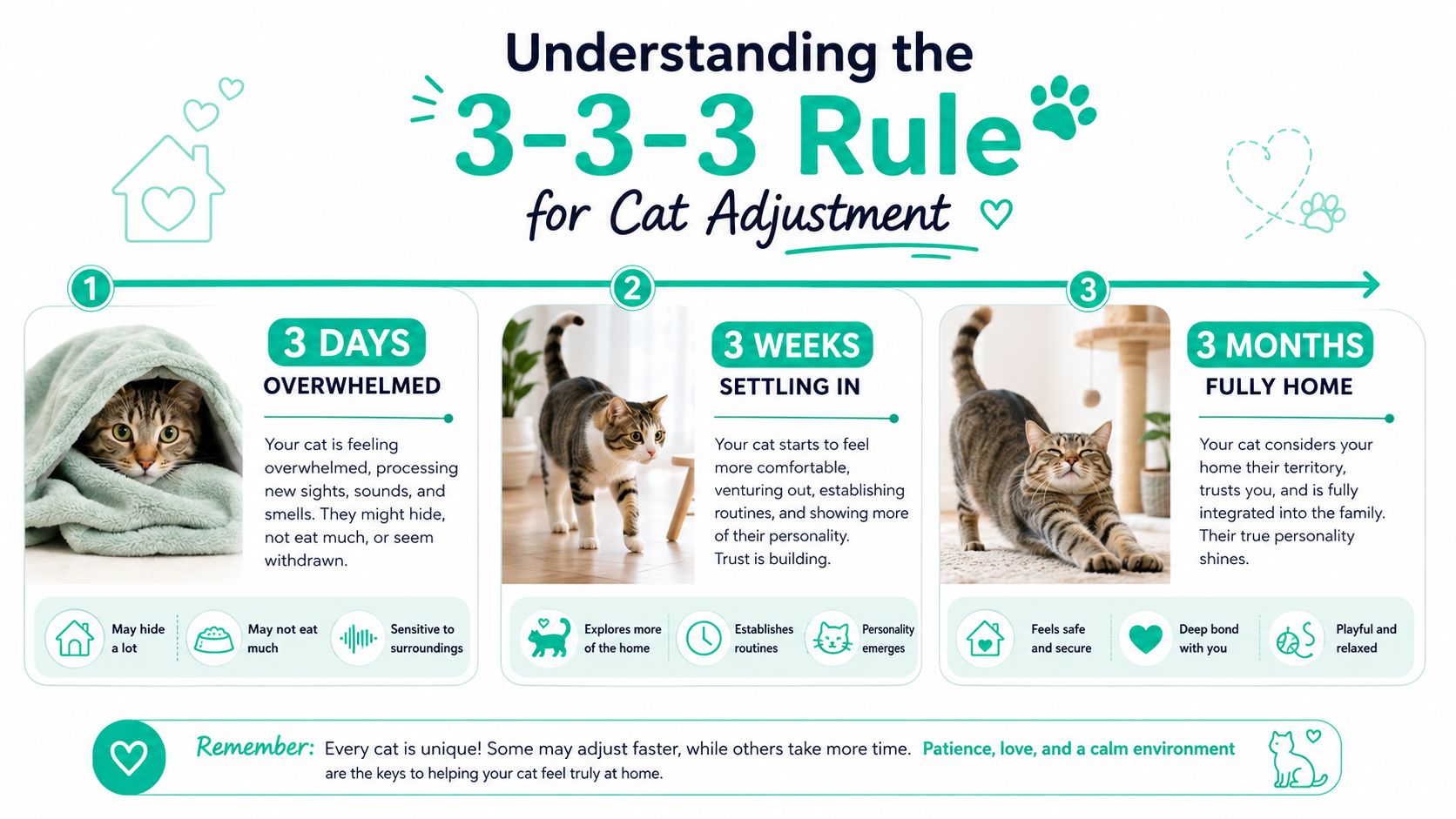
The adjustment timeline follows a widely recognized framework known as the 3-3-3 Rule. The first 3 days are for initial acclimatization, the next 3 weeks are the settling-in period, and by 3 months a cat typically feels fully at home. Some cats show settling behaviors within one to two weeks, but the full psychological transition often takes the full quarter-year, as outlined in this overview of the 3-3-3 rule for cats.
The first 3 days
This phase is often the hardest for humans because there's so little feedback. A cat may hide, stay silent, eat lightly, or avoid eye contact. None of that automatically means something is wrong.
What matters most here is reducing input. Keep the room quiet. Keep visits brief. Offer food, fresh water, and litter access without turning every check-in into a social event. If your cat wants contact, they'll start to show it with small behaviors like watching you from a hiding spot, peeking out, or shifting to a more relaxed posture.
The next 3 weeks
Many cats start connecting the dots. They learn when meals happen, what your footsteps sound like, and which routines mean safety instead of chaos.
You might notice:
More movement at night or when the house is quiet
Interest in toys or treats
Less crouching and more normal walking
Grooming in the open
Longer periods outside the hiding spot
This phase rewards consistency. Feed at similar times. Use the same calm voice. Keep household noise manageable. If you change everything every day, your cat has to keep recalculating risk.
Some owners expect a straight line from fear to comfort. Most cats move in a zigzag. A good morning doesn't guarantee a brave evening, and that's still normal progress.
The 3-month mark
By this point, many cats behave like the home belongs to them. Which, to be fair, it does now. This is often when personality really blooms. A quiet cat may turn playful. A watchful cat may become affectionate. A previously hidden cat may start supervising your every move from the hallway like a tiny furry manager.
That said, the timeline isn't identical for every cat. Age, health history, prior socialization, and general confidence all shape the pace. If your cat is slower to warm up, don't treat the rule like a deadline. Treat it like a map.
What the 3-3-3 Rule changes for owners
The biggest benefit of the rule is emotional. It stops people from assuming there's a problem just because a cat isn't acting settled yet. It also prevents the common mistake of rushing freedom before security.
Time period | What the cat may need from you |
|---|---|
First 3 days | Quiet, space, minimal pressure |
First 3 weeks | Predictable routine, gentle interaction |
By 3 months | Normal life, trust, play, stable household patterns |
A cat adjusting to a new home doesn't need perfect handling. They need calm repetition. That's the cat's version of a welcome mat.
From Hiding to Exploring Building Your Cat's Trust
Trust-building doesn't start when your cat climbs into your lap. It starts much earlier, when you prove that you won't crowd them, chase them, or make every interaction feel like a test.

A common moment goes like this: your cat peeks out from under the bed, and your first instinct is to reach in with loving hands. Resist that instinct. A better move is to turn slightly sideways, stay low, and let the cat decide whether to close the gap.
Start with presence, not pressure
Sit in the room and do something boring. Read. Scroll. Fold laundry. Let your cat learn that your presence doesn't predict grabbing or cornering.
If the cat looks at you, give a soft blink and look away. That's less threatening than direct staring. If they approach, let them sniff first. Don't immediately pet the top of the head unless the cat clearly leans in for it.
Trust grows faster when the cat controls the distance.
Some cats want play before touch. Some want food before play. Some want a week of observation before either. That's normal. You're not auditioning for best friend on day two.
Use scent to make the house feel familiar
Cats live through scent as much as sight. One gentle way to reduce the “stranger danger” factor is scent transfer. Rub a soft cloth on the cat's cheeks if they tolerate it, then place that cloth near doorways or furniture in areas they'll eventually explore. You can also bring bedding from the safe room into the next space before expanding access.
This doesn't have to be fancy. It just has to be consistent. You're letting the home smell a little more like the cat before the cat has to explore all of it.
If you want a helpful primer on body language while you're doing this, how to interpret cat signals can make those tiny cues easier to read.
Build confidence with play
A wand toy is often better than hands, stuffed mice, or noisy gadgets. It creates distance, encourages stalking behavior, and lets the cat “win” without feeling trapped.
Try this sequence:
Start small: Move the toy slowly near the hiding area, not directly into the cat's face.
Pause often: Many nervous cats need time to watch before they engage.
Let the cat finish the hunt: End with a catch, not endless frustration.
Pair with something positive: A small meal or treat after play can help the cat settle.
This kind of play does more than entertain. It helps convert nervous energy into a familiar predator-prey pattern. That can be a big confidence booster for shy cats.
Know when to back off
The line between encouragement and pressure is thin. If your cat freezes, flattens their ears, lashes the tail, or ducks back into hiding, scale down the interaction. Don't try to “push through” the moment.
Here's a quick read on common situations:
Cat behavior | Best response |
|---|---|
Peeking out and watching | Stay calm, avoid reaching |
Sniffing your hand | Hold still, let the cat decide |
Batting at a toy | Continue gentle play |
Retreating suddenly | End the session quietly |
Taking treats near you | Repeat the routine later |
Your role is to become predictable. Predictable people are safe people in a cat's world. Once your cat learns that you don't force things, they usually start writing you into their comfort zone. That's when their true purr-sonality begins to show.
Decoding Your Cat's Behavior Signs of Stress and Comfort
Owners often ask the same question in different words. Is this normal hiding, or is my cat struggling? The answer depends on patterns, not one isolated moment.
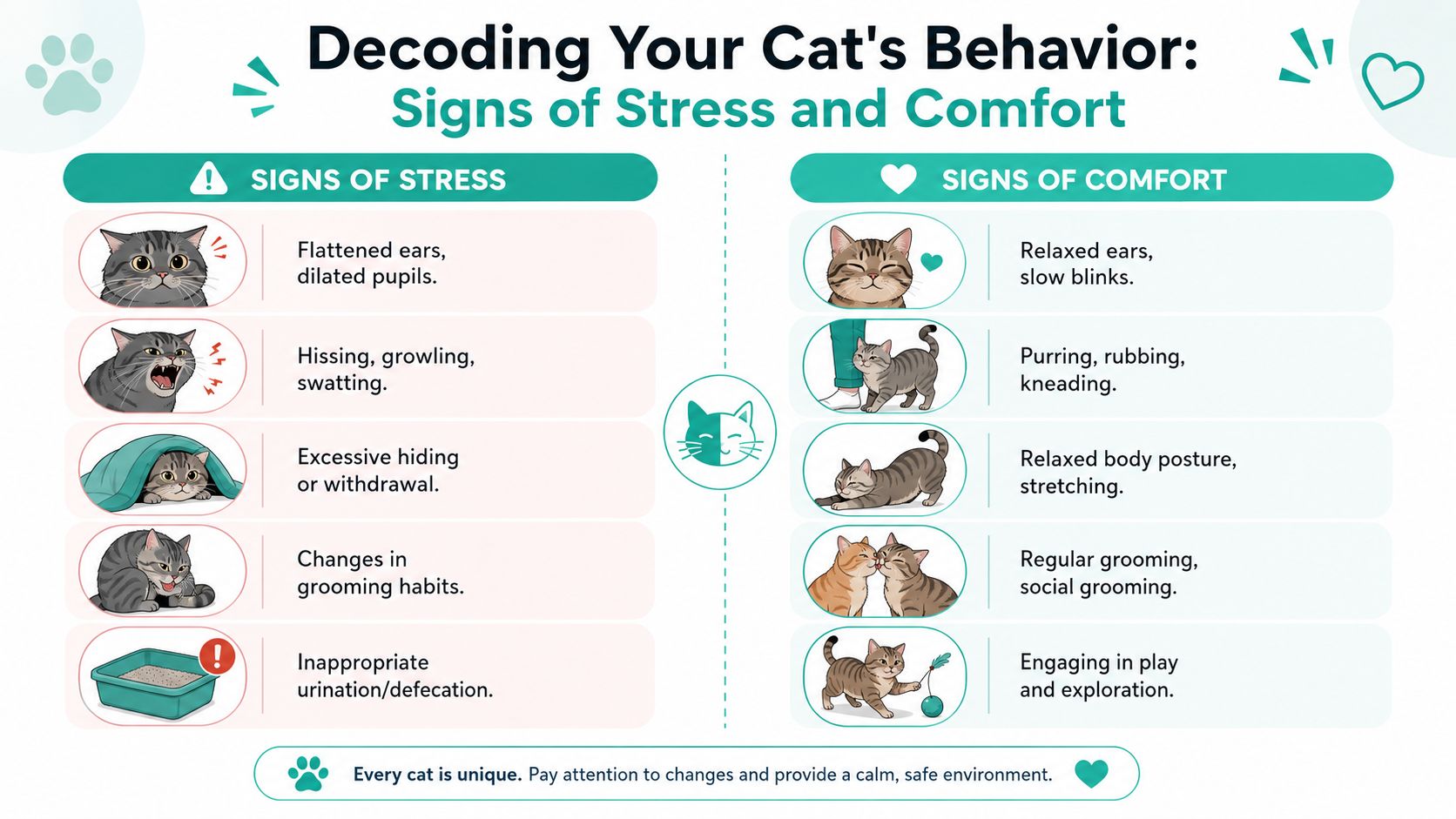
Signs of successful adjustment include regular eating and drinking, normal grooming behavior, increased curious exploration, and consistent use of the litter box. If a cat remains too fearful to eat, drink, or use the litter box by day two, the environment and interaction style should be evaluated to reduce stress, according to this guide on signs your cat is adjusting.
Signs that usually mean progress
A comfortable cat doesn't need to be clingy. Comfort often looks subtle.
Regular appetite: The cat eats without looking alarmed between every bite.
Normal grooming: They wash, stretch, and settle rather than staying tense all day.
Curious exploration: They investigate corners, furniture, and sounds instead of only hiding.
Consistent litter box use: This is one of the clearest practical markers.
Relaxed body language: Ears and posture soften. Movement looks less crouched and urgent.
A cat can still be shy and be adjusting well. Shy is a personality style. Stressed is a physical and behavioral state.
Signs that need closer attention
Some behaviors suggest the setup needs adjusting, and sometimes they suggest a health issue rather than just nerves.
Likely stress sign | Why it matters |
|---|---|
Persistent refusal to eat or drink | Can become a medical concern quickly |
No litter box use | May reflect fear, setup problems, or illness |
Excessive hiding with no improvement | Suggests the cat still feels unsafe |
Hissing, swatting, or growling during simple approach | The cat may feel cornered or overwhelmed |
Major grooming changes | Stress can affect self-care patterns |
If your cat is too scared to eat, drink, or use the litter box by the second day, don't just “wait it out” without changing anything. Make the room quieter. Reduce visits. Check placement of food and litter. Rule out obvious stressors like loud appliances, barking, or strong odors.
A cat that won't perform basic daily behaviors isn't being stubborn. They're telling you the current setup isn't working.
Comfort and stress can overlap
People often misinterpret signs. A cat may purr and still be anxious. A cat may hide and still be making normal progress. Look for clusters of behavior rather than one signal.
For example, a cat who hides but comes out to eat, grooms normally, and uses the litter box is very different from a cat who hides, won't eat, and won't toilet. The first cat is cautious. The second cat may be overwhelmed.
A helpful way to think about it is trend over time. Is your cat doing a little more, a little more comfortably, every day or two? That's good. Are daily basics still not happening? That needs attention.
When to get help
Call your veterinary team if you're seeing fear plus basic function problems. Appetite, hydration, litter box use, and grooming matter more than whether your cat is cuddly yet. If you also live with a dog and want a comparison for how adjustment signs differ across species, this article on signs a dog is adjusting to a new home is a useful contrast.
You don't need to decode every whisker twitch. Focus on the basics first. Cats tell you a lot through routine. When routine returns, comfort usually follows.
Adjusting to a New Home After International Travel
International travel changes the equation. A cat who has flown, changed environments repeatedly, and moved through airports or customs hasn't just relocated. They've gone through a high-stress event on top of a home transition. That means standard advice sometimes needs tweaking.
For cats undergoing international transport, the standard 3-day safe room phase can sometimes worsen stress. The process may require a 2-4 week pre-travel desensitization period to the carrier and pheromone protocols that differ from domestic moves, as noted in this article on introducing cats to a new home after relocation.
Why travel cats can respond differently
A domestic move often starts with stress at arrival. International travel often starts well before arrival. The carrier, the transit, unfamiliar handlers, unusual smells, time changes, and disrupted routine all add load. By the time the cat reaches the new home, they may already associate confinement, movement, and novelty with threat.
That's why pre-travel carrier work matters. If the carrier only appears right before departure, it can become a stress trigger. If it's introduced gradually as a resting place before travel, it's less likely to feel like a trap. Owners planning flights often appreciate broader Haute Jets pet travel advice because the travel day setup itself can influence how easily the cat settles afterward.
What to do when you arrive
Keep the first room especially calm, but don't assume every cat benefits from the exact same script used for a local adoption. Some travel-stressed cats settle better when the familiar carrier scent remains part of the room instead of being removed right away. Others need a very low-stimulation space with minimal handling for longer than expected.
Focus on these priorities:
Keep familiar scents available: Carrier bedding and known fabric can help.
Lower sensory load: Quiet room, low traffic, dimmer light if needed.
Watch function, not friendliness: Eating, drinking, toileting, and resting matter first.
Avoid stacking stress: Don't combine arrival day with guests, pet intros, or room changes.
International moves also put pressure on owners. Documents, timing, health certificates, and destination rules can eat up attention you'd rather spend on your cat. If you're preparing for that kind of move, this guide on moving internationally with pets is a useful starting point.
Passpaw helps veterinary teams and pet owners simplify the paperwork side of international pet travel, including health certificate workflows and destination-based requirements. When the documentation side is more organized, you can spend more energy on the part your cat feels: a calmer trip, a steadier arrival, and a smoother landing in their new home. If you're planning pet travel and want less admin chaos, learn more at Passpaw.

More articles
From regulatory changes to best practices for veterinarians and pet owners, our resources keep you ahead of the curve.