Are you a team member in a veterinary practice?
Are you a pet parent planning a trip with your furry pal?
Bring Dog to Europe Made Simple and Stress Free
You've booked the flights, found a dog-friendly place to stay, and started picturing your dog trotting beside you through a European square. Then the paperwork arrives, and the holiday suddenly feels less like a simple trip and more like a queue with paws, dates, stamps, and one very important rabies record.
The good news is that bringing a dog to Europe becomes much easier once you treat it as a timeline-driven workflow. The microchip, rabies vaccination, antibody test, health certificate, entry point, and any tapeworm treatment all have to line up. Start early, keep the records together, and you'll avoid the last-minute scramble that leaves owners, clinics, and dogs feeling distinctly ruffled.
Before You Book What Bringing a Dog to Europe Really Involves
A family planning a summer move might begin with a flight search. They choose a route, compare baggage rules, and then remember the dog needs a vet appointment. That order can work for a simple domestic trip, but EU entry usually needs more thought because the dog's identity, vaccination history, laboratory results, and travel documents must fit a set sequence.
The European Commission's EU pet travel framework generally requires dogs entering or moving between EU countries to be microchipped and vaccinated against rabies. Depending on the country of origin, the dog may also need a rabies antibody test and an EU animal health certificate. For non-commercial travel, the dog must travel with the owner or under the owner's direct responsibility.
That framework also limits non-commercial movement to 5 pet animals in a single vehicle. A household with several dogs, cats, or ferrets therefore needs to count the animals before making arrangements, rather than assuming every pet can be added to the same plan. Dogs entering from many non-EU countries must also use a designated travellers' point of entry, where officials carry out documentary and identity checks.
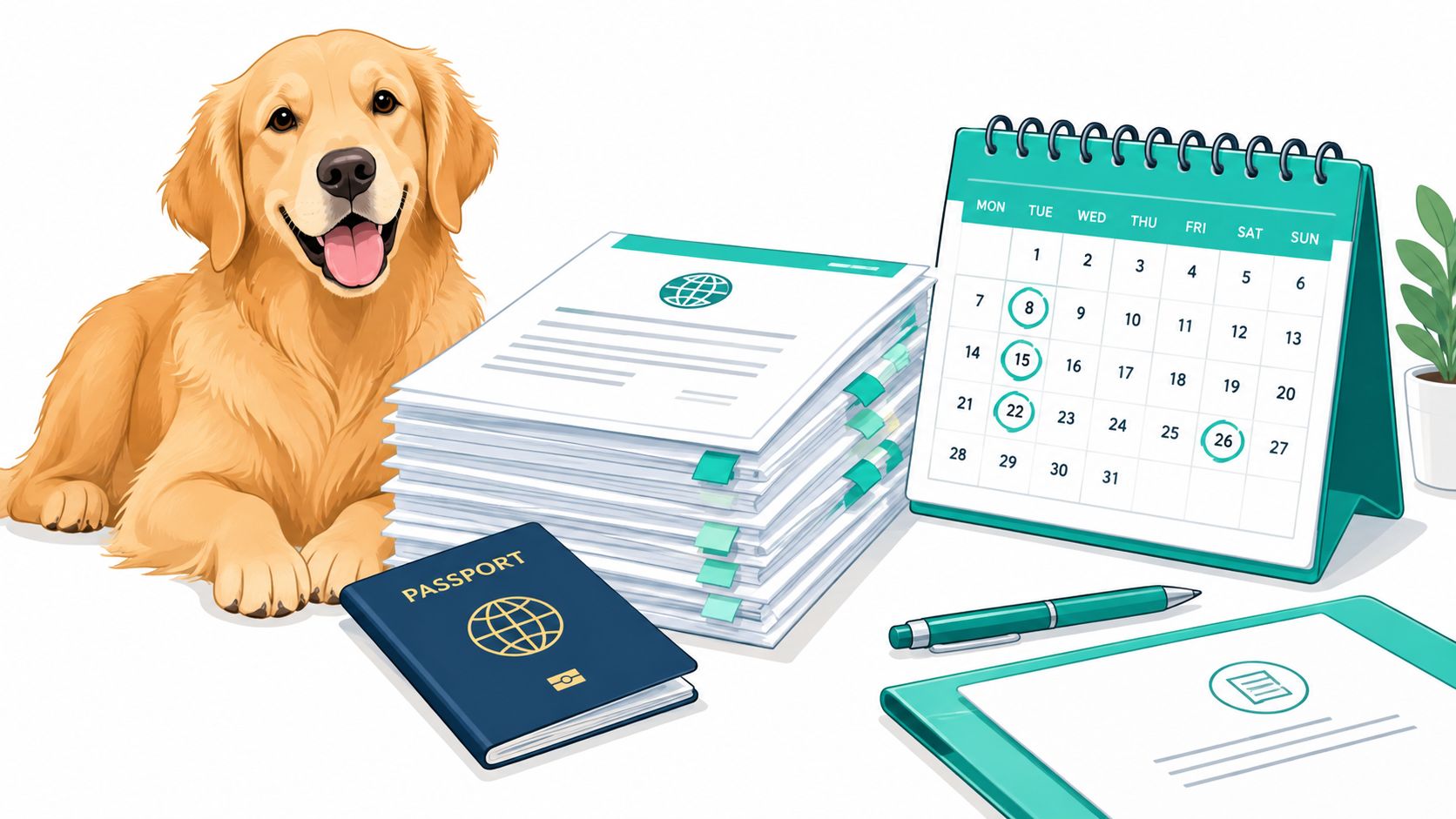
Why the order matters
Think of the process as a shared queue between you and your veterinary practice. The clinic can check the chip, confirm vaccination dates, arrange laboratory work, prepare documents, and communicate deadlines. You still need to provide accurate travel details, book appointments at sensible times, and confirm that the route and destination haven't changed.
What doesn't work is treating the health certificate as the starting point. A certificate can't fix a missing chip record or a rabies vaccination that hasn't reached its required timing. It's the final piece of a chain, not a magic travel passport.
A useful companion to your planning is this guide to moving pets overseas, especially if your European trip is part of a longer relocation.
Start the clock before you book the crate. Confirm the origin country, destination, microchip, and rabies status first. Your dog's travel plan should be built around the dates that biology and document rules allow.
The Non Negotiables Every Dog Needs for EU Entry
A dog can be healthy, vaccinated, and still miss the travel window if its identity record and rabies timing do not line up. Set those foundations before the clinic prepares passports or certificates. The order creates a shared queue: you provide the route and dates, while the veterinary team checks the chip, vaccination history, and any required testing.
Start with the microchip
EU identification rules generally require an electronic microchip. A readable tattoo is accepted only when it was applied before 3 July 2011, as described in official UK pet travel guidance. Have the clinic scan the chip and record its number before giving the rabies vaccine.
Ask the veterinary team to verify three details:
The chip scans correctly: The number on the scanner must match the medical record.
The records agree: Use that same number on vaccination records and travel documents.
The sequence is valid: If the chip was implanted after vaccination, the earlier vaccination may not support the intended travel timeline.
For practical guidance on choosing and checking ISO-compliant microchips, review the chip's format before the appointment. The chip is your dog's identity key. A certificate with the wrong number can cause a document problem even when the dog is otherwise ready to travel.
Then check rabies timing
Rabies vaccination can begin from 12 weeks of age, and the vaccine becomes effective at least 21 days later, according to the government guidance cited above. The clinic should identify whether the injection is a primary vaccination or a valid booster, then record the date precisely.
Check for gaps rather than relying on memory or a photograph of a vaccine sticker. An expired vaccination may be treated differently from a current one, and the route may determine whether antibody testing is required. If the history is incomplete, the clinic may need to rebuild the timeline before issuing travel paperwork.
Keep responsibility and route clear
For non-commercial travel, the dog generally travels with the owner or under the owner's direct responsibility. Tell the clinic who will accompany the dog, which route it will take, and whether the movement is a family trip or a separate transport arrangement. Those details can affect how the paperwork is prepared.
Run this short audit early:
Identity: Is the microchip readable and recorded consistently?
Rabies: Is the vaccination valid for the planned route?
Timing: Has the required waiting period passed?
People: Is the dog travelling with the owner or under the owner's direct responsibility?
Destination: Does the destination require an additional treatment?
These checks belong at the start of the schedule, not during travel week. Once they are confirmed, you and the clinic can reserve the right appointments, leave room for laboratory work if needed, and prepare the final documents without turning the process into a last-minute paperwork scramble.
Choosing Your Paperwork Path EU Pet Passport or Health Certificate
The correct document starts with the dog's departure point. Owners sometimes ask for “the EU passport” as though it covers every journey, yet EU travel paperwork follows two separate routes. Choosing the route early lets the owner and clinic manage appointments, records, and certificate windows as one timeline instead of rushing through paperwork at the end.
Travel within the EU
For travel between EU countries, the EU pet passport is normally the appropriate document. It records the dog's identification and rabies vaccination details, and it can support later trips when the information remains current. A move from Paris to Berlin is the kind of journey where an EU pet passport fits naturally, provided the dog's records satisfy the applicable rules.
The passport does not replace the microchip or rabies vaccination requirements. It is the organised record of those requirements, not a shortcut around them. If the identification details, vaccination entry, or dates do not match, the document may still cause problems at the border.
Entry from outside the EU
A dog entering the EU from a non-EU country generally needs an EU animal health certificate prepared for that journey, rather than an EU pet passport issued for the trip. The European Commission's guidance for bringing a pet into the EU from a non-EU country explains the certificate process and the conditions that may apply.
For dogs travelling from Great Britain, a new animal health certificate is needed for each separate trip into the EU. It is valid for 10 days for entry, according to the relevant travel guidance. A New York to Lisbon journey therefore needs different preparation from a Paris to Berlin move, even though both journeys involve the same dog and the same broad region.
Match the certificate to the route
Certificate timing is a common source of avoidable stress. The document is issued close to entry, so the clinic needs the planned travel dates and the first EU country of entry. A change to the arrival country, border point, or schedule after preparation can mean new checks or revised paperwork.
Send the practice these details before booking:
The origin country: This helps establish whether rabies serology may apply.
The first EU destination: The certificate must reflect the entry route.
The planned date: Entry depends on the certificate's time window.
The full itinerary: Later travel within Europe may require destination-specific treatment.
The EU animal health certificate form resource helps owners review the document before the appointment. Bring original vaccination records, and check that every identification detail matches the microchip record. A tidy file gives the clinic a clean starting point and keeps the paperwork queue moving, rather than leaving one missing detail to bite during travel week.
The Rabies Titre Test Timeline That Trips Up Most Travelers
A family may have flights, a hotel, and a dog-friendly itinerary ready, then discover the rabies titre test still controls the departure date. The test is required for some origin countries, not all, so classification comes before booking a blood draw or promising a travel timeline.
The EU lists non-EU countries and territories from which dogs can enter without rabies antibody titration testing. If the origin is not listed, the route may require the test and a waiting period. Ask the clinic to confirm the origin country first, then build the travel queue around that answer.
The laboratory sequence
For a route requiring serology, an authorised veterinarian must collect the blood sample at least 30 days after the primary rabies vaccination. The antibody result must be at least 0.5 IU/ml. Where the route requires the waiting period, the sample must also be collected no less than 90 days before the animal health certificate date, according to EU rabies testing guidance.
The clinic and owner are managing one shared timeline:
Confirm the microchip and vaccination history.
Give the primary rabies vaccination if needed.
Wait at least 30 days before collecting the blood sample.
Send the sample to an appropriate laboratory.
Confirm a result of at least 0.5 IU/ml.
Allow the required 90-day period from sampling when the origin and route call for it.
Schedule the certificate around the permitted entry window.
Why vaccination status changes the queue
A dog with a valid rabies vaccination may be able to have the antibody test immediately. A first or primary vaccination still creates the 30-day wait before sampling, which can turn a short preparation path into a much longer one.
The clinic needs four practical answers: Is the vaccine current? Is the origin country listed? Which laboratory will process the sample? What happens if the result misses the threshold? Ask these questions before setting flights, because laboratories are not automatically interchangeable for travel purposes.
Borderline or failed results may require another serology step and put a booked departure at risk. Keep the laboratory report with the travel file, and wait to schedule the certificate appointment until the clinic confirms that the result supports the planned route.
The dog rabies titre test guide can help owners prepare questions for the veterinarian. The practical lesson is simple: the titre test can control the entire itinerary. Confirm whether it applies before the countdown begins, then keep the microchip, vaccine, sample, result, and certificate windows moving in the same queue.
Travel Week Tips for Airlines Customs and Tapeworm Treatment
By travel week, the big decisions should already be settled. The final task is making sure the airline, documents, entry point, and treatment timing agree with one another.
Start with the airline's pet policy and crate requirements. Confirm whether your dog will travel in the cabin, hold, or as cargo, and check the carrier dimensions, weight rules, booking process, and breed restrictions directly with the airline. A compliant EU certificate won't help if the airline hasn't accepted the booking.
Dogs entering the EU from many non-EU countries must use a designated travellers' point of entry for documentary and identity checks. Check the location, opening arrangements, and procedure before departure. Don't assume the airport used for the flight is automatically the correct inspection point.
Travel-week habit: Confirm the entry point and its operating details with the relevant authority or carrier before you leave. A correct document at the wrong desk is still a very tiring start to a holiday.
The tapeworm treatment is especially date-sensitive. Dogs entering Finland, Ireland, Malta, Northern Ireland, or Norway need treatment against Echinococcus multilocularis 24 to 120 hours before entry, according to EU treatment guidance.
Destination | Treatment Required | Timing Window |
|---|---|---|
Finland | Echinococcus multilocularis treatment | 24 to 120 hours before entry |
Ireland | Echinococcus multilocularis treatment | 24 to 120 hours before entry |
Malta | Echinococcus multilocularis treatment | 24 to 120 hours before entry |
Northern Ireland | Echinococcus multilocularis treatment | 24 to 120 hours before entry |
Norway | Echinococcus multilocularis treatment | 24 to 120 hours before entry |
Book this appointment against the arrival time, not the day of departure. A flight that leaves late at night, a ferry delay, or a changed arrival can turn a well-intended treatment into a timing question. Ask the vet to record the treatment correctly in the travel document.
Families should also count every pet travelling in the vehicle. EU rules cap a single non-commercial movement at 5 pet animals, as set out in the EU legal text on non-commercial movement. If your route includes post-Brexit border paperwork for goods or supplies, a practical guide to customs and VAT after Brexit can help separate those arrangements from your dog's veterinary documents.
Pack originals, copies, contact details for the clinic, water, familiar bedding, and a calm travel routine. Your dog doesn't need a suitcase full of drama. They need a clear plan and a handler who knows where the paperwork lives.
Make the Journey Smooth With a Smarter Workflow
The most reliable workflow follows the order of dependency:
microchip first, rabies status next, titre testing when the origin requires it, health certificate after the supporting records are ready, and tapeworm treatment inside its narrow destination window.
That order helps owners and clinics share responsibility. The owner supplies accurate route and date information, attends appointments, and checks the airline booking. The clinic verifies identity, reviews vaccination records, coordinates testing, prepares the certificate, and flags anything that needs correction.
A digital process can make that queue easier to manage. A platform such as Passpaw provides tools for international pet health certificates, country-specific planning, document collection, real-time validation, travel-date task prioritisation, and client communication. Those features are useful when a practice is tracking several families whose dogs are all at different points in the process.
A practical final check
Before departure, ask:
Is the chip number identical everywhere?
Is rabies valid for the route and timing?
Has the origin country been classified correctly?
If required, does the titre result meet the threshold?
Is the certificate within its entry window?
Is the arrival point approved for the route?
Is tapeworm treatment booked inside the destination window?
Has the airline accepted the dog's reservation and crate?
Travel preparation also includes your dog's comfort. For general background on ingredients used in calming products, this guide to dog calming supplement ingredients explained may help you prepare questions for your veterinarian. Don't introduce a new supplement or routine at the airport without professional advice, especially if your dog has a medical condition or takes other medication.
A calm trip starts with a visible timeline. Put every appointment, waiting period, document deadline, and arrival requirement in one place, then review it with your veterinary team.
Once the sequence is clear, bringing a dog to Europe feels manageable rather than mysterious. The process still needs care, but it no longer needs to be a last-minute paperwork chase.
Passpaw helps veterinary practices and pet owners organise international health certificates, destination requirements, document collection, and travel-date tasks in one workflow. Visit Passpaw to build a clearer plan for your dog's EU journey and share the right information with your veterinarian.

More articles
From regulatory changes to best practices for veterinarians and pet owners, our resources keep you ahead of the curve.