Are you a team member in a veterinary practice?
Are you a pet parent planning a trip with your furry pal?
Moving Pets Overseas: The Ultimate Guide
Bringing your furry family member along for an international move is a big project, but it’s definitely not im-paw-ssible. While there are a lot of moving parts, thinking of it as a long-term plan with clear steps can make the whole process feel much more manageable.
With the right information and a solid plan, the journey can be a smooth one for both you and your pet.
This is a journey more and more people are taking. The global pet relocation market hit around $2.5 billion in 2023, a number driven by people just like you who see their pets as non-negotiable family members. You can dig into the specifics in this comprehensive market analysis.
Charting Your Course for an International Pet Move
Let’s get into how to map out this journey. It’s all about a structured approach, starting with the big picture and then zeroing in on the details.
The Golden Rule: Start Early
If you take only one piece of advice, let it be this: start planning as early as you possibly can. That 6 to 12-month timeline isn't an exaggeration. Some countries have vaccination, testing, or quarantine requirements that genuinely take that long to complete.
The biggest mistake I see pet owners make is underestimating the timeline. Waiting until the last minute can lead to missed flights, unexpected quarantine, or even being denied entry at the border. A proactive approach is your best friend in this process.
Starting early gives you a crucial buffer for any unexpected hiccups. For instance, a mandatory blood test might have to be sent to a specific, approved lab, and getting the results can take weeks. Giving yourself plenty of time means you can meet every deadline without that last-minute, frantic scramble.
First Steps on Your Pet Relocation Journey
Before you get bogged down in the fine print, focus on the basics. Your first research should center on a few key areas that will guide your entire plan. Once you're ready to get organized, our detailed pet travel planner is a great tool for tracking every task.
Here's what you need to tackle first:
Destination Country Rules: Every single country has its own unique import regulations. Your first stop should be the official government source—usually the Ministry of Agriculture or a similar agency.
Microchip Check: Does your pet's microchip meet the standard? Many countries require a specific ISO-compliant chip. If yours isn't, you’ll need a new one put in before any new vaccinations are given.
Rabies Vaccination and Titer Tests: This is a big one. Many countries require a rabies shot followed by a blood titer test to confirm immunity. This process alone can easily take several months from start to finish.
Budgeting: It's important to understand the financial side of a pet move. While specialized pet transport has its own pricing, getting a general idea by understanding shipping costs can be a good place to start your budget.
Navigating Vet Visits And Paperwork
Alright, let's get into the heart of your pet’s travel prep: the paperwork. This is where the details and deadlines really matter, and where having a great veterinarian on your side makes all the difference. Nailing this part is what separates a smooth journey from a stressful, last-minute scramble. It’s less of a simple check-up and more of a carefully timed series of events.
The complexity is a big reason the pet travel industry is booming. Market data shows the sector was valued at around USD 2.4 billion and is expected to more than double by 2034. That growth just goes to show how much people care about getting this right for their pets. You can dig into these pet transport industry trends yourself to see why planning is so critical.
This infographic gives you a bird's-eye view of the key milestones you'll be hitting.
As you can see, this whole process is a marathon, not a sprint. The real work starts months before you even think about packing a bag.
Your Veterinarian Is Your Co-Pilot
Your first and most important partner here is a government-accredited veterinarian. It's a key distinction—not all vets are certified to sign international health documents, so you should confirm this from the start. This is the pro who will walk you through microchipping, vaccinations, and any blood tests your destination country requires.
Think of them as your project manager for all things medical. They'll help you map out a timeline to make sure every single step happens in the right order. Something as simple as getting a booster shot too late or doing a blood test too early can completely throw off your schedule.
An accredited vet isn't just signing a form; they are confirming that your pet meets the biosecurity standards of another country. Their endorsement is the official seal of approval that authorities look for upon arrival.
Microchips And Vaccinations: The Essentials
Before any official paperwork can even begin, your pet needs an up-to-date microchip. Most countries, especially those in the European Union, now ask for a 15-digit ISO 11784/11785 compliant microchip. If your pet has an older, non-compliant chip, they'll need a new one.
Here’s a critical detail: the microchip must be implanted before the rabies vaccination. If the rabies shot comes first, it may be considered invalid for travel, and you might have to start the whole vaccination process over. This is a common and totally avoidable mistake.
Once the microchip is squared away, you can focus on vaccinations.
Rabies Vaccination: This is the big one. It has to be given after microchipping, and many countries require a waiting period of at least 21 days post-vaccination before your pet can travel.
Rabies Titer Test: Some destinations, like Japan or certain non-EU countries, require a blood test to prove the rabies vaccine worked effectively. This test is typically done at least 30 days after the vaccination, and you often face another multi-month waiting period after the results come in before travel is permitted.
Other Vaccinations: Depending on where you're headed, your pet might need other shots for things like distemper or leptospirosis. Your vet will have the full list.
To give you a clearer picture of how these steps fit together, here’s a simplified timeline for a common travel route, like moving a pet from the US to the EU.
Sample Pet Relocation Timeline USA to EU
Time Before Departure | Action Item | Key Detail |
|---|---|---|
6+ Months | Research & Vet Consultation | Confirm your vet is USDA-accredited. Check your pet's microchip is ISO-compliant. |
3-4 Months | Rabies Vaccination | Administer the rabies vaccine after the microchip has been scanned and confirmed. |
21+ Days After Shot | 21-Day Waiting Period | Pet cannot enter the EU until at least 21 days have passed since the primary rabies vaccination. |
Within 10 Days | Final Vet Visit & International Health Certificate (IHC) Issued | The accredited vet performs a final health check and completes the official EU Health Certificate. |
Within 10 Days | USDA Endorsement | The completed IHC is often sent to the USDA for an official endorsement stamp. |
Departure Day | Travel with All Original Documents | Carry the endorsed IHC, rabies certificate, and microchip records with you. |
This table is just a guide, of course. Your specific timeline will depend on your pet's history and your destination's exact rules, but it shows how each step builds on the last.
Health Certificates and Government Endorsements
The International Health Certificate is the final, crucial piece of the puzzle. This isn't just your pet's vaccination record from the clinic; it's a formal government document stating your pet is healthy and meets every single import rule for your destination. For a deep dive, check out our guide on the veterinary international health certificate.
The timing for this certificate is famously tight. Most countries require it to be completed by your vet within 10 days of departure. Once your vet fills it out, it generally has to be sent to your country's official veterinary authority—like the USDA in the United States—for a final, official endorsement stamp.
This government sign-off is a must-have. The turnaround can vary, so you have to build that time into your final week of prep. It’s the last hurdle that ties all your careful planning together, getting your furry friend fully cleared for their big adventure.
Choosing The Right Airline And Travel Crate
Picking the right airline and travel crate are two of the biggest decisions you'll make when moving your pet overseas. This goes way beyond just booking a ticket. It's about making sure your pet is safe, comfortable, and secure from the moment you leave home until you're reunited at your destination.
Get these two pieces right, and you’re setting the stage for a much smoother, less stressful move for everyone involved.
You’re not alone in wanting to bring your best friend along. It's estimated that roughly 78% of American pet owners travel with their pets each year. With nearly 2 million pets taking to the skies on commercial flights annually in the U.S., airlines have had to create very specific procedures for handling them. If you're curious, these pet travel statistics show just how common it is.
Selecting The Perfect IATA-Compliant Crate
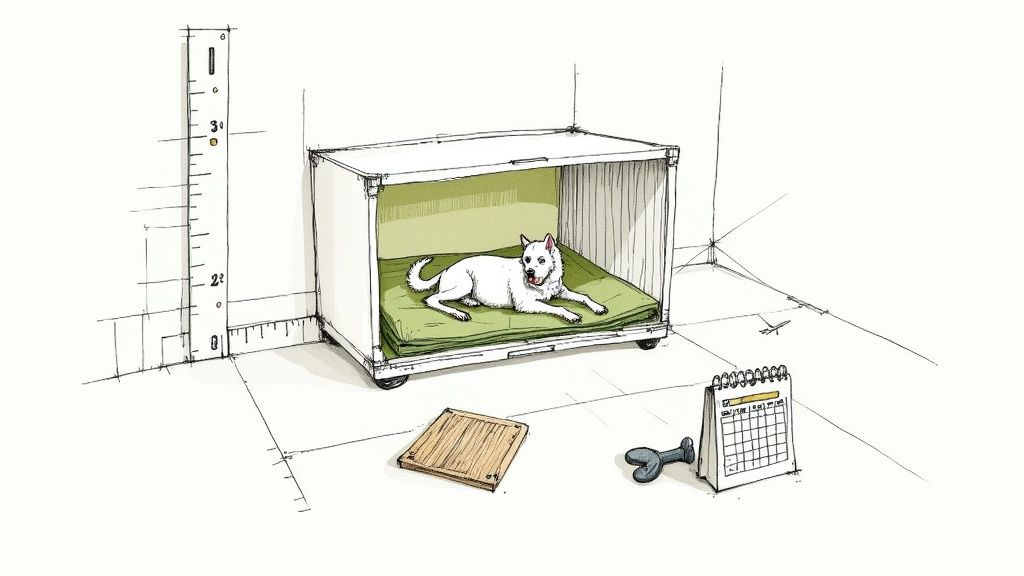
Your pet’s crate is their personal cabin for the flight. It needs to be a safe haven, not just a box. For any international flight, the crate should meet the standards set by the International Air Transport Association (IATA).
Airlines are very strict about this. If you show up with a crate that doesn't meet the rules, your pet may be denied boarding. It’s a heartbreaking and expensive mistake to make.
An IATA-compliant crate usually checks all these boxes:
Plenty of Airflow: It needs vents on at least three sides.
Solid Construction: Should be made of rigid plastic, wood, or metal. Wire crates are a no-go. Any wheels must be removed before check-in.
A Secure Door: The door needs a spring-loaded lock that can't be nudged open by a determined nose or paw.
Leak-Proof Bottom: The floor has to be solid and waterproof.
But the most important factor? Size. Your pet must have enough room to stand up, turn around, and lie down comfortably in a natural position. Too small, and it's unsafe and unkind. Too big, and they could be jostled around during turbulence. Measure your pet from the tip of their nose to the base of their tail, and from the floor to the top of their head when standing.
Crate Training Your Furry Co-Pilot
Once you've bought the right crate, the real work begins: making it a happy place. Crate training is a really good idea. It's the single best thing you can do to reduce your pet’s anxiety on travel day. The goal is simple: help them see the crate as their den, not a cage.
Start this process months in advance, not days. Leave the crate in your living room with the door open. Toss treats or a favorite toy inside to get them exploring on their own. Once they're comfortable going in and out, start feeding them their meals inside. Every positive experience builds their confidence.
Think of the crate as your pet’s personal suite for the flight. The more you can do to make it feel like a five-star accommodation—with familiar scents, comfortable bedding, and positive reinforcement—the better their travel experience will be.
Finding A Pet-Friendly Airline
Not all airlines view pet travel the same way. Some have fantastic, well-established programs, while others have a long list of restrictions. The best airline for you will depend on your pet's size, breed, and where you're headed.
For the most part, pets fly in one of two ways:
In-Cabin: This is usually the best option for very small dogs and cats. The carrier has to fit under the seat in front of you, and the weight and size limits are very strict.
Manifest Cargo: This is how larger animals travel. They are in a climate-controlled, pressurized compartment that's separate from luggage and handled by specially trained staff. It's safe and designed specifically for live animals.
When you're comparing airlines, dig into their policies on these key issues:
Breed Restrictions: Many airlines have rules about flying brachycephalic (snub-nosed) breeds like Pugs, Bulldogs, and Persian cats. Their respiratory systems can be more sensitive to stress and temperature changes, making air travel risky.
Temperature Embargoes: Airlines often won't fly pets as cargo if the temperature at the departure, arrival, or connecting city is too hot or too cold. These rules are there to protect your pet.
Direct vs. Connecting Flights: A direct flight is always the best choice. It drastically cuts down on travel time and reduces the risk of a pet being mishandled or left on the tarmac during a transfer.
Taking the time to research airlines and their track record with pet transport is key. For more in-depth advice, check out our guide on choosing an airline-friendly pet carrier. A little extra homework now can make all the difference for a smooth journey.
Sorting Out Import Rules and Quarantine
Once you’ve got your pet’s crate and airline tickets figured out, the next big puzzle is understanding what happens when you land. Every country rolls out the welcome mat for pets a little differently. Getting a handle on these import rules and potential quarantine is a must for moving pets overseas—it's the key to avoiding stressful, and frankly, expensive surprises at the border.
Think of it this way: each country has its own unique security checkpoint for pets. The goal is always the same—to protect local animals and people from diseases that aren't native to that region. This is exactly why you can't just assume the rules for Spain will be the same as the rules for Singapore.
Finding Official Pet Import Information
The absolute best source for import rules is always the government of your destination country. This is usually the Ministry of Agriculture or a similar agency, like the Department of Agriculture, Fisheries and Forestry in Australia. It's really important to stick to these official sources. Unofficial forums and old blog posts can be dangerously out of date.
Let's look at two popular destinations to see just how different the requirements can get.
Moving a Pet to the United Kingdom: The UK is rabies-free and they want to keep it that way. On top of the standard microchip and rabies vaccine, a key step is a specific tapeworm treatment. A vet must give it no less than 24 hours and no more than 120 hours (5 days) before you arrive. If your timing is off by even a few hours, you could face serious problems with border officials.
Moving a Pet to Australia: Australia is famous for having some of the strictest biosecurity laws on the planet. For pets coming from most countries, a mandatory quarantine period upon arrival isn't just a possibility; it's a requirement. This means a required stay at a government-run facility.
These examples make it clear there's no "one-size-fits-all" checklist. You have to do the homework for your specific destination. To get a head start, you can explore our detailed guide on international pet travel requirements, which is a great launchpad for your research.
What Is Quarantine And Why Is It A Thing?
If your destination has a quarantine requirement, it helps to understand what it is and why it exists. Quarantine is a mandatory period of isolation for your pet in a secure, government-approved facility right after you land. It's a preventative step designed to make absolutely sure your pet isn’t carrying any pests or diseases that could harm local wildlife or agriculture.
It’s not a punishment; it’s a precaution. Island nations like Australia, New Zealand, and Japan often have the tightest quarantine rules because their isolated ecosystems are very vulnerable to foreign diseases.
The whole point of quarantine is observation. It gives officials a window of time to confirm your pet is healthy and poses no biosecurity risk before they're cleared to enter the country.
Preparing For a Quarantine Stay
If your pet needs to be quarantined, you have to plan for it far in advance. These facilities have limited space and can get booked up months ahead, especially during busy moving seasons.
Here’s what you can generally expect when arranging a quarantine stay:
Booking Their Spot: As soon as your travel dates are firm, get that import permit application in and book a spot at the quarantine facility. This is almost always done online through an official government portal.
The Costs Involved: Quarantine isn't free. You’ll be responsible for the bill, which can range from several hundred to a few thousand dollars, depending on the country and how long your pet needs to stay. The fee covers their lodging, food, and basic care.
Care During Quarantine: I know it's tough being separated, but your pet will be looked after by trained staff. They handle feeding, fresh water, and exercise in a secure environment. You usually can't visit, but the staff will be in touch if any health concerns pop up.
Facing the idea of quarantine can feel overwhelming, but when you're prepared, it’s just another manageable step in the process. It's one more box to check before starting your new life together in a new country.
Preparing for Travel Day and Arrival
The checklists are done, the paperwork is filed, and the big move is finally here. This final stretch is all about making the travel day as calm and predictable as possible for your pet. A little preparation now helps ensure a smoother transition when you land.
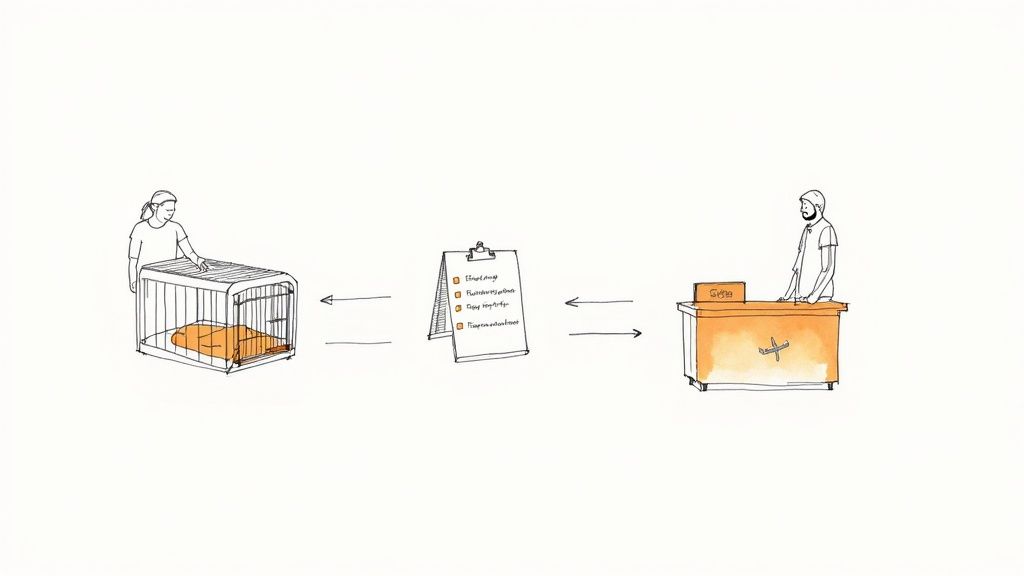
This is the moment all your careful planning pays off. Keeping a level head and sticking to their routine will help your pet feel secure, even with all the unusual activity swirling around them.
Your Pre-Flight Checklist
The day before and the morning of the flight are important. The goal is to keep your pet comfortable without causing any last-minute issues.
I always recommend a light meal about four hours before you head to the airport. Traveling on a full stomach can lead to motion sickness, so keeping it light is best. Of course, always provide fresh water right up until you leave home.
Just before you place them in the crate for the final time, give them one last long potty break. This helps ensure they are as comfortable as possible for the start of their big adventure.
Pro Tip: Make the travel crate a familiar, comfortable space. Line it with absorbent puppy pads and toss in an old t-shirt you've worn or a small blanket that smells like home. Those familiar scents can be incredibly comforting during a stressful new experience.
Clearing Customs and The Big Reunion
After you land, your first priority is reuniting with your furry co-pilot. The process for this varies quite a bit depending on the airport and country, but you'll generally head to a specific cargo facility or a designated animal reception center.
Don't be alarmed if it takes an hour or two. Airport staff need time to safely unload the animals and process their arrival paperwork. This is where your super-organized documents become your best friend.
You will need to present the original endorsed health certificate and any other required import permits to the customs officials. They will review everything and conduct a check on your pet before officially clearing them for entry.
Once the paperwork is approved, you'll finally be reunited. It’s a fantastic moment! Have a leash, collar, and some fresh water ready for them.
Helping Your Pet Settle In
Your journey isn't quite over once you leave the airport. The first few days in a new country are a huge adjustment period for your pet. They'll be dealing with new sights, new smells, and probably a bit of jet lag.
Here are a few things I always tell clients to make the transition easier:
Establish a "Safe Zone." Set up their bed, food, water, and a few favorite toys in a quiet corner of your new home. This gives them a predictable spot to go to if they feel overwhelmed.
Stick to a Routine. As much as possible, keep feeding and walking times consistent with your old schedule. That sense of normalcy helps them adjust much more quickly to the new environment.
Find a Local Vet. One of your first errands should be to locate and register with a local veterinarian. It's best to know who to call before you need them in an emergency.
Be Patient. Some pets adjust in a day; others might take a few weeks. Give them plenty of affection, patience, and positive reinforcement as they explore their new world.
Your careful planning has brought you both this far. With a little extra love and attention upon arrival, your pet will be feeling right at home in no time.
Common Questions About Moving a Pet Overseas
Even the most buttoned-up travel plan can leave you with a few nagging questions. Moving a pet internationally is a massive undertaking, and it's completely normal to feel a little uncertain about some of the finer points.
Let's walk through some of the most common questions we hear from families just like yours. Think of this as a final gut-check to give you the confidence you need for the journey ahead.
Should I Hire a Professional Pet Relocation Service?
This is a big one, and the honest answer is: it depends. Your budget, timeline, and how complex your move is all play a role. If you’re a hyper-organized person and your destination country has pretty straightforward rules, a DIY approach can absolutely work.
But for more complex moves, a professional service can be a lifesaver.
If you’re heading to a country with very strict biosecurity laws like Australia or New Zealand, or if you have a snub-nosed breed facing travel restrictions, an expert is worth their weight in gold. They’ve seen it all before.
Think of these pros as specialized travel agents for your pet.
They have connections. They already have established relationships with airlines, government agencies, and vets, which helps things move smoothly.
They prevent costly errors. Their entire job is to catch the tiny paperwork mistakes that can snowball into massive, expensive delays.
They take the stress off your plate. Juggling logistics is their specialty, freeing you up to focus on the million other things involved in an international move.
Can I Sedate My Pet for the Flight?
We get this question all the time, and the answer from nearly every veterinarian and airline is a firm no. It comes from a good place—you want to ease your pet’s anxiety—but sedation at 30,000 feet can be dangerous.
Sedatives can affect an animal's natural ability to regulate their body temperature and keep their balance in a moving environment. The American Veterinary Medical Association (AVMA) also warns that it can increase the risk of heart and respiratory problems mid-flight. It's a risk you just don’t want to take.
The single best thing you can do is get your pet comfortable with their travel crate long before the flight. When they see their crate as a safe, familiar den, it’s far more effective and safer than any medication. If you're still worried, talk to your vet about natural, flight-safe calming supplements.
What Happens If My Paperwork Has an Error?
Unfortunately, a tiny mistake on your pet's travel documents can create a huge headache. Something as simple as a wrong digit in a microchip number, a missing government stamp, or a miscalculated vaccination date can have serious consequences. This is why you have to double-check everything.
If an official discovers an error upon arrival, things can get stressful—and expensive—fast.
Here’s what could happen:
Denied Entry: Your pet could be put right back on the next flight home, entirely at your expense.
Extended Quarantine: Authorities might place your pet in a long and costly quarantine until the issue is resolved, if it can be.
Flight Delays: An airline agent might spot the problem before you even take off and refuse to let your pet board, messing up your own travel plans.
This is the high-stakes reality of pet travel and a primary reason so many families choose to work with a professional. An expert in document verification can help you avoid these heartbreaking scenarios. It’s not just about convenience; it’s about ensuring your pet has a safe and successful journey.
Moving a pet overseas is a big project, but it doesn't have to be a source of stress. At Passpaw, we simplify the most critical part of the process—the international health certificate. Our platform gives your veterinarian the tools to manage every document and deadline with precision, dramatically reducing the risk of errors. Ensure your pet’s paperwork is purr-fect for their big adventure. Learn more about how Passpaw can help.
More articles
From regulatory changes to best practices for veterinarians and pet owners, our resources keep you ahead of the curve.