Are you a team member in a veterinary practice?
Are you a pet parent planning a trip with your furry pal?
Your Complete Guide to the Dog Rabies Titer Test for Pet Travel
So, what exactly is a dog rabies titer test? In a nutshell, it's a blood test that checks the level of rabies antibodies in your dog's system. Think of it as a report card for their immune response, giving official proof that their rabies vaccine is doing its job and they are well-protected.
Understanding the Rabies Titer Test

Planning a big international move with your dog can feel like a mountain of paperwork. The rabies titer test is often one of the first hurdles you'll face, and getting a handle on what it is—and what it isn't—makes the whole process much smoother.
The test is really just a verification tool. It doesn't check if your dog has rabies. Instead, it offers scientific proof that their body is ready to fight off the virus if it ever needs to. That difference is key.
When your dog gets a rabies shot, their immune system creates antibodies—think of them as tiny, specialized soldiers—trained to stop the rabies virus on sight. A titer test just does a headcount of how many of these soldiers are on patrol in their bloodstream.
What the Test Shows
The result of a dog rabies titer test is given in International Units per milliliter (IU/mL). Most countries that require this test have a minimum pass level, which is almost always 0.5 IU/mL.
If your dog’s result is at or above that number, it tells officials in your destination country that the vaccine was effective. This shows your dog is a very low risk for carrying or spreading the virus. It's this reliable proof of immunity that allows many rabies-free countries to welcome pets without long, stressful quarantine periods.
Why It's Not a Rabies Diagnostic Test
This is a really common point of confusion. A titer test does not diagnose an active rabies infection. It's important to remember that the test is looking for the immune response to a vaccine, not the presence of the rabies virus itself.
To make it crystal clear, here’s a quick breakdown:
Rabies Titer Test At a Glance
What the Test Is | What the Test Is Not |
|---|---|
A measure of protective antibody levels | A test for an active rabies infection |
Proof of a successful vaccination response | A substitute for a rabies vaccine |
A requirement for entry into many countries | A guarantee of entry without other paperwork |
One part of your pet's travel health documents | The only document needed for international travel |
Getting this test done is just one step in putting together your pet's travel portfolio. Documents like the veterinary international health certificate all work together to show your dog meets every single entry rule. The titer test is a critical piece of that puzzle, giving everyone peace of mind that your furry companion is protected and ready for the adventure ahead.
Why Your Dog Needs This 'Paw-sport' Stamp

While every dog needs a rabies vaccine, not all of them will need a rabies titer test. So, when does it become necessary? The number one reason your dog might need one is for international travel.
Think of it as the ultimate security check for your pet. Many rabies-free or rabies-controlled countries have very strict rules to protect their own animal and human populations. They need more than just a word that your dog’s vaccine worked; they need solid, scientific proof.
This is where the dog rabies titer test comes in. It provides that certainty, assuring border officials that your dog hasn’t just been vaccinated but has actually developed a strong antibody response. It shows they are an extremely low risk for carrying the virus across borders.
The Global Entry Requirement
For a growing list of destinations, this test isn't just a suggestion—it's a firm entry requirement. Without a passing result, your dog could face a long, expensive quarantine or, in the worst-case scenario, be denied entry entirely.
Some of the key regions and countries that commonly require a rabies titer test include:
The European Union: Required for pets entering from countries considered to have a higher rabies risk.
Japan: Known for its thorough import rules, Japan requires the test for all dogs coming into the country.
Australia & New Zealand: As rabies-free island nations, they have some of the strictest biosecurity rules in the world.
Other popular destinations: Many other places, like Taiwan, Singapore, and the UAE, also ask for the test.
This test is a critical piece of the puzzle when putting together your pet's travel documents. For a deeper dive into the paperwork you'll need, check out our guide on how to get a pet passport.
A successful titer test is your dog's key to the world. It’s a proactive step that demonstrates responsible pet ownership on a global scale, ensuring a smoother, safer journey for everyone involved.
Beyond International Travel
Although travel is the main driver, there are a few other situations where a vet might suggest a titer test. For example, if a dog has a health condition that affects their immune system, a titer test can confirm whether their body responded properly to the rabies vaccine.
This gives both the vet and the owner peace of mind, confirming the dog has the protection it needs. For the vast majority of pet owners, though, the need for a dog rabies titer test will pop up when planning an exciting international adventure with their four-legged family member.
How the Rabies Titer Test Actually Works
So, how can a simple blood draw tell you everything you need to know about your dog’s immunity to rabies? Let's pull back the curtain on the science behind the dog rabies titer test. It’s way less complicated than it sounds and boils down to the tiny defenders swimming around in your dog’s bloodstream.
When your dog gets a rabies vaccine, their body learns to see the virus as a major threat. In response, their immune system produces a special army of proteins called antibodies. Think of these antibodies as highly trained soldiers with a single mission: find and stop the rabies virus before it ever has a chance to cause trouble.
The titer test is really just an inspection of this antibody army. It’s a readiness check to make sure your dog’s internal defense force is on high alert and ready for action.
From Blood Sample to Lab Result
Once your veterinarian draws a small blood sample, it’s shipped off to a government-approved laboratory. There, technicians run a specific procedure to see just how good your dog’s antibodies are at their job. They essentially introduce a controlled form of the rabies virus to your dog's blood serum.
The goal is to measure how well the antibodies in the sample can neutralize the virus. The better they are at it, the higher the antibody concentration, which means a higher titer result. This isn’t just a simple head count; it’s a functional test that confirms your dog's immune system knows exactly how to win this fight.
Understanding the Numbers
The result comes back in a specific unit of measurement: International Units per milliliter (IU/mL). When it comes to international pet travel, there’s a clear, globally recognized standard for what counts as a passing grade.
The vast majority of countries that require a rabies titer test set the minimum acceptable level at 0.5 IU/mL. A result at or above this number is the official proof authorities need to confirm your dog has sufficient protective antibodies.
But hitting that score isn't a given, even for a vaccinated dog. A large-scale study revealed that a dog's vaccination history is the biggest factor. The research showed that about 8% of vaccinated dogs still failed to reach the required antibody level, particularly if they had only ever received one rabies shot. Dogs who had gotten at least two rabies vaccinations—an initial shot plus a booster—were far more likely to pass. You can dig into the details yourself in the research on dog rabies antibody levels.
This is exactly why staying on top of your dog's vaccine schedule is so important. A consistent vaccination history isn't just about good health—it’s what builds the strong, lasting immune response needed to pass this test and make your travel plans a walk in the park.
Navigating the Titer Test Travel Timeline
When it comes to using a dog rabies titer test for international travel, timing isn't just important—it's everything. Getting the timeline wrong can lead to heartbreaking delays, unexpected costs, and even quarantine for your pet. That's why planning ahead is the secret to a smooth, stress-free journey.
Many pet owners are surprised to learn just how long this process can take. From the first vet visit to your final departure date, the entire timeline can easily stretch over several months. This isn't something you can handle at the last minute, which is why we always recommend starting the process up to six months before you plan to travel.
That six-month buffer is your best friend. It accounts for mandatory waiting periods between steps, potential lab processing delays, and any other little hiccups that might pop up along the way. Think of it as building a safety net for your travel plans.
The Critical Steps in Order
Just as important as the timing is the sequence of events. Each step builds on the one before it, and doing things out of order can invalidate the entire test, forcing you to start all over again. You have to get the order exactly right.
This flowchart breaks down the basic phases of the process, from the initial vaccination to the final lab work.
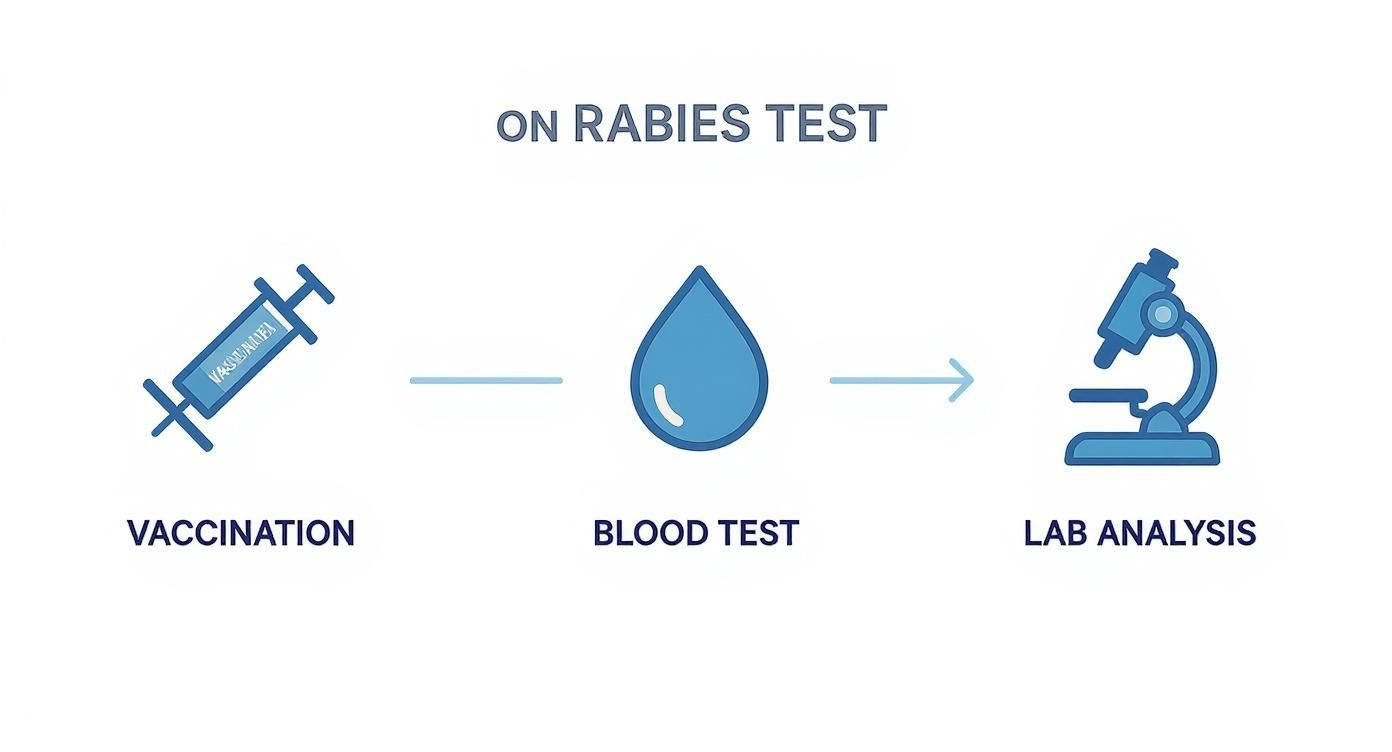
As the visual shows, it’s a logical flow: the vaccine jump-starts the immune system, the blood test captures that immune response, and the lab analysis gives you the official proof you need.
Here’s a more detailed breakdown of the timeline you'll need to follow:
Microchip and Rabies Vaccination: First things first. Your dog must have a recognized microchip implanted before receiving their rabies vaccine. Many countries will not recognize a vaccine that was given before a microchip was in place.
The First Waiting Period (Post-Vaccination): After the rabies shot, you have to wait. There's a mandatory waiting period of at least 30 days before your vet can draw blood for the titer test. This pause gives your dog's immune system time to build up a strong, measurable level of antibodies.
The Blood Draw: Your veterinarian will draw a small blood sample and prepare it to be shipped to a government-approved laboratory for testing.
Lab Processing Time: Once the lab gets the sample, it can take anywhere from two to six weeks—and sometimes even longer during busy travel seasons—to process the test and issue the results.
The Second Waiting Period (Post-Blood Draw): This is the big one and the most critical part of the timeline. After a successful blood draw, many strict countries have another mandatory waiting period before your dog is allowed to enter. For places like Japan or the EU (if arriving from a high-rabies country), this waiting period is often three months or more.
It's very important to understand that this second waiting period usually starts from the date the blood sample was drawn, not the date you receive the results. Always confirm this detail with your destination country's authorities.
To help visualize this, here is a simplified timeline for a pet traveling to a country with strict entry requirements.
Sample Titer Test Timeline for International Travel
Step | Action Required | Typical Timing |
|---|---|---|
1 | Implant microchip & administer rabies vaccine. | Day 1 |
2 | Wait for the immune system to respond. | Day 1 to Day 30 |
3 | Vet draws blood for the titer test and sends it to the lab. | On or after Day 30 |
4 | Lab processes the sample and sends the results back. | Day 45 to Day 75 |
5 | Mandatory waiting period before entering the destination country. | Day 30 to Day 120 (3 months from blood draw) |
6 | Eligible to travel to the destination country. | On or after Day 120 |
This table shows how quickly the days add up, underscoring why an early start is essential for a successful journey.
Why Timing Matters for Vaccine Effectiveness
Even the timing of the initial rabies vaccine can impact the outcome of the titer test. Research has shown that a dog's age at vaccination can affect how strong their antibody response is. For instance, one study found that dogs vaccinated after 16 weeks of age had a much higher antibody level compared to those vaccinated earlier. You can dig into the full details of the vaccination timing study to see just how much age can influence immunity.
Mastering this timeline is a huge part of managing international pet travel requirements. By mapping out these key milestones, you can make sure every box is checked on time, making the journey to your new home as seamless as possible for you and your furry first mate.
What to Do If Your Dog Fails the Test
Seeing a "fail" on your dog's rabies titer test can feel ruff, especially with travel plans on the horizon. It’s natural to feel stressed, but take a deep breath. A failed test is almost always a fixable problem, and it certainly doesn't mean your dog is unhealthy.
A low antibody count simply means your dog's immune system hasn't quite produced enough of those protective soldiers to meet the 0.5 IU/mL standard. It’s not a reflection on you or your dog; it's just a biological outcome. Think of it less as a failure and more as a "not quite there yet."
This is more common than you might think. Some dogs are just a bit slower to build up a strong immune response. In other cases, the timing might have been slightly off—maybe the blood was drawn a little too soon after the vaccine for the antibody levels to really ramp up.
Creating a New Game Plan
So, what’s next? The path forward is usually straightforward, and your vet will guide you. You won’t be in the doghouse for long.
Rabies Vaccine Booster: The first and most common step is getting another rabies vaccine. This booster shot acts as a powerful reminder to your dog's immune system, kicking antibody production into high gear.
Wait and Re-test: After the booster, you'll need to wait again before re-testing. Your vet will recommend the ideal window—typically at least 30 days—to give those new antibody levels time to build before the next dog rabies titer test.
A failed titer test is not the end of the road. It is a manageable hurdle that highlights the importance of a strong and consistent vaccination history to ensure a solid immune response.
Unfortunately, this process does reset your travel timeline, which is why starting your preparations early is so crucial. All your documents, including the all-important health certificate, depend on getting a valid, passing titer result. For more on that, check out our guide on how to get a USDA-endorsed pet health certificate.
Vaccine Response Can Vary
It’s important to remember that not every dog responds to a vaccine in the same way. In fact, studies show that a surprising number of vaccinated dogs may not have adequate protection.
For example, one study in India found that a significant number of vaccinated dogs had insufficient protective rabies antibody levels within a year of their last shot. That rate is much higher than in other parts of the world, highlighting just how much regional factors can play a role and why re-testing is so critical.
Your Top Questions About the Dog Rabies Titer Test
When you’re navigating the maze of international pet travel rules, a few questions always pop up. Getting straight answers about the dog rabies titer test is crucial for feeling confident about your move. Let’s tackle some of the most common queries pet owners have.
My goal here is to cut through the confusion and give you the practical details you need for a smooth journey with your furry co-pilot.
How Long Is a Rabies Titer Test Good For?
This is a great question, and the answer can save you a lot of time and money down the road. For many popular destinations, including the entire European Union, a passing titer test result is considered valid for the life of your pet. But there’s a huge catch.
Your dog’s rabies vaccinations can never lapse. Not even by one day. If a booster shot is overdue, that chain of protection is officially broken, and the titer test becomes instantly invalid. If that happens, you’re back to square one: new vaccine, another waiting period, and a brand-new test.
While the "valid for life" rule is common, always double-check the specific regulations for your destination country. Some places have their own validity periods. The bottom line? Keeping those rabies boosters on schedule is the single best way to keep your dog’s travel credentials ready to go.
Can My Regular Vet Do the Titer Test?
Yes, your trusted local vet is exactly where you should start the titer test process. They are perfectly set up to handle the first and most critical steps: drawing your dog’s blood and getting the sample ready for its journey to the lab. It's a routine procedure for them.
The actual analysis, however, has to be done by a specialized, government-approved laboratory. Your vet can't run this test in-house. Their job is to draw the blood correctly, fill out all the necessary forms, and ship the sample to a certified lab that your destination country recognizes. It’s always smart to ask if your vet has handled international travel paperwork before just to make sure they know the ropes.
Think of it this way: your vet is your partner in getting the sample, but the official result has to come from an approved lab. This system ensures the results are standardized and trusted by border officials everywhere.
How Much Does a Dog Rabies Titer Test Cost?
Budgeting for a big move is key, and the dog rabies titer test is a definite line item to include. All in, you can expect the total cost to be somewhere between $200 and $500. This price isn't just for the lab analysis; it’s a bundle of services.
Here’s what that final cost typically covers:
The vet visit fee for the exam and blood draw.
The laboratory’s fee for processing the sample.
Shipping costs to get the sample to the lab, which usually needs special handling and overnight delivery.
Prices can swing quite a bit depending on where you live, your vet’s pricing, and which approved lab they use. To avoid any surprises, just ask your vet for a complete cost estimate before you get started.
Feeling buried in travel timelines and paperwork? Passpaw takes the headache out of getting international pet health certificates. Our platform helps your vet manage every single detail, so nothing gets missed and you can focus on the adventure ahead. See how we make pet travel simpler at https://passpaw.com.
More articles
From regulatory changes to best practices for veterinarians and pet owners, our resources keep you ahead of the curve.