Are you a team member in a veterinary practice?
Are you a pet parent planning a trip with your furry pal?
Bearded Dragon Travel Carriers: A Safe Buying Guide
You've packed the appointment paperwork, a towel, and perhaps half the contents of the reptile cupboard. Your bearded dragon, meanwhile, is sitting in a carrier that seemed perfectly fine on the shop shelf. Then the driveway bumps, the lid rattles, and a passing truck fills the window with noise and motion. Your dragon flattens its body, darkens its beard, and stares wide-eyed at the road.
The warm sun through the glass makes the carrier feel stuffy. The soft hiss is easy to miss beneath the engine. By the time you reach the vet, a quick visit has become a stressful little road trip for everyone, including the lizard who contributed nothing to the packing.
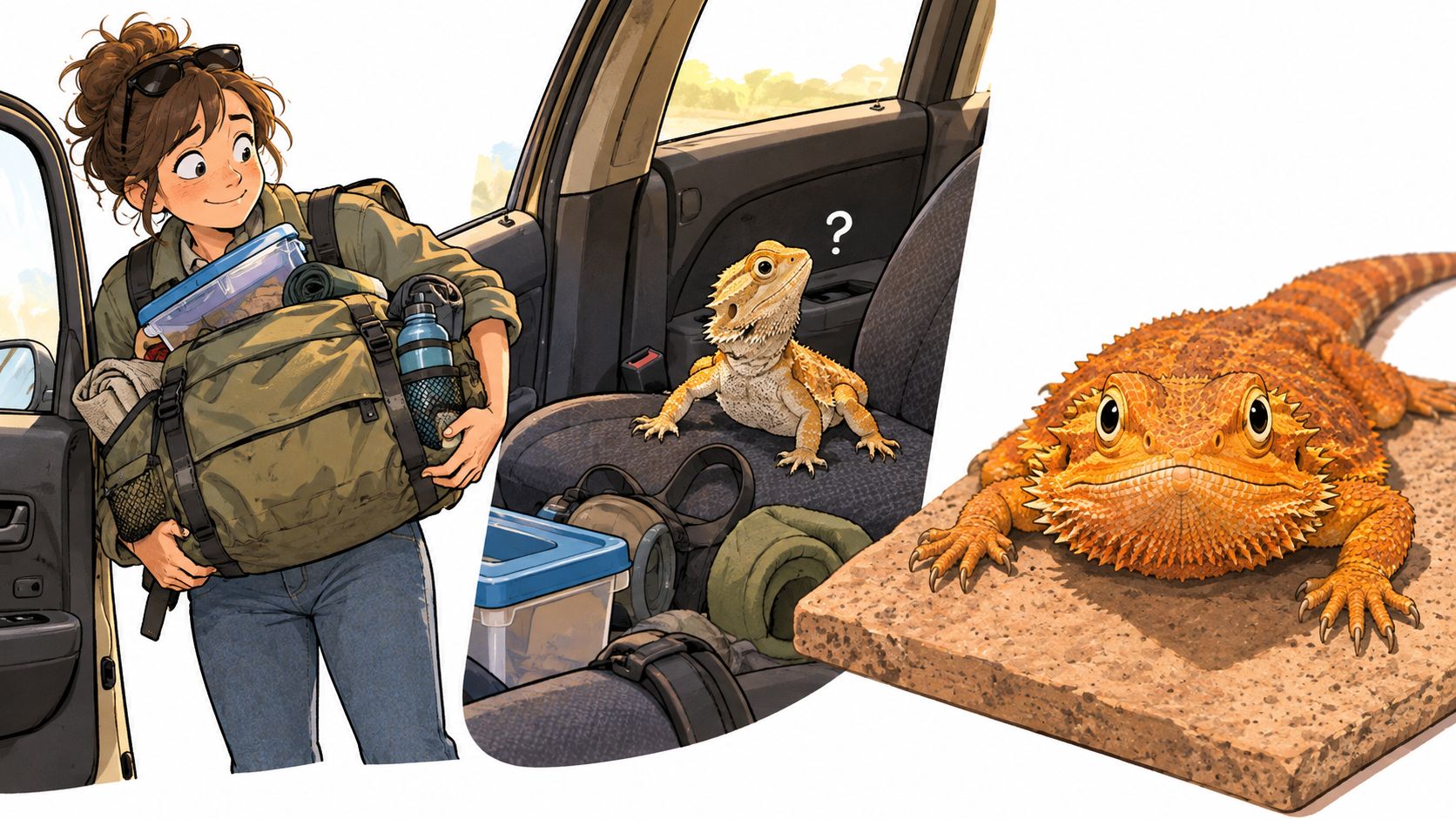
The carrier isn't just a container. It controls how much your dragon moves, sees, hears, and heats up while away from its enclosure. The right choice can make a vet visit feel uneventful. The wrong one can turn your pet into a very worried pancake.
So what separates a calm ride from a panicked one?
Picture This, You and Your Dragon on the Road
A bearded dragon doesn't understand that you're heading to a familiar reptile veterinarian and will be home soon. It only experiences the immediate changes. Its enclosure has disappeared, the floor is moving, unfamiliar shapes flash past, and a human hand keeps reaching toward the carrier to check whether everything is all right.
That reaction doesn't mean your dragon is difficult. Flattening can help a dragon absorb warmth or appear larger when it feels threatened. Darkening and beard puffing can signal stress, fear, or a defensive response, while a sudden change in posture may reflect the animal's attempt to manage an unfamiliar environment. These signals are useful because they show you what the carrier experience feels like from the inside.
A clear-sided carrier can make every passing car, tree, and person part of the show. A loose bag can sway with each turn. A large container can let your dragon slide across the floor when you brake. Even a comfortable-looking carrier can become unpleasant if sunlight warms one side while poor airflow leaves no cooler place to shift.
The small details matter
Now imagine the same trip with a stable carrier on a non-slip surface. The interior is dim rather than visually busy. The floor has a towel that gives your dragon traction, the lid stays firmly shut, and the ventilation allows fresh air without turning the carrier into a wind tunnel. You still hear the engine, but the ride has fewer surprises.
That doesn't guarantee a completely relaxed dragon. Travel is still travel, and some beardies are better passengers than others. It does give your pet a sensible, predictable space instead of a rattling viewing box.
A good carrier doesn't make the journey disappear. It makes the journey easier for your dragon to handle.
The rest of your setup matters too. Temperature, restraint, handling, and the length of the trip all change the decision. A carrier for a short examination shouldn't be chosen exactly like one for a long car journey. The first step is understanding what “safe” means beyond a cute design or a product label.
What Makes a Carrier Actually Safe for a Bearded Dragon
Think of a carrier as a tiny portable house. A house needs a strong frame, doors that stay closed, fresh air, and enough room to move without sliding across the floor. A bearded dragon carrier needs the same four basics, just with much less furniture.
Strong frame
Rigid walls keep the carrier from folding inward when another bag presses against it or when you grip it by the handle. A flexible dog carrier may look roomy, but a side that caves in can trap toes or press against the dragon's body. Hard-sided plastic often provides the most dependable structure for car trips and vet visits.
Fresh airflow
Ventilation should come from more than one direction. Mesh panels or vents on multiple sides allow air to circulate while reducing the risk of a hot, stagnant pocket. A sealed plastic tote with a few tiny holes might hold a dragon, but it won't create the balanced airflow needed for a comfortable trip.
A carrier also shouldn't be so open that it loses heat immediately. Independent transport guidance places practical travel targets around 70 to 85°F, or 21 to 29°C, at the animal's level, and warns that prolonged exposure below about 65°F, or 18°C, can reduce activity and digestion. The same guidance notes that temperatures above about 88°F, or 31°C, inside a closed carrier can increase heat-stress risk because the dragon can't move to a cooler zone. See the bearded dragon travel guidance on carrier temperatures for the reasoning behind that narrow middle ground.
Locked doors
A bearded dragon may look relaxed while testing the lid. A curious nose can find a weak point, especially if the carrier has a simple zipper or a loose plastic tab. Choose secure latches that close fully and check them before lifting the carrier.
The right view
Limited sight lines can help reduce visual overload. A dark or partly covered interior gives your dragon fewer moving objects to track than a transparent bubble window. This doesn't mean blocking every vent or sealing the carrier in a blanket. It means offering shelter while preserving safe airflow.
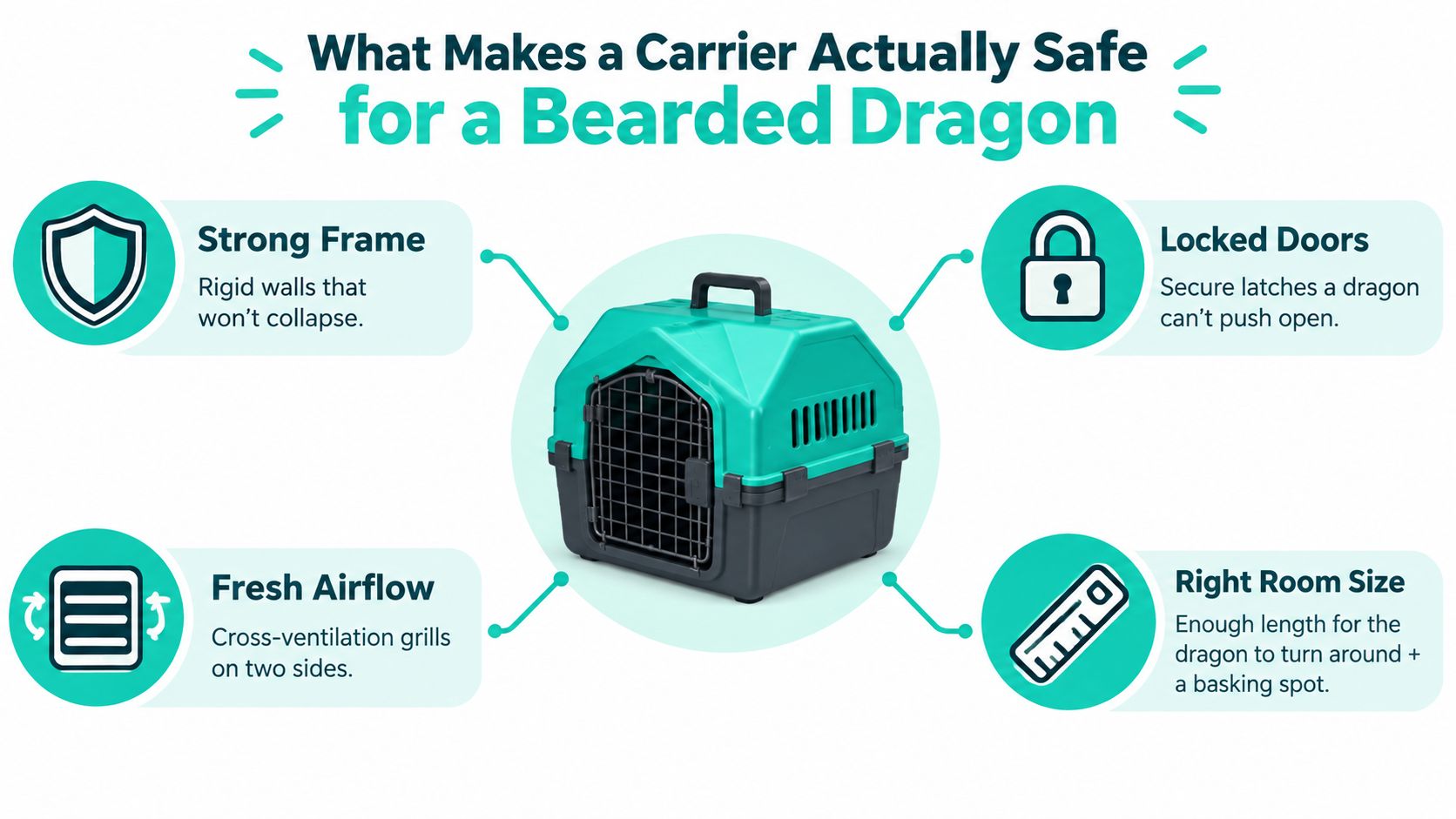
Size joins the other pillars
The carrier should let your dragon turn around, but it shouldn't be so large that the animal slides during movement. A roomy carrier with poor traction can be less safe than a smaller one with a stable towel liner. A rigid carrier with weak ventilation still fails, just as a well-ventilated bag with an unreliable zipper fails.
For a broader overview of safe pet transport habits, use these pet travel safety tips. Once you know the four pillars, comparing carrier styles becomes much easier.
The Main Types of Bearded Dragon Travel Carriers
No single carrier style wins every journey. A hard shell may be excellent for a car, while a lighter design is easier to carry into a clinic. The useful question is not “Which carrier is best?” but “Which design meets the safety basics for this trip?”
Carrier Type | Strength | Weakness | Best For |
|---|---|---|---|
Hard-sided plastic pet carrier | Durable frame and secure structure | Can be bulky and heavier to carry | Vet visits and car travel |
Soft-sided fabric carrier | Light and easy to pack | May flex, sag, or offer less dependable latching | Short, carefully supervised trips |
Reptile-specific front-opening enclosure | Often gives a darker, calmer interior and easy access | May be less convenient to transport or clean | Vet examinations and controlled handling |
DIY storage-bin conversion | Allows budget customization and a tailored footprint | Ventilation, edges, latches, and materials can create risks | Owners comfortable checking every modification |
Hard-sided plastic carriers
These are the dependable workhorses. A rigid plastic carrier can resist compression, support a non-slip liner, and provide a firm base during a car journey. For a 10-minute vet visit, it may be the most practical choice, especially if the opening is wide enough for gentle removal.
Look for more than a familiar cat-carrier shape. The carrier should have ventilation on multiple sides, a lid that can't be pushed open, and enough space for the dragon to turn without sliding.
Soft-sided fabric carriers
Fabric models are lighter and easier to store. They can work for a short, calm transfer when the frame stays firm and the mesh remains open. Their weak points are usually sagging floors, exposed zippers, and walls that offer little protection from bumps or visual activity.
A soft carrier is a poor match if it collapses when lifted or if the dragon can press directly against thin mesh. Treat lightweight construction as a convenience, not a safety feature.
Reptile-specific enclosures
Front-opening reptile carriers can provide a darker interior and easier access than a top-opening box. That matters at the clinic, where pulling a nervous dragon through a small opening can add unnecessary handling. These designs are useful when you want the carrier to serve as a short-term holding space while paperwork is completed.
DIY conversions and backpacks
A modified storage bin can be inexpensive and thoughtfully sized, but every drilled edge, vent, latch, and handle needs inspection. Rough plastic can injure toes, while poorly placed vents can leave one side stagnant.
Backpack-style reptile carriers deserve extra scrutiny. For owners comparing air travel options, the airline pet travel carrier guide can help separate airline language from actual animal needs. Whatever style you choose, return to the same four checks: rigidity, ventilation, secure closure, and manageable sight lines.
Sizing, Materials, and Temperature the Right Way
A product label saying “for bearded dragons” doesn't tell you whether the carrier suits your animal. Measure the dragon, look at the interior dimensions, and consider how it will stand on the floor during movement.
A useful starting point is an interior length of roughly one and a half times your dragon's body length, with enough height for the head to remain clear when the animal is alert. For adult animals, carrier guidance commonly references a size of up to about 24 inches, or 61 cm, while still warning that excessive space can allow sliding. Check the bearded dragon carrier size and restraint guidance before treating a large box as an upgrade.
The footprint should also accommodate a natural resting posture. A dragon that sprawls to absorb warmth needs more usable floor space than one curled tightly in a towel. Don't size only from the animal's smallest resting shape.
Compare the material
Material | Durability | Cleanability | Weight | Best For |
|---|---|---|---|---|
Plastic | Strong and resistant to flexing | Usually simple to wipe and dry | Moderate | Regular car trips and clinic visits |
Fabric | Can be comfortable but may sag or tear | Liners and seams need close inspection | Light | Short transfers with a firm base |
Wood-veneer reptile carrier | Can feel sheltered and rigid | Must be sealed appropriately and dried fully | Varies | Controlled use when surfaces are safe and treated |
Plastic usually offers the best balance for routine transport because it resists chewing, wipes clean, and holds its shape. Fabric can work when the floor is stable and the mesh is durable. Wood-veneer designs need particular care because untreated or poorly sealed surfaces can absorb moisture and odors.
Use a ruler and a thermometer
For ventilation, use a simple visual test. You want vents on the top and sides, not a single opening on one wall. Some owners use a rough design target of vents covering at least 25% of the carrier's surface area, but that figure is no substitute for checking whether air moves through the carrier.
Temperature guidance for bearded dragons often places preferred air temperature around 77 to 90°F, with basking temperatures about 5°C warmer and nighttime temperatures able to fall to roughly 65 to 80°F. The carrier and transport setup guidance from SpectrumCare explains why a short trip needs a stable microclimate rather than full basking heat.
Place a probe thermometer at animal level and test the carrier before departure. An ambient gauge can show the general air temperature, but a probe tells you what the dragon's space is experiencing. Don't add a loose heating device inside the carrier, where it can shift, press against the animal, or create a hot spot.
Red flags include:
Warped lids: They can create gaps or prevent the latch from engaging.
Exposed zippers: A dragon may press against them, and the zipper can fail under movement.
Single-vent walls: One-sided airflow can leave the interior stale or unevenly heated.
Untreated soft mesh: It can snag claws, collapse under pressure, or tear during handling.
For practical crate and carrier considerations beyond reptiles, review this pet travel crate guide, then apply the reptile-specific temperature and visibility checks above.
Prep and Acclimate Your Dragon Before Travel Day
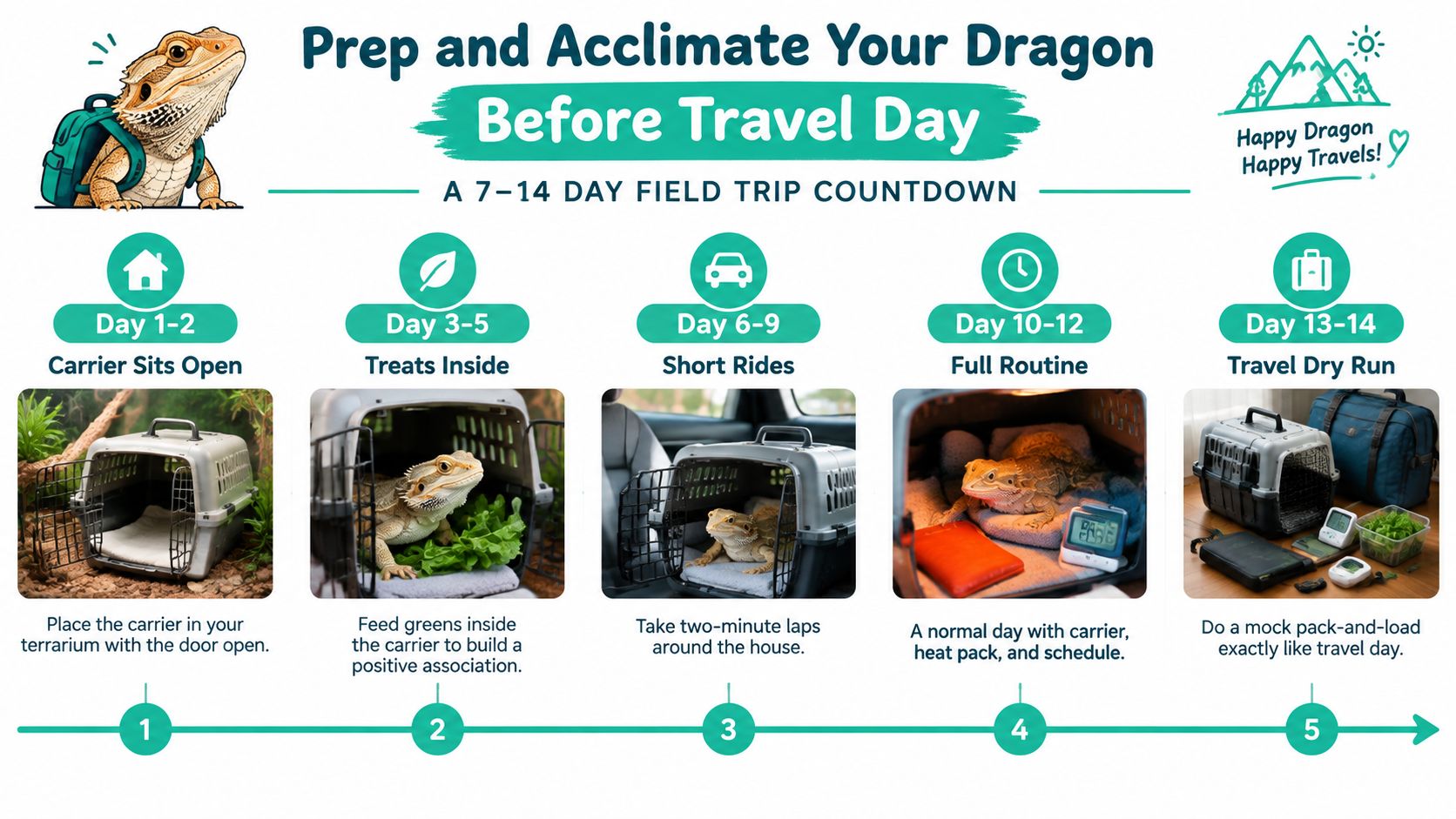
Travel works better when the carrier becomes familiar before the appointment. Treat the process like a school field trip. The dragon gets to inspect the “bus,” sample a snack, and learn the routine before anyone starts the engine.
Begin 7 to 14 days before travel by placing the open carrier inside or beside the enclosure. Add a used hide or familiar towel so the carrier carries a known scent. Offer treats inside, but let your dragon leave freely at first.
Build the routine gradually
Early days: Keep the door open and let curiosity do the work.
Middle days: Close the door briefly, then open it before your dragon becomes distressed.
Later practice: Try closed-door sessions of 5, 15, and 45 minutes, increasing only when the previous session stays calm.
Sound practice: Sit with the carrier near an idling car so the engine becomes ordinary background noise.
Dry run: Pack the same supplies, lift the carrier, load it, and return home without making the first real trip a surprise.
Keep the body comfortable
For cold-weather travel, pre-warm the surrounding space with a heat-safe disc, keeping the heat source outside the dragon's direct contact and checking the carrier with a thermometer. A light mist before departure can support hydration, but don't turn the carrier into a damp enclosure.
Avoid feeding in the 2 hours before travel to reduce the chance of regurgitation. If your dragon has a medical condition or your veterinarian has given different feeding advice, follow that individual guidance instead.
If the trip includes a planned appointment, compare local veterinary costs and services ahead of time with this routine vet cost comparison. It can help you prepare questions before travel day rather than juggling them beside a rattling carrier.
Travel-day checklist
Towel liner: Use a clean, non-slip surface that won't bunch under the dragon.
Spare heat pack: Carry one for emergencies, but keep it outside the carrier and monitor the temperature.
Mini spray bottle: Use it only for light hydration when appropriate.
Vet paperwork: Pack records, appointment details, and any requested samples.
Backup power bank: Keep temperature monitors running if the journey takes longer than planned.
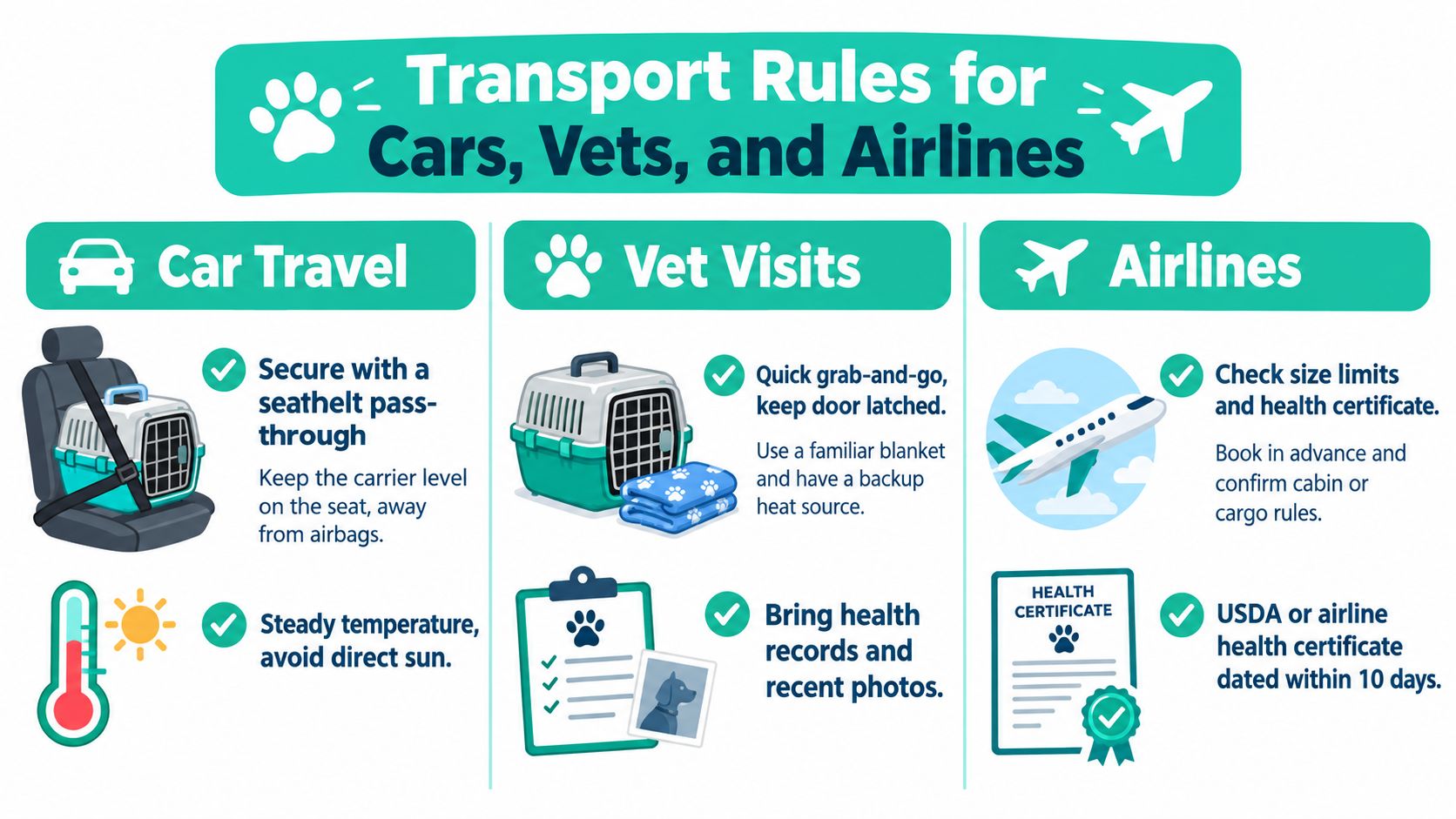
Transport Rules for Cars, Vets, and Airlines
The same carrier can serve several trips, but the way you use it changes by setting. A car needs restraint and temperature control. A clinic needs easy access. An airline adds documentation, handling, and rules that can change by route.
Car travel
Secure the carrier so it can't slide, tip, or become a projectile during braking. A seatbelt pass-through or a non-slip mat can help, while placing the carrier on the floor behind the front seat may offer a more stable position than an exposed seat. Keep the carrier level, away from airbags, and out of direct sun.
Never leave your dragon unattended in a parked vehicle. Even a pleasant day outside can create a dangerous temperature change inside a closed car.
Vet visits
A carrier should be easy to lift, open, and clean. Choose a design that can sit securely on a standard exam table and serve as a temporary holding space while the receptionist processes paperwork. A familiar towel can make the clinic feel less alien, provided it doesn't block vents or bunch under the animal.
Bring health records, recent photos of the dragon's enclosure if the veterinarian may need husbandry context, and any requested samples. The carrier door should stay latched whenever your dragon isn't being handled.
Airlines
Air travel requires advance confirmation. USDA, IATA, and individual airline policies may address carrier construction, animal acceptance, cabin or cargo handling, temperature conditions, and health documentation. Many US airlines don't permit reptiles in the cabin, and cargo arrangements can involve temperature restrictions or warranties that differ by carrier.
Some airline processes require a health certificate dated within 10 days, but the exact requirement depends on the route and policy. Rules can shift by country and season, so call the airline for confirmation before booking. A 15-minute call can prevent you from arriving with a carrier or document that the airline won't accept.
For longer journeys, use this guide to transporting pets across the country. If you need help arranging care around departure or arrival, a local service such as Denver Dog runners in Commerce City may also help with practical pet logistics, although reptile-specific care should always be confirmed first.
Why Those Cute Backpack Carriers Need a Second Look
Transparent backpack carriers sell a lovely idea. Your dragon can see the world, you can watch it through a bubble window, and your hands stay free. The problem is that the design often prioritizes the owner's view over the animal's ability to retreat from stimulation.
Heat can build against your back
A backpack sits close to the wearer's body and may receive warmth from both the person and the surrounding weather. Clear plastic can also trap heat when sunlight reaches the carrier. A bearded dragon can't move into a cooler zone if the whole compartment warms up.
Motion becomes constant
Every step shifts the carrier. Light changes across the transparent panel, people pass close by, and vehicles appear suddenly in the dragon's field of view. A nervous dragon may flatten, darken its beard, hide, or breathe more quickly. Those behaviors deserve attention rather than a cheerful assumption that the pet is enjoying the sightseeing.
Ventilation may be weaker than it looks
A grid of small openings isn't automatically good ventilation. Some openings face the wearer's back, some can be covered by clothing, and some panels flex inward under pressure. Mixed-species marketplace listings also make the category harder to judge. Products marketed for bearded dragons may also be sold for hedgehogs, guinea pigs, birds, and other small pets, with listings commonly showing dimensions around 12 x 10 x 10 inches or 12 x 10 x 12 inches. See the marketplace examples of mixed-species carrier listings, but treat the label as marketing rather than proof of species-specific safety.
Independent reptile care guidance generally favors dark, rigid, well-ventilated carriers over exposed designs for stressful transport. Phrases such as “360 view” and “bonding window” may sound friendly, but your dragon doesn't need a panoramic commute.
A backpack may be acceptable for a very short outdoor transfer in mild weather, when the carrier remains stable, shaded, ventilated, and closely supervised. It shouldn't be the default for a hot day, a long walk, a bumpy ride, or any situation where you can't monitor the interior temperature.
Care, Cleaning, and Quick Answers After the Trip
Clean the carrier as soon as you get home. Remove the towel, launder washable soft liners at 60°C, and wipe hard shells with a reptile-safe disinfectant. Rinse when the product requires it, then air-dry every surface fully before storage, since trapped moisture can encourage bacterial growth.
Inspect the parts that fail first: zippers, mesh, seams, handles, corners, and latches. Replace a liner that no longer grips the floor, repair or retire damaged mesh, and don't trust a closure that needs force to stay shut.
Quick answers
How long can a bearded dragon stay in a carrier?
Keep the trip as short as practical, especially when the carrier can't provide a meaningful temperature gradient. For a longer journey, check the animal's temperature at its level, offer stable traction, and plan around the dragon's welfare rather than treating the carrier as a second enclosure.
Should I feed before travel?
Avoid feeding in the 2 hours before departure to reduce regurgitation risk. Follow your reptile veterinarian's advice if your dragon has a health condition or a special feeding plan.
What temperature is safe inside the carrier?
Practical travel guidance targets about 70 to 85°F, or 21 to 29°C, at animal level. Temperatures below about 65°F, or 18°C, may suppress activity and digestion, while a closed carrier above about 88°F, or 31°C, can raise heat-stress risk. Check the reptile transport safety recommendations alongside your veterinarian's advice.
How can I tell stress from calm resting?
A calm dragon usually has alert eyes and a settled posture. Persistent flattening, black beard displays, rapid breathing, hiding, or refusal to eat can signal stress or discomfort. If behavior doesn't settle after the trip, contact a qualified reptile veterinarian.
Passpaw helps pet owners and veterinary teams organize international health certificates, validate documents, and track travel requirements around departure dates. Visit Passpaw to make the paperwork side of your bearded dragon's journey as orderly as the carrier itself.

More articles
From regulatory changes to best practices for veterinarians and pet owners, our resources keep you ahead of the curve.