Are you a team member in a veterinary practice?
Are you a pet parent planning a trip with your furry pal?
Application Tracking Number Guide for Pet Travel
A client calls five days before departure: “What's our status?” The veterinarian remembers submitting the international health certificate, but the certificate is still under review, the courier receipt is in a different folder, and the owner is looking at a number that doesn't open any public page. Everyone has a number. Nobody is quite sure which answer it supports.
That situation is common because an application tracking number isn't a universal travel-status code. It identifies a particular application inside a particular workflow. The submitting veterinary practice may control the record, an authority may update the status, and the pet owner may receive only selected milestones. The number can bring order to the paperwork, but it can't replace careful date checking, document review, or clear communication.
What an Application Tracking Number Really Is
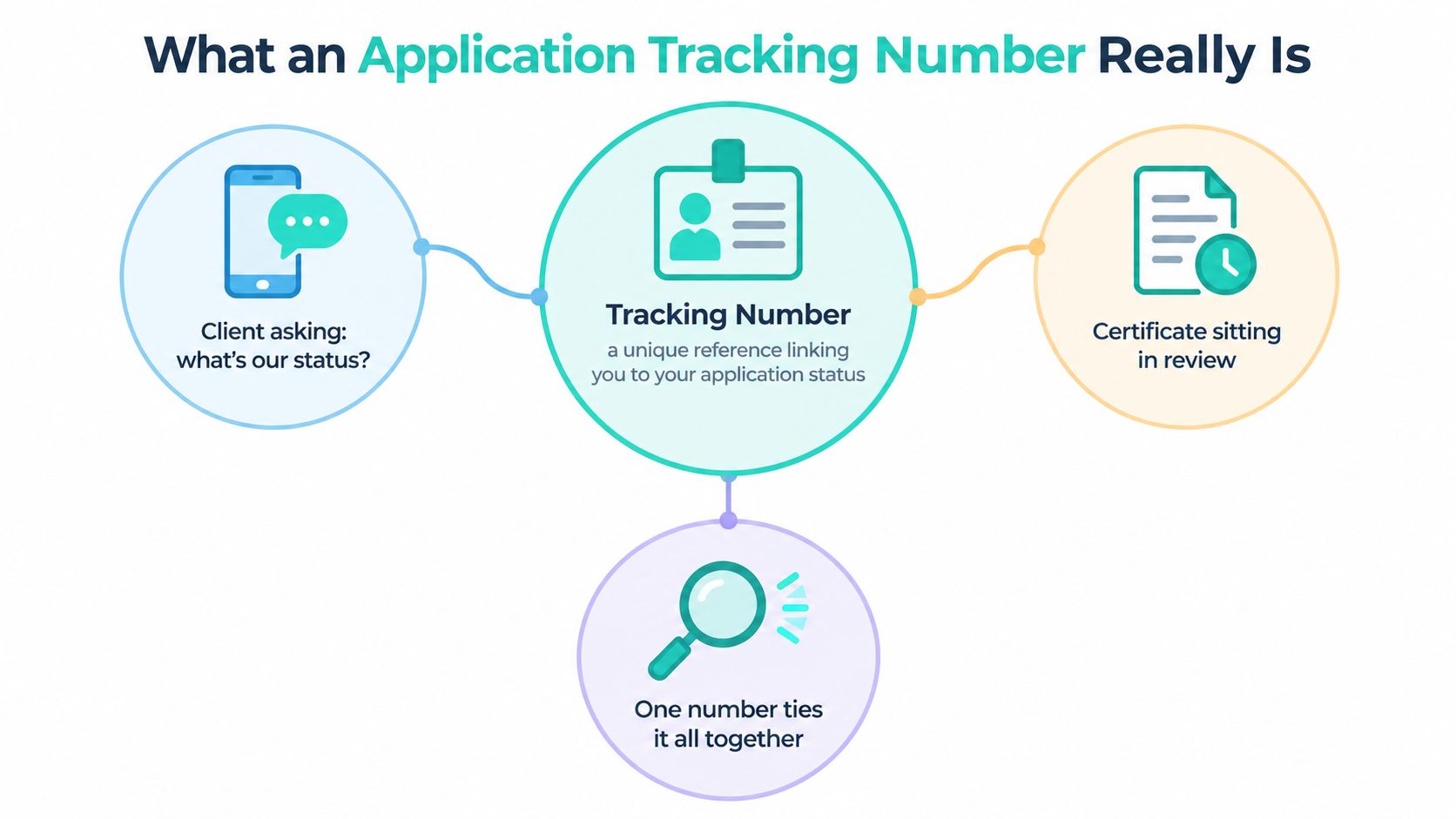
An application tracking number is a unique reference assigned to a specific case. It connects the application with its documents, people, dates, and status history. It isn't the pet's microchip number, the international certificate number, an airline booking reference, or a courier code.
For international pet travel, that distinction matters. One case can contain an international health certificate, vaccination records, laboratory results, an import permit, and correspondence between the practice and an endorsing authority. Without a shared reference, staff may attach a correction request to the wrong pet file or answer an owner using a delivery update that says nothing about approval.
The USDA Veterinary Export Health Certification System, or VEHCS, provides a useful real-world example. USDA describes VEHCS as a secure online system for creating, issuing, submitting, and endorsing animal health certificates. Each submission receives a tracking number that connects documents, responsible professionals, timestamps, and status changes in one record.
Keep four numbers separate
A helpful mental model is to treat the application tracking number as the thread running through the case.
Application number: identifies the submitted workflow and its current record.
Certificate number: identifies the completed, officially endorsed certificate where the system issues one.
Microchip number: identifies the animal, not the application.
Courier tracking number: follows a physical envelope or parcel.
The same pet may appear in all four records, but each identifier answers a different question. “Has the certificate been endorsed?” belongs to the application or authority system. “Where is the original document?” belongs to the courier system.
Practical rule: Store the application number beside the pet's case record, then label every other identifier by its purpose.
That simple habit gives a veterinary team a stable reference without placing sensitive details in the visible code. A tracking number shouldn't reveal the owner's name, the pet's name, passport details, destination, or travel date.
The Lifecycle of a Pet Travel Application
A tracking number becomes useful when the team follows the application through its actual milestones. In a VEHCS-style workflow, the veterinarian prepares and signs the certificate, submits it electronically, and receives an endorsement decision through the system.
Five milestones worth recording
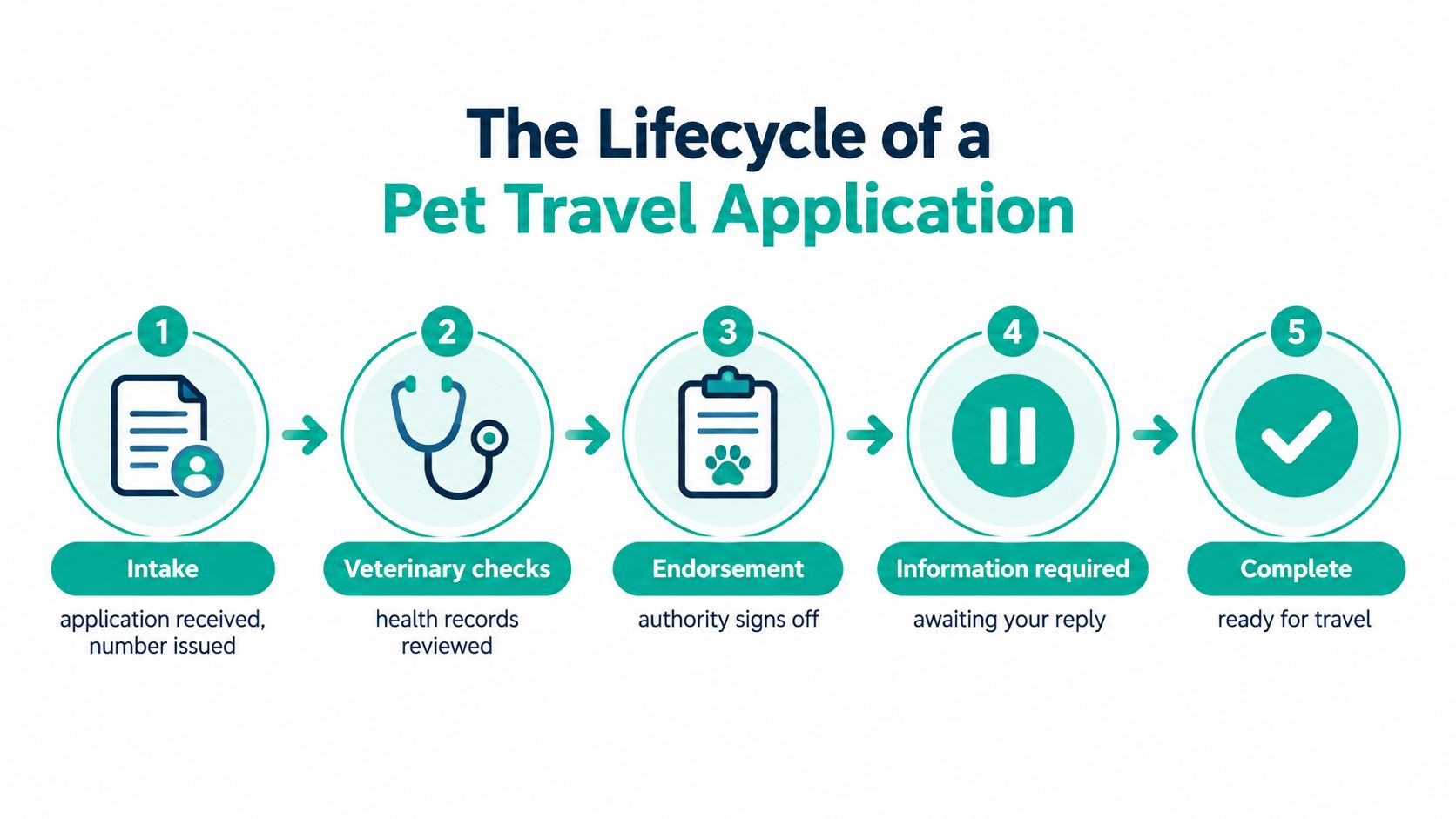
Intake and document collection. The practice opens the case, records the destination, and gathers the health certificate, vaccination evidence, test results, and any permit information. The tracking number should be attached as soon as the application enters the workflow.
Veterinary checks. An accredited veterinarian reviews the animal's records, completes the certificate, and signs and dates it. Missing dates, inconsistent identification details, or incomplete clinical information can stop the file before submission.
Electronic submission. The veterinarian submits the package through VEHCS when electronic endorsement is used. The system records operational details such as creation date, submission date, current status, and the responsible veterinary medical officer.
Authority review. The endorsing authority may approve the certificate or request information or corrections. A “submitted” status doesn't mean the certificate is approved. It means the file has entered the relevant workflow.
Completion or correction. After endorsement, the tracking number may be replaced by an official certificate number. USDA's VEHCS tutorial tells accredited veterinarians to record the tracking number for contact with the relevant Endorsement Office.
A good case file preserves each stage rather than only the latest label. That history helps staff explain what happened, identify who must act, and keep the record aligned with the wider documentation life cycle.
Where Application Tracking Numbers Appear Across Systems
A pet-travel team may handle several identifiers during one journey. The safest approach is to ask, “What event does this number track?” before entering it into a search box.
Identifier Type | Issued By | What It Tracks | Who Can Look It Up |
|---|---|---|---|
VEHCS application tracking number | USDA VEHCS workflow | Submission, review, endorsement, and related certificate records | The submitting accredited veterinarian or authorized practice staff |
EU entry certificate reference | Issuing official veterinarian or authority | The animal health certificate and its supporting details | The issuing practice, authority, border officials, and authorized parties |
Airline or cargo reference | Airline or cargo operator | Booking, acceptance, and transport handling | The shipper, airline, cargo agent, and authorized customer |
Courier tracking number | Postal or courier service | Movement and delivery of a physical package | The sender, recipient, and carrier using the delivery system |
These numbers can sit in the same case file without being interchangeable. A courier number may show that an envelope was delivered, but it can't prove that an authority accepted the contents. An application number may show that a submission is under review, but it won't show where the original papers are in transit.
USDA recommends retaining shipping tracking information for paper submissions, while the veterinarian checks submission status separately through VEHCS. That separation is easy to miss when a client says, “The tracking says it arrived, so are we approved?”
Match the question to the identifier
If the question is about document approval, use the application or certificate record. If it's about physical delivery, use the courier record. If it's about transport acceptance, use the airline or cargo reference.
Teams that manage many cases also benefit from a documentation hub that keeps these references under clear labels. A separate resource such as this Mail Tracker for Gmail overview can help explain the difference between message or delivery visibility and the status of a regulated application. For a broader practice workflow, keep the distinction visible in your documentation hub.
Don't place all numbers in one unlabeled field. “Tracking number” is too vague for a busy clinic. Use labels such as VEHCS application number, official certificate number, courier number, and airline reference.
How to Find the Tracking Number in Your Records
Start with the system where the application was submitted. In a VEHCS workflow, look for submitted or in-progress certificates and search using the available case details. The record may show the creation date, submission date, status, endorsement date, and the veterinary professional connected to the file.
If the number isn't immediately visible, work outward from the case file rather than guessing.
Open the practice record. Search by the pet's name, owner, microchip identifier, or destination. Confirm the correct animal before copying any number.
Check the submission confirmation. Look for a receipt, confirmation message, or saved PDF created when the application entered the authority workflow.
Review printed paperwork. A paper submission may have a receipt or shipping record. Keep the courier number separate from the application number.
Search the clinic mailbox. Use terms connected with the authority, certificate, submission, or endorsement. Verify that the message belongs to the right pet and destination.
Record the number in the main case file. Don't leave it only in one employee's inbox or on a handwritten note.
Verify before you share
A search result is useful only when its identity details match the case. Check the pet, microchip, destination, certificate version, and submitting veterinarian. This matters especially when a practice has several pets travelling to the same country.
Your record should also show who last handled the application and when the status changed. Clear veterinary record keeping makes it easier for another team member to continue the case without starting from scratch.
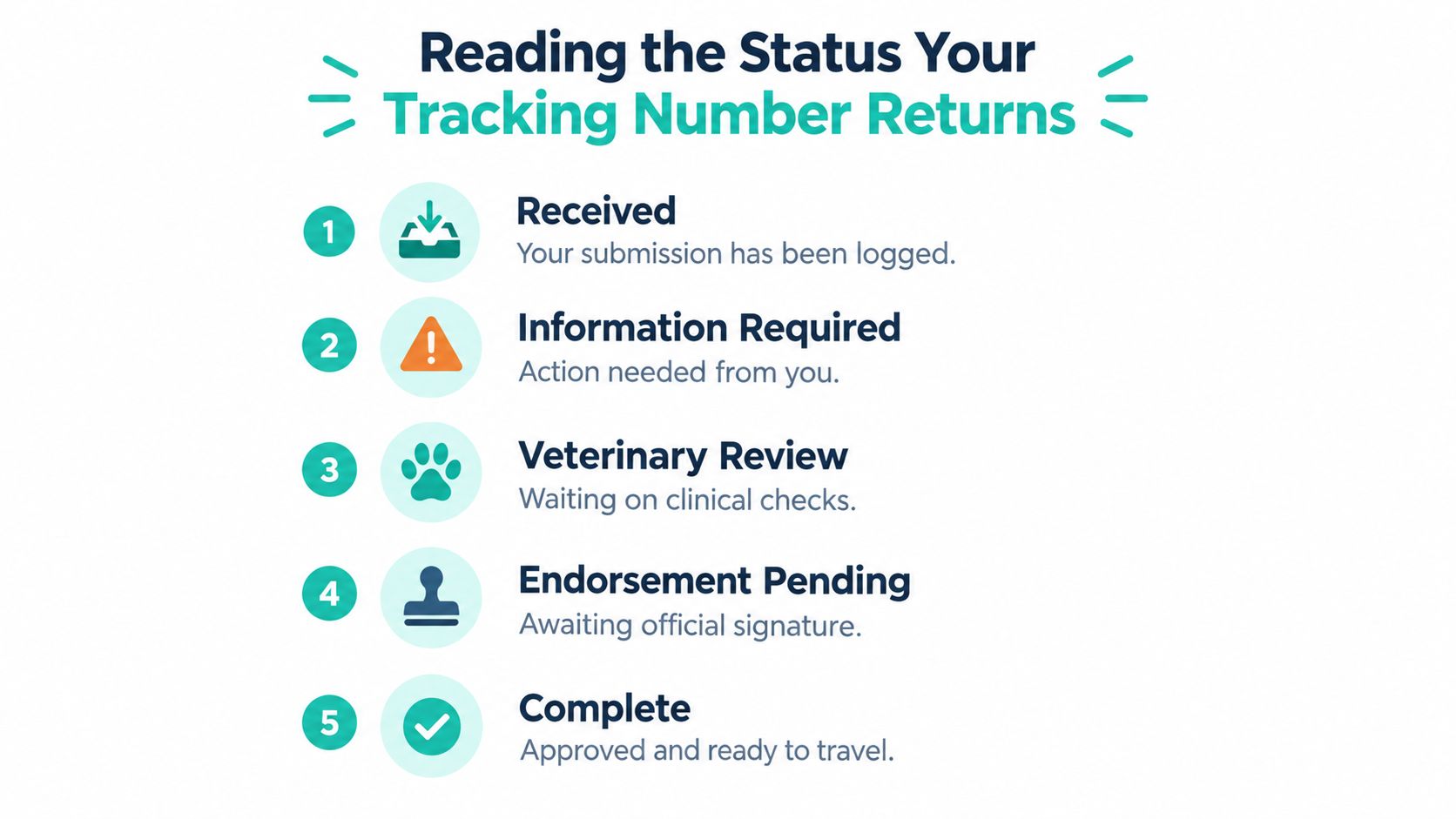
Reading the Status Your Tracking Number Returns
A status label is a short description of where the application sits. It isn't a promise that the pet can travel. Read the label together with the timestamp, the latest document version, and the next person who must act.
Translate the label into an action
Received: The system has logged the application. Confirm that the expected documents are attached.
Information required: Someone must provide missing or corrected information. The practice should identify the exact request and respond through the accepted channel.
Veterinary review: Clinical or certificate details are being checked. The veterinarian or authorized practice staff may need to resolve a question.
Document validation: The paperwork is being checked for completeness, consistency, and destination requirements.
Authority submission: The package has been sent to the endorsing authority. The submitting practice should retain the reference and monitor the record.
Approved or endorsed: The authority has completed its review. Confirm whether an official certificate number or final document has been issued.
Rejected: The application hasn't been accepted in its current form. Read the reason before deciding whether correction or a new submission is appropriate.
Expired: The application or document has passed a relevant validity point. Ask the veterinarian or destination authority what replacement process applies.
Withdrawn: The case is no longer active. Record who withdrew it and why.
A practice can use a simpler client-facing vocabulary while keeping the internal status model precise. For example, “action needed from the practice” may be clearer to an owner than “information required,” while the underlying record retains the formal label. The document status types should remain consistent enough for staff to recognize the next step.
A status without a date is only half a status.
Record the event time in UTC, the previous and new status, the acting user or system, the source channel, and a reason code. Keep corrections as new events instead of erasing the original entry. That gives the team a reliable history when two people work on the same case or a submission is retried.
Why Tracking Status Alone Is Not Enough
A status such as “processing” can sound reassuring while a certificate moves closer to the end of its permitted validity period. The tracking number tells you where the application is. It doesn't, by itself, tell you whether the resulting document will still be usable on the planned journey.
For travel from the United States, USDA explains that a signed international health certificate may have a limited validity window, such as 30 days, for obtaining endorsement and travelling, depending on the destination's rules. USDA also warns that endorsement can take several business days, and incomplete paperwork can delay or prevent endorsement. Check the destination-specific rule rather than treating 30 days as a universal rule.
EU entry has a separate timing structure. For travel from a non-EU country, the animal health certificate must be issued by an official veterinarian no more than 10 days before the pet arrives in the EU, according to the European Commission's pet-travel guidance. After entry and the required checks, it generally supports onward travel within the EU for up to 6 months, or until the rabies vaccination expires, whichever comes first.
Put dates beside status
A deadline-aware record should show:
certificate signing or issue date
planned departure and arrival dates
endorsement deadline
authority submission date
courier or mailing time where paper documents are involved
destination-specific validity notes
the next escalation date
A sea journey may extend the initial EU period by the length of the voyage, so the travel method can affect the calculation. The point isn't to make staff perform complicated legal analysis. It's to prevent “under review” from becoming a substitute for checking whether the dates still work.
If a deadline is approaching, contact the submitting veterinarian or responsible practice team promptly. A correction, replacement certificate, or new appointment may be needed, depending on the authority and destination rules.
Application Status Versus Courier Delivery Status
A courier scan answers one question: where is the package? An application status answers another: what has happened inside the review workflow? Those answers can disagree without either system being broken.
A package may show “delivered” while the authority hasn't completed its review. It may show “in transit” while an electronic submission is already under review. A delivery event doesn't confirm that the documents were complete, legible, correctly signed, or accepted.
USDA states that endorsement offices can't confirm delivery or provide individual status updates. USDA directs pet owners to contact their accredited veterinarian for VEHCS updates, while a separate postal tracking number is used for physical delivery.
Use a two-line answer with clients
When an owner asks for an update, separate the systems clearly:
Application status: The submitting veterinarian checks whether the file was received, requires information, remains under review, or has been endorsed.
Courier status: The carrier reports whether a physical envelope was accepted, moved, or delivered.
The owner shouldn't be expected to know which office can see which record. The practice can make the conversation easier by sharing the meaningful application milestone, the date it changed, and the next action. Don't say “the documents are approved” because a courier says “delivered.”
For paper submissions, keep the shipping receipt and carrier number with the application record. For electronic submissions, preserve the authority reference and confirmation. Two separate trails may be needed for one certificate package, and that's perfectly normal. The paperwork has two legs, so to speak.
Fixing the Most Common Tracking Number Problems
Tracking problems feel urgent because they often appear close to departure. A calm sequence helps the team avoid duplicate submissions and misplaced documents.
The number is missing
First, check the submitted application record, confirmation receipt, practice management file, and clinic mailbox. Search by the pet, microchip, destination, and submitting veterinarian, then verify the identity fields before saving a recovered number.
If the number still can't be found, contact the submitting veterinarian or the relevant system administrator through the approved channel. Gather the pet's case details, certificate version, submission date, and any courier reference. Do not create a second application just because the first number is missing.
The status hasn't changed
Review the last status timestamp and confirm whether the authority requested information. Then check that the practice submitted the complete package through the correct channel and that staff have not missed a message.
The accredited veterinarian or authorized submitting practice is usually the right first contact for a VEHCS case. USDA explains that owners should request updates from their veterinarian, who can check the system, rather than contacting the agency for individual case updates. Avoid promising a completion date when the system doesn't provide one.
A correction arrives near expiry
Compare the correction request with the certificate signing date, intended travel date, and destination validity rules. Ask the veterinarian whether the existing certificate can be corrected or whether a new certificate appointment and submission may be necessary.
Keep the original request, the corrected version, and the response timestamp together. That history shows what changed and prevents staff from working from an outdated document.
The courier loses the envelope
Use the carrier's claim or investigation process with the courier number, mailing receipt, sender details, and delivery information. Separately, ask the submitting practice or authority what electronic record exists and whether replacement paperwork is possible.
A lost envelope doesn't automatically mean the application was rejected, just as an electronic status doesn't locate the paper original. Keep both issues open until each system gives a clear answer.
A Sample Tracking Record Explained
Consider a fictional record for a dog travelling from the United States to an EU destination:
Field | Example | What it tells the team |
|---|---|---|
Application reference | PP-2026-7K4M2Q | The practice-facing case reference |
Created | 2026-05-03 | When the case record began |
Submitted | 2026-05-08 | When the package entered the authority workflow |
Current status | Information required | Someone must resolve a request |
Last event | 2026-05-10, UTC | When the status last changed |
Acting party | Submitting veterinary practice | Who recorded or triggered the event |
Endorsement date | Not yet recorded | The authority has not completed the final step |
Certificate number | Not yet issued | The completed certificate identifier isn't available |
The reference is useful for daily conversations, but it isn't proof of approval. The most important field here is information required, because it points to action rather than passive waiting.
A staff member should open the request, identify the missing evidence, check the planned arrival date against the applicable certificate window, and notify the owner in plain language. Once the authority endorses the document, the record may gain an official certificate number, while the application reference remains valuable for the historical trail.
Share only the information the recipient needs. A client may need the current milestone, next action, and relevant date. Internal audit fields, user identities, document versions, and sensitive health information should stay protected through role-based access.
Who Owns the Number and Who Needs to Know
The submitting accredited veterinarian or practice owns the operational responsibility for monitoring the application. The endorsing authority updates the official review record. The pet owner needs understandable milestones, action dates, and prompt notice when the practice must provide something.
USDA states that accredited veterinarians submit pet export documents and track endorsement status through VEHCS, while owners should request updates from their veterinarian because USDA can't provide individual status updates due to volume. Treat possession of the number as a lookup aid, not authorization or proof that travel is cleared.
Passpaw provides cloud-based tracking for ongoing international pet health certificate applications and their statuses, with document validation, deadline-aware task prioritization, and client communication in one workflow. Visit Passpaw to keep each application reference connected to the right pet, documents, status changes, and next action.

More articles
From regulatory changes to best practices for veterinarians and pet owners, our resources keep you ahead of the curve.