Are you a team member in a veterinary practice?
Are you a pet parent planning a trip with your furry pal?
What Is Task Prioritization and Why It Matters
Monday morning starts with four international pet trips already in motion. Two vaccination timelines are close to expiring, a lab result is still pending, and a destination country has changed its entry rules. Your inbox keeps filling, clients want updates, and every request sounds urgent.
A reactive approach sends the team from one interruption to the next. Someone answers the newest email while another person checks a form, but the lab draw that allows the rest of the process to proceed stays buried. By Friday, the team has worked hard, yet a pet's travel plan may still be at risk.
Task prioritization gives your team a shared way to decide what happens first, what gets scheduled, what can be handed off, and what should be removed. In international pet travel, that order must account for more than a due date. Documents, treatments, lab results, veterinary exams, client responses, and destination rules often depend on one another.
This guide uses friendly, practical examples from veterinary practices and pet travel agencies. You'll learn a clear definition, four useful frameworks, a dependency-aware pet travel example, a rollout plan, and metrics that help you see whether the system is working. For owners preparing their own trip, a resource on a safe journey with your dog can also help connect the workflow to the pet's wider travel experience. Teams that want to understand the documentation role in more detail can review this documentation specialist guide.
A Familiar Day in a Pet Travel Workflow
The first client calls before the practice has finished opening. One dog is flying soon, but the rabies vaccination window is narrowing. A cat's laboratory result hasn't arrived. Another family has sent an incomplete form, while a new country rule has changed which documents the team needs to check.
Without a ranking system, the loudest request usually wins. The client who calls twice gets attention before the client whose lab draw must happen first. A simple form correction feels easier than checking a destination rule, so the team clears small tasks while a high-impact dependency waits. That's how a busy day becomes a kennel full of loose ends.
A structured priority order changes the conversation. The team asks:
What has a hard timing constraint? Identify travel dates, treatment windows, examination dates, and laboratory timing.
What enables other work? Move tasks forward when later documents or approvals can't begin without them.
What carries the greatest impact? Consider whether a missed step could delay a flight, create rework, or leave a client without a clear answer.
Who should own it? Give clinical judgment to the veterinarian and route administrative checks to the appropriate support role.
The result isn't frantic speed. It's calmer coordination. The veterinarian can focus on clinical decisions, support staff can manage document flow, and clients receive updates based on a visible plan rather than scattered replies.
A team may still face surprises. Prioritization doesn't remove changing rules or delayed results, but it helps the team respond without losing sight of the next critical step. That's the difference between a flat list and a working workflow.
Defining Task Prioritization in Plain Language
A pet travel coordinator may start the morning with three open items: verify a rabies certificate, request a laboratory result, and answer a client's question. They all belong on the task list, yet they should not all be handled in the same order. Task prioritization means deciding the order in which work should happen by weighing its timing, value, effort, dependencies, and consequences. A to-do list records tasks. A priority system explains why one task comes before another.
The certificate may be needed before an application can proceed. The laboratory result may depend on a testing window and affect the flight date. The client reply may be routine, or it may reveal a missing detail that blocks the other work. Good prioritization separates those situations instead of treating every notification as equally important.
A busy team can easily spend its day on coordination, status checks, and small corrections while a time-sensitive document waits. The task-management statistics for 2026 illustrate why relying on memory or the latest notification is risky, especially when several cases are moving toward different travel dates.
A priority list is a living decision
Prioritization is a working loop, not a one-time sort at the start of the week. Workplace guidance treats it as an executive process that includes setting an agenda, reassessing conditions, starting and monitoring tasks, allocating resources, and interrupting lower-priority work when an urgent item appears. The workflow prioritization guidance supports the same practical principle: priorities must change when the facts change.
A pending lab result can move from “waiting” to “review now” as soon as it arrives. A destination-rule update can reorder several applications. A late client reply can create a dependency that the team needs to record and address.
Use five repeatable steps:
Capture the work in one reliable place.
Assess the work with shared decision rules.
Assign the order and owner.
Monitor progress and blockers.
Reorder when deadlines, dependencies, or risks change.
This approach gives a veterinary team a shared way to decide what opens next, protects document work from deadline noise, and produces clearer client updates. For broader management guidance, Time Management For Managers provides additional context.
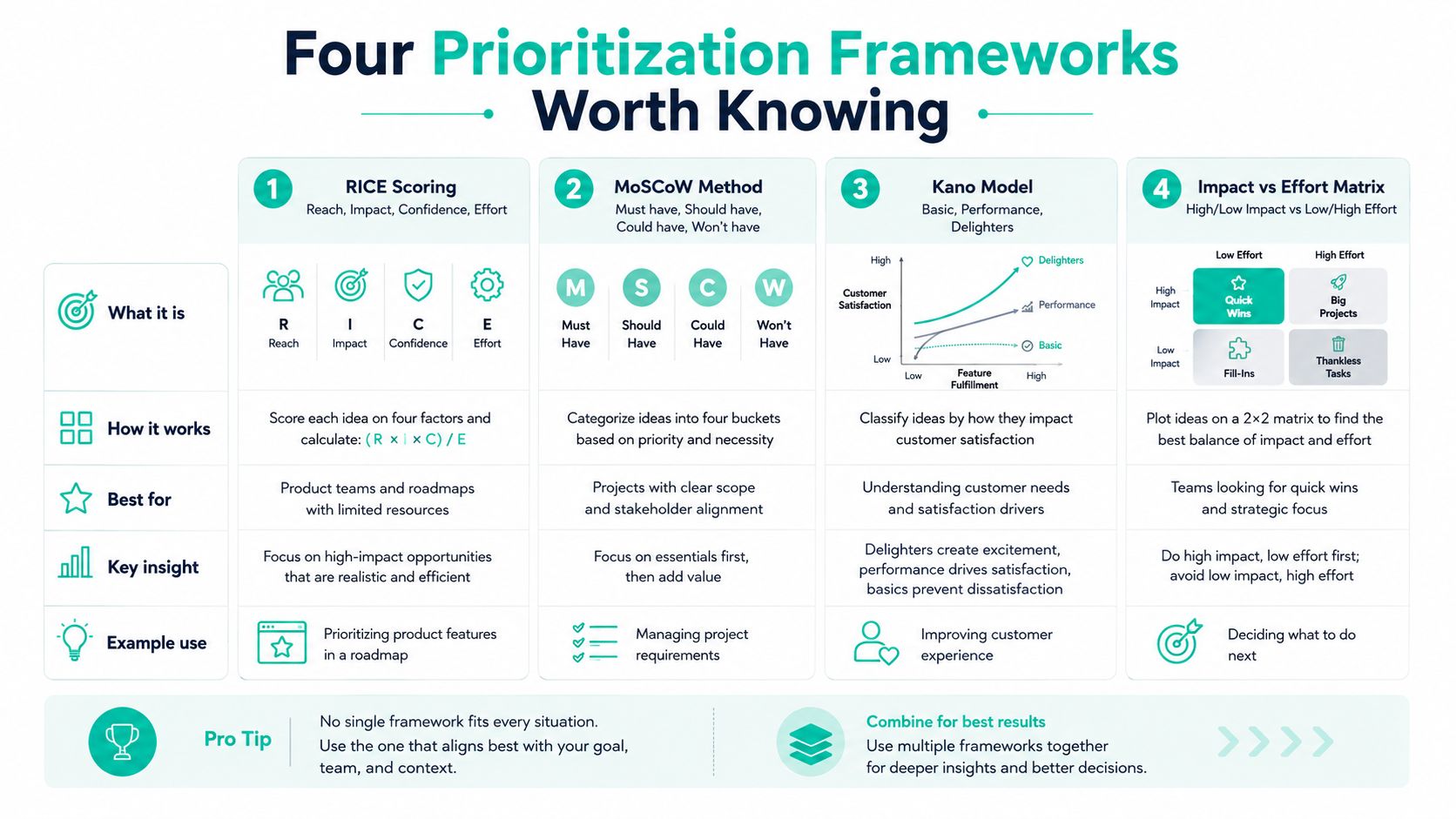
Four Prioritization Frameworks Worth Knowing
A framework is a decision rule, not a personality test. Choose the method that matches the work in front of you, then keep the labels simple enough that every team member can apply them.
The Eisenhower Matrix
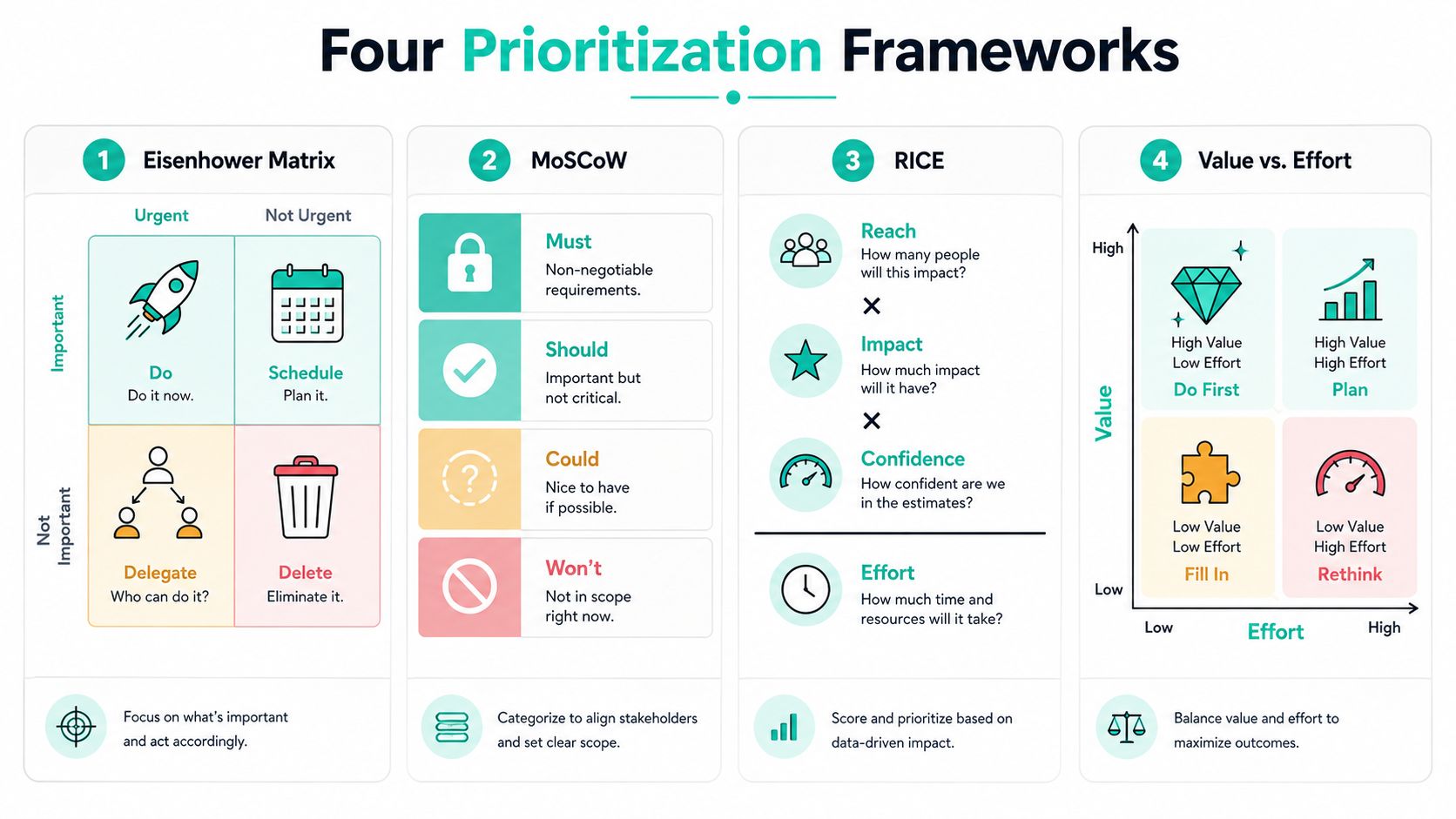
The Eisenhower Matrix uses urgency and importance as its two axes. It divides tasks into four quadrants and assigns a clear action to each, do first, schedule, delegate, or delete, as described in this Eisenhower Matrix explanation.
Urgent and important, do first. A flight-related document problem that needs immediate resolution belongs here.
Important but not urgent, schedule. Reviewing upcoming destination requirements or preparing a future application deserves protected time.
Urgent but not important, delegate. A routine status request may need a prompt response, but not necessarily from the veterinarian.
Not urgent and not important, delete. Remove work that doesn't support the pet, client, or team's outcome.
The matrix helps correct a common mistake, treating every short deadline as the highest-value task. It's especially useful during a morning huddle because the four actions give the team quick language.
MoSCoW for shared decisions
MoSCoW sorts work into Must, Should, Could, and Won't. It works well when a client, veterinarian, coordinator, and manager disagree about what belongs in the current workload.
A Must task is necessary for the current travel process. A Should task matters but can follow the essential work. A Could task is useful if capacity allows. A Won't task is deliberately left out for now, which prevents optional improvements from taking over the day.
The value is the explicit “Won't.” Teams often avoid saying no, so low-value work remains active forever. MoSCoW turns that omission into a visible decision.
ABCDE for individual workload control
The ABCDE method gives each task a letter:
A, must do. Missing it has a serious consequence.
B, should do. It matters, but an A task comes first.
C, nice to do. Complete it when the essential work is covered.
D, delegate. Another capable person can take ownership.
E, eliminate. The task doesn't justify its place on the list.
This method suits a coordinator who needs a fast personal filter. It can also support a team conversation, but the group should agree on what each letter means before applying it.
Deadline-based ordering
Deadline-based prioritization is the right choice when timing controls the work. Rank tasks by due date, but also consider effort, dependencies, and available buffer, as outlined in this deadline-based prioritization guide.
A task due soon isn't automatically first if another task must happen before it. For instance, a certificate review may have the nearer visible deadline, but a lab draw may need to happen earlier to make that review possible. In date-driven pet travel work, combine deadline order with dependency checks rather than trusting the calendar alone.
How Pet Travel Workflows Change the Priority Order
Consider a representative case. A dog is traveling from the United States to a destination that requires a six-month rabies titer period before entry. The team has several open items, including a client email, a certificate review, a laboratory draw, and a country-specific requirements check.
A naive list sorts the work by the closest visible deadline. The certificate exam may appear first because its appointment date is approaching. The client email may follow because the owner is waiting. The lab draw can look less urgent because its result won't be needed until later.
That order misses the dependency chain. The laboratory draw may need to happen before the result can be reviewed. The result may need to be available before the certificate examination. The destination check may change which documents or timing details the team must confirm. If the first enabling step waits, the later appointments can't rescue the schedule.
Practical rule: Put the task that unlocks the most important downstream work ahead of a task with a closer but less meaningful deadline.
Task | Naive Order, Nearest Deadline | Dependency-Aware Order |
|---|---|---|
Client email | 1 | 4 |
Certificate exam scheduling | 2 | 2 |
Country-specific requirements check | 3 | 3 |
Rabies titer laboratory draw | 4 | 1 |
The dependency-aware order starts with the lab draw because it begins the timing chain. The certificate exam comes next because the team can plan it around the required information. The country-specific check follows as a control point, and the client email is handled with an accurate update rather than a vague promise.
The exact order can change when new information arrives. If the destination rule changes, that check may move to the front. If the lab reports a result, the review task may become the next action. The team should record blockers clearly, so nobody mistakes “waiting for laboratory result” for “not important.”
This is also where documentation gaps in pet travel can create hidden work. A missing field isn't just an incomplete form. It may block review, create another client exchange, or force the team to repeat a check.
Daily standups should therefore focus on movement, not busywork. Ask which task is next, what is blocked, who owns the decision, and what the client needs to know today. That keeps the workflow aligned with the travel date while giving the team room to respond when the rules or evidence change.
Rolling Out Prioritization in Your Team
A veterinary practice doesn't need a large transformation project to start. It needs a shared rule, clear ownership, and a short review habit that fits the tools the team already uses.
Start with one method
Pick the framework that matches your pressure:
Eisenhower Matrix: Use it when the team needs a visible distinction between urgent and important work.
MoSCoW: Use it when several stakeholders need to agree on what belongs in the current workload.
Deadline-based prioritization: Use it when travel dates, treatment windows, and document timing drive the workflow.
Don't launch every framework at once. A team that has four labels for the same task may spend more time debating labels than completing work.
Build a simple operating rhythm
Assign one person to maintain the queue, but don't make that person responsible for every decision. Support staff can collect requests, identify missing information, check dates, and flag dependencies. Veterinarians should retain clinical judgment and decide questions that require professional assessment.
Set intake rules that answer basic questions before work enters the active queue:
Required information: Record the pet, destination, travel date, task, owner, and blocker.
Priority reason: State whether the item is urgent, important, dependency-critical, or routine.
Next action: Write the smallest clear step, such as “request laboratory report” rather than “manage titer.”
Review point: Add when the team will reassess the task if it remains unresolved.
Use your existing practice-management system, shared board, or task tool. Add priority, due date, dependency, and owner fields instead of creating a second spreadsheet. A structured documentation hub for veterinary teams can support a central place for the records and workflow information.
Run a practical first week
On the first day, list active travel cases and remove duplicate tasks. On the next working day, assign owners and mark dependencies. During each morning huddle, review only the top work, blocked items, and new changes. At the end of the week, ask which tasks moved, which were repeatedly interrupted, and which priority rules caused confusion.
Keep the process light. If the system adds more admin than clarity, simplify the fields and sharpen the decision rule.
Metrics That Show Prioritization Is Working
Prioritization becomes useful when the team can inspect its effects. You don't need a complicated dashboard. A small set of consistent measures can show whether the queue is becoming clearer, whether work is moving on time, and whether quality is holding up.
Watch completed work and aging work
Start with throughput:
On-time completion rate: Compare tasks completed by their agreed due date with the total tasks due in the review period.
Overdue task count: Track how many items remain late at each review.
Queue age: Note how long open tasks have remained active, especially items that repeatedly carry forward.
Blocked-task count: Separate work waiting on a client, lab, veterinarian, or external rule check from work the team could complete now.
The absolute number matters less than the pattern. If overdue work keeps growing, the team may be accepting more work than it can sequence. If queue age rises while staff remain busy, low-value interruptions or unclear dependencies may be consuming capacity.
Protect quality while increasing flow
Speed alone can reward rushed work. Pair throughput with:
Rework rate: Count documents or tasks that must be corrected because an earlier step was incomplete.
Client complaint frequency: Record recurring complaints about delays, unclear updates, or repeated requests for the same information.
Re-prioritization frequency: Watch how often tasks change position during the week.
Reordering versus execution time: Estimate whether the team spends more time deciding what to do than doing it.
A high rate of re-prioritization isn't automatically bad. Changing destination rules or receiving a late result can require a new order. The concern is avoidable movement caused by poor intake information or unclear ownership.
Use a short weekly review
Ask four questions:
Which high-priority tasks finished on time?
Which overdue items stayed stuck, and why?
Which tasks were reworked?
Which rule or field should the team change next week?
The knowledge-worker figures cited by Harvard Business Review's discussion of important versus urgent work underline why teams need to reduce administrative drag, but your own queue tells you where that drag appears. Good metrics make the system visible without turning every pet journey into a spreadsheet circus.
Common Prioritization Mistakes and Quick Fixes
A priority system can look tidy and still fail in practice. These are the traps that deserve a quick team check.
Deadline bias: If the shortest deadline always wins, low-value requests crowd out important work. Signal: The team can name what is due soon but not what initiates the travel workflow. Fix: Add business impact and dependency fields before assigning order.
Dependency blindness: A non-urgent task may block several later tasks. Signal: Staff report that work is “waiting” even though the deadline hasn't arrived. Fix: Mark the next enabling action and move it ahead of tasks that depend on it.
Frozen priorities: A list created Monday may no longer fit Friday's reality. Signal: New rule changes or lab results sit in an intake folder until the next formal review. Fix: Reassess at the daily huddle and whenever a material condition changes.
Framework overload: Too many labels turn a simple decision into a committee meeting. Signal: Team members use different meanings for A, Must, urgent, and high value. Fix: Choose one primary framework and write a short definition for each label.
A flat spreadsheet records tasks, but it doesn't necessarily show why they belong in a particular order. Tools that encode owners, dependencies, due dates, and status reduce the chance that the team treats every item as the same size. Keep the system lean, or it'll become one more task to prioritize.
Putting It All Together for Pet Travel Teams
Task prioritization is choosing what to do first, what to schedule, what to delegate, and what to drop, then repeating that decision as conditions change. In international pet travel, the best order follows the whole chain, not just the nearest deadline.
Pin this checklist near the team board:
Capture: Put every request, blocker, and follow-up in one system.
Check timing: Record the travel date and every meaningful treatment, laboratory, examination, or document window.
Find dependencies: Move the task that makes the next critical step possible.
Assign ownership: Keep clinical decisions with the veterinarian and route administrative work to the right support role.
Review: Reorder when results, client replies, or destination rules change.
Measure: Watch overdue work, aging items, rework, complaints, and unnecessary reordering.
Platforms such as Passpaw can build priority logic into regulated pet travel workflows by organizing work around travel dates, laboratory result windows, destination requirements, and document status. Practices exploring how a structured process can support growth can also review scalable veterinary services for growing practices.
Choose one active pet trip this week and map its dependencies before the next team huddle. That small habit can help prevent avoidable delays, protect staff attention, and send more pets toward their flights with happier tails.
Passpaw helps veterinary teams organize international health certificate workflows, track travel-related requirements, validate documents, and communicate with clients in one place. Visit Passpaw to see how a destination and travel-date-based task workflow can make pet travel priorities easier to manage.

More articles
From regulatory changes to best practices for veterinarians and pet owners, our resources keep you ahead of the curve.