Are you a team member in a veterinary practice?
Are you a pet parent planning a trip with your furry pal?
Build Scalable Veterinary Services for Growing Practices
Monday starts with three full exam columns, two urgent walk-ins before 10 a.m., and a front desk already buried in callbacks. The schedule looks healthy on paper. Inside the clinic, it feels heavy. Doctors are rushed, technicians keep switching tasks, and client communication starts to slip by noon.
That pattern is common in growing practices. More demand does not mean the practice is built to scale.
A scalable clinic handles higher caseloads without adding the same level of stress to every role. Care stays consistent. Handoffs stay clear. Administrative work stops spilling into lunch breaks and the end of the day. Growth works best when systems carry more of the load than memory or overtime.
That shift matters because owners are under pressure from both sides. Clients expect convenience and fast updates. Teams need a workflow they can sustain for more than one busy season. Growth that depends on squeezing harder usually costs you somewhere else, often in turnover, delays, or missed charge capture.
The better model is operational, not heroic. Standardize the repeatable parts of care. Delegate work to the right level. Use technology where it removes duplicate entry and status chasing. Then look hard at services that produce strong margins without consuming exam-room capacity in the same way as routine appointments.
Pet travel documentation is one example. It can be profitable, specialized, and highly process-driven if the clinic treats it as a defined service line rather than a stack of one-off forms. The same principle applies more broadly. Practices grow more safely when they add structured services with clear intake, pricing, ownership, and follow-up.
If your clinic is feeling the strain of growth, this guide on growing a veterinary practice sustainably offers a useful starting point for reworking how demand flows through the business, not just how many appointments fit on the calendar.
From Growing Pains to Sustainable Growth
Monday starts with a full schedule, two urgent work-ins, three discharge callbacks waiting from Friday, and a doctor asking whether the travel certificate for Wednesday ever got submitted. By 10:30, the problem is clear. The clinic does not have a demand problem. It has a systems problem.

That distinction matters. Scalable veterinary services for growing practices come from structure, not hustle. A clinic can add revenue and serve more clients without asking the team to absorb every extra task through overtime, memory, or skipped breaks.
What scalable growth actually looks like
In a practice that scales well, added demand does not create equal added chaos. The team works from defined steps. Information is captured once and used again. Administrative tasks have an owner, a timeline, and a standard process.
That applies to medicine and to the services around it.
A scalable service model usually includes:
Clear intake criteria so the front desk and technicians collect the right details before the appointment starts
Defined appointment types with set prep, timing, and discharge expectations
Standard communication templates for estimates, follow-up, refill requests, and recheck instructions
Process-driven service lines for work that involves forms, deadlines, and documentation, such as pet travel paperwork
The last point is where many practices miss an opportunity. High-margin services like pet travel documentation can add meaningful revenue, but only if they are built as a system. If every certificate is treated like a one-off favor squeezed between appointments, the service becomes stressful and unprofitable. If the clinic sets rules for intake, document review, pricing, doctor signoff, and client deadlines, the same service can produce good margin without taking over the treatment floor.
Practical rule: If growth depends on one experienced employee catching every loose end, the clinic is still running on individual effort instead of a repeatable system.
Why this matters now
Independent practices still have room to grow, but the operating standard has changed. Clients expect faster updates, easier communication, and clearer timelines. Team members expect a workplace they can sustain. Owners need growth that improves margin without steadily increasing turnover and exhaustion.
That usually means making better choices about which work belongs in the exam room and which work can be standardized outside it. A vaccine visit, a chronic care recheck, and an international travel certificate do not need to move through the clinic the same way. Practices that separate these workflows usually protect doctor time better and reduce the constant task-switching that wears teams down.
For owners who need a practical starting point, this guide to growing a veterinary practice sustainably is a useful reference for reworking demand, staffing, and service mix around long-term capacity.
The shift that changes growth
A significant shift happens when a practice stops measuring growth only by appointment count and starts measuring it by capacity quality. How much doctor time is spent on work that only a doctor can do? Which services create strong revenue with predictable steps? Where does the team lose time to preventable back-and-forth?
Those questions lead to better decisions, as opposed to adding more to the schedule. In many clinics, the first gains come from tightening operations around specialized services, reducing avoidable admin drag, and packaging work in a way the team can deliver consistently. That is how growth becomes sustainable.
Designing Your Pawsitively Efficient Workflow
Most workflow problems aren't mystery problems. They're visibility problems. A clinic feels overloaded, but no one has mapped where the day breaks down.
Here's the visual version of the redesign process:

Start with the real client journey
Don't begin with software. Begin with a whiteboard.
Map the path from first contact to paid invoice and follow-up. Include the front desk, technicians, doctors, and client communication at each stage. Most practices find that the same few choke points show up again and again.
Look closely at:
Booking intake. Are clients giving the right reason for visit, or does the team spend time re-triaging later?
Arrival and check-in. Is the history complete before the patient is roomed?
In-clinic handoffs. Does the doctor walk into a room with enough context to move quickly?
Post-visit follow-up. Are discharge notes, rechecks, and reminders sent in a consistent way?
One weak handoff can create a kennel full of problems later in the day.
Fix bottlenecks in three zones
Intake before the appointment
The most preventable friction arises when your team collects incomplete histories, unclear presenting complaints, or missing records at the last minute, causing the whole day to slow down.
A stronger intake flow often includes:
Pre-visit forms tied to visit type
Rules for appointment categories so wellness, sick visits, technician appointments, and document-heavy visits don't all get scheduled the same way
A standard prep checklist for records, vaccines, medication history, and special instructions
For document-heavy services, consistency matters even more. If your team handles travel certificates, referral paperwork, or extended treatment plans, document control becomes part of clinical efficiency. These document management best practices for veterinary workflows are worth reviewing if your staff keeps chasing missing files or duplicate forms.
Flow inside the clinic
The middle of the visit should feel boring in the best way. Predictable is efficient.
Use SOPs for routine events that trigger repeated questions or delays:
Room readiness before the patient enters
Tech handoff format with the same sequence each time
Estimate approval process so doctors aren't pulled back into avoidable back-and-forth
Diagnostic routing for labs, imaging, and callbacks
The smoothest clinics don't rely on memory. They rely on agreed sequences.
Follow-up after the visit
This is the tail that wags the whole workload. Poor follow-up creates more inbound calls, confused clients, missed compliance steps, and dropped rechecks.
A simple before-and-after example:
Workflow stage | Before | After |
|---|---|---|
Appointment reminders | Sent manually when staff remembers | Automated by visit type |
Discharge instructions | Written differently by each person | Standard templates with case-specific edits |
Recheck booking | Client told to “call us” later | Team schedules before checkout whenever possible |
Prescription updates | Handled as scattered callbacks | Routed into a defined queue with ownership |
That kind of redesign doesn't sound dramatic. It is, however, the difference between a clinic that scales and one that sheds fur every time volume spikes.
Building Your All-Star Team for Growth
Practices don't scale because the owner becomes more efficient at doing everything. They scale because the work gets redistributed with purpose.
That's especially important in a field dealing with structural capacity strain. The profession still faces clinician shortages and access gaps in some areas, which is why sustainable growth has to focus on increasing revenue and efficiency without adding proportional labor, stress, or turnover, as discussed by the AVMA on the rural veterinarian gap.
Put every role at the top of its value
A common growth mistake is hiring more people into a messy system. That usually gives you a larger messy system.
The better move is to define who should do what, then protect those boundaries. Doctors should spend more of their time on diagnostics, treatment decisions, surgery, and complex conversations. Technicians and assistants should own more of the prep, education, follow-up, and execution that fits their role. Front-desk staff should manage communication flows, not serve as a dumping ground for every unresolved issue.
That means asking some blunt questions:
Does a DVM really need to handle this task?
Could a technician complete the prep work earlier?
Can a client service representative collect the needed information with a script or checklist?
Is this task unclear because nobody owns it?
If the answer to the last question is yes, fix that first.
Burnout usually starts in the gray areas
Team fatigue isn't only about long hours. It often comes from role confusion, interruptions, and constant context switching. A technician who gets pulled between rooms, callbacks, inventory questions, and front-desk rescue work never gets a clean run at anything. A veterinarian who has to re-check every handoff slows the whole system.
A stronger team structure often includes:
Named owners for recurring workflows such as lab callbacks, refill requests, surgery prep, discharge review, or travel paperwork
Daily huddles with a real purpose such as flagging overloaded blocks, complex cases, and staffing gaps
Predictable internal communication channels so urgent, same-day, and non-urgent items don't all hit the same inbox or hallway conversation
Cross-training with limits so coverage improves without turning everyone into a generalist for everything
If you're tightening communication across clinical and admin roles, this guide to building cohesive healthcare teams from Pebb offers practical ideas that fit well in a busy care environment.
Growth should remove friction from the team's day. If it adds friction everywhere, it isn't growth yet.
What works and what doesn't
Here's the plain version.
What works
Clear role definitions
Delegation with training
SOPs for repeatable tasks
Schedules that leave room for callbacks and case management
Team leads who can solve problems without every question climbing back to the owner
What doesn't
Expecting “good people” to absorb a broken process
Letting doctors become the safety net for every incomplete task
Promoting people into management without giving them workflow authority
Adding service lines before the team has capacity rules
People stay longer when the work feels doable. That's not soft management. It's operational design.
Integrating the Right Technology for a Smoother Practice
Technology should make the day quieter. If it creates more tabs, more duplicate entry, and more “Where did that message go?” moments, it's not helping.
The smartest tech stack starts with one principle. Every tool should reduce handoffs, not multiply them.
Build around your core system
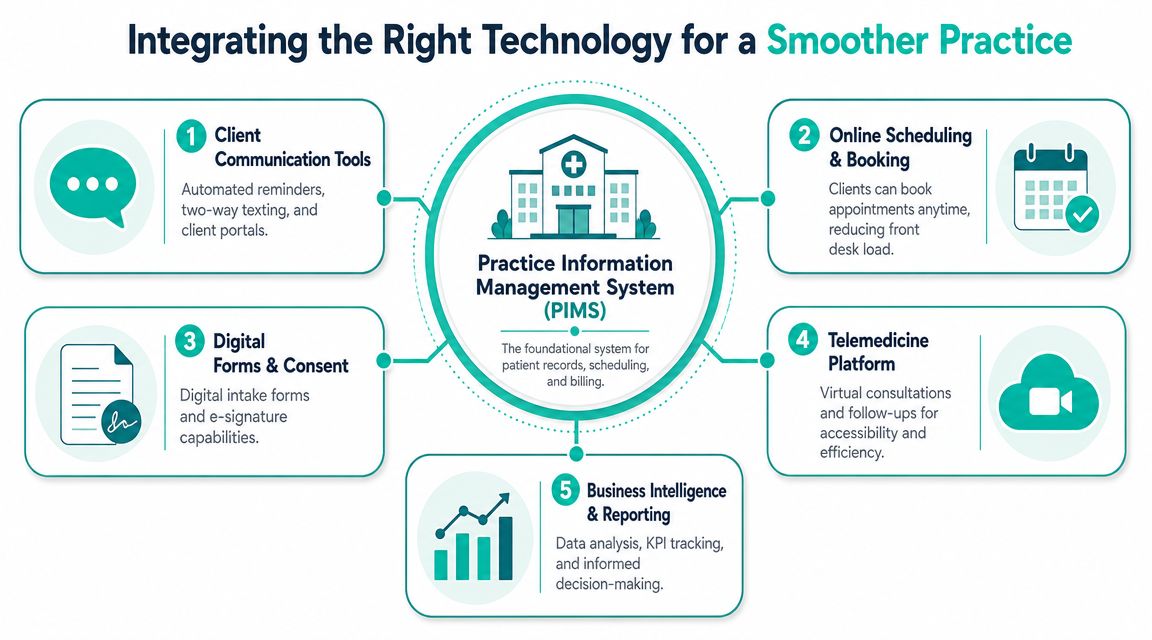
Your PIMS is the hub. That's where records, scheduling, billing, and patient history need to stay dependable. Around that hub, add tools only when they solve a specific operational problem.
A practical stack often includes:
Client communication tools for reminders, follow-ups, and message routing. This includes tools like an AI Veterinary Answering Service
Online booking controls for the appointment types you're comfortable letting clients self-schedule
Digital forms and e-signatures for intake, consents, and pre-visit information
Telemedicine or virtual follow-up tools where they fit your workflow
Reporting dashboards so leaders can see where bottlenecks keep happening
If your team is comparing options, this veterinary software comparison guide can help frame the decision around workflow fit rather than feature overload.
Use specialized tools for specialized services
Many practices leave money on the table. They add a complex service line, then try to manage it through inboxes, spreadsheets, sticky notes, and heroic memory.
That approach fails fastest with services that are both high-value and admin-heavy. Pet travel documentation is a good example. Clients often need urgent help, rules can vary by destination, and the process includes multiple documents, timing steps, and validation points. If handled manually, it eats doctor time and creates avoidable stress for staff.
The better approach is to standardize the service and support it with software built for that workflow. Practices looking at this category should focus on tools that handle task tracking, client communication, and compliance checks in one place. Passpaw is one example. It's a cloud platform designed to help veterinary teams manage international health certificates, destination requirements, document workflows, and client updates within a structured process.
Choose tech by workload impact
Don't buy based on demos alone. Buy based on what the tool removes from the team's plate.
Use this screen before adding anything new:
Question | Good sign | Warning sign |
|---|---|---|
Does it reduce duplicate entry? | Information flows once into the right record | Staff must retype details in multiple systems |
Does it clarify ownership? | Tasks are assigned and visible | Everyone assumes someone else handled it |
Does it support repeatable services? | Templates, queues, and checklists are built in | The process still lives in people's heads |
Does it improve client communication? | Updates are timely and consistent | Clients still call repeatedly for status |
The broader opportunity is clear. Practices should look to scale high-complexity services that can be standardized, and with rising costs pushing clients toward value, bundled and time-saving services such as pet travel documentation management can meet a real need when supported by automation and compliance validation, as noted in this IDEXX discussion of ways to scale a veterinary practice.
A good tool doesn't just make old work faster. Sometimes it makes a whole service line possible.
Smart Pricing and Service Packaging for Profitability
A packed schedule can still hide weak margins. That's the trap.
If a practice grows by adding low-margin, interruption-heavy work, the team gets busier without the business getting healthier. Scalable growth needs a financial filter. Which services create value, use staff time well, and can be delivered consistently?
Stop pricing everything as a one-off
A lot of practices still price in a very transactional way. One visit, one fee, one invoice. That works for some cases, but it often underprices the actual effort behind education, follow-up, admin coordination, and missed capacity elsewhere in the day.
A better model is to review services as service lines, not isolated line items.
That includes asking:
Which services create repeatable revenue and stronger retention?
Which ones look profitable until you factor in callback load and staff time?
Which ones could be packaged so clients understand the value upfront?
Which ones deserve annual fee review because costs have shifted?
A recent veterinary business review argues for standardized service lines and margin-based prioritization, including annual fee reviews, service-margin analysis, and shifting capacity toward stronger-margin offerings. It also notes that telemedicine follow-ups and wellness plans can support retention while lowering overhead when used with clear rules and team training, as discussed in this open-access review on sustainable veterinary business strategy.
Where packaging helps most
Service packaging works best when it removes decision fatigue for clients and operational chaos for staff.
Consider these examples:
Puppy and kitten bundles that group core preventive services into a defined sequence
Wellness plans that spread preventive care and improve continuity
Dental pathways that package exam, estimate, procedure planning, and follow-up
Travel documentation services that bundle exam time, document handling, client coordination, and revision management where appropriate for your workflow
Notice the pattern. Packaging isn't just about selling more. It's about making demand easier to deliver.
A service package should make the team's work more predictable. If it only makes pricing more complicated, redesign it.
Run a practical margin review
You don't need a fancy finance model to start. Pull a list of your major service lines and review each one with your managers and medical leads.
Use a table like this:
Service line | Questions to ask |
|---|---|
Wellness care | Is scheduling efficient and protocol-driven, or does every visit run differently? |
Surgery | Are prep, estimate approval, and discharge steps standardized enough to protect margin? |
Dental | Are blocks used well, or does underutilization quietly drain capacity? |
Admin-heavy specialty services | Can these be templated, delegated, and priced to reflect real effort? |
Then make a short list of actions.
Raise or rework services that consume time without clear return
Package services that clients buy repeatedly and staff can deliver consistently
Trim variation where too many exceptions are creating hidden labor
Protect high-value capacity so your best margin work doesn't get crowded out by low-yield noise
If you want to think through the economics of one specialized service line, this pet travel practice revenue calculator is a useful planning tool for modeling workflow and pricing assumptions.
Profitability doesn't come from charging more at random. It comes from aligning price, process, and team effort.
Measuring Success and Planning Your Next Steps
If you only track revenue, you'll spot problems late. By the time revenue softens, the team has usually been feeling the strain for months.
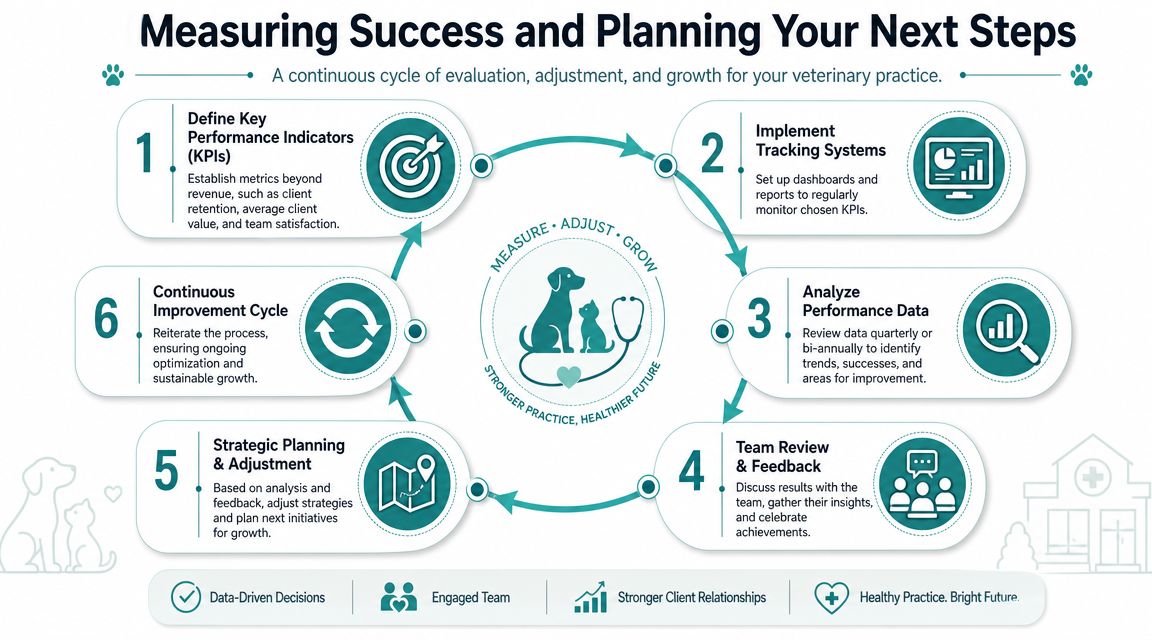
A better dashboard starts with KPI baselining. The AVMA's practice productivity guidance recommends tracking operational metrics in one dashboard, including appointment throughput, technician utilization, and new client conversions, then reviewing them weekly so small leaks show up before they become expensive habits. That framework is outlined in the AVMA article on benchmarking and efficiency in veterinary practice.
Build a dashboard that reflects reality
Your dashboard should answer three questions:
Are we using clinical capacity well?
Are clients moving smoothly through the system?
Is the team carrying the work in a sustainable way?
Here's a practical template.
Category | KPI | What It Measures | Target |
|---|---|---|---|
Capacity | Appointment throughput | How many scheduled visits the practice completes within normal flow | Stable or improving based on your baseline |
Team use | Technician utilization | Whether technician time is being used in the right tasks and blocks | Higher consistency week to week |
Growth | New client conversions | How well inquiries become booked visits | Improving trend from baseline |
Communication | Phone and message backlog | Whether inbound demand is being handled promptly | Minimal carryover into the next day |
Service quality | Follow-up completion | Whether rechecks, reminders, and discharge actions are completed reliably | High completion with few misses |
Team health | Schedule strain and workflow bottlenecks | Where overtime, interruptions, or handoff failures keep appearing | Fewer recurring pressure points |
A simple operating rhythm
The clinics that improve fastest usually don't review everything at once. They pick a short list and stay with it long enough to learn.
A practical rhythm looks like this:
Weekly. Review operational KPIs, backlog, and pressure points
Monthly. Check service-line performance and staffing fit
Quarterly. Revisit pricing, packaging, and workflow redesign priorities
Review patterns, not one weird Tuesday.
Your next 90 days
Keep it manageable.
First 30 days
Map one messy workflow from start to finish
Baseline your key KPIs
Identify one service line that creates too much admin drag
Days 31 to 60
Write or tighten SOPs for intake, handoffs, and follow-up
Reassign ownership for recurring tasks
Clean up one major communication channel
Days 61 to 90
Add or refine one technology tool that removes duplicate work
Reprice or repackage one service line
Review results with the team and adjust
That's how scalable veterinary services for growing practices get built. Not through bigger promises. Through better systems, cleaner roles, and fewer daily surprises.
If your practice wants to add pet travel and health certificate work without burying the team in manual admin, Passpaw offers a structured way to manage destination requirements, document workflows, validation steps, and client communication in one place. It's a practical option for clinics that want to turn a complex service into a repeatable one.

More articles
From regulatory changes to best practices for veterinarians and pet owners, our resources keep you ahead of the curve.