Are you a team member in a veterinary practice?
Are you a pet parent planning a trip with your furry pal?
What Are the Export Documents You Need for Global Shipping
Your shipment is packed, the customer is ready, and then someone asks for one more file. That's the moment many first-time exporters realize export documents aren't busywork, they're what keeps the cargo moving. If a form is missing or a field doesn't match, the whole handoff can slow down fast.
At a basic level, the export paperwork tells customs, carriers, banks, and regulators what's being shipped, who owns it, where it came from, and how it's moving. The World Bank treats “documents to export” as shipment-level compliance documents required by ministries, customs, port and terminal authorities, health and technical control agencies, and banks, with annual renewals excluded from that count, which shows how concrete this paperwork really is. World Bank metadata on documents to export
Why Export Documents Matter More Than You Think
A small manufacturer sends its first overseas order and assumes the invoice is enough. The freight forwarder asks for a packing list, the carrier wants transport details, and customs wants proof that the shipment matches the declared value and contents. That is the point many first-time exporters realize that export documents are not busywork, they are the chain of evidence that keeps a shipment moving.
The timing matters as much as the forms themselves. Some documents are created before the cargo is booked, some are completed while the goods are being packed, and others are checked again at handoff so the shipment can clear without delays. Treating paperwork as a last-minute task usually creates avoidable corrections, because each party in the chain is looking for a different piece of the same story.
The global scale makes that chain even more important. UNCTAD reports that global trade in goods and services reached about $32 trillion in 2022, with goods trade around $25 trillion and services trade around $7 trillion. UNCTAD Key Statistics and Trends in International Trade 2023 When trade moves at that scale, paperwork has to support quick checks across customs, transport, finance, and destination rules.
Documents do more than satisfy bureaucracy
Export paperwork helps prove four things at once, identity, value, origin, and transport chain. Governments use that information to decide whether a shipment can clear, carriers use it to accept liability, and banks use it to match payment and settlement details. If one field is off, a shipment can sit while people compare versions and ask for corrections.
Practical rule: the fastest export process starts with consistent data. The invoice, packing list, transport document, and any required permits should all tell the same story.
That is why treating export paperwork as a single checklist can be misleading. A better way to see it is as a verification system that starts before booking and stays active after the goods leave. The World Bank's definition shows why businesses should treat document count as a compliance metric, not a vague admin task. World Bank metadata on documents to export
The Four Main Categories of Export Documents
The simplest way to understand what export documents are needed is to group them by function, not by form name. In practice, most shipments fit into four buckets, commercial, transport, regulatory and compliance, and origin. That structure helps exporters see who needs each document and why, and it also makes the timing clearer, because some papers are created before the goods move while others travel with the shipment.
Commercial documents carry the business facts
Commercial documents include the commercial invoice and packing list. They are usually prepared first, often by the exporter or the export operations team, because they set out the sale terms, the item details, and the shipment contents before anyone books the rest of the movement.
A customs officer looks at commercial documents to check what's being sold, at what value, and in what quantities. If the invoice says one thing and the packing list says another, the mismatch becomes a clearance problem. A clean set of commercial documents is the export version of showing your work, because everyone downstream uses them as the reference point.
The same documents also help other parties coordinate. Carriers, freight forwarders, and banks may each read a different part of the paperwork, but they all rely on the same basic facts being consistent from the start.
Transport documents cover the handoff
Transport documents include the bill of lading for sea freight or the air waybill for air freight. These papers are usually issued once the carrier has accepted the goods, so they sit at the handoff point in the workflow rather than at the planning stage. They show that the carrier received the shipment and spell out how liability moves from one party to another.
That timing matters because a shipment can be packed and ready, but still not legally or operationally handed off until the transport record is in place. In practice, this is the document that tells everyone the freight has moved from exporter control into the carrier's care.
Regulatory and origin documents answer official questions
Regulatory documents cover licenses, health certificates, and other approvals tied to destination rules. These are often the documents that cause delays when they are created too late, because some destination authorities want them matched to the cargo before departure or before arrival. For specialized cases, such as animal movement, teams often use a dedicated service like Passpaw's international pet health certificate guide to keep the paperwork aligned with travel requirements.
Origin documents prove where the goods were made, which can affect tariff treatment or import eligibility. A certificate of origin does not move the freight by itself, but it can be the document that lets the shipment clear the destination side without unnecessary delays. It is also one of the papers that is easiest to get wrong if the manufacturing trail is unclear, so exporters usually confirm it against the commercial records before submission.
Essential Documents Every Exporter Must Know
A shipment can look ready on the warehouse floor and still stall if the paperwork is out of sequence. The core export set works best when each document has a clear job and a clear handoff. One form starts the commercial record, another confirms the goods, and another tells the carrier, customs, or destination authority what happens next.

The main shipment papers
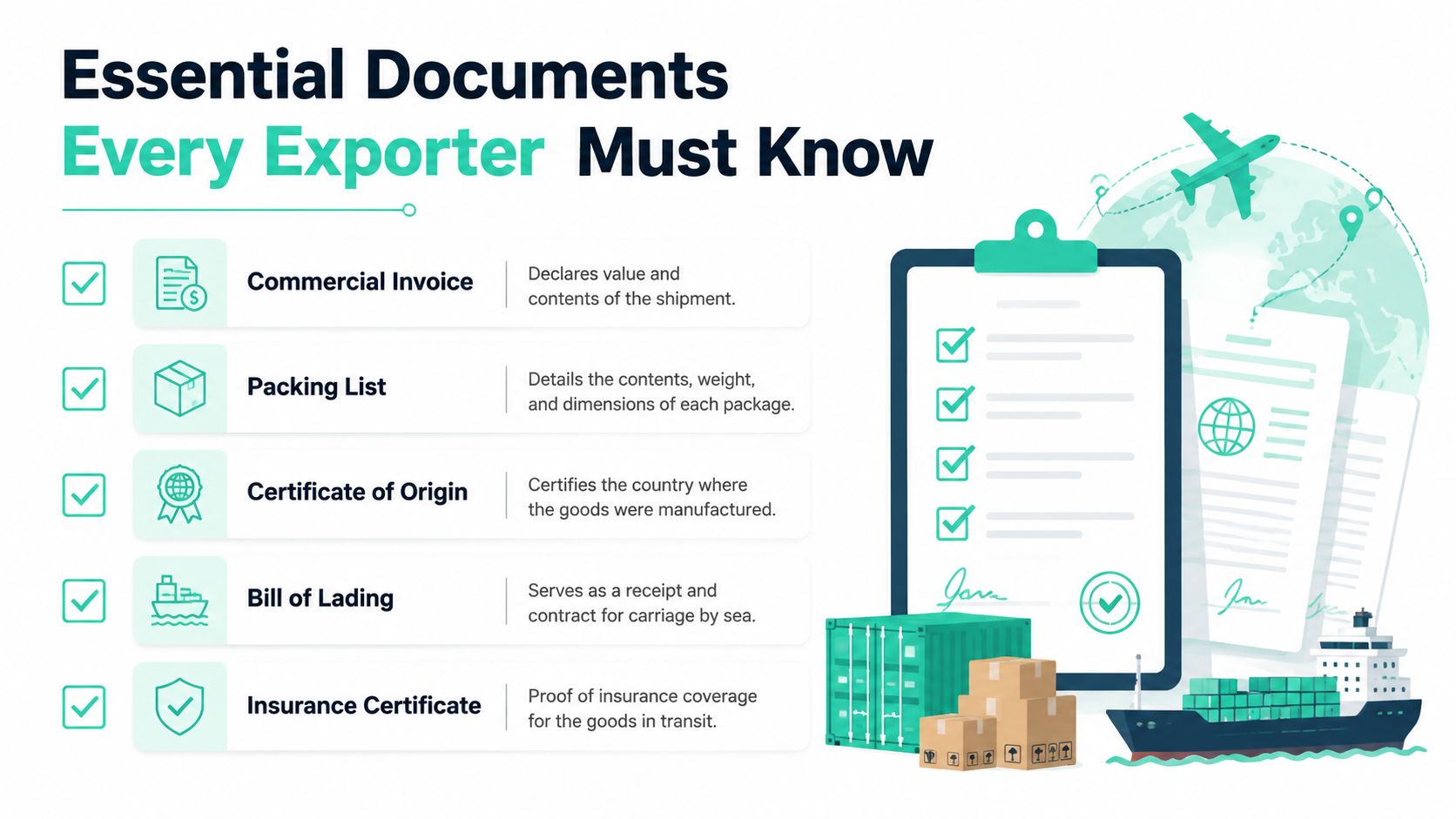
The commercial invoice usually comes first. It states what is being sold, the value, and the parties involved, so customs and banks can read the deal in one place. The packing list follows with a box-by-box or pallet-by-pallet breakdown, which helps each party verify counts and contents without opening every unit.
The bill of lading or air waybill is the transport record. It tells the carrier what was received and becomes the document that moves the shipment from exporter control into the carrier's care. Trade.gov groups these forms with the standard minimum set because they sit at the center of the handoff between shipper, carrier, and customs. Common export documents
The certificate of origin comes into play when the destination country or buyer needs proof of where the goods were manufactured. It does not move the freight by itself, but it can affect how the shipment is treated on arrival. If the manufacturing trail is unclear, exporters usually compare the certificate against the commercial records before it goes out.
The form that looks optional at the start is often the one everyone asks for at the end.
Filing and special cases
For U.S. exports, Electronic Export Information filing can become mandatory when the shipment value is over $2,500 per Schedule B code, or when a license is required, according to exporter guidance. EEI filing threshold and AESDirect guidance The filing goes through the Automated Export System, and the data usually comes from the shipper's export instructions, so a mistake at the drafting stage can carry straight into the government filing.
Specialized cases follow the same timing logic, but the document set changes. Pet travel is a good example, because the certificate package has to match the destination rules, the veterinary record, and the travel window. For the travel side, see how to travel with pets safely. For the paperwork side, the international pet health certificate guide explains how the certificate is prepared, reviewed, and matched to endorsement steps before departure. For teams that handle this work, Passpaw helps veterinary practices organize international pet travel health certificate paperwork and coordinate USDA APHIS endorsement, including form completion and a shipping label when a wet seal is required. The same basic rule applies here as with any export form, create it early, check it against the source records, then send it to the right reviewer.
The Export Documentation Workflow and Timeline
Export paperwork works best when it follows a sequence. If the team waits until the truck is booked, the chances of rushed edits and missing fields go up fast. The cleaner approach is to assign each document to a stage and a person, then lock the sequence before the goods move.
Start with the exporter, then hand off
The exporter usually drafts the commercial invoice and packing list first, because those documents define the shipment itself. A freight forwarder then checks the transport details and makes sure the carrier booking matches the cargo. If a license or certificate is needed, the exporter or broker often has to secure that approval before dispatch.
Practical rule: the person who creates the document is not always the person who should approve it. Separate drafting from review whenever possible.
That split matters because a forwarder may know the carrier requirements, while the exporter knows the product and buyer terms. A customs broker may also need to review the data before filing. When everyone works from the same master record, the process feels calmer and the risk of retyping mistakes drops.
Filing, retention, and who owns the deadline
U.S. guidance says exporters should retain export records for at least five years after the transaction is complete. Export record retention guidance That means the workflow doesn't end when the vessel sails or the plane departs, because records may still need to be produced long after the shipment is gone.
For pet travel, timing gets even more delicate because the veterinary team, pet owner, and destination rules all have to line up before the trip. Passpaw's platform is one example of a tool that keeps those steps in order by organizing health certificate tasks and validation points for the veterinary practice. For APHIS-related certificate work, the workflow also has to match the endorsement path, and APHIS 7001 health certificate details are a useful reference point for that specialized process.
Common Export Documentation Mistakes and How to Avoid Them
The most common export paperwork problems aren't dramatic. They're small, repeated, and easy to miss until a shipment is already in motion. A late filing, a wrong field, or a missing match between documents can slow the whole handoff.
Timing errors cause avoidable stress
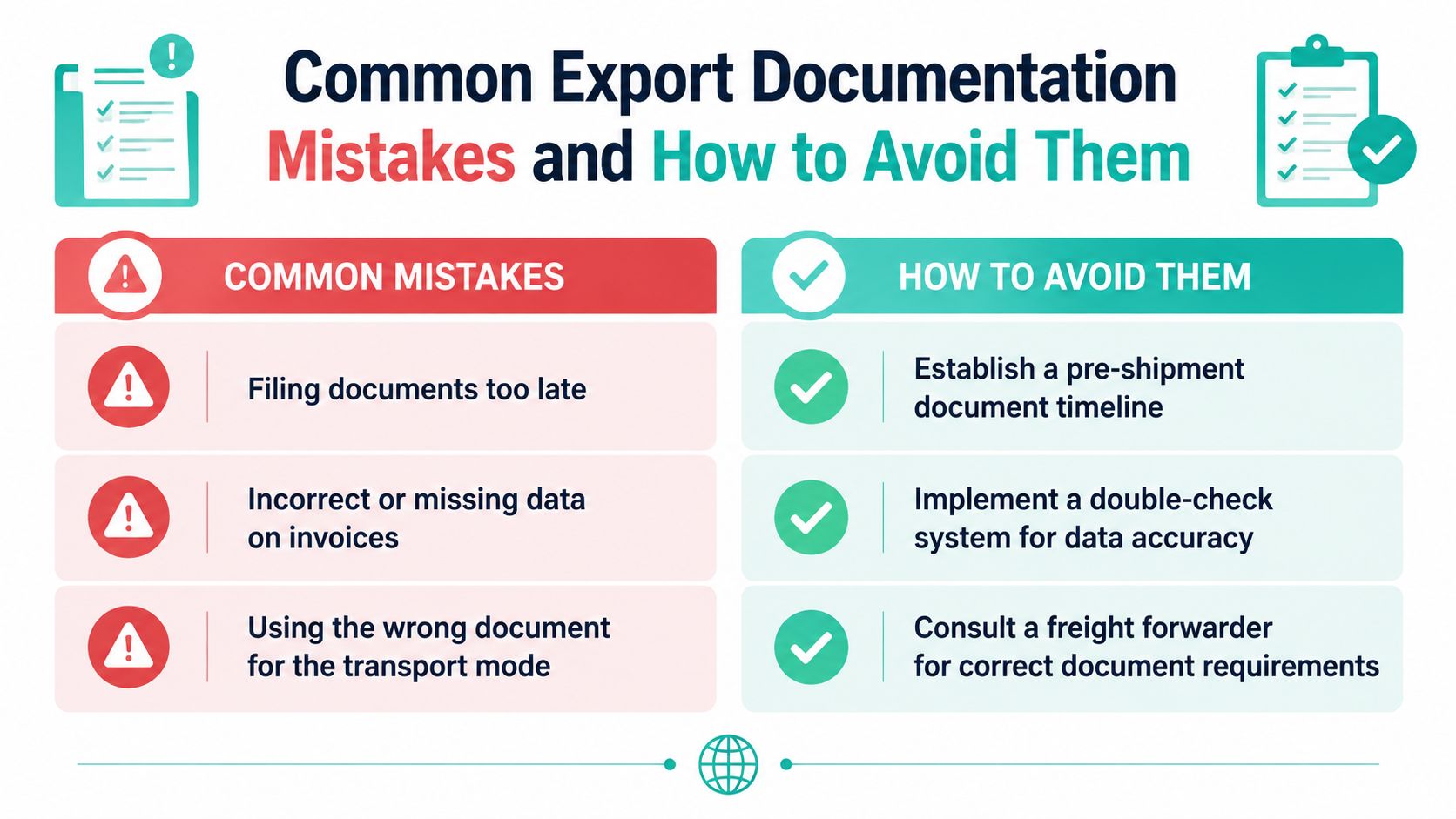
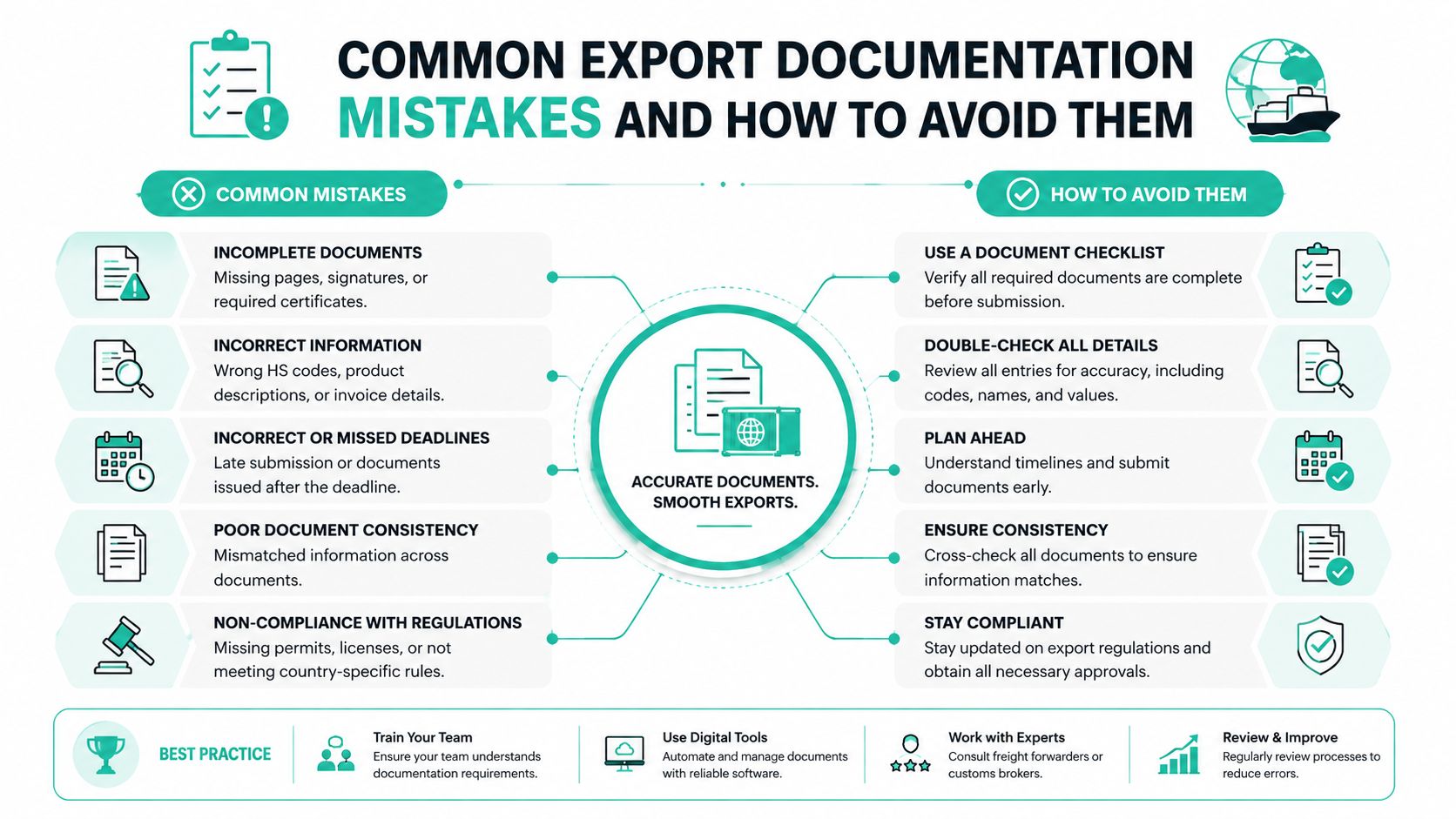
One frequent mistake is filing too late. Another is waiting until the shipment is packed before checking whether a license, certificate, or government filing is needed. Those delays often force teams to rush, and rushed paperwork is where errors multiply.
A better habit is to create a pre-shipment timeline. Put the document draft, internal review, carrier booking, and any external approval on the calendar before cargo is ready. That simple rhythm helps everyone know when their part starts.
Data mismatches create confusion
The second big problem is inconsistent data between the invoice, packing list, and transport record. If the description changes from one form to the next, or the quantities don't line up, the customs review becomes harder. A double-check system catches those mismatches before they travel with the shipment.
Checklist mindset: one shipment, one source of truth, one review before filing.
Destination rules also vary, so exporters need to check requirements country by country. The same product can move smoothly to one market and need extra paperwork in another. The safest approach is to verify destination needs early, then match the document set to the route, not just the product.
For exporters dealing with regulated items, an export license may also come into play. The license process is a separate workflow, and documentation verification guidance can help businesses think about review discipline before they submit anything official.
Specialized Export Documents for Pet Travel
Pet travel looks simple from the outside. A family wants to bring a dog or cat on a trip, so it feels like a booking problem. In reality, it's closer to a live-animal export workflow, where the health certificate, vaccination records, microchip details, and destination rules all have to line up before departure.
A veterinarian often starts by confirming the pet's identity and health records, then checks what the destination country needs. The owner may need proof of rabies vaccination, titer testing, or government endorsement, depending on the route. If any part is off, the certificate may need revision before travel can happen.
Passpaw fits into that workflow as a documentation platform for veterinary practices handling international pet travel health certificates. It helps teams automate form preparation, validate details as they're entered, and keep the practice and client aligned while the application moves forward. That matters because pet travel paperwork has the same problem as freight paperwork, too many handoffs, not enough visibility.
The best pet travel workflows reduce back-and-forth. A vet tech can prepare the file, the veterinarian can review clinical details, and the owner can track what still needs attention without guessing. That's especially helpful when a destination requires a wet seal, since the paperwork needs a clean final path from draft to endorsed document.
Your Export Documentation Action Plan
Start with the route, not the form. Check destination requirements, confirm the transport mode, and identify whether your shipment needs a commercial invoice, packing list, transport document, origin proof, license, or health certificate. If the shipment is under U.S. reporting rules, verify whether EEI filing applies before anything leaves the dock.
Then assign ownership. The exporter should control the master data, the freight forwarder should confirm transport details, and the broker or regulator-facing partner should review anything that needs filing or endorsement. That division keeps people from working from old versions.
Use software when the process starts to repeat. A document platform is most useful when you have multiple shipments, specialized products, or a lot of handoffs. Tools like Passpaw for pet travel and other export workflow systems can reduce retyping, organize approvals, and keep the file ready for retention.
If you're handling export paperwork right now, build one shipment record from start to finish and use it as your template. Then refine the timing, the review steps, and the handoff points until the process feels predictable, not improvised.
If export paperwork still feels messy, Passpaw can help bring more structure to the process by organizing document prep, validation, and handoffs for complex travel cases. Visit Passpaw to see how its workflow tools support international health certificate documentation and keep the right people aligned before departure.

More articles
From regulatory changes to best practices for veterinarians and pet owners, our resources keep you ahead of the curve.