Are you a team member in a veterinary practice?
Are you a pet parent planning a trip with your furry pal?
Usda Health Certificate Dogs
You've printed the passports, ordered the kennel, and packed everything except peace of mind. Your dog is sitting on the suitcase as if appointed head of security, while you're wondering whether a flight abroad requires a USDA health certificate for dogs and who is supposed to sign it.
International dog travel paperwork isn't one universal form. It's a chain involving a destination country's rules, a USDA-accredited veterinarian, possible APHIS endorsement, and sometimes special rabies documentation. The safest approach is to treat the paperwork like your dog's travel visa, then work backward from the departure date.
Why the USDA Health Certificate for Dogs Exists
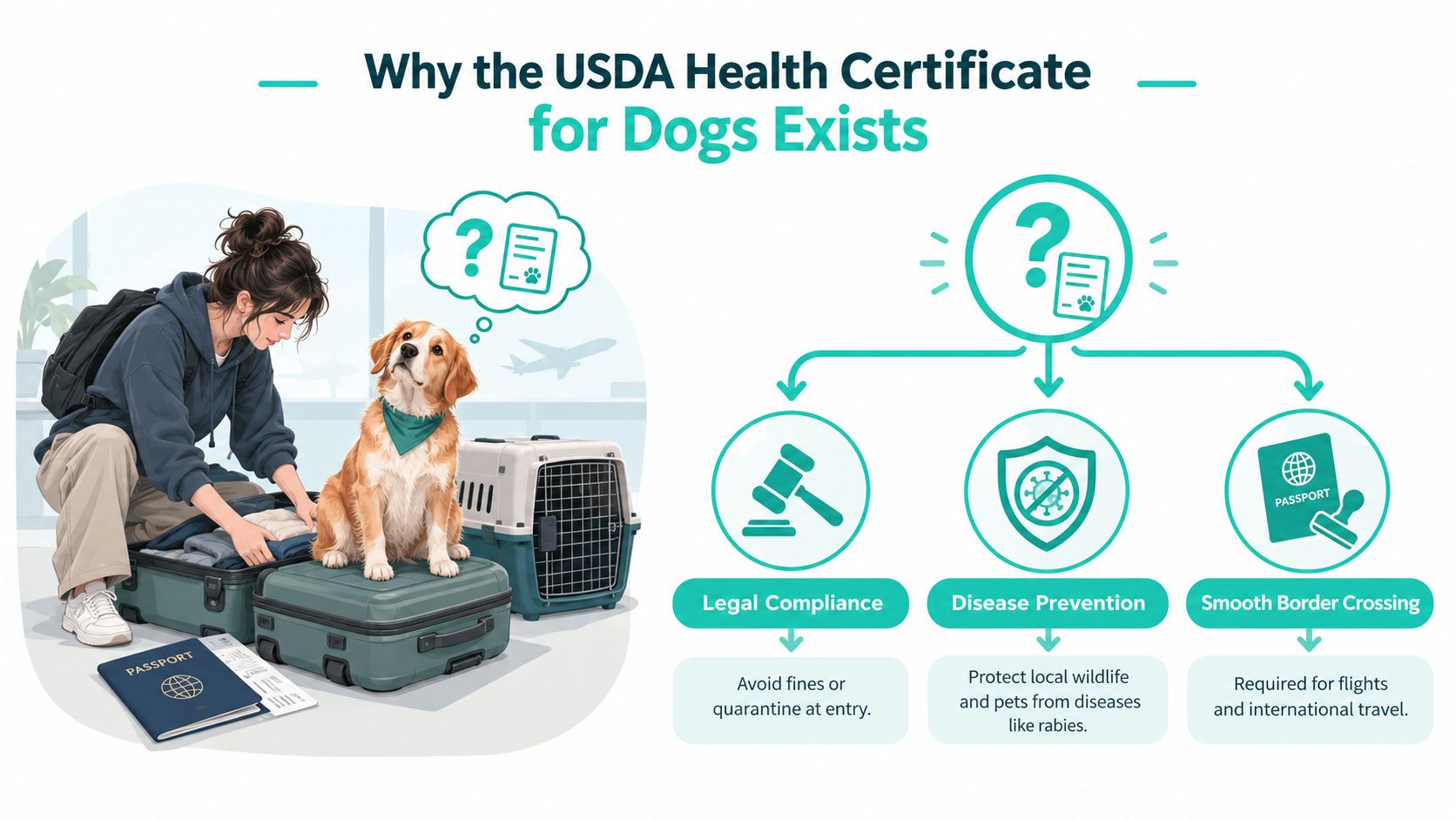
A USDA health certificate confirms that a veterinarian examined your dog and that the dog meets the destination country's entry requirements at the time of export. For many international trips, the certificate must be completed, signed, and dated by a USDA-accredited veterinarian, then endorsed by the USDA's Animal and Plant Health Inspection Service, or APHIS. APHIS explains the international pet travel process, including the role of the veterinarian and the endorsement step.
That endorsement isn't a decorative stamp. It helps the destination country recognize the certificate as an official U.S. export document. Countries use these requirements to manage the cross-border movement of regulated animal diseases, including rabies and other conditions that can affect animals, people, or local ecosystems. The exact requirements vary by destination, so the certificate works as part of a public-health agreement between the United States and the country you're visiting.
The certificate is only one part of the trip
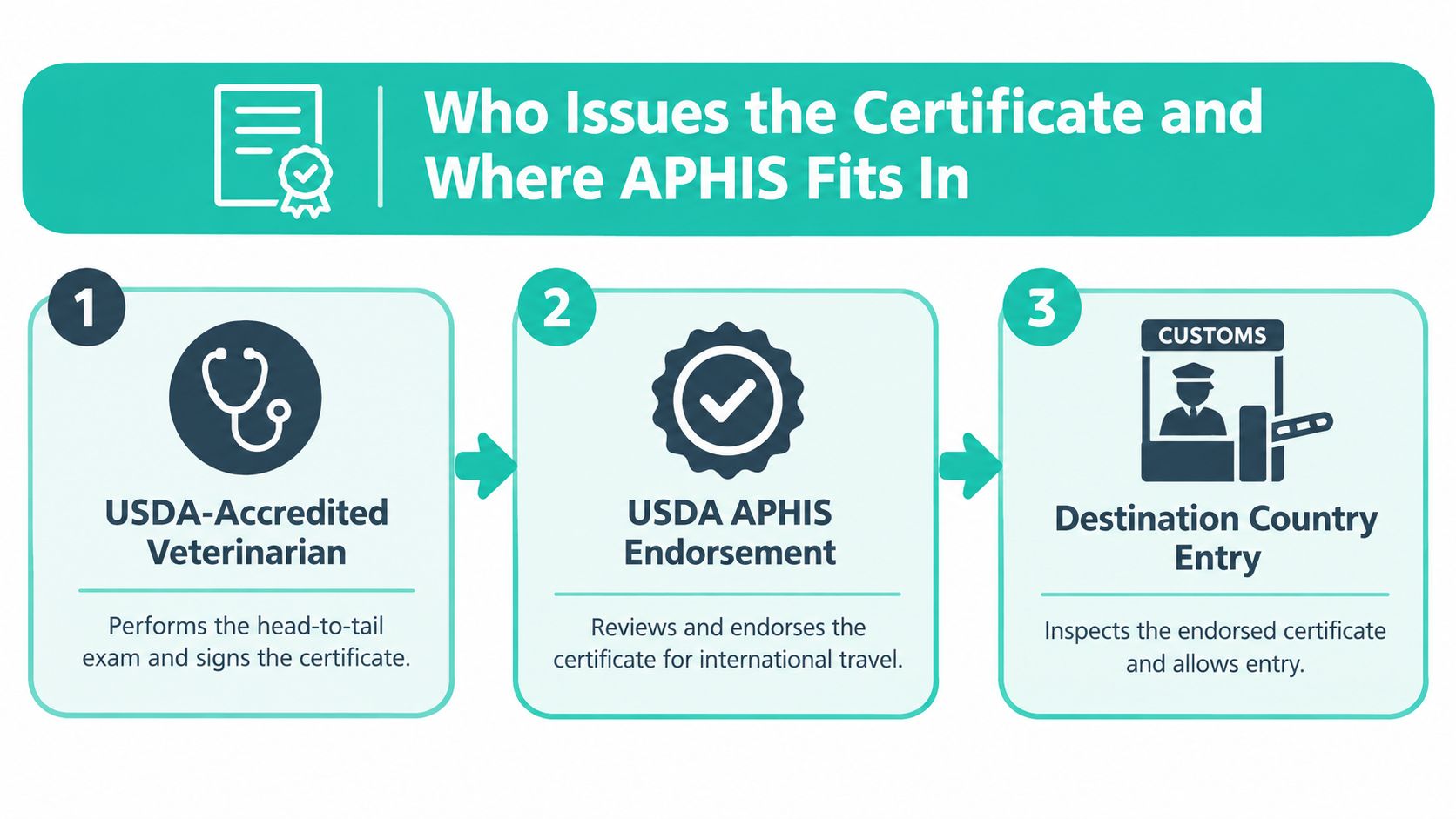
Think of the process as a relay race. Your veterinarian checks the dog and prepares the certificate. APHIS may review and endorse it. Border officials, airline staff, and the destination country's authorities then inspect the completed paperwork.
A certificate can be accurate and still fail to help if it's issued on the wrong form, completed outside the country's timing window, or missing a required rabies document. That's why a first-time traveler should ask about the entire chain, not just the appointment.
Practical rule: Your dog's exam starts the paperwork process, but the trip isn't paperwork-ready until every required handoff is complete.
The rest of the process comes down to four questions: who can issue the certificate, what the veterinarian checks, which destination-specific rules apply, and how the exam and endorsement fit your travel date.
Who Issues the Certificate and Where APHIS Fits In
Three roles can make the process easier to understand.
The USDA-accredited veterinarian
The veterinarian performs the physical exam, reviews your dog's records, completes the destination-specific certificate, and signs and dates it. For international export paperwork that requires USDA involvement, choose a veterinarian with the appropriate USDA accreditation rather than assuming any clinic can issue the document.
The veterinarian is the clinical professional in the chain. They confirm the dog's identity, vaccination information, exam findings, and any tests or treatments required by the destination country.
APHIS provides the government endorsement
APHIS is part of the U.S. Department of Agriculture. Its endorsement reviews the completed export certificate and supporting documentation when the destination country requires that official step. APHIS guidance notes that many countries require an endorsed certificate and that the usable period can be limited, sometimes to 30 days, depending on the destination and when the veterinarian signs the document. USDA's pet travel guidance explains the endorsement timing issue.
The simple analogy is that your veterinarian acts like the notary, while APHIS acts like the government office confirming the document for international use. The veterinarian's signature doesn't automatically mean the certificate has been endorsed.
VEHCS carries the paperwork
The Veterinary Export Health Certification System, or VEHCS, is APHIS's online platform for submitting export health certificates. The accredited veterinarian uses it to send the certificate and supporting documents for review. APHIS states that electronic signatures are accepted through VEHCS for live animal export health certificates, regardless of destination, although some countries still require paper originals or particular country forms. APHIS describes VEHCS and electronic signatures.
In practice, the owner usually works through the clinic rather than trying to manage an APHIS submission independently. The veterinarian is the sender, APHIS is the reviewer, and VEHCS is the courier. For a closer look at a commonly discussed form, see this guide to the APHIS 7001 health certificate.
Eligibility, Documents, and What Vets Actually Check
At the appointment, the veterinary team works through your dog's identity, medical history, vaccination records, and destination requirements. The dog should be visibly healthy during the exam, with no current infection, parasites, or unexplained weight loss that could raise concern.
Microchip and rabies records deserve special attention. If the destination requires an ISO-compatible, 15-digit microchip, the chip generally needs to be recorded before the rabies vaccination used for the travel application. A common paperwork problem occurs when the dog is microchipped after the relevant rabies shot, because the authorities may not accept the vaccine as properly linked to that identification.
What to bring to the appointment
Bring original records or reliable clinic copies, not just a photo of a vaccine reminder. Your veterinarian may need the vaccine date, product information, lot details, microchip number, previous travel records, and destination address.
Document | Why it matters |
|---|---|
Rabies certificate | Shows the vaccine date, product information, and current status required by the destination. |
Microchip record | Connects your dog's identity to the vaccination and travel documents. |
Prior travel records | Helps establish the dog's travel history when a country applies route- or risk-specific rules. |
Test results | Supports destination requirements when blood testing or other diagnostics are required. |
Owner identification | Helps the clinic match the certificate to the traveler and shipment details. |
Destination address | Gives the veterinarian the information needed for the export paperwork. |
Rabies timing can create another snag. A titer test or booster may be completed correctly but still miss the destination country's required waiting period. The clinic should check the sequence and dates before the exam is booked, not discover the issue while the suitcase is already open.
The certificate itself records details such as the dog's breed, age, microchip number, vaccination date and lot information, and physical exam findings. For a practical overview of the veterinary international health certificate, review the paperwork before your appointment so missing details don't send you chasing records later.
Country-Specific Rules That Change the Game
The USDA certificate is a baseline, not a worldwide permission slip. Each destination can add its own requirements for identification, vaccination, testing, treatments, permits, forms, and timing.
The European Union is a good example of why travelers should watch for form updates. USDA announced new EU-related health certificates for non-commercial dogs, cats, ferrets, and birds effective October 1, 2026, while older certificates may be endorsed through September 30, 2026. For commercial dogs, cats, and ferrets, the new certificate becomes effective October 17, 2026, and older forms may be endorsed through October 16, 2026. USDA's France travel page lists these certificate changes and dates.
Other destinations may add different layers. The United Kingdom can involve extended preparation and travel-history requirements. Australia may require advance testing and post-arrival quarantine arrangements. Japan can require a carefully ordered microchip, rabies vaccination, and serology process. Some countries may accept an APHIS-endorsed certificate without the same additional steps.
Destination | Extra requirement | Lead time | USDA cert sufficient? |
|---|---|---|---|
European Union | Use the certificate model applicable to the travel category and effective date. | Plan around the applicable 2026 form transition. | Not always. The correct EU certificate and any required treatments still matter. |
United Kingdom | May involve additional preparation tied to residency and entry rules. | Can require planning well before the appointment. | Not by itself. |
Australia | May involve testing and post-import quarantine arrangements. | Begin well ahead of travel. | No. Extra destination steps may apply. |
Japan | May require an ordered microchip, rabies, and serology sequence. | Start before the certificate exam. | No. The sequence and records are important. |
These examples aren't substitutes for checking the current instructions. Use the ISO-compliant microchip guide when reviewing identification, then confirm the destination's current rules through APHIS and the destination country's competent authority.
Timing the Exam, Endorsement, and Travel Date
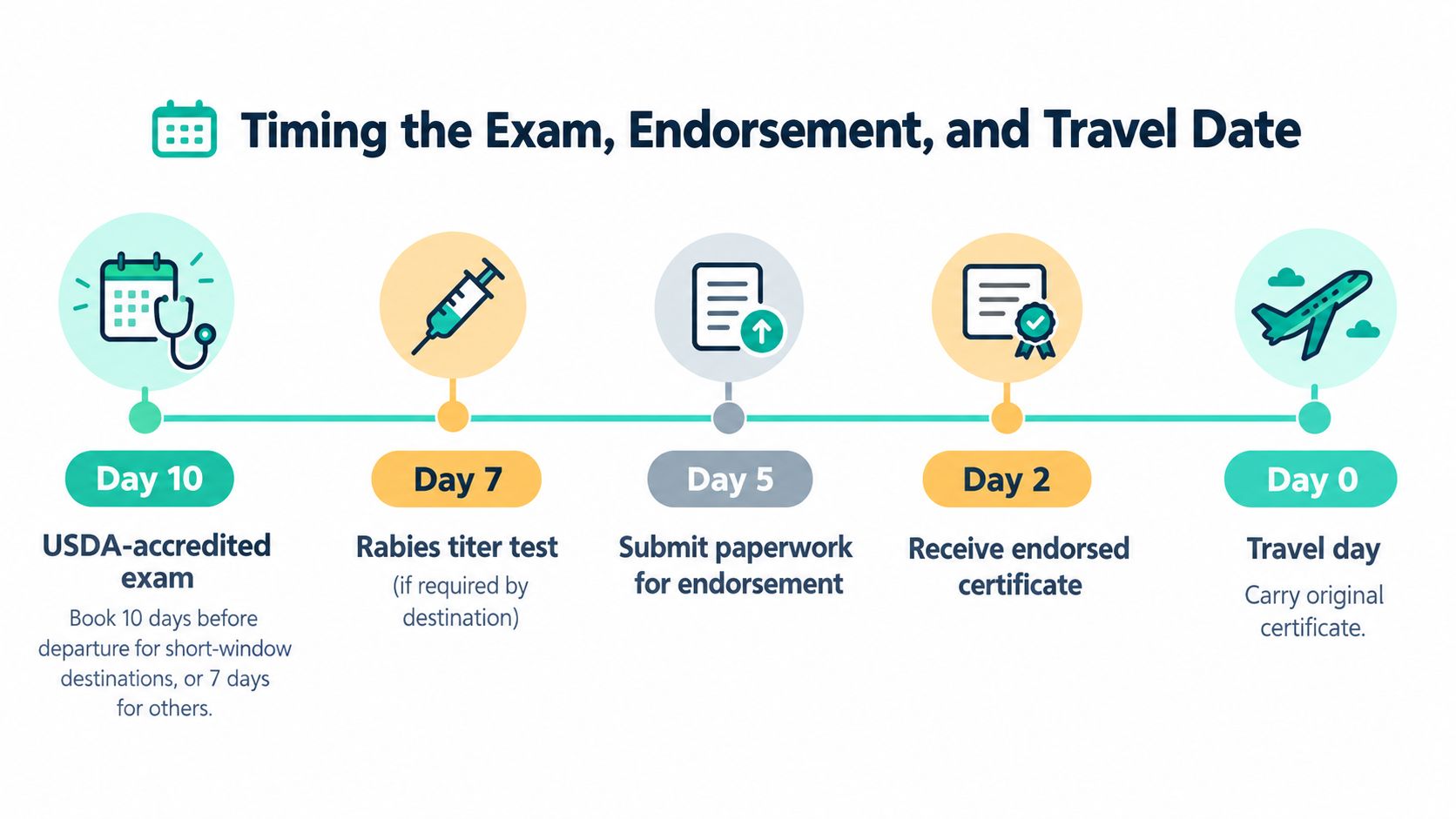
Timing is where many otherwise careful travelers get tangled. APHIS says the health certificate must usually be completed within a destination-specific window, and the original may remain acceptable only for a limited period, such as 30 days, before the destination country stops accepting it. APHIS's printed travel guidance explains this limited validity example.
Start with the departure date, then work backward. The exam is the anchor, but the certificate still needs review and endorsement before you travel. Some destinations accept electronic certificates, while others require paper originals or country-specific documents, so your clinic needs to know the delivery format before submission.
A practical backward-planning method
At the planning stage: Confirm the destination form, rabies rules, testing, treatments, and airline requirements.
Before the exam: Gather vaccination records, microchip information, prior travel history, owner identification, and the destination address.
At the exam: Ask the accredited veterinarian to verify every date and complete the correct certificate.
After the exam: The clinic submits through VEHCS when APHIS endorsement is required.
Before airline check-in: Confirm that the endorsed certificate is complete, readable, and in the format the destination and airline expect.
Keep the critical path visible
The critical path isn't only the veterinary exam. It also includes the veterinarian's accreditation status, document routing, APHIS review, the country's acceptance window, and the departure date. If one handoff runs late, the certificate may no longer fit the destination's rules.
Don't plan around the earliest possible approval. Give the clinic room to correct a missing attachment or clarify a form question, especially near holidays or busy travel periods. Your dog may be an excellent passenger, but paperwork rarely responds well to a last-minute zoomie.
Common Mistakes That Trip Up Pet Travelers
Most failures begin with a reasonable assumption. An owner checks the rabies record, books a flight, and expects the health certificate to be a single final form. International travel rules can be layered, so that assumption can leave an important requirement unnoticed.
High-risk rabies travel deserves special care. For dogs traveling to or from a country considered high risk for dog rabies, APHIS requires the CDC's Certification of U.S.-Issued Rabies Vaccination form in specific circumstances. The form must be completed by a USDA-accredited veterinarian and submitted before the dog leaves the United States. APHIS outlines the high-risk rabies documentation requirement.
Four checkpoints that prevent rework
Travel history: A dog that has been in a high-risk rabies country can face different documentation rules on a later trip. Tell the clinic every country visited, including transit locations.
Identification sequence: If the microchip was implanted after the rabies vaccination, the vaccine record may not satisfy the destination's identification requirement.
Endorsement timing: Waiting until the day before departure to route a certificate can leave too little time for corrections or review.
Veterinarian eligibility: A non-accredited veterinarian may be able to provide routine care, but international export certificates requiring USDA involvement need the appropriate accredited veterinarian.
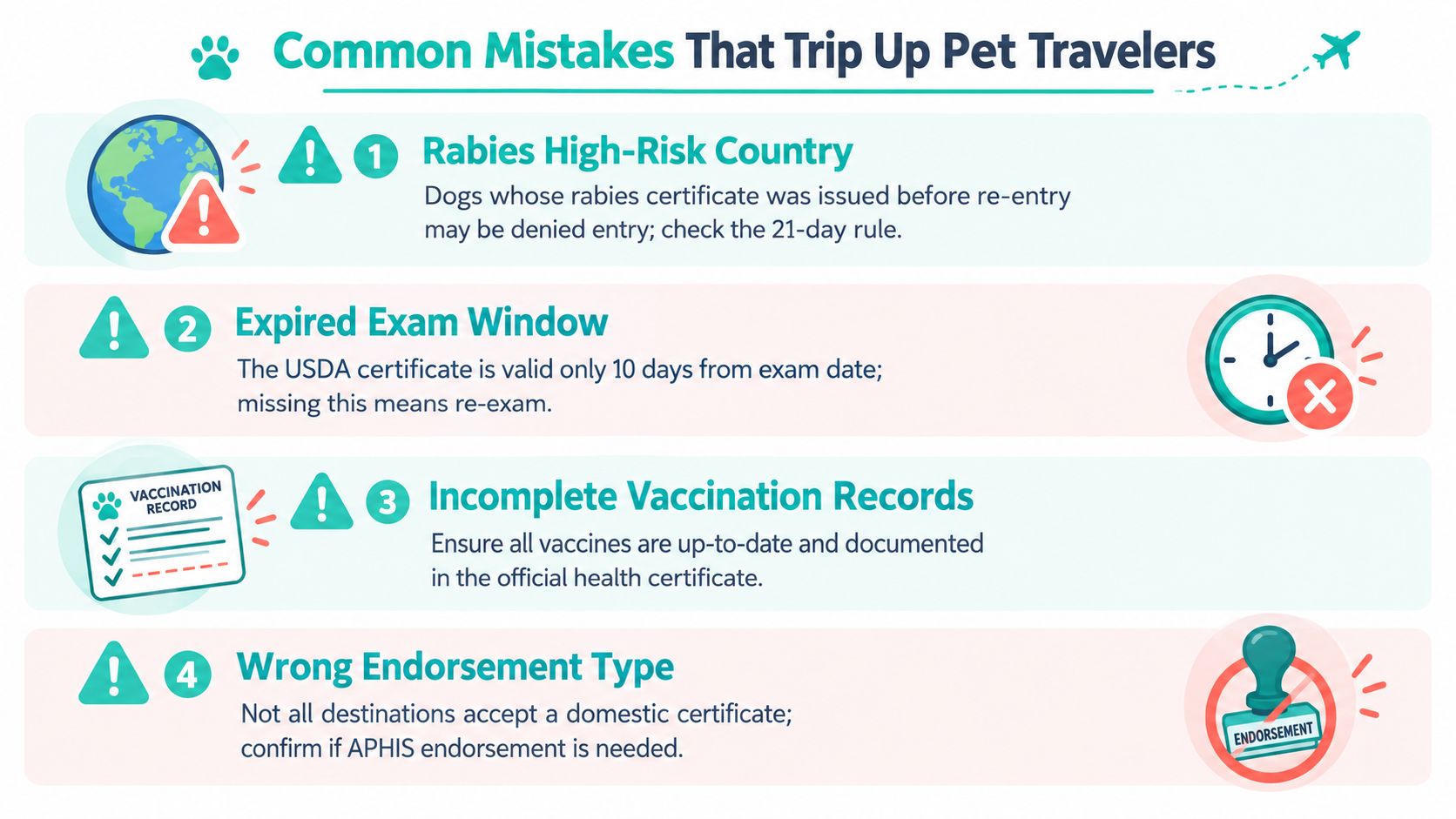
Names and numbers also need a quiet double-check. The dog's name, owner details, microchip number, destination, airline booking, signatures, supporting records, and form version should tell the same story. A missing signature or wrong country form can create a delay even when the dog's health status is fine.
Treat each mistake as a practice checkpoint. Ask about rabies travel history during intake, verify the chip before reviewing the vaccine, and confirm the endorsement route before the appointment ends. Those small checks turn surprises into ordinary workflow questions.
How Veterinary Practices Streamline the Workflow
A pet travel certificate works better as a repeatable clinical service than as a favor squeezed between appointments. The practice can map the work into stages, assign ownership, and give the client one clear place to see what's missing.
The intake form should capture the destination, departure date, travel category, transit countries, destination address, airline, microchip number, and rabies history. That first conversation can reveal whether the case involves a standard certificate, special rabies documentation, testing, treatment, or a country-specific form.
Build the workflow around checkpoints
Intake and destination review: Record itinerary details before scheduling the exam.
Identity and rabies verification: Confirm the microchip and trace the relevant vaccination history.
Clinical appointment: Schedule the exam inside the destination's certificate window.
Certificate preparation: Use the correct country form and attach supporting records.
VEHCS submission: Route the documents for APHIS review when endorsement is required.
Status communication: Tell the client what has been submitted, what remains pending, and what they must carry.
Follow-up: Store the completed documents and note any return-trip or future travel considerations.
Digital intake forms can reduce repeated phone calls by collecting the itinerary once. Automated reminders can prompt clients for missing rabies records or a destination address. A documentation hub can keep certificates, microchip details, test results, and correspondence together instead of scattering them across email threads. Practices exploring that model can review this pet travel documentation hub.
Passpaw fits into this type of workflow by capturing travel details, surfacing country requirements, creating a vet-ready checklist, organizing rabies certificates and microchip numbers, and communicating next steps to clients. It's one option for practices that want the administrative side of international certificates to follow a consistent path.
A separate veterinary practice AI receptionist can help with front-desk questions and appointment intake, especially when staff need to collect basic travel details before a coordinator reviews the case. The important design choice is to keep clinical decisions with the veterinary team while tools handle intake, reminders, document organization, and status visibility.
Your Quick-Start Checklist Before Booking the Vet
By the time you reach the airport, the ideal feeling is pleasantly boring. You're holding the printed certificate, your dog is settled in the carrier, and nobody is frantically searching email for a missing rabies record.
You can make that scene more likely by spending one focused afternoon on preparation.
Gather the essentials first
Confirm the destination rules: Check the current APHIS Pet Travel guidance and the destination authority's instructions.
Check the microchip: Verify that the number is readable, recorded correctly, and compatible with the destination's identification rules.
Find the rabies certificate: Confirm the vaccine date, product details, lot information, and any supporting laboratory records.
Collect older records: Include prior health certificates, travel history, test results, and treatment records.
Map the dates: Count backward from departure and identify the acceptable exam and endorsement window.
Find the right veterinarian: Book a USDA-accredited veterinarian who understands the destination's paperwork.
Ask about VEHCS: Confirm who submits the certificate, what format the destination accepts, and how the clinic will communicate status.
Prepare a travel folder: Keep scanned copies and printed documents together, including the endorsed original when required.
Don't assume yesterday's instructions will still be the right instructions for a later trip. APHIS notes that destination rules, certificate forms, endorsement requirements, and validity periods can differ, so the destination authority and APHIS should have the final word on your specific itinerary.
Once your folder is ready, send the clinic your destination and travel date before booking the exam. That gives the team a chance to identify the correct form, flag any waiting period, and build a calm plan for you and your four-legged traveler.
Passpaw helps veterinary practices and pet travel teams organize destination details, required documents, task timing, and client communication around international health certificates. Visit Passpaw to see how the platform can help turn a complicated dog travel file into a clearer, repeatable workflow.

More articles
From regulatory changes to best practices for veterinarians and pet owners, our resources keep you ahead of the curve.