Are you a team member in a veterinary practice?
Are you a pet parent planning a trip with your furry pal?
Pet Travel Crates: Sizing, Safety, and Airline Rules
You're at the airport, your pet is rested, your documents are in a folder, and the crate looks perfectly respectable. Then the agent checks the door, looks at the ventilation, and asks whether the kennel has the required fasteners. One small hardware detail can turn a calm departure into a frantic search for a replacement.
That's why choosing among pet travel crates isn't just a shopping exercise. The right crate must fit your pet's body, the aircraft's physical limits, and the airline's inspection process. A carrier can look roomy and sturdy at home yet fail because of a flexible door, weak latch, blocked ventilation, or a material the route doesn't accept. For broader preparation, this guide on how to travel with a pet is useful, while Passpaw's pet travel guide adds helpful planning context.
Why the Right Crate Makes or Breaks Your Trip
At the check-in counter, crate rejection rarely feels like a minor correction. Your dog may be watching every movement, your cat may be hiding at the back of the carrier, and the departure clock keeps moving. An agent might reject the kennel because it collapses, has wheels, lacks suitable bolts, or doesn't provide enough ventilation for the route.
The crate's job goes well beyond containment. It needs to keep your pet from escaping, protect them from contact with baggage and equipment, and provide enough room for natural movement. It should also feel familiar, because a pet that already treats the crate as a safe den is more likely to settle during a demanding travel day.
Practical rule: Don't buy a crate based only on a product label. Buy it for the exact pet, route, aircraft, and handling conditions.
Air travel rules have developed around predictable risks such as injury, escape, and overheating. USDA guidance for air travel with pets requires kennels for dogs and cats to display “Live Animal” in 1-inch letters on the top and at least one side. It also says dogs and cats must be at least 8 weeks old and fully weaned before travel.
That detail matters because a crate can be comfortable but still unsuitable for commercial transport. A soft-sided carrier may work for an airline-approved cabin journey, while a cargo route usually demands a rigid enclosure with stronger structural protection. Treat the crate as part of the travel system, not as an accessory you can improvise at the airport.
Measuring Your Pet for a Perfect Fit
Measure your pet before comparing crate dimensions. Manufacturers often advertise external measurements, but usable space is determined by the inside of the enclosure, including the space taken by the door frame, walls, and bedding.
Start with your pet standing naturally on a level surface. Keep the measuring tape relaxed, and measure more than once if your dog is convinced the tape is a chew toy.
Take the key measurements
Length: Measure from the tip of the nose to the base of the tail. Don't include the full tail length.
Standing height: Measure from the floor to the top of the head or the highest ear tip, whichever is higher.
Width: Measure across the shoulders or the widest part of the body.
Bedding allowance: Account for the thickness of the absorbent bedding you'll use during travel.
Your pet must be able to stand without touching the roof, sit upright, turn around completely, and lie down naturally. These movements test the crate in real use. A pet that can technically fit but must duck, twist, or curl tightly doesn't have an inspection-ready enclosure.

Check the inside, not the marketing label
Place a tape measure inside the crate and record the usable length, width, and height. Sloped roofs, raised floors, thick doors, and interior rims can reduce the space more than expected. If the crate only works without bedding, it's too small for practical travel.
A crate that's excessively large isn't automatically safer. Extra space can allow a pet to slide or be thrown around more during movement, especially if the animal is nervous or the journey involves handling and transfers. The target is natural movement with controlled space, not a miniature room.
USDA guidance usually allows one dog or cat per kennel. The limited exception permits two comparable puppies from 8 weeks to 6 months old, weighing 20 pounds (9 kg) or less, to travel together in one kennel. IATA guidance also permits a maximum of two compatible adult animals of comparable size, up to 14 kg each, in one primary enclosure when they're accustomed to cohabiting. Animals over 14 kg must travel individually, according to IATA's pet transport guidance.
For breed-specific planning, use this practical reference on dog crate size by breed, then verify the final internal dimensions with your airline.
Navigating Airline and International Crate Rules
Airlines inspect physical features, not just the words “airline approved” on a box. The same carrier may be acceptable in the cabin but unsuitable for cargo, or accepted on one route and rejected on another because ventilation, aircraft space, or material requirements differ.
For in-cabin travel, IATA passenger guidance says the dog or cat must travel in a compliant container that fits under the seat in front of you, or in another location specified by the airline. That's a hard space constraint. Your pet's comfort still matters, but the carrier also has to physically fit the aircraft's seat area.
Cargo kennels face a different inspection. Common requirements include rigid construction, a front-opening door, secure fastening, leak-proof flooring, and ventilation on multiple sides. Guidance commonly calls for ventilation on three sides for domestic U.S. travel and four sides for international travel, with enough internal room for the pet to stand, sit, turn, and lie naturally. Delta's crate requirements also exclude soft-sided and collapsible designs for this type of transport.
Feature | In-Cabin Carrier | Cargo Hold Kennel |
|---|---|---|
Main space limit | Must fit under the seat or in the airline-specified cabin location | Must fit the aircraft and cargo-handling limits |
Construction | Soft-sided carriers may be accepted when the airline permits them | Rigid construction is required |
Ventilation | Must meet the airline's cabin carrier design rules | Commonly three sides for domestic travel and four sides for international travel |
Door and closure | Secure closure that won't open during handling | Rigid front door with reliable locking hardware |
Movement inside | Pet must remain contained throughout the flight | Pet must stand, sit, turn, and lie down naturally |
Mobility features | Wheels may be part of a cabin design if permitted | Wheels are commonly rejected or must be removed or made inoperable |
Top-loading doors deserve particular caution. They can be useful for placing a cat into a household carrier, but cargo staff need a secure, inspectable front door that won't flex during handling. Wheels can also create movement and snagging risks, so a cargo crate without wheels is the safer default.
Check the airline's current policy for every flight segment, including partner airlines and international connections. For more context on the practical differences between cabin and cargo travel, see this guide to the cargo hold on a plane.
Safety Features and Materials That Pass Inspection
A crate's material affects both comfort and inspection performance. Soft fabric is light and convenient, but it can collapse, tear, or allow the pet to press against the sides. Rigid plastic is more protective, provided the frame, door, hinges, and fasteners are strong enough for repeated handling.
For cargo travel, look for a rigid kennel with an escape-resistant metal door. Secure the two halves with nut-and-bolt fasteners or an equivalent approved fastening system. Plastic clips can hold a household crate together, but they're a poor choice when the crate may be pushed, lifted, or exposed to pressure from several directions.
The Center for Pet Safety found that, at the time of its study, the United States had no performance or dynamic testing standards for pet crates. Its work highlights the importance of independent validation rather than relying only on manufacturer claims. The study is documented in the Center for Pet Safety crate research.
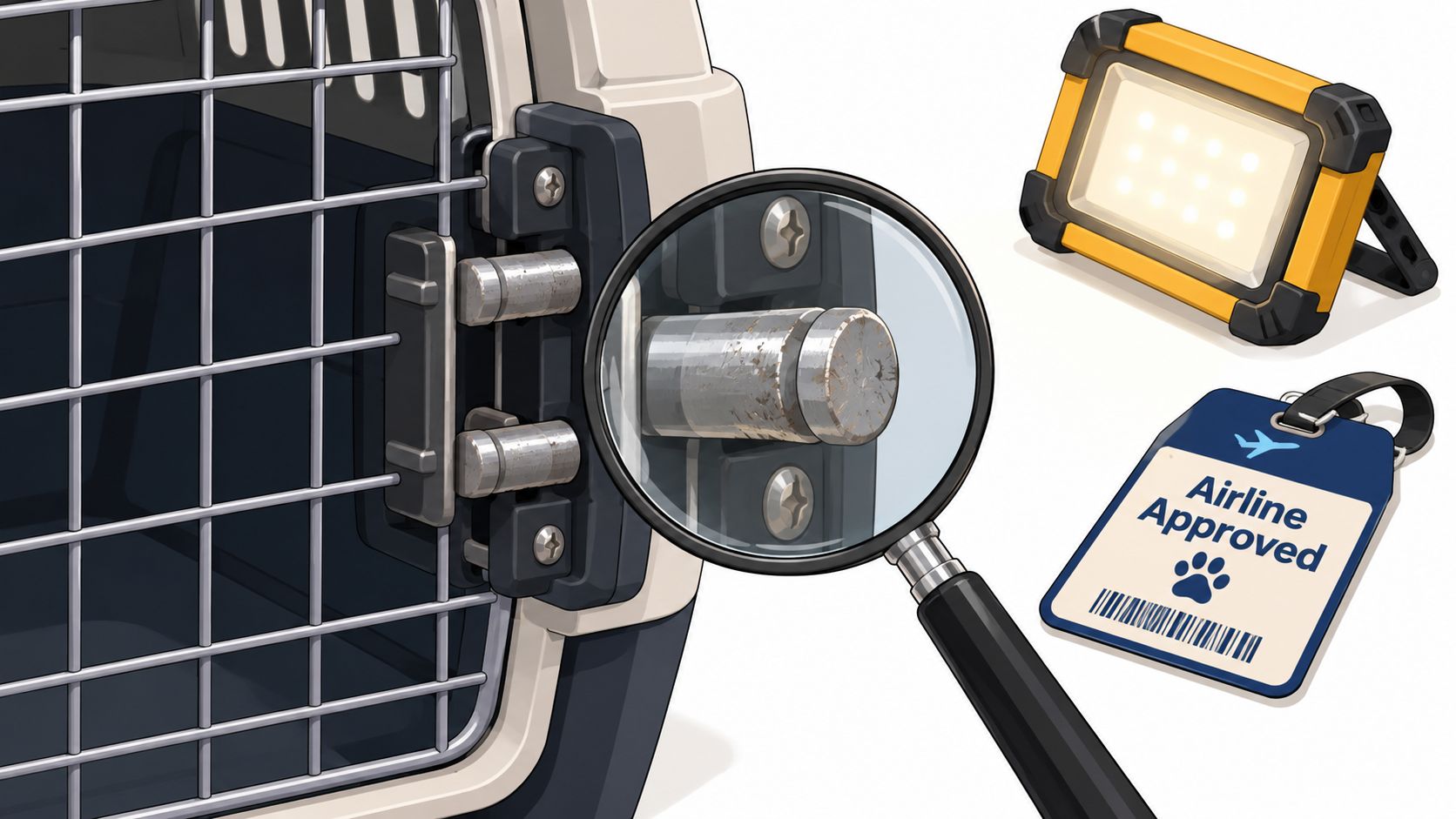
Compare the failure points
Flexible panels: Convenient for cabin use, but a weak choice for cargo handling because the enclosure can deform.
Plastic doors: They may have a familiar household feel, but many cargo requirements favor a rigid metal door.
Weak latches: A latch that shifts when you pull the door is a warning sign. Your pet shouldn't be able to nose it open.
Top vents: Openings in the roof can weaken the structure and may not match the airline's ventilation pattern.
Wheels: Handy in a terminal, but cargo agents may reject them or require that they be removed or made unusable.
Wooden construction: Some carriers reject specific materials, including wood, so confirm the route's policy before buying.
A good crate doesn't need to look industrial, but it should feel solid when you lift it, press the door, and check every connection. Open and close the door repeatedly. Pull gently on the latch. Inspect the floor for gaps and confirm that bedding can't block ventilation openings.
Labeling Requirements and Travel Day Prep
Handlers need to identify the contents quickly and understand how the crate should be managed. Put “Live Animal” in 1-inch letters on the top and at least one side of the kennel, following USDA guidance. Use clear directional markings where the airline requires them, and attach your contact details securely to the crate rather than relying only on a collar tag.
The floor should be leak-proof and lined with absorbent bedding. Avoid loose material that can block ventilation or create a mess during inspection. Food and water dishes should attach inside the crate and, where required by the carrier, be fillable from outside so handlers don't need to open the door.
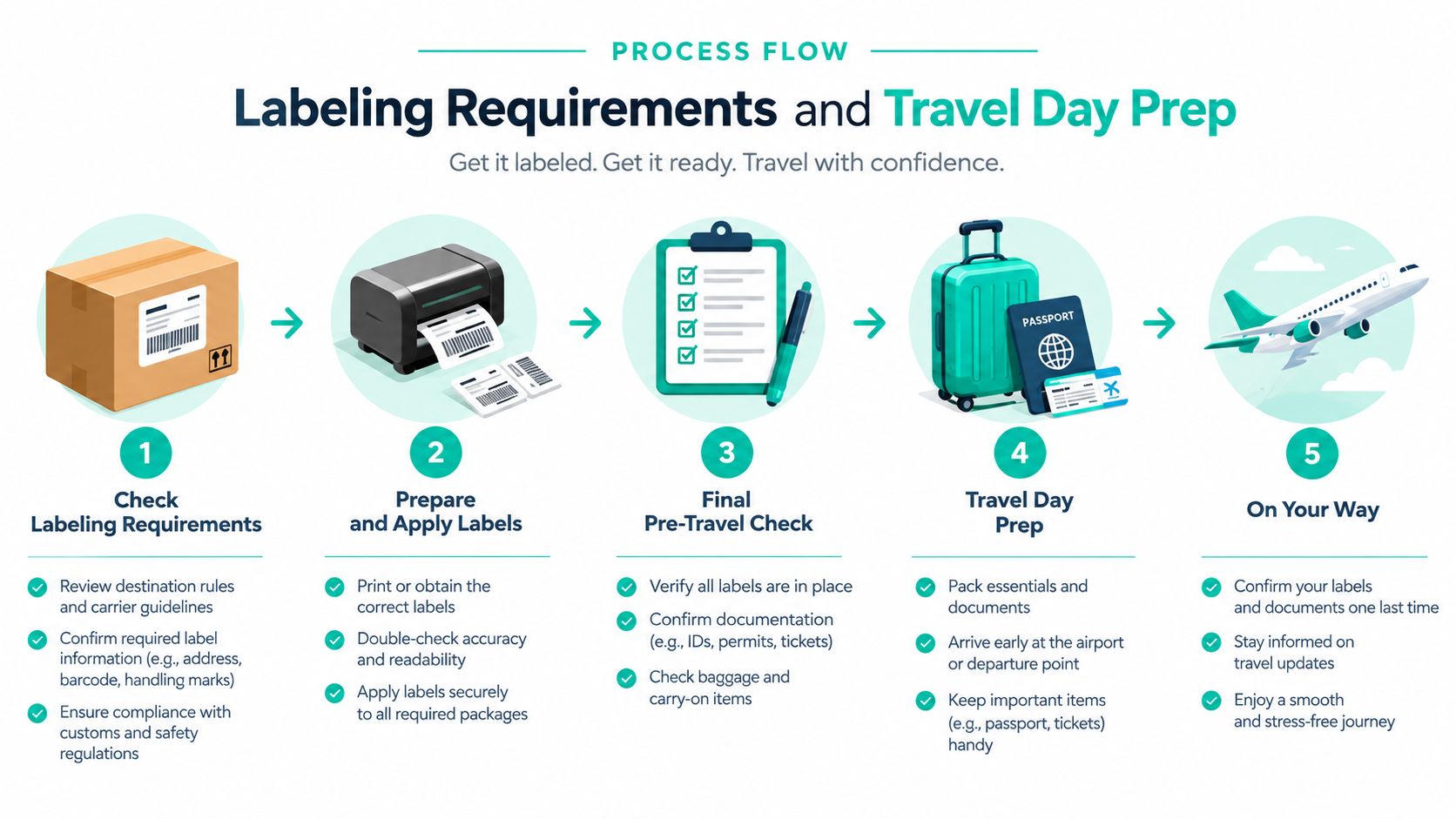
Prepare the crate before travel day
Introduce it early. Leave the crate open at home and place familiar bedding inside. Reward voluntary visits with treats or meals.
Build duration slowly. Close the door for short periods, then extend the time while your pet remains relaxed.
Rehearse movement. Carry or roll the crate only if its design permits that use, and let your pet experience ordinary household noise around it.
Inspect every attachment. Check the bowls, bolts, door, hinges, and labels the day before departure.
Pack lightly. Use absorbent bedding and approved dishes. Skip bulky toys or loose objects that can shift and obstruct the space.
A familiar-smelling blanket can make the crate feel less like airport equipment and more like home. Keep the setup practical, though. Comfort shouldn't reduce ventilation or usable room.
USDA-related preparation can involve documents as well as labels, so this USDA shipping label guide can help you organize the crate and paperwork together. Keep printed documents accessible, and confirm the airline's latest instructions before leaving for the airport.
Your Final Pre-Flight Crate Checklist
Run this inspection with the crate empty, then repeat it with the bedding and dishes installed. The second check catches problems that a showroom-style inspection misses.
Measure internally: Confirm that your pet can stand, sit, turn completely, and lie down naturally.
Check the height: Make sure bedding doesn't force the head or ears against the roof.
Test the structure: Press the panels and door. They should feel rigid, not floppy or easily distorted.
Inspect the closure: Confirm that the metal door, latch, hinges, and nut-and-bolt fasteners hold firmly.
Review ventilation: Check that openings match the route, with common guidance calling for three ventilated sides domestically and four internationally.
Remove risky extras: Take off wheels if the airline requires it, and avoid loose items that can block openings.
Confirm labeling: Place “Live Animal” in 1-inch letters on the top and at least one side where USDA rules apply.
Verify the route: Ask each airline involved, including connecting carriers, whether the exact crate and dimensions are accepted.
Rules and aircraft limits can change, so confirm the current requirements before booking and again before departure. A little preparation now can spare you and your pet a very un-fun surprise at the counter.
Passpaw helps veterinary practices and pet travel professionals manage international health certificates, validate documents, prioritize tasks by travel dates, and communicate with clients. Visit Passpaw to organize the paperwork alongside your crate and route preparation.

More articles
From regulatory changes to best practices for veterinarians and pet owners, our resources keep you ahead of the curve.