Are you a team member in a veterinary practice?
Are you a pet parent planning a trip with your furry pal?
Pet Transport Requirements: Essential Guide for Safe Travel
A first rabies vaccination generally requires a 21-day wait before travel, and the microchip must be implanted and read before, or on, the vaccination date. Pet transport is therefore a timeline problem: the documents matter, but when each event happens relative to the others matters more.
You may be looking at a folder filled with vaccination records, a health certificate, microchip details, and an airline confirmation, wondering whether your dog or cat is finally ready to fly. That confidence can disappear at the airport if one date appears in the wrong order. A document can be genuine and complete yet still fail to prove that your pet met the required sequence.
The safest approach is to plan backward from departure, check every date, and treat government approval, transit rules, and airline acceptance as separate parts of the same journey.
Why Pet Travel Papers Fail: The Sequence Problem
At the airport, a pet owner opens a neat folder containing the rabies certificate, signed health certificate, microchip record, and airline confirmation. Everything appears ready until an agent compares the dates and stops the journey.
The problem is often the sequence is wrong. The microchip may have been implanted after the rabies vaccination, the vaccination may be too close to departure, or the certificate may have been issued before a required examination. An identification number that does not match the animal can create the same result.
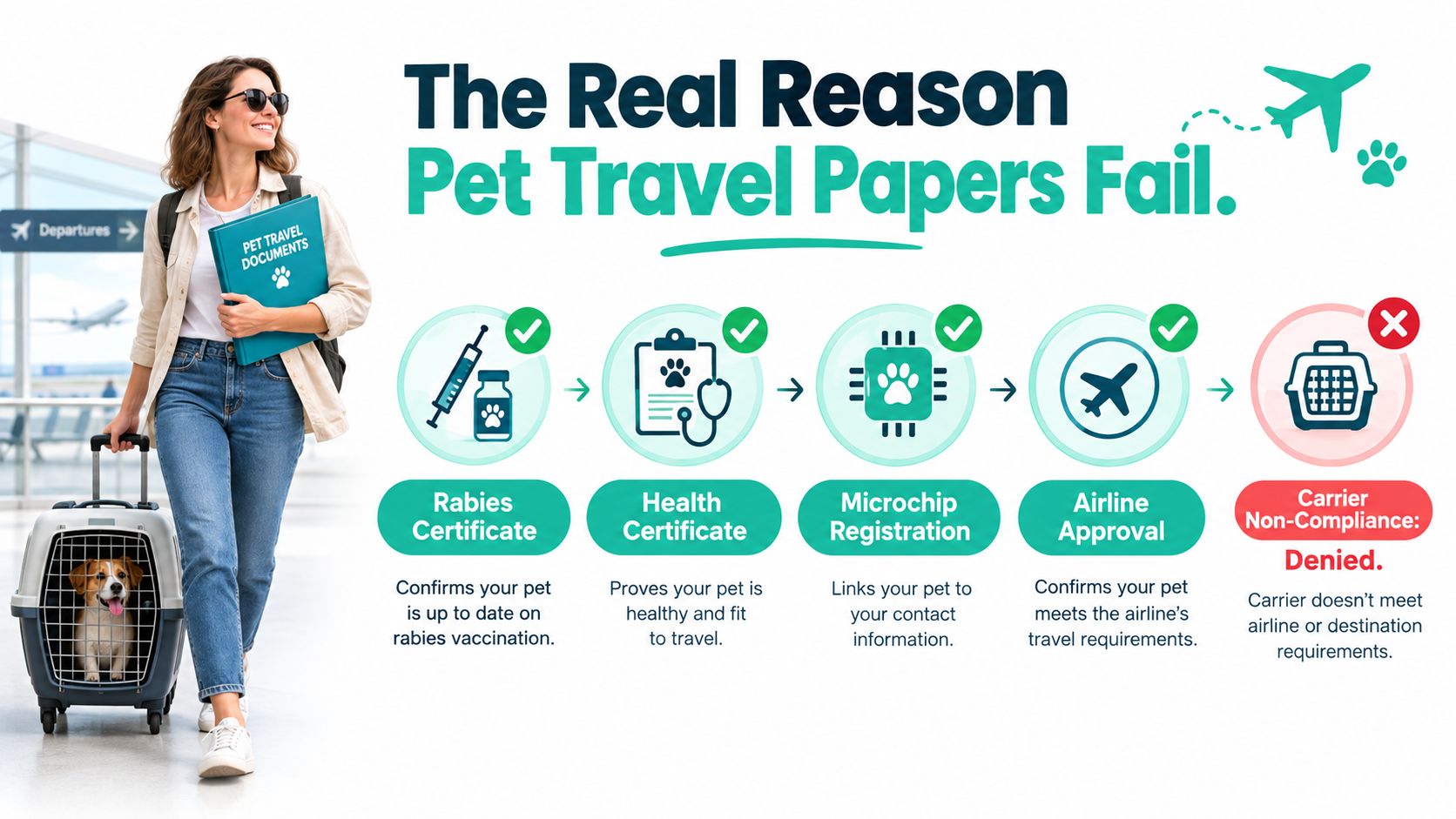
For travel to the European Union, USDA guidance says the microchip must be implanted and scanned before the rabies vaccination. After a primary rabies vaccination, the pet generally must wait at least 21 days before travel, as explained in this USDA timing guidance for EU pet travel. A vaccination certificate therefore proves only one event. Officials may also need evidence that identification came first and that the waiting period has ended.
Think in events, not documents
Write the journey as a timeline:
Identification: Record the microchip number and the date it was implanted or read.
Vaccination: Confirm that the rabies vaccination followed the identification event.
Waiting period: Count the required time from the correct vaccination date.
Examination and certificate: Arrange the veterinary examination within the destination's permitted window.
Airline review: Confirm acceptance of the pet, route, container, and documents.
A folder can conceal an ordering error. A file called “rabies certificate” records what happened, but not whether it happened at the right point in the process.
Practical rule: A complete document set is not the same as a valid travel timeline.
The same issue can appear after a destination changes its requirements or a pet is re-vaccinated. A new vaccination may affect the applicable waiting period. An unreadable or incompatible microchip may also break the link between the animal and its medical record. Owners and veterinary teams can use this review of common documentation gaps to check for missing connections before departure approaches.
Successful pet transport depends on date validation, not paperwork collection alone. Keep original event dates, supporting records, and route details together. If one date changes, review every later step, because existing certificates may no longer prove that the required sequence was followed.
How Pet Transport Rules Are Built
A pet can arrive at the airport with every document in a folder and still be unable to travel. The problem is often the order behind those papers. Pet transport rules come from several systems, and each one asks a different question.
The destination country decides whether the animal may enter. Airlines decide whether they will carry the animal under their operating conditions. Transit countries may apply separate checks, even when the pet is only changing planes. A document that satisfies one authority may not satisfy another.
The destination gate
Destination rules can depend on the origin country, animal species, travel purpose, identification method, vaccination history, and route. They may also differ when a pet travels with its owner for a private move rather than for sale or transfer.
The European Union provides a clear example. For non-commercial travel, its simplified framework covers dogs, cats, and ferrets accompanying their owners, with no more than 5 animals under that regime. A journey involving more than 5 animals may fall outside the simplified framework and trigger commercial or other regulated-movement requirements, as described by the European Commission's rules for travelling with pets within the EU.
That number affects the journey's legal classification. Once the classification changes, the certification and control process may change with it.
Destination compliance also follows a sequence. Authorities may need to see that identification was established before the relevant vaccination, that any waiting period was completed, and that the certificate describes the same animal and route. Collecting each paper separately does not prove that the papers form a usable chain.
The carrier gate
Airlines set their own conditions for pet travel. They may limit species, animal numbers, container dimensions, confinement arrangements, or acceptable health documents. Their approval is a separate decision from the destination country's entry approval.
Ask these questions in order:
Can the destination legally admit this pet on this route?
Will every operating carrier and airport segment accept the pet under its own policy?
A multi-leg itinerary requires a review of each transit point, operating airline, transfer arrangement, and transport method. A certificate accepted at the first arrival point may not meet a later border or transit control. A carrier may also require information in a particular format or by a particular deadline.
The practical model is two gates connected by a route. The pet must pass the legal entry gate and the operational carrier gate. If either gate fails, the journey can stop before the pet reaches its destination. The documents work only when the route, dates, identification, and approvals line up.
The Critical Timing Steps for Pet Travel
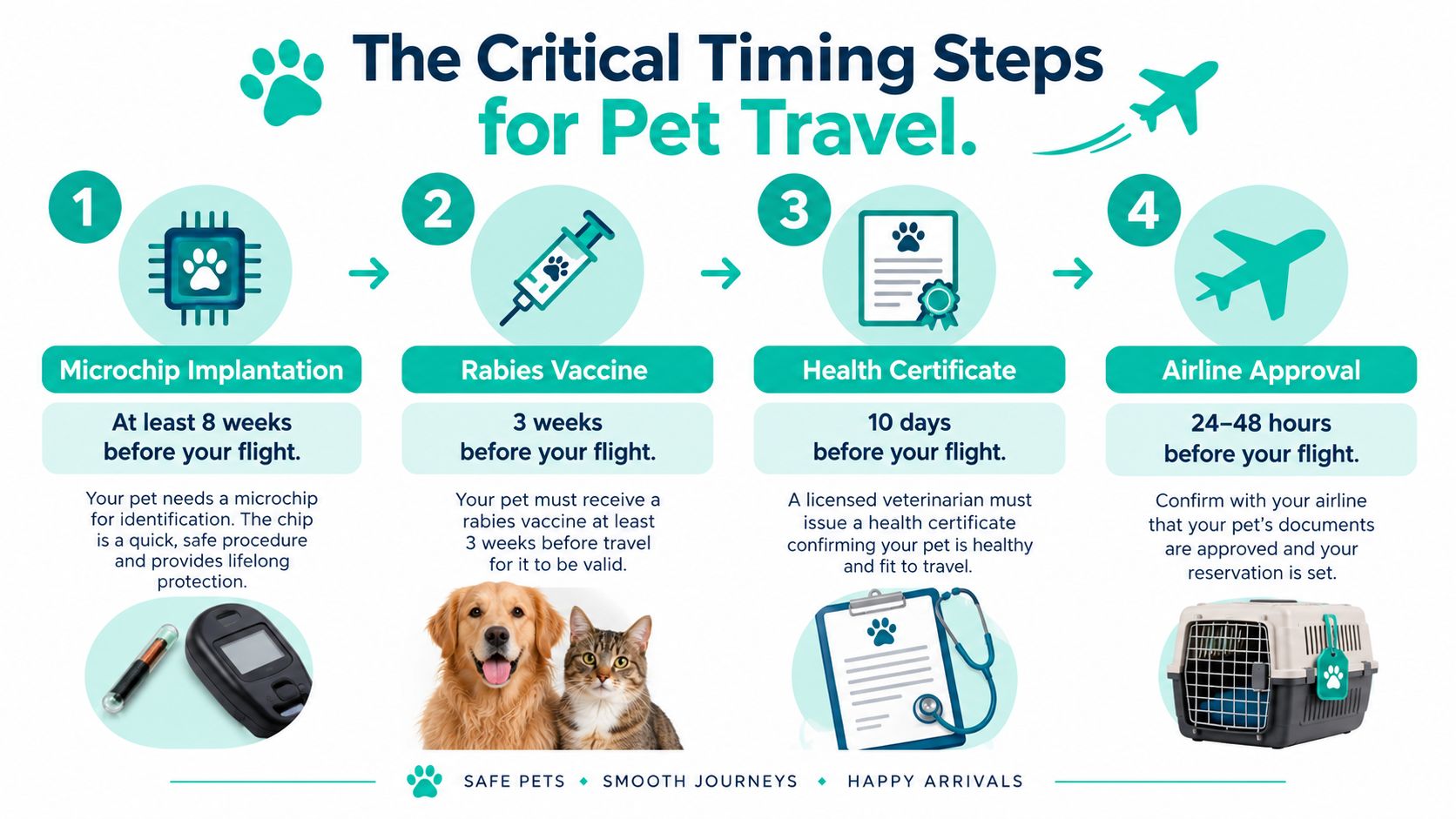
The calendar should drive the preparation. Begin with the intended departure date, then work backward through identification, vaccination, waiting periods, veterinary certification, and airline confirmation.
Start with the microchip
Record the microchip number exactly as it appears when scanned. The microchip must be implanted before, or read on, the rabies vaccination date for EU travel, according to Your Europe's pet travel guidance.
This is the first dependency. If the vaccination happened before the chip was implanted or verified, the vaccination may not support the intended travel route. Ask the veterinarian to scan the chip and confirm that the number matches every later record.
Schedule rabies vaccination carefully
For EU travel, a pet must be at least 12 weeks old when receiving its first rabies vaccination. After that first vaccination, the owner must wait at least 21 days before travel. A last-minute vaccination therefore normally can't support immediate international transport, even if the animal appears healthy.
Revaccination can also require careful review. Don't assume that a new dose automatically preserves the previous travel timeline. Check the destination's rules, the vaccination record, and the date of the proposed journey together.
Add the certificate after the prerequisites
Destination authorities commonly require a veterinarian to examine the pet and complete, sign, and date the health certificate after performing or verifying the required procedures. For U.S.-origin exports, a USDA-accredited veterinarian may issue certificates that require federal endorsement, and some certificates can be submitted electronically through the Veterinary Export Health Certification System. Some destinations still require original or endorsed documents, so the route must determine the exact process.
Work backward from departure. First identify the certificate window, then book the veterinary appointment inside that window. Leave enough time for endorsement or document correction, because a mistake in the pet's name, microchip number, vaccination date, or route can make an otherwise good certificate unusable.
Use a date dependency map
Write each event in one place and mark what it sets in motion:
Microchip verification: Establishes the animal's identity for later records.
Rabies vaccination: Starts the relevant waiting period when it is a primary vaccination.
Waiting period: Determines the earliest possible departure date.
Health examination: Supports the certificate within the destination's permitted window.
Carrier confirmation: Checks whether the chosen airline and container meet operating rules.
A missed window can move the trip by weeks or require a new veterinary appointment. A simple guide to common application deadlines can help teams coordinate owners, veterinarians, and certification steps around the actual travel date.
EU Pet Passports vs USDA Health Certificates
An EU pet passport and a USDA health certificate can both contain identification and health information. They apply to different travel systems, however, and neither document is automatically valid for every route.
The EU passport supports identification, traceability, and compliance when dogs, cats, and ferrets travel between EU countries under applicable non-commercial rules. The owner normally travels with the pet and remains responsible for the movement. An authorized person may accompany the animal when the arrangement fits the permitted relationship to the owner's journey.
The USDA model is tied to the destination. For an export from the United States, the destination country sets the required certificate, examinations, vaccinations, tests, and treatments. A USDA-accredited veterinarian may complete the certificate, and federal endorsement may be required. The USDA pet travel certificate guide explains how that process works.
Travel question | EU pet passport framework | USDA export certificate model |
|---|---|---|
Typical use | Movement between EU countries under applicable non-commercial rules | Export from the United States to a specific destination |
Main record | A pet passport containing identity and compliance records | A destination-specific health certificate |
Veterinary role | An authorized or official veterinarian, depending on the task | A USDA-accredited veterinarian when federal involvement is required |
Route effect | Transit and travel purpose can change the requirements | The destination and each transit point shape the certificate process |
Owner responsibility | The owner normally travels with the pet or uses an authorized person under the rules | The owner coordinates the certificate, endorsement, and destination requirements |
The document is only one part of the sequence. Identification must support later records, vaccinations may start a waiting period, and examinations or treatments must fall within the destination's permitted window. A complete file can still fail if its events occurred in the wrong order.
Great Britain illustrates this route-specific approach. A dog may need treatment against Echinococcus multilocularis no less than 24 hours and no more than 120 hours before expected arrival, according to British government guidance on tapeworm treatment. The veterinarian must record the treatment details in the relevant travel document.
The practical question is not which document sounds more official. Ask which authority governs the route, which document it accepts, and which events must appear in order for that document to remain usable.
When Travel Plans Go Off Track
Maya arrived at the airport with her dog, a vaccination record, completed health certificate, microchip record, and confirmation that the destination authority accepted her paperwork. She had also booked a route with a connection.
The government documents passed review at the first airport. The second operating carrier created a different problem: it would not accept Maya's planned container on that aircraft under the selected transport arrangement. Her destination paperwork was usable, but her dog could not board the connecting segment.
The setback was not caused by one missing form. It came from a timing and sequencing gap between separate systems. Government approval covers entry into a destination. Airline acceptance covers the specific aircraft, carrier, container, and transport arrangement. Written airline confirmation should therefore cover every operating segment, not only the airline that issued the ticket. Airline requirements can also change by route or aircraft, so check the carrier's current pet policy before finalizing the booking.
Three lessons from the missed departure
Check every operating carrier. The airline selling the ticket may operate only part of the journey. Confirm each carrier's policy, including the connection airport and the planned transport method.
Match the aircraft to the container. Approval for pet travel does not guarantee acceptance on every aircraft. Confirm that the container fits the selected arrangement and that the carrier has approved the dog's actual method of travel.
Keep records in travel order. Arrange the destination rules, transit requirements, airline approvals, veterinary records, and certificate instructions according to the journey. A folder labeled “pet documents” can hide which record supports each step.
A government-approved document answers the destination's entry question. It does not confirm that an airline will accept the pet for a particular flight.
The safest time to find an operational conflict is before the booking becomes final. Ask each operating carrier for written confirmation, record the representative's name, and compare the approved container with the requirements for every segment. This check connects the paperwork sequence to the physical journey and can prevent an airport refusal.
Building Your Pet Travel Compliance Plan
A workable plan has four phases. Keep each phase tied to a date and an owner, whether that owner is the pet parent, veterinarian, travel agency, or pet shipper.
Before the veterinary visit
Write down the full itinerary, including every transit point and operating carrier. Record the pet's species, travel purpose, microchip number, vaccination history, and intended travel date. Then ask the destination authority or an experienced veterinary travel professional which rules apply to that exact route.
During document preparation
Check the timeline rather than just collecting files. Confirm that the microchip was read before the relevant rabies vaccination, that the waiting period has passed, and that the veterinary examination and certificate fall inside the destination's required window.
Use one shared record for dates and corrections. A platform such as Passpaw can gather trip and pet details, create destination-specific task lists with deadlines, validate vaccination records against destination requirements, and help manage health-certificate workflows. A practical example of compliance management shows why task ownership and deadline tracking matter when several people handle one journey.
Before airline confirmation
Contact every operating carrier, not only the booking airline. Confirm the accepted transport method, container dimensions, confinement requirements, health certificate expectations, and any route or aircraft restrictions. Keep the written response with the itinerary.
At departure
Carry the required originals and copies in a route-organized folder. Recheck the microchip number, pet description, vaccination dates, certificate dates, treatment records, and airline approval before leaving for the airport.
Pet transport requirements become manageable when you treat them as a chain of dated events. Start early, ask the veterinarian to verify the sequence, and review the complete route whenever a flight, vaccination, or document changes.
Passpaw helps veterinary practices and pet travel teams organize trip details, assign destination-specific tasks, validate vaccination records, and manage health-certificate workflows. Visit Passpaw to see how it can help you keep pet transport timelines and documents together.

More articles
From regulatory changes to best practices for veterinarians and pet owners, our resources keep you ahead of the curve.