Are you a team member in a veterinary practice?
Are you a pet parent planning a trip with your furry pal?
Pet Relief Area LAX: A Complete Guide for 2026
LAX has 11 pet relief stations total, including 8 indoor post-security stations and 3 outdoor pre-security stations, spread across most major passenger terminals. The right choice depends on where you are in the airport, whether you've cleared security, and whether construction has changed access that day.
You've just reached the LAX departures curb. Your dog is shifting in the carrier, the terminal is busy, and the nearest paw-print sign seems to be hiding on purpose. The first question isn't “Where is the pet relief area at LAX?” It's “Am I before or after security?”
That distinction can save you a rushed walk and another trip through TSA. This guide covers terminal locations, service-animal and pet access, connecting-flight strategy, and practical ways to keep your animal comfortable. If you're also trying to make a long airport wait easier, you can find lounges near LAX, but check whether your lounge is before or after security before leaving your terminal area.
A suitable carrier matters too, especially for smaller pets traveling in the cabin. Review this pet carrier for air travel guide before you leave home, then treat the relief stop as part of your travel plan, not an emergency backup.
Navigating LAX With Your Furry Travel Companion
The safest sequence is simple. If you're still outside security, use an outdoor station before joining the checkpoint line. If you've already cleared TSA, look for the indoor station serving your terminal instead of heading back downstairs.
Practical rule: Once you leave the secure area, you'll need to go through security again before returning to the gates.
LAX's three outdoor stations serve travelers on the Lower/Arrivals Level. They're useful before check-in, before security, or after baggage claim. The eight indoor stations serve passengers who are already airside, making them especially useful during a connection or before boarding.
Terminal layout can make a quick break feel like a small expedition. A dog may need time to settle in, and a nervous pet might not cooperate because you've found the room. Give yourself enough walking time to locate the station, let your pet adjust, clean up, and return to the gate.
Your terminal assignment also matters. LAX connects many passenger areas, but an adjacent station isn't automatically convenient. A connector may be open, crowded, or affected by construction, so verify the route when you arrive rather than relying on an old memory or a static map.
How LAX Built Its Pet Relief Network
LAX's current system grew from a major April 2016 expansion, when Los Angeles World Airports announced seven new indoor relief stations for service animals and pets. The stations were placed across the passenger complex, including Terminal 1 near Gate 13, Terminal 2 near Gate 21, Terminal 3's open-air atrium, the Tom Bradley International Terminal and Terminal 4 connector, Terminal 5 near Gate 52B, Terminal 6's open-air atrium, and the area between Gates 73 and 75B in Terminals 7 and 8. (LAX's official pet relief location document)
That change was important because passengers no longer had to depend only on outdoor areas. A traveler who had already passed through security could use an indoor room instead of exiting the terminal and facing another checkpoint. The network also created a more consistent experience for service-animal users moving through different terminals.
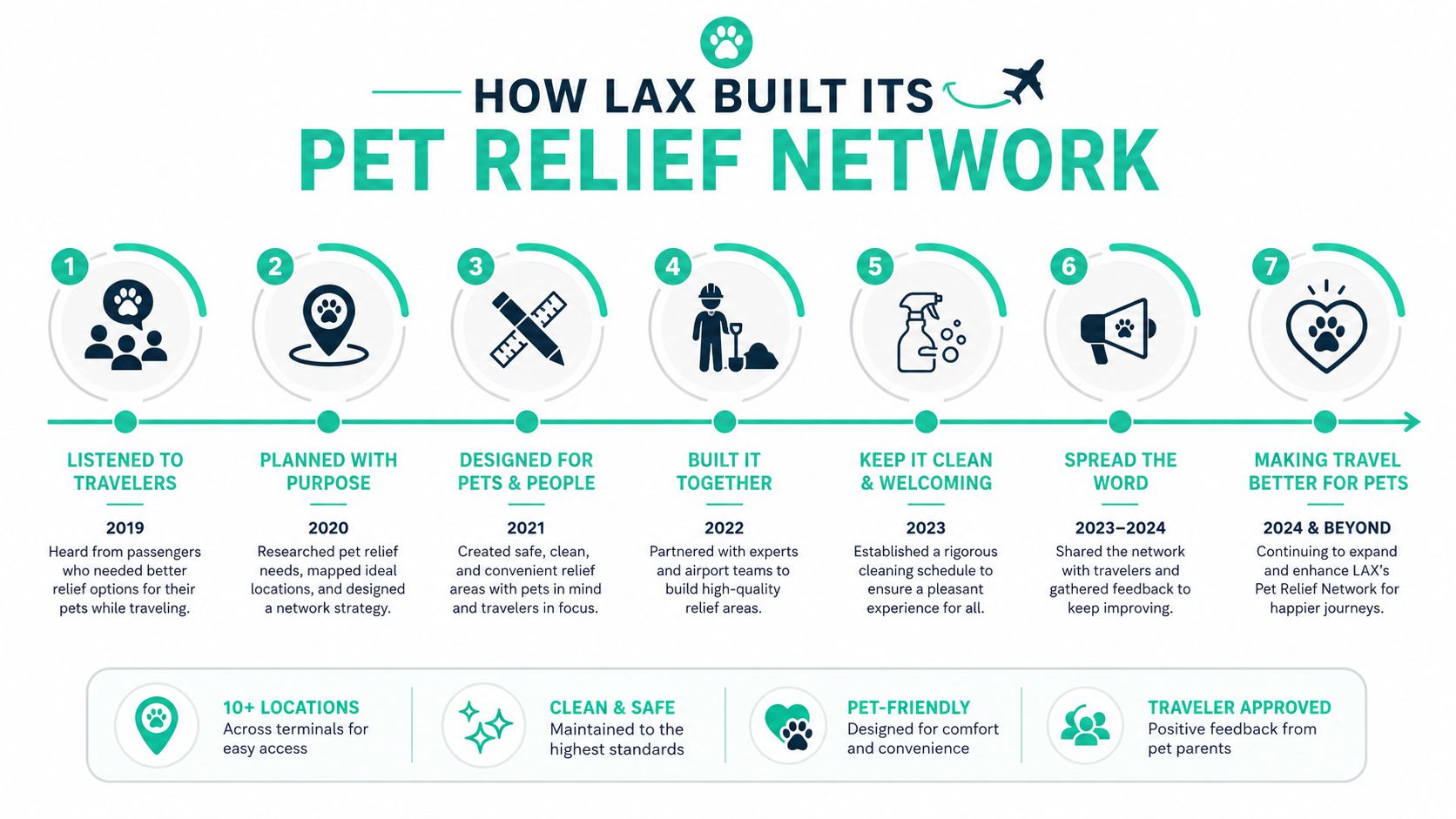
By 2019, LAX was publicly described as having 11 animal relief stations, a total commonly divided into 8 indoor and 3 outdoor locations. (LAX travel guidance describing the network) The lasting value of the expansion is practical rather than historical trivia. It gave travelers a network to plan around.
Terminal modernization still affects how that network works on the ground. Independent travel references have noted that a relief area near the Terminal 3 and TBIT corridor was unavailable during construction, while official terminal pages show current station information by location. For travelers who care about a clean, calm airport experience, planning the pet stop is part of creating a traveler memorable sanitary experience, not just finding a patch of turf.
For broader changes in airline paperwork and pet travel preparation, review recent changes in pet travel before your departure.
Terminal by Terminal Relief Area Locations
Use the table as a starting point, then confirm the station on the airport's current map when you arrive. Locations can be described by terminal, gate, connector, or atrium, and signage may not always be obvious.
Terminal | Pre/Post Security | Location / Nearby Landmark |
|---|---|---|
Terminal 1 | Pre-security and post-security | Outdoor area between Terminals 1 and 2. Indoor room near Gate 13. |
Terminal 2 | Pre-security and post-security | Outdoor area between Terminals 1 and 2. Indoor room near Gate 21. |
Terminal 3 | Post-security | Inside the open-air atrium. |
Tom Bradley International Terminal | Post-security | Near the connector to Terminal 4. |
Terminal 4 | Post-security | Along the connector corridor to Tom Bradley International Terminal. |
Terminal 5 | Post-security | Near Gate 52B. |
Terminal 6 | Post-security | Inside the open-air atrium. |
Terminal 7 | Pre-security | Outdoor area at the east end of Terminals 7 and 8. |
Terminal 8 | Post-security | Indoor station between Gates 73 and 75B. |
Terminals 1 and 2 are the clearest examples of the two-access system. Before security, head toward the outdoor area between the terminals. After security, use the indoor room near the relevant gate area. Don't assume the outdoor location is still convenient once you're inside the secure zone.
At Terminal 3, look toward the open-air atrium rather than searching only beside restrooms. The Tom Bradley and Terminal 4 stations are tied to the connector corridor, so follow signs toward the neighboring terminal and watch for the relief-area indication along the route. Terminal 5's room is near Gate 52B, while Terminal 6's is in its open-air atrium.
For Terminals 7 and 8, distinguish the outdoor east-end location from the indoor station between Gates 73 and 75B. That difference is essential if you've already passed security. If you're flying with American Airlines or another carrier that requires special planning, review the airline's rules, including this guide to American Airlines pet cargo, before relying on terminal access alone.
Pre-Security vs Post-Security Access Explained
Think of LAX's relief areas as two separate groups serving two different moments in the journey.
Pre-security outdoor stations are useful when you're still on the Lower/Arrivals Level. Use one before entering the terminal, before joining the TSA line, or after landing and collecting your pet. They're also useful if your animal needs a break immediately after a car ride.
Post-security indoor stations are for travelers who've already reached the gate area. They're placed in terminal or connector locations, so you can use them during a layover without leaving the secure side. The rooms are designed for animal relief, with features such as artificial turf, drainage, and waste disposal.
Your position | Better choice | Why |
|---|---|---|
At the curb before check-in | Outdoor station | You can take a break before entering the security process. |
Waiting to join TSA | Outdoor station | It avoids an urgent need while you're in the checkpoint line. |
Past TSA with time before boarding | Indoor station | You stay airside and avoid re-screening. |
Arriving after baggage claim | Outdoor station | It's accessible on the public side of the airport. |
Connecting between terminals | Current airside station or verified alternative | Connector access may depend on construction and terminal conditions. |
Leaving the secure area for a potty break can turn a short stop into a much longer airport task.
The most common mistake is seeing an outdoor location on a map and assuming it's available from the gates. It isn't. Before walking anywhere, check your terminal position, your security status, and the time needed to return to the gate.
If you're traveling with a cat rather than a dog, the same airport logic applies, but carrier handling and airline procedures can differ. This guide on how to book a flight for a cat can help you prepare before you reach LAX.
Travel Day Tips for a Smooth Potty Break
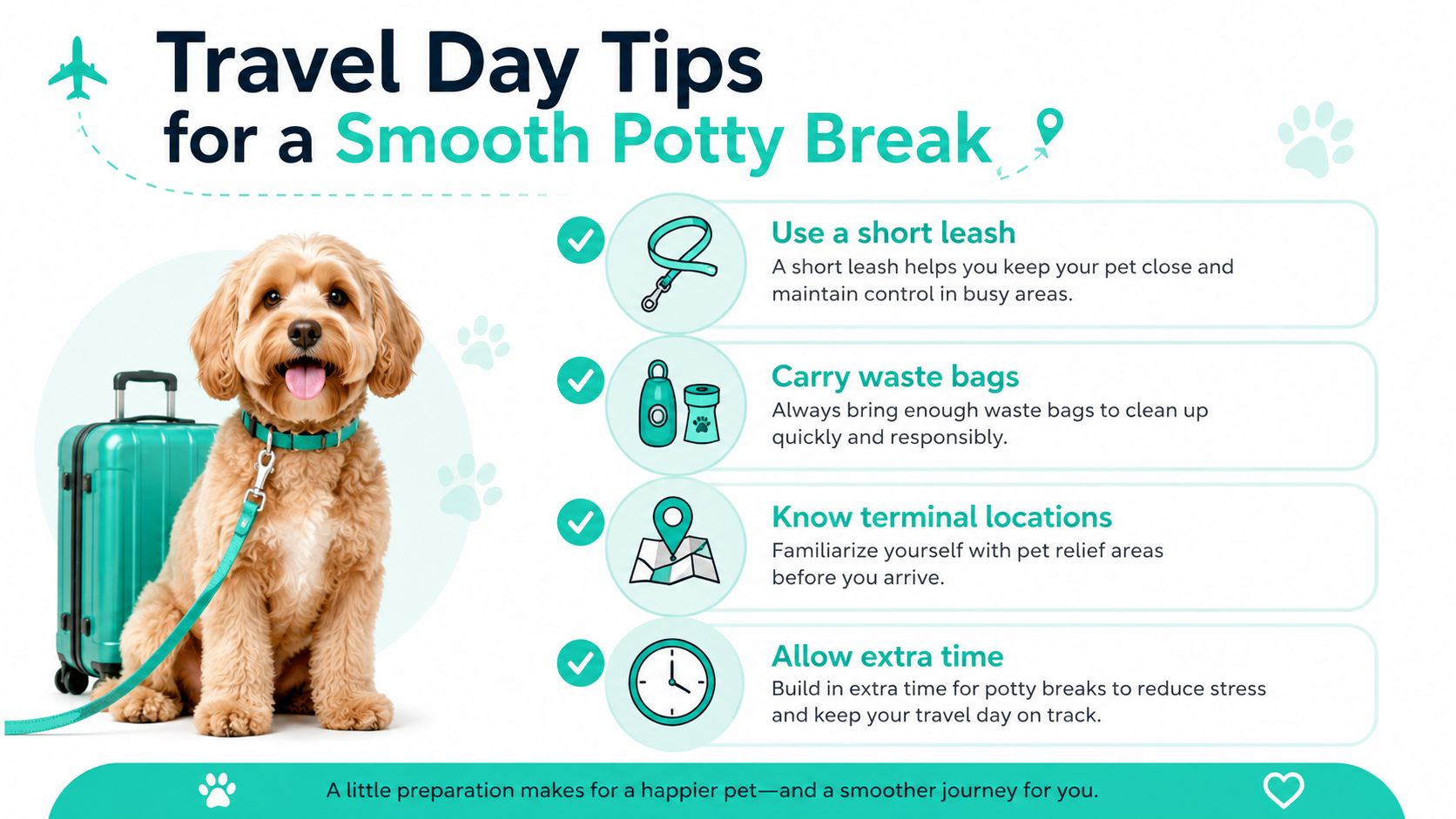
A calm relief stop starts with a small travel kit and a realistic pace. Keep your dog on a short leash, even if your pet normally walks well. Crowded corridors, rolling luggage, and sudden noises can make a retractable leash awkward and difficult to control.
Bring waste bags from home. Dispensers may be stocked, but carrying your own means you're not depending on a supply that could be empty when you need it. After your dog finishes, use the station's waste bin rather than a general terminal trash can.
Make the stop comfortable
Some dogs step onto airport turf without hesitation. Others need a moment to sniff and understand the unfamiliar space. A small blanket or another familiar-smelling item can give an anxious pet a reassuring cue, as long as you can place it neatly and remove it afterward.
Offer water thoughtfully. Small sips can be easier to manage than a full bowl immediately before departure, while your pet's normal hydration needs should still guide you. If your dog has a medical condition or a history of travel sickness, follow advice from your veterinarian rather than changing its routine for convenience.
Build in a buffer
For a connection or long layover, plan the relief stop well before boarding. Walking between terminals, locating the room, waiting for your dog to settle, and dealing with possible re-screening can all take longer than expected.
A simple packing system keeps the essentials reachable. These convenient packing strategies for your tote can help you keep bags, wipes, water, paperwork, and comfort items together instead of buried under clothes.
A courteous routine helps everyone. Keep your pet close in hallways, give other animals space, clean the area after use, and avoid turning the relief room into a rest stop for people. Your dog gets a calmer break, and the next traveler gets a cleaner station.
When Construction Changes the Plan
The assumption that all 11 LAX stations will be equally easy to reach can cause trouble. Terminal construction has affected relief-area access before, including a location near the Terminal 3 and Tom Bradley corridor that was reported out of service during construction. (Official Terminal 3 animal relief information)
The practical lesson is to verify, not guess. Airport construction can block a corridor, change a walking route, or move the useful entrance even when the broader terminal map still looks familiar. A station you used on a previous trip may not be the station you can use today.
Check the current LAX website before leaving home and again on travel day. If you need an immediate answer, contact the airport information service or ask an airport employee once you reach the terminal. Keep your airline and gate details ready, since the best alternative depends on where you're departing or connecting.
Backup plan: Identify one nearby alternative before your pet becomes desperate.
Airside connectors may let you reach another indoor station without leaving the secure area, but don't treat that as automatic. Construction, closed corridors, and terminal-specific access can change the route. Ask for directions using the terminal number, gate area, and connector name rather than asking only for “the dog bathroom.” That wording may earn a smile, but precise landmarks will get you there faster.
Simplifying Pet Travel Beyond the Airport
The relief stop is only one part of a successful trip. You may also need health certificates, vaccination records, airline-specific documents, and destination permits, especially for international travel. Requirements can vary by destination and carrier, so confirm them before you arrive at the check-in counter.
Passpaw is one option for organizing pet travel compliance. Its platform helps manage veterinary records, prepare health-document workflows, validate information, prioritize tasks by travel details, and support communication between veterinary practices and clients. That can make the paperwork side easier to track while you focus on terminal access and your pet's comfort.
Use a final checklist before leaving:
Confirm the airline policy: Recheck your carrier's pet rules 48 hours before departure.
Pack the relief kit: Carry waste bags, a collapsible water bowl, a short leash, and a familiar comfort item.
Review the terminal map: Check your departure terminal, security status, and a backup station.
Keep documents accessible: Store records where you can show them without unpacking the entire bag.
A prepared traveler makes fewer rushed decisions, and pets often respond to that calmer pace. Know whether you need a pre-security or post-security station, verify current construction conditions, and give your dog time to settle before the next part of the journey.
Passpaw helps pet owners and veterinary teams organize travel documents, manage health-certificate tasks, and keep destination requirements easier to track. Visit Passpaw before your LAX trip, so your paperwork is organized while you focus on your pet's next comfortable break.

More articles
From regulatory changes to best practices for veterinarians and pet owners, our resources keep you ahead of the curve.