Are you a team member in a veterinary practice?
Are you a pet parent planning a trip with your furry pal?
American Airlines Pet Cargo Your 2026 Travel Guide
So, you're planning to fly with your pet on American Airlines. If your furry friend is too big to fit under the seat in front of you, you'll be using their special cargo service. This is handled by the American Airlines Pet Cargo program, also known as PetEmbark.
It's a system designed to transport your pet in a temperature-controlled, pressurized area, completely separate from passenger luggage.
Your Pet's Travel Options on American Airlines
Before you book anything, it's important to understand the two main ways your pet can fly with American. The choice almost always comes down to your pet's size and weight.
In-Cabin vs. Pet Cargo (PetEmbark)
For small dogs and cats who can rest comfortably in a carrier under the seat, flying in the cabin is a fantastic choice. They get to stay right by your side for the whole trip. But for bigger animals, that's just not an option.
This is where PetEmbark comes in. It’s the cargo service for animals that are too large for the cabin or are flying solo without a human companion. They’re looked after by specially trained staff and travel in a climate-controlled hold designed for their safety and comfort.
A Quick Word of Advice: The PetEmbark service isn't just for large dogs. It's often the only option for most animals other than cats and dogs, and it’s often required for all pets flying to certain international destinations, no matter their size.
To make the choice clearer, here's a quick comparison of the two services.
American Airlines Pet Travel Options at a Glance
Service Option | Pet Location | Typical Pet Size | Best For |
|---|---|---|---|
Carry-On Pet | In the cabin, under the seat | Small cats & dogs | Pets small enough to fit in a carrier that goes under the seat in front of you. |
PetEmbark (Cargo) | Pressurized, climate-controlled cargo hold | Medium to large pets, or animals traveling alone | Larger pets, most non-cat/dog animals, and pets traveling to specific international locations. |
Choosing the right service from the start will save you a lot of headaches down the road.
Is PetEmbark the Right Choice?
The idea of putting your pet in cargo can feel a bit nerve-wracking, but it's important to know this is a system built with animal welfare in mind. American Airlines has a solid track record to back it up.
Between January 2015 and December 2020, the airline transported 405,719 animals with a very low average incident rate of just 0.71 per 10,000 animals. This shows a real commitment to safety.
Ultimately, PetEmbark provides a safe and reliable solution when in-cabin travel just won't work. It helps pets of all shapes and sizes get where they need to be. If you’re weighing your options, our guide on other airlines that take dogs in cargo can give you a broader look at what’s available.
Now that you have the basics down, let's dig into the details of booking your pet's flight.
How to Book Your Pet's Flight with PetEmbark

Getting your pet a confirmed spot on an American Airlines pet cargo flight is the first big step in their journey. Unlike booking your own ticket online, this is a hands-on process. You'll need to speak directly with the airline's cargo team to get it done.
There’s no online booking for a reason—each animal's safety and needs are unique. This direct contact is how American Airlines makes sure the aircraft, route, and timing are all a good fit for your specific pet.
Get Your Pet's Info Ready Before You Call
Before you pick up the phone, pull together all your pet's information. Having these details ready makes the call with the booking agent much smoother. Think of it as creating your pet’s travel profile.
Here’s what you’ll need:
Pet Details: Breed, age, and the combined weight of your pet plus their travel crate.
Crate Dimensions: The exact length, width, and height of the kennel in inches.
Travel Plans: Your desired origin and destination airports, along with possible travel dates.
The agent uses this info to calculate the cost and, more importantly, to confirm there's enough space in the climate-controlled hold. Be precise, especially with those crate measurements—an inch can make all the difference.
Why You Need to Book Well in Advance
When it comes to pet travel, it doesn't pay to wait. We always tell our clients to book their pet's flight with American Airlines PetEmbark at least two to four weeks ahead of time. If you're traveling during busy times, like summer or around the holidays, give yourself even more time.
The number of pets allowed on any single flight is limited. Waiting until the last minute can leave you in a tough spot, scrambling to find a flight with an open spot for your companion.
Booking early also gives you a buffer to handle any unexpected paperwork or last-minute vet visits. It’s all about locking in that confirmed spot and giving yourself peace of mind.
Understanding Weather and Temperature Rules
The weather is a huge factor in the American Airlines pet cargo booking process. For the safety of every animal they fly, the airline has strict temperature rules. This means they will not transport pets if the forecast temperature at the origin, destination, or any connection point is too hot or too cold.
The standard safe range is between 45°F (7°C) and 85°F (29°C). But these numbers can shift based on the season or aircraft, so always confirm the current policy when you book.
Here's a real-world example: someone wants to fly their Golden Retriever out of Phoenix in July. The airline will likely deny the booking. Why? The ground temperature in Phoenix will almost certainly be over the 85°F limit, making it unsafe for the dog to be on the tarmac, even for a short time.
Special Rules for Snub-Nosed Breeds
If you have a brachycephalic (snub-nosed) dog or cat, like a French Bulldog, Pug, or Persian, you have an extra layer of rules to follow. These breeds are more sensitive to heat and air quality changes, so American Airlines has even tighter restrictions for them.
Stricter Temperature Window: The cutoff is often much lower, sometimes capping at 75°F (24°C).
Bigger Crate Required: You’ll likely need to use a travel crate that is one size larger than what’s normally required to help with better airflow.
You Must Share the Breed: It's important to inform the agent that you're shipping a snub-nosed breed during the booking call.
These policies aren't designed to make your life harder—they exist to keep your pet safe. Trying to fly a Bulldog last-minute in the summer is nearly impossible. Your best bet is to plan months ahead for a flight during a cooler season. If these rules feel like a bit much, working with a dedicated pet travel agent can remove a lot of the guesswork and stress.
Choosing the Right Crate for a Comfortable Journey
When shipping your pet as cargo, their travel crate is the single most important piece of gear you'll buy. For American Airlines' PetEmbark service, the crate is their personal suite for the journey, and the airline has strict rules to ensure every animal's safety.
Getting the crate right is key. Think of it as their ticket to a smooth travel day—if it doesn't meet the airline's standards, your pet won't be flying.
Crate Construction: The "Fort Knox" Standard
This isn't the place to get creative. American Airlines requires all travel kennels to be made of rigid, hard-sided plastic. Forget about wire mesh crates, soft-sided carriers, or anything made of wood—they simply aren't allowed for cargo travel.
The real deal-breaker we see all the time? The fasteners. The crate must be held together with metal nuts and bolts. Those plastic clips or dial-style locks that come standard on many kennels are a no-go at the cargo facility. Airline staff will check to make sure the kennel is bolted securely and can't pop open.
A quick tip from people who've been there: The moment you buy a crate, take a trip to the hardware store. Swap out any plastic fasteners for metal nuts, bolts, and washers. This ten-minute fix can save you from a travel day disaster.
Finding the "Purr-fect" Fit: Not Too Big, Not Too Small
Sizing is a balancing act. The crate needs to be large enough for your pet to be comfortable, but not so big that they could get jostled around. The airline is very particular about this.
Here’s what they’ll check for:
Standing: Your pet must be able to stand up straight without their head or ears touching the top of the crate.
Turning: They need enough room to turn around freely.
Lying Down: They should be able to lie down in a natural, comfortable position.
To get it right, measure your pet from the tip of their nose to the base of their tail (don't include the tail itself), and then from the floor to the top of their head. Add three to four inches to both of those measurements, and you'll have the minimum internal dimensions for your crate. That little buffer is key to meeting the airline's rules.
Airflow and Security: Keeping Them Safe and Sound
Proper ventilation is a non-negotiable safety feature. Your pet's crate must have ventilation openings on at least three sides. The door always counts as one side.
For international flights, many countries ask for ventilation on all four sides. Our advice? Just get a crate with four-sided ventilation from the start. It gives you more flexibility and helps make sure you’re covered no matter where you're headed.
The door itself has to be made of metal with a secure lock that an escape artist couldn't figure out. Finally, the crate needs a leak-proof bottom. A simple blanket or an absorbent crate pad is perfect for keeping your pet dry and comfortable throughout their flight.
Crate Training for a Calm Journey
A great crate is only half the puzzle. Your pet needs to see it as a safe den, not a scary box. The only way to get there is through positive experiences and consistent crate training, starting well before your travel date.
Begin at least a few weeks in advance.
Make It Part of the Scenery: Set the open crate up in a busy part of your house. Toss some tasty treats inside and let your pet explore it on their own terms.
Create Positive Vibes: Put their favorite blanket and a toy inside. Start feeding them their meals in the crate with the door wide open.
Practice Short Stays: Once they're comfortable, start closing the door for just a few minutes while you're still in the room. Praise them calmly when they're quiet.
Increase the Duration: Gradually work up to longer periods. Leave the room for a few minutes, then come back. This helps them understand that you always return.
This process makes a world of difference, helping to reduce their stress on travel day. For a deeper look at IATA standards and our top brand picks, check out our complete guide on selecting the best pet crate for travel.
Getting Your Pet's Health Documents in Order
Navigating the paperwork for your pet's flight can feel like a lot, but getting it right is non-negotiable. Think of these documents as your pet’s passport—they are absolutely essential for a smooth journey with American Airlines Pet Cargo.
For any domestic flight, your pet will need a Certificate of Veterinary Inspection (CVI), more commonly known as a health certificate. This is the airline's proof that your pet is healthy enough to fly and free from contagious diseases.
The 10-Day Rule for Health Certificates
Timing is everything here. American Airlines has a strict rule: the health certificate must be issued by an accredited veterinarian within 10 days of your pet's departure. This isn't a suggestion; it's a hard deadline.
This tight window helps ensure the vet’s assessment of your pet's health is current right before they travel. A common mistake is getting the certificate too early. If your flight is on June 20th, the earliest you should schedule the vet appointment is June 10th. A certificate issued on June 9th would be invalid, and American Airlines would likely have to turn your pet away.
For international travel, the timing gets more complicated. You're often juggling different timeframes for multiple documents, so always double-check the specific rules for your destination country.
Finding an Accredited Veterinarian
Not just any vet can issue a travel health certificate. The vet who checks your pet and signs the form must be accredited by the USDA's National Veterinary Accreditation Program (NVAP).
While most veterinarians have this accreditation, it's always smart to confirm when you book the appointment. This accreditation means the vet is authorized to sign off on animal transport documents, making sure health standards are met. Without it, the certificate is not valid for travel.
While you're sorting out the health documents, don't forget about the crate. The two go hand-in-hand.
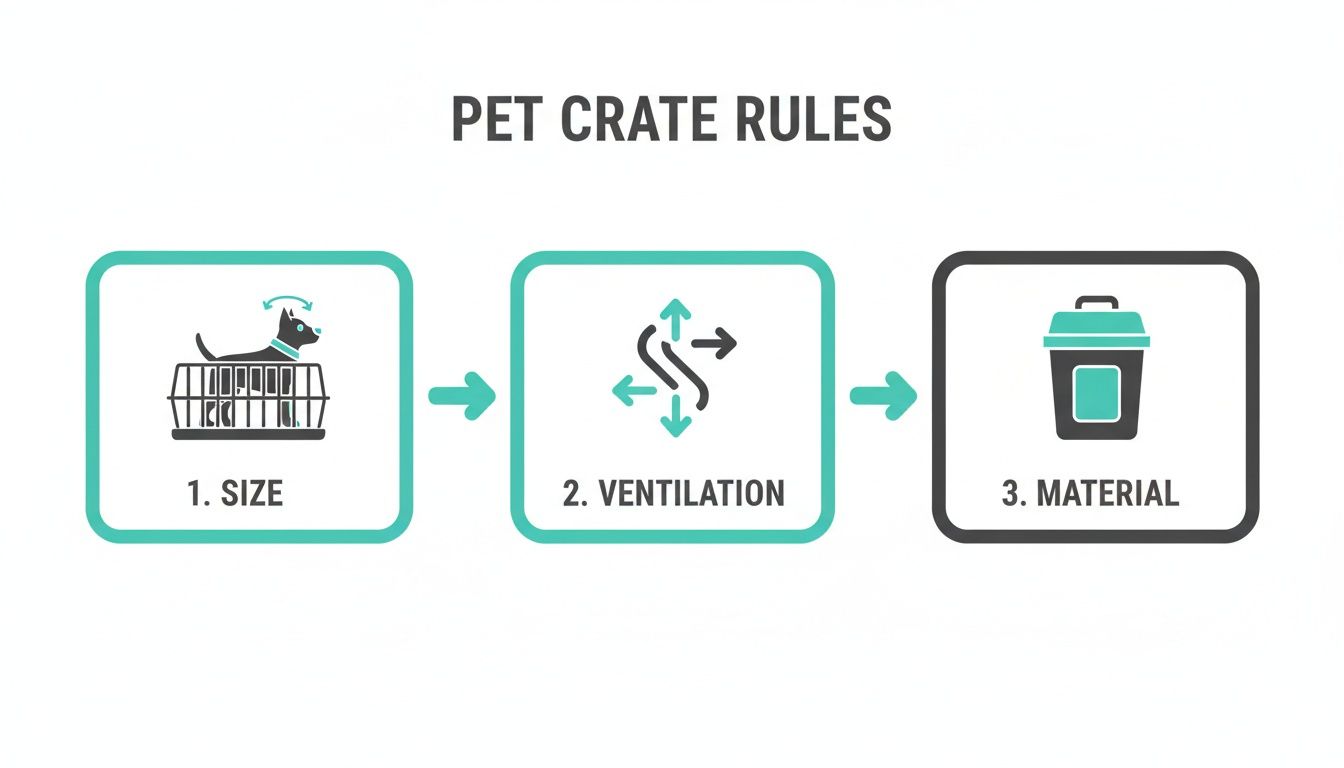
These three things—proper size, ventilation, and material—are just as crucial as the paperwork for your pet's safety and meeting airline rules.
International Travel: A Whole Different Ball Game
If you're flying internationally, the paperwork becomes a different beast entirely. A simple health certificate won't cut it. You're now dealing with a stack of documents that could include import permits, specific vaccination records, and government-endorsed health certificates.
Each country has its own unique, and often very strict, set of import rules.
Government Endorsements: Many countries require your pet's health certificate to be officially endorsed (stamped and signed) by the USDA's Animal and Plant Health Inspection Service (APHIS). This is a separate step that happens after your vet visit.
Precise Timelines: Some nations require parasite treatments to be given within a very narrow window before travel—for example, between 24 and 120 hours before arrival.
Microchip Rules: Most countries ask for an ISO-compliant microchip, and it often must be implanted before the rabies vaccination is given.
When your pet arrives, you'll also need to understand your role as the Importer of Record, which is the term for the person responsible for making sure the shipment meets all customs and import laws.
For a deeper look into the specifics, you can learn more about the vet health certificate process and what it involves. The small details can make all the difference.
How Passpaw Makes Paperwork Easier
This is the point where many pet owners—and even some vet clinics—start to feel lost. Juggling different forms, government agencies, and tight deadlines is a lot to handle, especially when your pet's travel plans are on the line.
That's precisely why we built Passpaw. It’s a platform designed to take the guesswork and stress out of creating international health certificates.
Passpaw gives your veterinarian a clear, step-by-step workflow tailored to your destination's exact rules. By guiding them through the process, it helps manage all the necessary forms and timelines, reducing the risk of human error. A simple mistake like a wrong date or a missed signature can get your pet denied entry.
Instead of a chaotic task, Passpaw makes it a manageable and organized process. It gives you confidence that every "t" is crossed and every "i" is dotted for your pet's big trip.
Your Travel Day Plan from Home to Airport
The day your pet flies is finally here. After all the careful planning, this is where everything comes together. A successful, low-stress travel day starts with a calm morning and a few final checks before you head out the door.
Your main goal is to keep your pet as relaxed and comfortable as you can. This means sticking to their normal routine as much as possible, with just a couple of key adjustments for the flight.
Final Preparations at Home
On the morning of the flight, you’re setting your pet up for a smooth ride. That starts with managing their food and water, a common question we get from shippers.
A light meal is the way to go. American Airlines suggests offering a small meal four to six hours before you plan to drop them off at the cargo facility. This gives them plenty of time to digest and helps prevent an upset stomach during the trip.
Water is a similar story. You’ll want to avoid letting them gulp down a huge bowl right before you leave. A few sips are fine, but a full belly of water can lead to a full bladder when they don't have a place to go.
Just before you put your pet in the car, take them for one last potty break. A quick walk or a few minutes in the yard helps make sure their bladder is as empty as possible before they settle into the crate.
A Quick Note on Sedation: American Airlines, along with most other airlines, strongly advises against sedating your pet for travel. Sedatives can affect their breathing and balance at altitude, which is a safety risk. Rely on your positive crate training to keep them calm instead.
Navigating the Airport Cargo Facility
This is probably the most common point of confusion for first-time pet shippers. You are not going to the passenger terminal. Let me repeat: you will head directly to the American Airlines Cargo facility, which is a totally separate building.
Before you leave home, it's a great idea to double-check the address and hours for the cargo facility at your departure airport. You can usually find this on the AA Cargo website. These locations can be a bit hidden, often tucked away in the airport's industrial or logistics areas.
To make sure your pet’s check-in goes smoothly, you need to understand how early to arrive at the airport for cargo, which is different from passenger flights. Plan to get to the cargo facility at least two to three hours before your pet’s flight is scheduled to depart.
The Drop-Off and Inspection Process
Once you get to the facility, an airline agent will walk you through the check-in process. They're going to do a full check of both your pet's crate and your paperwork, so have everything ready. This is their final quality control check.
Here’s what you need to have in your hands:
A government-issued photo ID for yourself.
Your pet's health certificate and all other required travel documents.
The air waybill (AWB) number from your booking confirmation.
The agent will carefully inspect the crate to make sure it meets every single American Airlines pet cargo standard. They’ll check the bolts, the ventilation, the sizing, and the security of the door. This is exactly why getting the crate right from the very beginning is so important.
After they approve the paperwork and the crate, it's time for goodbyes. I know it can be tough, but you can feel good knowing they are now in the care of trained professionals who are focused on their safety.
Tracking Your Pet's Journey
As soon as your pet is checked in, you can start tracking their progress using the air waybill (AWB) number you received when you booked. This 11-digit number is your pet’s unique tracking ID for the whole trip.
Just enter the AWB number on the American Airlines Cargo tracking website for real-time updates. You’ll see when your pet has been loaded onto the plane, when the flight has taken off, and when it has safely landed at its destination. It provides some much-needed peace of mind.
Your Top Questions About American Airlines Pet Cargo, Answered
Alright, we’ve walked through the booking process, crate requirements, and what to expect on travel day. But I know from experience that even with a solid plan, a few nagging questions can pop up.
Let's tackle some of the most common ones we hear from pet owners using the American Airlines pet cargo service.
How Much Does It Cost to Ship a Pet with American Airlines Cargo?
This is the big one, and the honest answer is: it varies. There’s no flat-rate price list for the PetEmbark service. The final cost is a unique calculation based on a few key factors.
The quote you receive will depend on:
The combined weight of your pet plus their travel crate.
The distance of the flight from your origin to the final destination.
The service level you book (for example, standard vs. priority).
To give you a ballpark idea, shipping a small dog on a short domestic flight might run you a few hundred dollars. On the other hand, a very large breed in a giant crate heading overseas could easily top $1,000.
The only way to get a firm number is to call the American Airlines Cargo booking team with your pet’s exact weight, crate dimensions, and your travel route. Don't forget to also factor in the cost of the travel kennel itself and the vet visit for the health certificate.
Can I Ship My Snub-Nosed Breed on American Airlines?
Yes, but you absolutely must plan ahead. Shipping brachycephalic (snub-nosed) breeds like Bulldogs, Pugs, or Persian cats comes with very strict rules designed for their safety. These pets are more sensitive to heat and air quality changes.
Because of this, American Airlines has a few policies in place:
Strict Temperature Limits: They are not allowed to fly if the temperature at any point on their journey—origin, connection, or destination—is forecast to go above 75°F (24°C). This makes summer travel very difficult for many.
One-Size-Up Crate Rule: You are often required to use a travel crate that is one size larger than what would normally be needed. This is not a suggestion; it's a key safety step for better airflow.
You Must Share the Breed: When you book, you have to inform the agent that you are shipping a snub-nosed breed. Hiding this information puts your pet at risk.
These rules are about safety, period. Be upfront about your pet's breed from the very first phone call to help ensure they are handled correctly.
What Happens if My Pet's Flight Is Delayed or Canceled?
Flight disruptions are a reality of travel, and this is where an airline's animal handling procedures are truly put to the test. American Airlines has a clear plan for these situations.
If a flight gets delayed, your pet won’t be left sitting on the tarmac. They will be moved to a secure, climate-controlled holding area where trained staff can monitor them and provide fresh water.
In the case of a full cancellation, an airline representative will contact you immediately using the details you provided at drop-off. They'll work with you to either rebook your pet on the next available flight or arrange for you to pick them up. This is exactly why it’s so critical to have accurate, accessible contact information on all your paperwork.
How Passpaw Helps with International Travel Documents
This is where a smooth trip can turn into a nightmare. Every country has its own maze of pet import regulations, and one tiny mistake on a form can derail everything.
Passpaw was built specifically to solve this problem. Our platform guides veterinarians through the process of creating a compliant International Health Certificate (IHC).
Instead of guessing, the platform shows your vet the exact requirements for your destination country. It helps make sure every field is filled out correctly, every signature is in the right place, and every timeline is met. This helps avoid the common errors—like a missed date or a wrong test number—that can lead to your pet being denied entry or stuck in a long, stressful quarantine.
Using Passpaw transforms a confusing, high-stakes part of pet travel into a clear, organized process. It gives you confidence that your pet's documents are 'paws-itively' perfect for the journey. Learn more at https://passpaw.com.
More articles
From regulatory changes to best practices for veterinarians and pet owners, our resources keep you ahead of the curve.