Are you a team member in a veterinary practice?
Are you a pet parent planning a trip with your furry pal?
Pet carry on united airlines: 2026 Guide to Fees, Rules & Booking
Thinking about bringing your small dog or cat along on your next United flight? The good news is, you absolutely can. For a fee of $125 each way, United Airlines welcomes small pets to travel in the cabin on most domestic flights. Your pet will travel right with you in an approved carrier that tucks safely under the seat in front of you.
Flying With Your Furry Co-Pilot on United Airlines
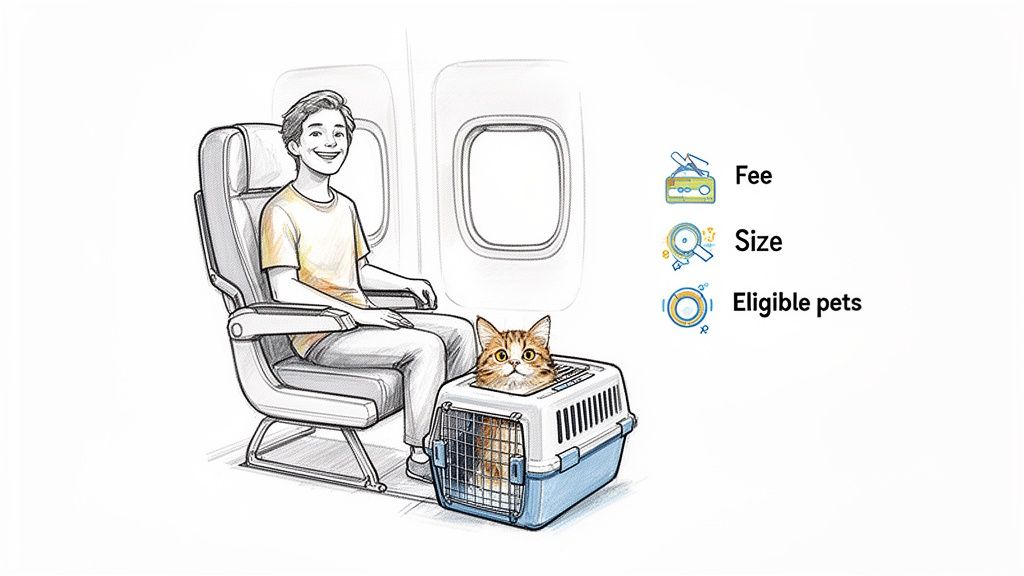
Planning a trip with your four-legged family member can feel like a lot, but it doesn't have to be overwhelming. Bringing a pet into the cabin is a very common way to travel, and with a little prep work, you and your furry co-pilot can have a smooth, stress-free journey. Think of this guide as your pre-flight briefing.
Our goal here is to make the rules clear and simple. We want you to feel confident from the moment you book your flight to the second you touch down. After all, adventures are always better when your best friend is along for the ride.
United Airlines In-Cabin Pet Policy At a Glance
To kick things off, let's get right to the most important details. Understanding these key rules is the first step to making sure your trip goes off without a hitch. This table is your quick-reference checklist for the essentials of flying with a pet as a carry-on with United Airlines.
Requirement | Details for 2026 |
|---|---|
Eligible Pets | Small dogs and cats are welcome on most flights. Rabbits and household birds (excluding cockatoos) are permitted on domestic flights only. |
In-Cabin Fee | The fee is $125 per pet, each way. An additional $125 service charge applies for any stopover longer than four hours on domestic flights. |
Carrier Dimensions | Hard-sided carriers: max 17.5" L x 12" W x 7.5" H. Soft-sided carriers: recommended max 18" L x 11" W x 11" H. |
Flight Restrictions | Pets are not allowed on flights to, from, or through certain destinations, including Hawaii, Australia, and the United Kingdom. Always confirm the rules for your specific route. |
This overview covers the basic rules you'll need to follow. One key point to remember: your pet's carrier will count as your personal item or your carry-on bag, but not both. It's a common mix-up, so be sure to plan your other luggage accordingly. Being prepared is the key to an enjoyable flight for everyone.
Understanding United's In-Cabin Pet Rules
Flying with a pet is about more than just buying them a ticket. To make sure the trip is smooth for you, your pet, and everyone else, you need to know the airline’s specific rules.
United Airlines has a pretty clear set of guidelines for its in-cabin pet program. Getting familiar with them ahead of time will save you a ton of stress on travel day.
First, let's cover who is allowed on board. United welcomes small, domesticated pets like dogs, cats, rabbits, and most household birds (cockatoos are a notable exception) in the cabin on many of their U.S. domestic flights.
Who Can Fly and How Many
When you’re making plans, the numbers really matter. United allows one pet carrier per paying customer. That part is simple, but it leads to a much bigger, and often overlooked, detail: the flight’s total pet capacity.
For the safety and comfort of everyone, United puts a limit on the number of pets allowed in the cabin. On most planes, that number is six carriers per flight, and it can be even lower on smaller aircraft. Pet spots are a hot commodity, and they fill up fast, especially on popular routes and during the holidays.
Pro Tip: Don't wait until the last minute. The moment you book your own ticket, call United to add your pet to the reservation. This is the best way to avoid the crushing disappointment of finding out the flight is already at its pet limit.
Your Pet Carrier as a Carry-On
Here’s a rule that catches a lot of travelers off guard: your pet's carrier counts as your one carry-on bag.
This means you can bring your pet carrier and one small personal item (like a purse or a laptop bag that fits under the seat in front of you), but you cannot bring a regular, full-sized carry-on for the overhead bin. Thinking of the carrier as your main carry-on helps you pack smarter. Any larger luggage will need to be checked, so plan for that to avoid surprises at the gate.
Finally, your pet needs to meet a few basic requirements. Puppies and kittens should be at least two months old to fly domestically. While a health certificate isn't always required for domestic trips, having a recent one from your vet is always a good idea—it’s a simple step that can prevent a lot of potential headaches.
Choosing the Right Pet Carrier for Your Flight
Think of your pet’s carrier as their personal little travel suite. It's not just a bag; it’s their safe, familiar space in a loud, new environment. Nailing this choice is one of the biggest steps toward a smooth trip when you plan to have a pet carry on with United Airlines.
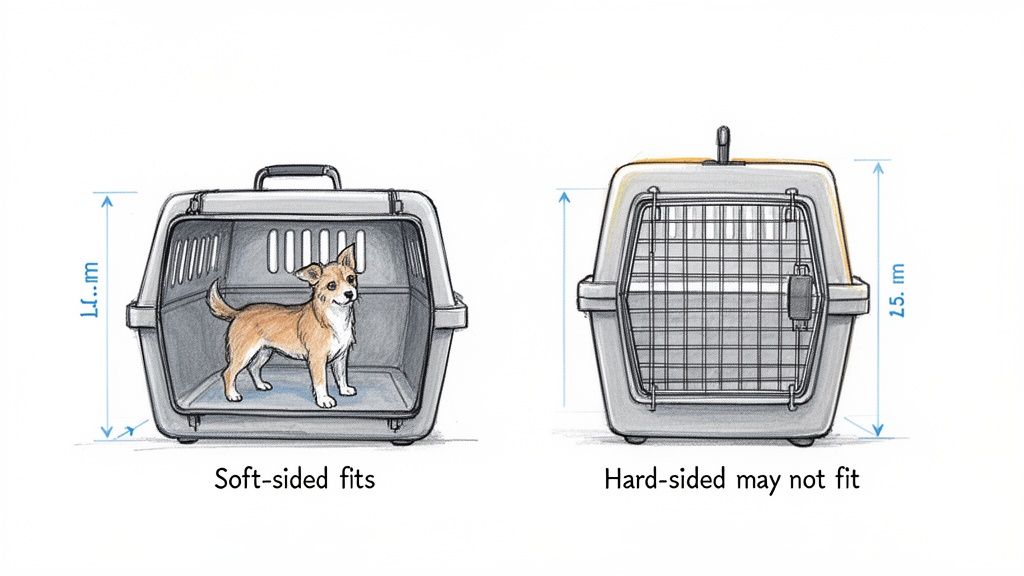
Your choice boils down to two types: hard-sided and soft-sided. While both have their place, soft-sided carriers are almost always the better bet for air travel. Their flexibility gives you a little wiggle room, making it much easier to slide them under the seat, which can vary in size from one aircraft to another.
Sizing Up the Space
The most important rule is the fit. Your pet's carrier has to slide completely under the seat in front of you and remain there for the entire flight. This isn't just a technicality—it’s an important safety measure.
For most flights, United Airlines suggests maximum dimensions for soft-sided carriers as 18 inches long, 11 inches wide, and 11 inches high. Hard-sided carriers, being rigid, have a tighter size limit, typically 17.5 x 12 x 7.5 inches.
But the size isn't just about fitting in the plane; it's about your pet's comfort. They need enough room to stand up and turn around inside without hitting their head. Finding that sweet spot between snug-for-the-plane and roomy-for-your-pet is the goal.
Safety First, Always
That rule about keeping the carrier under the seat? It's a big one. That specific spot is designed to keep your pet secure during takeoff, landing, and any unexpected turbulence.
A critical safety reminder: Your pet must always stay inside their carrier at your feet. Tragically, a 2018 incident involving a puppy that died after being placed in an overhead bin prompted United to reinforce this important policy.
This rule exists to keep every animal passenger safe. The overhead bins are not pressurized or temperature-controlled, making them incredibly dangerous for any living creature. Remember, the right carrier is your first step to a stress-free travel day for both you and your pet.
Getting Your Pet’s Ticket: Fees and Booking
Okay, you've got the carrier sorted. Now for the logistics: booking your pet’s spot and handling the fees. No one likes surprise charges, so let's break down exactly what to expect when you fly with your pet on United.
First, the cost. United charges a flat fee of $125 each way to bring a small pet in the cabin. Pretty simple, right?
But there’s a catch for itineraries with long layovers. If you have a stopover that’s more than four hours on a domestic flight or 24 hours on an international one, you'll be charged an additional $125. Think of this fee as your pet's ticket—it confirms their spot on the plane, and you’ll typically pay it when you add them to your reservation.
Securing Your Pet's Spot on the Plane
This is the part where you need to act fast. United only allows a handful of pets in the cabin on any given flight, and those spots get snapped up quickly. Don't wait. The best move you can make is to add your pet to your reservation the moment you book your own ticket.
You’ve got a couple of ways to do this:
Book Online: This is the easiest route. When you're booking your flight on United's website, just look for the "Add a pet" option under the traveler details section.
Call United: If you've already booked your own flight, you'll need to call United's customer service at 1-800-UNITED-1 (1-800-864-8331). Make sure you have your flight confirmation number handy.
No matter which method you use, timing is everything. Waiting even a day or two, especially during peak travel times, could mean all the pet spots are gone.
Booking your pet's travel doesn't need to be a headache. If you're looking for a more detailed walkthrough of the reservation process, our guide on how to book a flight for your cat is a fantastic resource. The steps are nearly identical for small dogs and other approved pets, making it a must-read for any pet parent prepping for a trip.
Your Pre-Flight Checklist for a Smooth Journey
When it comes to travel day, a bit of prep work is the key to keeping things stress-free for both you and your pet. Good planning turns a potentially chaotic experience into a smooth one. This checklist will walk you through the important steps in the days leading up to your flight.
First things first: the carrier. The goal is to make it a familiar, safe spot—not a scary box they only see once a year. A few weeks before your trip, just leave the carrier open in your living room with a favorite blanket or toy inside. This simple trick helps build a positive association, which makes a huge difference on the day of travel.
Before you start packing your own suitcase, get a "go-bag" ready for your pet.
Key Documents: Have copies of their health certificate and vaccination records easily accessible.
Comfort Items: A small blanket that smells like home or a familiar toy can be incredibly calming.
Practical Supplies: Don't forget a leash, a collapsible water bowl, and a small portion of their regular food for after you land.
Navigating the Airport
Once you arrive at the airport, your pet will feed off your energy. They are incredibly good at sensing stress, so take a deep breath and project confidence. Before you even head toward security, make a point to find one of the airport’s designated pet relief areas for a final potty break.
This visual guide breaks down how simple it is to get your pet’s spot secured on a United flight.
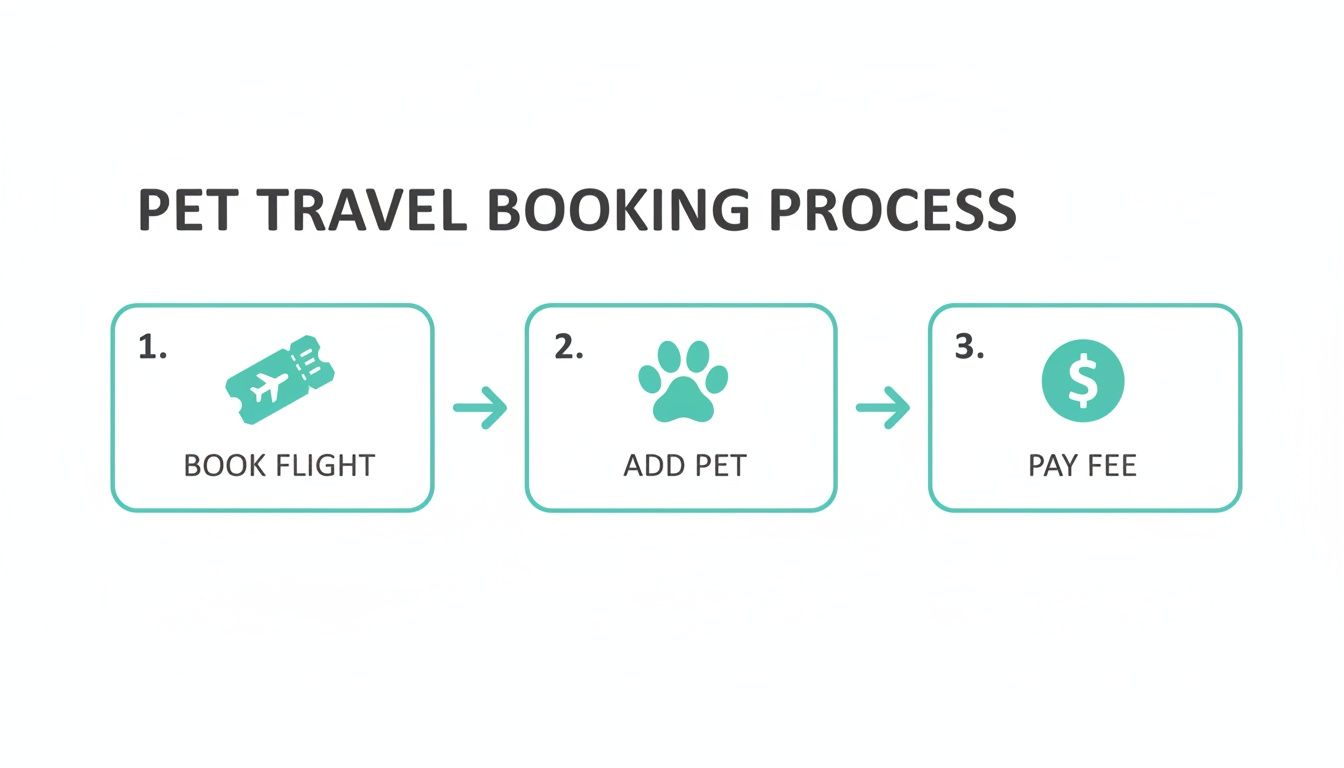
The process is designed to be straightforward, allowing you to add and confirm your pet’s travel plans right after booking your own ticket.
When you get to the security checkpoint, you'll need to take your pet out of their carrier. You’ll carry them through the metal detector with you, while the empty carrier goes through the X-ray scanner along with your luggage. I always recommend keeping your pet securely on a leash during this part—it just adds an extra layer of safety.
Remember: A calm owner almost always means a calm pet. Your relaxed attitude is the single most important thing you can bring to the airport. It truly sets the tone for the entire journey.
Getting all the necessary paperwork, especially the health certificate, sorted out well in advance is the ultimate stress-reducer. It helps avoid any last-minute surprises at the check-in counter.
Frequently Asked Questions About Flying With Your Pet
Even the most organized pet parent has a few 'what if' questions pop up before heading to the airport. To put your mind at ease, we’ve answered some of the most common queries we hear about flying with a pet carry on United Airlines.
United is no stranger to four-legged flyers. In fact, back in 2017, they transported over 110,000 animals, which was more than any other airline in the U.S. at the time. As you can see on Fox Business, they have plenty of experience getting pets from point A to point B.
Common Questions and Simple Answers
Navigating the airport on travel day can be hectic enough. Let’s clear up a few common uncertainties before you go.
Can I bring my pet's food and water through security?
Yes, you can bring a small, reasonable amount of solid pet food, but expect it to be screened by TSA. For water, the best bet is to bring an empty, collapsible bowl and fill it up at a water fountain once you're past security.What happens if my pet makes noise during the flight?
It’s perfectly normal for a pet to get a little vocal. If your companion gets fussy, the flight attendants will likely ask you to do your best to soothe them. This is exactly why getting your pet comfortable with their carrier long before you travel is so important for a quiet flight.
Health Certificates and Seating Rules
Paperwork and where your pet can sit are two topics that come up constantly. Here’s the deal.
While United may not always ask to see a health certificate on domestic flights, we highly recommend you carry one anyway, along with proof of rabies vaccination. State-to-state rules can vary, and having these documents ready is the best way to prevent any unexpected hang-ups.
And what about giving your pet a little more room? It’s a common question, but you cannot purchase an extra seat for your pet. They must stay inside their carrier, tucked safely under the seat in front of you for the entire flight. Think of the carrier as their ticketed spot, and it counts as your one personal carry-on item.
Prepping for pet travel can feel like a huge task, but it doesn’t have to be. With Passpaw, veterinarians and pet owners can easily generate and manage the necessary paperwork, like health certificates, making your journey smooth from start to finish. Visit https://passpaw.com to see how we make travel prep simple.
More articles
From regulatory changes to best practices for veterinarians and pet owners, our resources keep you ahead of the curve.