Are you a team member in a veterinary practice?
Are you a pet parent planning a trip with your furry pal?
Travel Documents for Pets: Your Essential Guide
Traveling with your best furry friend should be an adventure, not a paperwork nightmare. It all comes down to having the right travel documents for pets. Think of it like this: your pet needs their own version of a passport and visa, and that usually starts with their vaccination records and a special health certificate from your vet.
Getting these papers sorted is the single most important first step you can take. It’s your ticket to a smooth, stress-free journey together.
Your Essential Pet Travel Document Checklist
Prepping for a trip with your pet can feel a bit chaotic, but it doesn't have to be. The secret to avoiding last-minute panic is understanding the core paperwork. These documents are your pet’s permission slip to see the world—they show that your companion is healthy, up-to-date on their shots, and ready for an adventure.
Without the correct documentation, you could hit some serious snags. We’re talking about frustrating delays, unexpected fees, or even the heartbreaking scenario of being turned away at the airport or border. This guide will walk you through the key papers you'll almost always need, so you can get started on the right paw.
The Two Most Important Documents
While every destination has its own rulebook, two key documents are the foundation of nearly every pet travel plan: the vaccination records and the health certificate. These are the absolute essentials that airlines and border officials will often ask for first.
Vaccination Records: This is the official, vet-signed history of your pet’s shots. The rabies vaccine is the big one here, as most places require proof of it to help prevent the spread of the disease. Make sure your records clearly show when the vaccine was given and when it expires.
Certificate of Veterinary Inspection (CVI): Most people just call this a "health certificate." It's an official form filled out by an accredited veterinarian confirming your pet was recently examined and found to be healthy enough to travel and free of contagious diseases. To learn more about this, you can learn more about getting a pet health certificate for travel and make sure you have all your bases covered.
A health certificate is more than just a piece of paper; it's a veterinarian's official statement that your pet is fit for the journey. It helps protect your pet, other animals, and the public.
These documents serve a dual purpose. First, they help protect your own pet by making sure they're in good shape before taking on the stress of travel. Second, they help protect the animal populations at your destination by helping prevent diseases from crossing state or international lines.
What to Look for on Each Document
Once you get these papers from your vet, take a minute to double-check them. A quick review can save you a lot of trouble later on. Check that every detail—your pet's name, breed, age, and microchip number—is perfectly accurate and easy to read.
Pay special attention to the health certificate, as it has a very short shelf life. Many airlines and countries ask for it to be issued within 10 days of your travel date. That’s a tight window, so timing your final vet visit is one of the most important parts of your planning.
To make it even clearer, here’s a quick rundown of the core documents you'll be juggling.
Core Pet Travel Documents at a Glance
This table breaks down the most common documents, what they're for, and how long they're typically valid. It's a great cheat sheet to keep handy.
Document | Primary Purpose | General Validity Window |
|---|---|---|
Vaccination Record | To show your pet is up-to-date on required shots, especially rabies. | Valid until the vaccine's expiration date. |
Health Certificate (CVI) | To declare your pet healthy and free from contagious disease before travel. | Often must be issued within 10 days of travel. |
Microchip Registration | To provide permanent identification in case your pet gets lost. | Lifelong, but ensure your contact details are current. |
Having these fundamentals in order is the first big win in your pet travel prep. With these squared away, you can focus on the more specific rules for your destination.
Navigating Domestic Pet Travel Paperwork
You’d think staying within your own country means you get to dodge the paperwork shuffle, right? Not so fast. It’s a common misconception that no borders mean no rules. Pet travel regulations can, and often do, change from one state to another, making domestic trips a bit more involved than just packing a bag.
Whether you're flying to a neighboring state or setting off on a cross-country road trip, getting the right travel documents for pets is essential. A little prep work helps ensure the journey is smooth sailing for everyone, avoiding any ruff patches at the airport or on the road.
Taking to the Skies: Domestic Flights
Flying with your pet, even domestically, means playing by the airline’s rules. It’s best to think of each airline as its own little country with its own set of entry requirements. The one document they almost always ask for is a recent health certificate, often called a Certificate of Veterinary Inspection (CVI).
Most U.S. airlines request a health certificate issued no more than 10 days before your flight. This tight window is there for a reason—it confirms your pet is healthy right before traveling, which helps protect them and everyone else on board.
This short timeline makes scheduling your vet visit a key piece of the pre-flight puzzle. The certificate is basically your pet’s official "fit to fly" note from their doctor. If you're wondering what goes into this important document, you can learn more about securing a pet health certificate.
Why You Should Call Your Airline
A website gives you the general idea, but it’s no substitute for a real conversation. Calling the airline directly is a highly recommended step. This is your chance to pin down every last detail and sidestep any nasty surprises at the check-in counter.
Here are a few essential questions to ask:
What are your specific requirements for the health certificate, including the valid travel window?
Are there any breed restrictions or temperature embargoes in effect for my travel dates?
What are the exact dimensions and specs for my pet’s carrier, whether they're in the cabin or in cargo?
Do you need any other forms besides the health certificate and rabies vaccination records?
Getting verbal confirmation—and taking notes—can be a real lifesaver. An airline agent will have the most current information, which might not have made it to the website yet. This one phone call can truly be the difference between a smooth boarding process and a stressful travel experience.
Road Tripping with Peace of Mind
Hitting the open road definitely offers more freedom, but that doesn't mean you should leave your pet's file at home. While you're unlikely to be pulled over and asked for papers, having them ready is just smart, responsible pet ownership.
Imagine you have an unexpected emergency and need to see a new vet or use a boarding facility on your route. Having your pet’s full health history and rabies records will make everything worlds easier. It's always better to have them and not need them. A simple folder in your glove compartment is all it takes to be ready for anything.
Finally, there's one travel prep step that's universal: the microchip. A microchip is your pet's permanent ID, a silent guardian that can help reunite you if you get separated, no matter how far from home you are. It’s a tiny thing that provides immense security for any journey you take together.
Decoding International Pet Travel Rules
Taking your pet across international borders is a whole different ball game compared to a domestic road trip. Think of it less like packing a bag and more like applying for a visa for your furry family member. Every single country has its own unique rulebook, and they take these rules very seriously to help protect their local animal populations and ecosystems.
Getting all the required travel documents for pets in order takes serious planning, often months in advance. A single missed detail can lead to heartbreaking situations, like being denied entry at the border or your pet facing a long, expensive quarantine. But with the right information, you can get ahead of the game and make sure your global trek is a success.
It's no surprise that this process is getting more attention. An incredible 78% of American pet owners now travel with their pets each year, and a full 53% of pet owners worldwide would love to bring their companions on vacation. This demand has fueled a pet travel services market valued at $2.4 billion, and it's projected to more than double to $5.3 billion by 2034. It’s clear that more people than ever are figuring out how to navigate these complex international rules.
The Role of Government Endorsement
When you travel abroad, your passport needs to be official, right? The same logic applies to your pet’s paperwork. It's not enough for your local vet to just sign a health certificate. For many international destinations, that document needs an official government stamp of approval to be considered valid.
In the United States, this official endorsement comes from the U.S. Department of Agriculture's Animal and Plant Health Inspection Service (USDA-APHIS). Your accredited veterinarian will fill out the health certificate, and then it has to be sent to the USDA for their official seal. This stamp is what certifies that the document is legitimate and meets global standards.
Think of the USDA endorsement as your pet's official passport stamp. It tells the destination country that all the information has been verified by the highest authority in your home country.
Other countries have their own government bodies that do the same thing. The main takeaway here is that you'll want to factor this extra step into your timeline. Mailing documents back and forth takes time you can't afford to lose.
Key Documents for International Travel
While a trip within your own country might only require a couple of core documents, international journeys add several new layers of complexity. The exact requirements depend entirely on your destination, but here are some of the most common additions you'll likely run into.
ISO-Compliant Microchip: Most countries require a microchip for identification, but it can't be just any old chip. It often has to be an ISO 11784/11785 compliant 15-digit microchip. This is the global standard, which helps ensure scanners anywhere in the world can read it. If your pet has an older, non-ISO chip, you might even have to bring your own scanner.
Import Permit: Some countries, especially those that are rabies-free like Australia or Japan, require you to apply for and receive an import permit before your pet is even allowed to travel. This process alone can take months, so it should be one of the very first things you look into.
Rabies Titer Test: This isn't just proof of vaccination; it's a specific blood test that shows the vaccine is actually working. The test measures the level of rabies antibodies in your pet’s bloodstream to confirm they are properly immunized. Many strict countries require this test to be done months before travel, often with a mandatory waiting period after the blood is drawn.
Country-Specific Requirements Are Very Important
Here’s the biggest challenge of international pet travel: there's no "one-size-fits-all" checklist. Every country sets its own rules based on its animal health status, and there's little room for error.
For example:
The European Union: Generally asks for an ISO microchip, a current rabies vaccination, and a specific EU Health Certificate issued within 10 days of arrival. For pets coming from certain high-rabies countries, a rabies titer test is also needed.
United Kingdom: After Brexit, the UK now has its own set of rules separate from the EU. This can include a mandatory tapeworm treatment for dogs, which must be administered by a vet just a few days before you arrive.
Australia & New Zealand: As island nations, they have some of the strictest import conditions in the world to protect their unique ecosystems. You can expect a long preparation timeline, import permits, multiple tests, and a mandatory quarantine period for your pet upon arrival.
Failing to meet these specific requirements isn't a minor hiccup; it could result in your pet being sent right back home at your expense. To avoid any cat-astrophes, it's critical to research your destination's exact rules the moment you know you're traveling. For a deeper dive, check out our guide to understanding international pet travel requirements.
Your Step-by-Step Document Preparation Timeline
Feeling buried in paperwork? Let's clear a path. Getting your pet’s travel documents in order is all about timing. Think of this timeline as your roadmap—it breaks a huge job into small, doable steps to help you sidestep any last-minute chaos and get you both ready for takeoff.
Preparing travel documents for pets is a marathon, not a sprint. The secret to a stress-free trip for you and your furry co-pilot is starting early. Seriously, don't put this off. Some of these requirements can take months to complete.
6+ Months Before Travel
The moment you know you’re moving or taking a long trip, the clock starts. This is your time for big-picture planning and digging into the details. The rules for your destination country will shape your entire timeline, so getting this right from the very beginning is everything.
Deep-Dive Research: Go all-in on investigating the specific import rules for your destination country or state. Every place has its own unique rulebook, and you need to know yours inside and out.
Initial Vet Consultation: Book a visit with a USDA-accredited veterinarian to walk them through your travel plans. They can check if your pet's microchip is ISO-compliant and review their vaccination history against what's required.
Rabies Titer Test (If Needed): This one is a big deal. Certain countries require a rabies titer test, which is just a blood test to prove the rabies vaccine is working effectively. But here's the catch: this test often comes with a mandatory waiting period of 3 months or more after the blood is drawn before your pet is even allowed to travel.
This infographic breaks down the main milestones for preparing international pet documents into three clear phases.
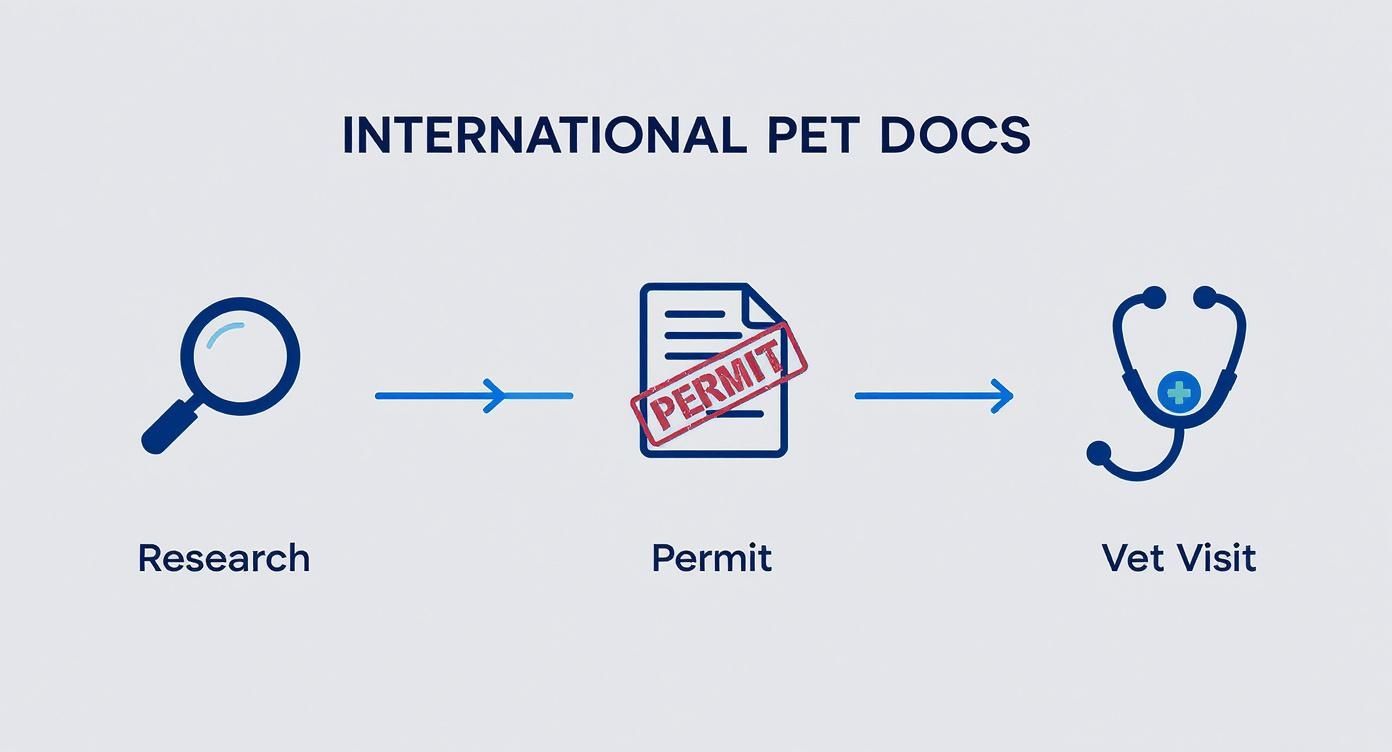
As you can see, the whole process flows from initial research to securing permits and finally to that crucial vet visit, driving home why starting well in advance is so important.
2 to 3 Months Before Travel
Okay, research done. Now it's time to shift from planning to doing. This phase is all about locking in official permissions and booking the major parts of your journey.
This is when you need to apply for any required import permits. Countries like Australia, Japan, and New Zealand have a formal application process that can take weeks, sometimes even months, to get approved. Don't drag your feet on this step.
While you're waiting on permits, book your pet’s flight. Be sure to confirm the airline’s specific policies on everything from carrier size and breed restrictions to the exact paperwork they need to see at check-in. This is also the perfect time to start crate training to make the journey as calm as possible for your pet.
1 Month Before Travel
You're in the home stretch! This month is all about locking in the last few critical pieces of the puzzle. At this point, accuracy and timing are key.
You’ll need to schedule your pet’s final veterinary appointment. The trick is to have the exam fall within the very specific window required by your airline and destination—usually 10 days before your travel date. This is the appointment where the official international health certificate gets filled out.
Key Takeaway: The international health certificate is extremely time-sensitive. You have to time your vet appointment perfectly to ensure the document is valid for your entire journey, from departure to arrival.
10 Days Before Travel
This is it—the final countdown. All your careful planning comes together in this last, crucial window. With your final vet visit done, your main job is getting the official government stamp of approval.
The completed health certificate has to be sent to the right government authority for endorsement. In the U.S., that’s the USDA-APHIS. This step is a must for most international destinations. You can learn more about how to get a USDA-endorsed pet health certificate to make sure you nail this part.
Finally, do one last check of your travel folder. Make sure you have the originals and a few copies of every single document: the endorsed health certificate, vaccination records, microchip certificate, and any import permits. With everything in order, you and your pet are truly ready to fly.
Choosing the Right Way for Your Pet to Travel
How your pet gets from A to B—whether by plane, train, or car—is the first big decision you'll make, and it shapes all the paperwork that comes next. Think of it like booking your own trip; the mode of transport you choose affects everything. This single choice impacts your pet's comfort, your stress levels, and the specific travel documents for pets you'll need to gather.
Getting your head around the differences is key. A cross-country road trip is a world away from an international flight in terms of rules and regulations. Making the right call now will save you a world of headache later and help ensure the journey is as smooth as possible for your furry co-pilot.
Flying with Your Four-Legged Friend
Flying is usually the quickest way to cover long distances, but it's also where you'll find the strictest rules. When you take to the skies, your pet generally has three ways to fly, and each comes with its own paperwork, price tag, and pros and cons. It's definitely not a one-size-fits-all deal. The best option depends on your pet's size, personality, and your final destination.
In the Cabin: This is the best-case scenario for small pets who can fit in a carrier under the seat in front of you. It's the least stressful option for them (and you), and the document requirements are often simpler. Just be prepared for strict size and weight limits that can vary a lot between airlines.
As Checked Baggage: Some larger pets can travel as checked baggage in a special temperature-controlled, pressurized part of the hold. This option has become less common, but a few airlines still offer it on certain routes.
As Manifest Cargo: For big dogs or pets on long international flights, this is the standard. They travel in a dedicated, climate-controlled cargo hold, with the whole process managed by specialized airline staff. It might sound a bit scary, but for long hauls, it’s often the safest and most regulated option for larger animals.
Don't forget that your pet's journey doesn't start and end at the airport gates. Arranging for smooth airport transfer options is just as important as the flight itself. A calm ride to and from the terminal can make a huge difference in the overall experience.
No matter how they fly, you can bet the airline will want to see a recent health certificate and proof of rabies vaccination. For cargo, especially on international trips, the stack of paperwork gets a lot thicker.
Comparing Air Travel Options
To help you figure it all out, here's a quick side-by-side look at the three ways your pet can fly.
Travel Method | Best For | Key Considerations |
|---|---|---|
In-Cabin | Small dogs, cats, and household birds. | Strict size/weight limits; carrier must fit under a seat. |
Checked Baggage | Medium-sized pets on shorter, direct flights. | Limited availability; subject to weather embargoes. |
Manifest Cargo | Large pets, international travel, or complex routes. | Safest for long journeys; often handled by specialists. |
Hitting the Road by Car or Train
For domestic trips, nothing beats the freedom of traveling by car. You have total control. You can stop for potty breaks, stretch legs, and the paperwork is practically non-existent. While you won't get asked for documents at state lines, it's always a good idea to keep your pet's rabies certificate and health records tucked away in the glove compartment, just in case.
Train travel is more of a mixed bag. Some rail companies are wonderfully pet-friendly, while others have tight restrictions or ban pets altogether. The golden rule here is to check the specific policy of the train operator you’re thinking of using before you even think about booking tickets.
It’s no surprise that hitting the road or taking to the skies with pets is more popular than ever. Dogs are the most seasoned travelers, making up 58% of all pet journeys globally. Cats come in second, accounting for 22% of trips. This boom has thankfully pushed many transport companies to create clearer and safer rules for our animal companions. For a deeper dive, check out the latest statistics on pet travel trends and airline performance from Condor Ferries.
Common Questions About Pet Travel Documents
Figuring out the paperwork for your pet's trip can feel like you're trying to solve a puzzle. It's totally normal to have questions, and this section is here to clear up some of the most common ones.
Think of it as your quick-reference guide to health certificates, pet passports, and knowing when it might be time to call in a pro. We want you to feel confident about the paperwork so you can focus on the fun part—the actual adventure with your furry co-pilot.
How Long Is a Pet Health Certificate Valid For?
This is probably one of the most critical and time-sensitive questions out there. The honest answer? It depends. The validity of a pet health certificate (sometimes called a CVI) is set by your airline and your destination country, and it's not always the same.
For most domestic flights within the United States, airlines want the certificate issued within 10 days of your flight. That 10-day window is also a pretty standard rule for many international spots, including the European Union. But don't treat this as a universal rule, because it isn't.
Always, always, always confirm the exact validity period with your airline and the official import authority of your destination. Your final vet visit has to land squarely within that window. It’s an important step for a smooth trip.
What Is the Difference Between a Pet Passport and a Health Certificate?
It’s easy to get these two mixed up, but they really serve different purposes. The simplest way to think about it is this: a health certificate is a one-time pass for a single trip, while a pet passport is built for repeat travel in a certain region.
A health certificate is an official form your vet fills out for a specific journey. It basically declares your pet is healthy and fit to fly at that exact moment.
An EU Pet Passport is more like a detailed medical record in a booklet. It holds all your pet's permanent info, like their microchip number and their entire rabies vaccination history, making it easy to hop between EU countries without new paperwork each time.
Just a heads-up: even if you have a shiny new pet passport, if you’re coming into the EU from a non-EU country for the first time, you'll likely still need an official, government-endorsed health certificate to get in.
Should I Prepare the Documents Myself or Use a Service?
Ah, the classic "DIY vs. hire a pro" debate. Honestly, the right call here comes down to your destination, how comfortable you are with juggling details, and your budget. Plenty of people handle their pet's travel documents themselves and do it successfully.
For a simple domestic flight, you can often manage just fine by working directly with your vet and the airline. The paperwork is less complicated, and the timeline is pretty straightforward. It’s a great way to save some money and keep control of the whole process.
But for complex international moves—especially to countries with a reputation for strict rules like Japan, Australia, or New Zealand—a tiny mistake can turn into a complete cat-astrophe. This is exactly where professional pet relocation services can be worth every penny.
These experts live and breathe international pet travel rules. They know the exact forms, understand the tight deadlines, and have been through the government endorsement maze hundreds of times. If the move is complicated or you’re just feeling swamped, using a service can buy you an incredible amount of peace of mind.
Feeling like you need a helping hand to get all this paperwork in order? Passpaw offers a simple, cloud-based platform that helps veterinary practices manage the entire international health certificate process. From tracking requirements to ensuring every detail is correct, Passpaw makes pet travel compliance a walk in the park. Learn more about how we can help at https://passpaw.com.
More articles
From regulatory changes to best practices for veterinarians and pet owners, our resources keep you ahead of the curve.