Are you a team member in a veterinary practice?
Are you a pet parent planning a trip with your furry pal?
Crate Training for Cats: Your Stress-Free How-To Guide
If your cat bolts the second the carrier comes out, you're not alone. Most cats learn one thing about that box early on. Carrier equals vet, car, noise, and loss of control.
That's why good crate training for cats starts long before you need to leave the house. Done well, it doesn't teach your cat to “put up with” confinement. It teaches them that the carrier is a small, protected space they can understand, predict, and even choose. For a species that cares greatly about security, that shift matters a lot.
A cat who walks into a carrier willingly is easier to help in everyday life and in urgent moments. It makes vet trips smoother, travel less dramatic, and those last-minute scrambles far less likely to turn into a full feline fiasco.
Choosing the Purrfect Carrier and Setup
Before you train behavior, choose gear that makes success easier. The best carrier is big enough for your cat to stand, turn around, and lie down comfortably, but not so roomy that they slide around when you lift it. Cats usually feel safer when the space feels contained rather than cavernous.
Hard-sided carriers usually win for durability and cleaning. Soft-sided models can work well for some trips, especially when flexibility matters, but they need good structure so they don't sag into the cat's space. If you're comparing options, give extra credit to a carrier that opens from the top or comes apart easily. Those designs are easier on both cat and human.
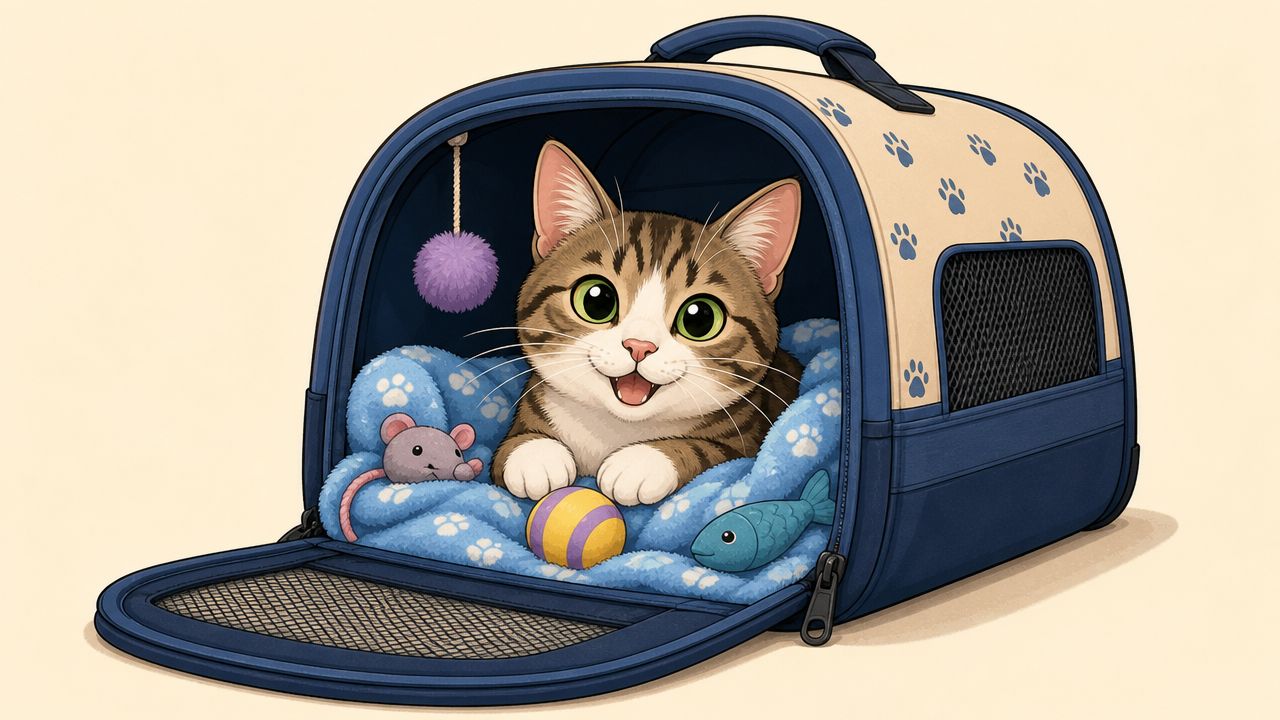
If you're still deciding between styles, this roundup of cat travel crates is a useful place to compare practical features.
What makes a carrier feel safe
Cats don't relax because we tell them to. They relax when the environment makes sense to them.
A good starter setup includes:
A familiar location: Place the carrier where your cat already likes to rest, not in a random hallway or laundry room.
Soft scent cues: Add a blanket or towel that already smells like your cat.
Open access: Start with the carrier available all day instead of only bringing it out before a trip.
Open Farm's guide to crate training your cat recommends placing the carrier in the cat's favorite resting area, removing the top and door at first, and putting the cat's favorite blanket inside so feeding and play can build good associations before the top and door go back on.
Setup mistakes that slow everything down
The most common problem isn't a stubborn cat. It's a carrier that only appears during stressful events.
Practical rule: If the carrier lives in a closet, your cat can't learn that it's part of normal life.
Another mistake is making the carrier too exposed. Many cats prefer a little elevation and a little protection. A stable bench, dresser, or low table can make the space more attractive than the middle of the floor, as long as the carrier can't wobble or fall.
Keep the first impression boring in the best possible way. No grabbing. No stuffing. No “just this once.” You're not trapping your cat. You're furnishing a tiny safe room.
Your Week-by-Week Crate Acclimation Plan
Cats do best when each new piece of the carrier arrives in digestible bits. That's why I like a gradual timeline instead of a rushed weekend project. Slow training feels slower at first, but it's usually faster than undoing panic later.
The core idea comes from the Free Access Crate Training (FACT) approach. In this feline crate training resource, the sequence is clear: first the cat accepts the carrier bottom, then the top is attached, and finally the door is added. With consistent daily practice, over 80% of cats achieved full entry within 2 to 3 weeks.

That kind of progress happens because the cat stays in control. Control lowers fear. Lower fear makes learning possible.
Week 1 and Week 2
Start with the carrier base only if your model allows it. Add bedding your cat already likes. Then let the base become furniture.
Look for simple wins:
your cat sniffs it
your cat steps in with one paw
your cat sits in it briefly
your cat naps there without being coaxed
Week 2 is about comfort, not duration. Offer meals nearby if your cat is cautious. If they're bolder, place treats or part of a meal in the base. A wand toy dragged past the opening can also work beautifully because it lets the cat “hunt” around the carrier without pressure.
Don't move to the next stage because the calendar says so. Move on when your cat looks casual.
If your household has already gone through dog crate work, you may notice the rhythm feels familiar even though the species is very different. This guide to crate training an older dog shows the same broad truth. Confidence grows when the animal can predict what happens next.
Week 3 and Week 4
Once your cat is willingly entering the bottom half, reattach the top. Keep the door off if possible. At this point, many owners rush, because the carrier suddenly looks “finished.” Your cat doesn't care whether it looks finished. They care whether it still feels safe.
At this stage, I like to watch for body language more than entry itself. A cat who walks in but stays tense, low, and wide-eyed isn't ready for door work. A cat who grooms, settles, or turns around inside is telling you something much better.
Try short routines:
Toss a treat in.
Let the cat enter and eat.
Offer another treat while they remain inside.
End before they want to leave in a hurry.
Then add the door. Don't latch it right away. Swing it gently. Let it move. Let it become ordinary.
Week 5 and beyond
The five-week progression used in Little Paw Products' crate training protocol builds from early confinement and routine to broader freedom, with the carrier staying available for future vet visits and travel. Whether you follow that exact structure or a lighter version, the useful lesson is this: independence comes after security, not before it.
Here's what I want by the end of this phase:
Sign | What it tells you |
|---|---|
Cat enters without prompting | The carrier has become familiar |
Cat stays inside to eat or rest | The space feels worth choosing |
Cat tolerates brief door closure | The carrier no longer predicts panic |
Cat recovers quickly after sessions | Stress is low enough to keep training |
A carrier-trained cat isn't “submitting.” They're recognizing a known shelter. That's the whole game.
Fun Daily Exercises for Crate Confidence
Your cat strolls into the carrier on Tuesday to chase a toy, then acts suspicious of it again on Wednesday. That back-and-forth is normal. Confidence grows through repetition, and the daily exercises that work best are the ones that feel safe, brief, and predictable from the cat's point of view.
Cats return to places that protect them from surprise. That is the reason these exercises matter. A carrier stops feeling like a trap when it regularly functions as a small, sheltered spot where food appears, play happens, and nothing unpleasant follows. That same comfort pays off later when you need the carrier for a vet appointment, a road trip, or airline travel paperwork through Passpaw.
A simple morning routine
Use the first quiet part of the day well. Drop a high-value treat just inside the carrier as you pass by, then keep moving. Many cats investigate more willingly when no one is hovering over them.
The goal is not speed. The goal is choice.
If your cat puts only their head in, that still counts as a useful repetition. If they step in, eat, and walk out calmly, even better. Cats build trust faster when they can control the interaction, because control lowers the sense of risk.
A few rewards tend to work well:
Freeze-dried fish: Smells strong and breaks into tiny pieces
Lickable treat: Useful for cats who hesitate at the doorway
Small favorite treats: Easy to repeat without overfeeding
Evening play that teaches the carrier is part of the territory
Evening is a good time to use a wand toy. Let the toy skim past the carrier, pause at the entrance, then slip just inside. Many cats will follow movement into a space before they choose to walk in for food alone, because hunting engages focus and makes the environment feel familiar instead of loaded with pressure.
Keep the toy action low and fluid. Wild flicking can make a cautious cat avoid the opening.
I also like to leave one familiar scent inside during this stage, such as a blanket your cat already naps on. Cats judge safety heavily through scent. A carrier that smells like home is easier to revisit, and that matters if you are also working on travel readiness rather than just carrier tolerance in the living room.
One-minute confidence builders during the day
Short practice wins here. Scatter a few kibble pieces in the carrier for a mini forage session. Toss a soft toy near the back. Let your cat hop in, check it out, and leave without comment.
Some owners make the mistake of saving the carrier only for departures. That teaches the cat a pattern they do not like. Daily neutral use changes that pattern.
If your cat sheds, drools, or has occasional accidents during training, clean the setup promptly so the carrier stays comfortable and familiar. If any mess reaches nearby rugs, this guide to solving pet stains on your carpet can help you deal with it before odor becomes part of the area.
How to tell the exercises are working
Look for softer body language, not dramatic milestones. A cat who pauses inside to sniff, turns around comfortably, sits for a few seconds, or goes back in later on their own is making real progress.
Those small choices matter because they show the carrier is starting to register as a refuge, not a warning. That is the mindset you want before adding actual demands of car rides, vet handling, or air travel.
Solving Common Crate Training Problems
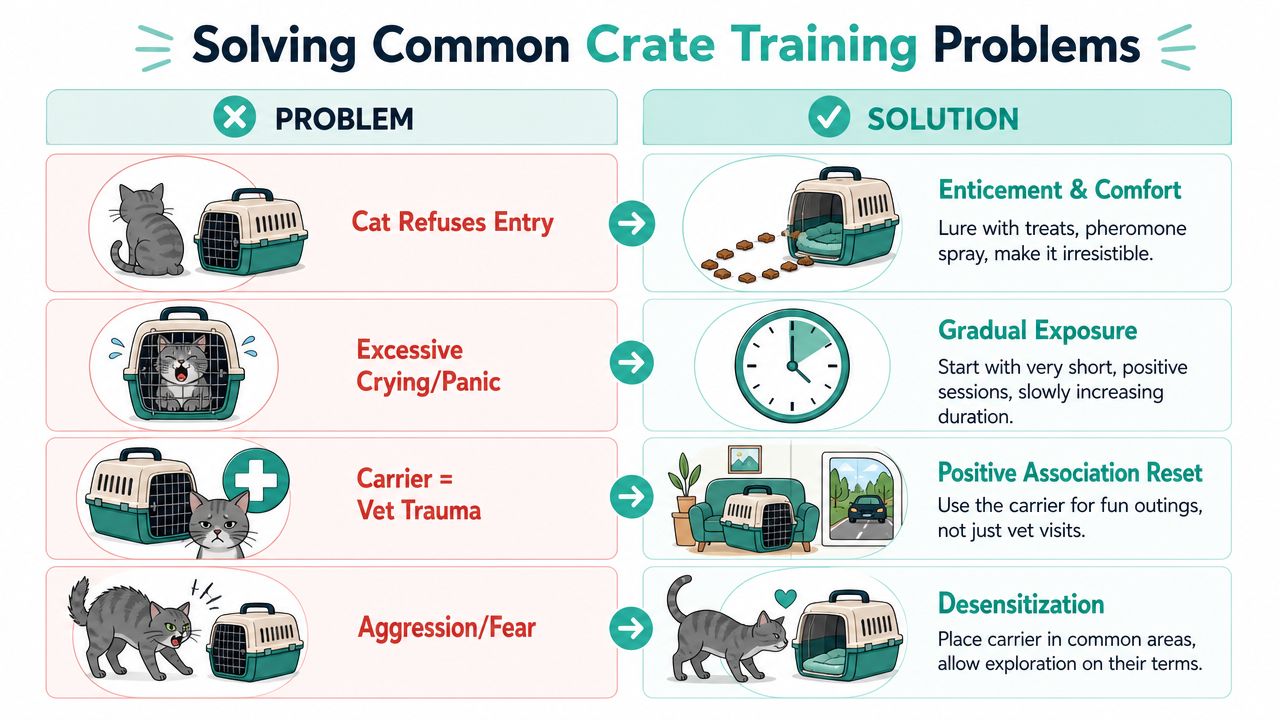
You set the carrier down, and your cat disappears under the bed. That reaction is frustrating, but it is also useful information. Cats look for control, cover, and a clear escape route. When the carrier feels too exposed or too closely tied to stressful trips, resistance is a predictable safety response.
When the cat won't go in
Start by asking what the cat is avoiding. Some cats dislike the narrow doorway. Some dislike the slippery floor. Others are reacting to the pattern: carrier appears, then something unpleasant happens.
Make the space easier to trust. Add a towel or bedding that smells familiar, keep the door secured so it cannot swing and startle the cat, and place high-value food just outside the entrance before moving it farther in. A carrier on a stable surface often works better than one that shifts under the cat's feet.
If progress stalls, change one variable at a time. Move the carrier to a quiet corner, try a different reward, or leave the room after setting up the treat. That last step helps shy cats because they can investigate without feeling watched.
When the cat cries after the door closes
This usually means the carrier itself is becoming acceptable, but confinement still feels risky. From the cat's point of view, the problem is not the box. It is the sudden loss of choice.
Work on door practice as its own exercise. Close the door for one or two seconds, then open it while your cat is still calm. Repeat that several times before increasing the duration. Small, boring repetitions build trust faster than one long attempt.
A covered top or partially draped side can help some cats settle because less visual input means fewer things to monitor. Watch body language. If your cat crouches, pants, or throws their body at the door, the session was too hard and needs to be shortened next time.
A calm three-second closure is real progress.
When the carrier only means bad news
This is one of the most common setbacks I see. If the carrier only comes out for the vet, your cat is not being dramatic by avoiding it. They are making a strong association and trying to stay safe.
Break that pattern on purpose. Leave the carrier out between trips. Drop treats into it on ordinary afternoons. Let your cat nap near it or inside it without closing the door. Then add low-stakes travel practice, especially if you are also planning flights. Pair carrier work at home with practical trip planning, like reviewing how to book a flight for your cat, so training supports the kind of real travel your cat will face.
If stress spills over into house-soiling during this process, it helps to clean thoroughly so the area doesn't keep drawing the cat back. This guide on solving pet stains on your carpet is a practical resource for removing odor cues and keeping setbacks from snowballing.
When fear looks like aggression
Hissing, growling, swatting, or striking at the carrier usually means the cat feels cornered. Distance matters here. Give more of it.
Stop trying to place the cat into the carrier by hand. Leave the carrier open in a room the cat uses every day and reward any calm interaction around it. A glance, a step closer, a sniff at the doorway. Those are the first wins. Once the cat is choosing to approach again, you can rebuild from there.
Punishment makes this problem worse. It confirms that the carrier predicts force, and that is the exact association you are trying to undo.
Preparing for Vet Visits and Air Travel
Home practice matters most when real travel begins. A cat who can settle in a carrier is easier to transport in the car, easier to check in at the clinic, and far less likely to turn the whole outing into a yowling opera.
For travel prep, PetRelocation's guidance on crate training your cat recommends short practice car rides of about five minutes, followed by treats, then gradually increasing duration. The same guidance advises against clear plastic dome carriers because they can overheat, and suggests mesh options for better airflow.

What practice trips should look like
A useful first ride is boring. Put the cat in the carrier, drive around the block for about five minutes, come home, and offer a reward. Don't make every car ride end at the vet. If every trip ends with a thermometer and a stranger, your cat will connect the dots fast.
A few details help more than people expect:
Stable placement: Buckle the carrier in so it doesn't slide.
Airflow matters: Skip enclosed dome-style designs for travel.
Cover strategically: A light towel over part of the carrier can reduce visual overload for some cats.
For broader advice for safe pet travel, it also helps to review carrier sizing, ventilation, and how to keep movement gentle during transit.
Air travel needs more than carrier skills
Flying adds logistics. Airlines may have rules about carrier dimensions, ventilation, and placement under the seat. International trips can also involve health certificates, timing windows, and destination-specific paperwork. Your cat doesn't need to understand those details, but they absolutely feel the difference when the humans around them are organized.
If you're planning a flight, start with practical prep like this guide on how to book a flight for a cat. It helps to sort out the travel side early so training sessions can stay focused on comfort rather than last-minute scrambling.
A calm carrier routine won't solve every travel challenge, but it gives you a strong foundation. Instead of wrestling your cat into an unfamiliar box on departure day, you're working with a skill they already know.
Your Cat's Crate From Scary Box to Safe Haven
The carrier doesn't have to stay the villain in your home. With patience, repetition, and decent timing, it can become a familiar retreat your cat understands. That change is bigger than it sounds.
A comfortable carrier supports safer transport, easier vet care, and less chaos when life suddenly changes. It also respects the true nature of cats. They're not animals who feel brave because we insist. They feel brave when they can predict the space around them and choose it without being forced.
That's why crate training for cats is worth doing even if you rarely travel. You're building a practical safety skill and giving your cat a small place that feels like theirs. For many households, that peace of mind is the ultimate prize.
If you keep the carrier out at home, wash bedding with pet-safe products, and avoid bringing harsh smells into your cat's resting spaces, you'll protect the good associations you worked hard to build. This guide to safe cleaning products for homes with pets is a handy reference if you want your home setup to stay as cat-friendly as possible.
For everyday use, a well-chosen portable cat carrier can make the whole routine easier to maintain. The best carrier is the one your cat knows, trusts, and can step into without drama.
A little patience now saves a lot of panic later. That's a pretty good trade, and your cat would probably agree if they weren't busy pretending they invented the blanket inside.
If you're preparing for a trip and want the paperwork side to feel less overwhelming, Passpaw helps simplify the international pet travel document process so you can spend more energy on your cat's comfort and less on chasing forms.

More articles
From regulatory changes to best practices for veterinarians and pet owners, our resources keep you ahead of the curve.