Are you a team member in a veterinary practice?
Are you a pet parent planning a trip with your furry pal?
International Pet Transport Canada: A Practical Guide
You've probably got a folder open, a flight in mind, and one nervous question sitting on top of everything else: can your dog or cat make this trip without a last-minute scramble? That's the shape of international pet transport Canada, not a single form, but a chain of decisions that has to hold together from the first vet visit to the airport counter and, in some cases, the border inspection desk. When people get tripped up, it's usually because one part of the chain was right and another part was off, and pet travel is too furry to forgive that kind of mismatch.
The easiest way to think about it is like a relay race with four runners. You've got the owner, the family veterinarian, sometimes a CFIA-accredited vet for export cases, and then the airline and border officers who each check a different piece of the handoff. A clean trip happens when the paperwork matches the pet, the carrier fits the animal, the timing lines up, and the pet is fit to travel. That's why this guide treats the process as a layered system, not a one-page checklist. If you want a broader planning lens while you read, this international moving guide for pets is a useful companion.
What International Pet Transport in Canada Actually Looks Like
A family usually starts with a simple goal, such as moving to Toronto, bringing a show dog through Vancouver, or sending a cat home after a posting abroad. Then the detailed work begins. One person books the flight, another books the veterinary appointment, someone checks whether the route is an import, a transit stop, a temporary visit, or a return home, and the airline decides whether the pet travels in cabin, as checked baggage, or as manifest cargo. By the time the trip is ready, at least three or four handoffs have happened, and every handoff has its own rules.
That's why pet transport feels so different from booking a human ticket. A pet can be accepted by the clinic and still be turned away by the airline if the carrier is wrong, or stopped by border officers if the paperwork is incomplete. In Canada, that matters because animals may be entering permanently, passing through, visiting temporarily, or coming back with a Canadian family, and each path changes the document stack.
Who touches the file
The owner usually brings the timeline together, but the clinic often becomes the hub. The family veterinarian checks the pet's health and issues the medical documents, while a CFIA-accredited veterinarian may need to be involved for export situations that require official endorsement. Airline staff check container compliance and cabin limits, and CBSA officers can inspect the animal when it arrives.
Practical rule: if one person is guessing, the whole trip is at risk. Pet travel works best when one file tells the same story to the clinic, the airline, and the border.
Consumer confusion often begins when people ask for “the pet passport,” but Canada does not work like a single universal document solves every route. A cat flying to visit family for two weeks, a rescue dog entering for rehoming, and a returning Canadian pet all sit in different lanes. The sooner the family names the lane, the calmer the rest of the process gets.
Choosing the Right Travel Situation Under CFIA Rules
At the border, the first question is not which form to print. It is which travel situation the pet fits into. Canada's pet rules split into four paths, permanent import, transit through Canada, temporary visit, and returning Canadian pet, and each path starts with a different question. If the wrong lane is chosen early, the file can end up complete on paper and still miss the document that matters.
Match the trip to the lane
A family relocating from the United States to Ontario is usually dealing with an import case. A show dog changing planes in Montréal on the way to another country is in a transit case. A cat visiting grandparents for the summer is a temporary visitor, and a Canadian family bringing its own pet home after an overseas posting is using the return path. Those cases can look similar at the airport, but the paperwork does not.
The CFIA's travel guidance lays out these situations clearly in its traveling with pets overview. The cleanest way to read it is as a set of branches, not a single checklist. One route may rely mainly on proof of rabies vaccination and health status, while another may need extra export or import paperwork depending on origin and destination.
When the case needs extra scrutiny
Some trips do not fit a neat consumer checklist. Commercial resale, adoption imports, and some exotic-pet moves can trigger extra review because they are not simple companion-animal travel. The same form name can still carry different expectations depending on the route and purpose, which is where people get tripped up by the phrase “same documents.”
If the file has to move through scanning, signing, and emailing, file handling matters. A clean workflow often means merging the final PDF packet before submission, and a practical tool for that is PDFKing's PDF merging guide, which reduces submission errors at border checkpoints when a clinic or owner has to combine multiple certificates into one file. If the trip is an export case, the distinction between a regular vet and a CFIA-accredited veterinarian matters, and this health certificate explainer helps separate the terms people often mix up.
The lesson is simple. Do not start with, “What do pets need to go to Canada?” Start with, “What kind of trip is this?” That one question prevents a lot of tail-chasing.
Core Documents Every Cross-Border Pet Needs
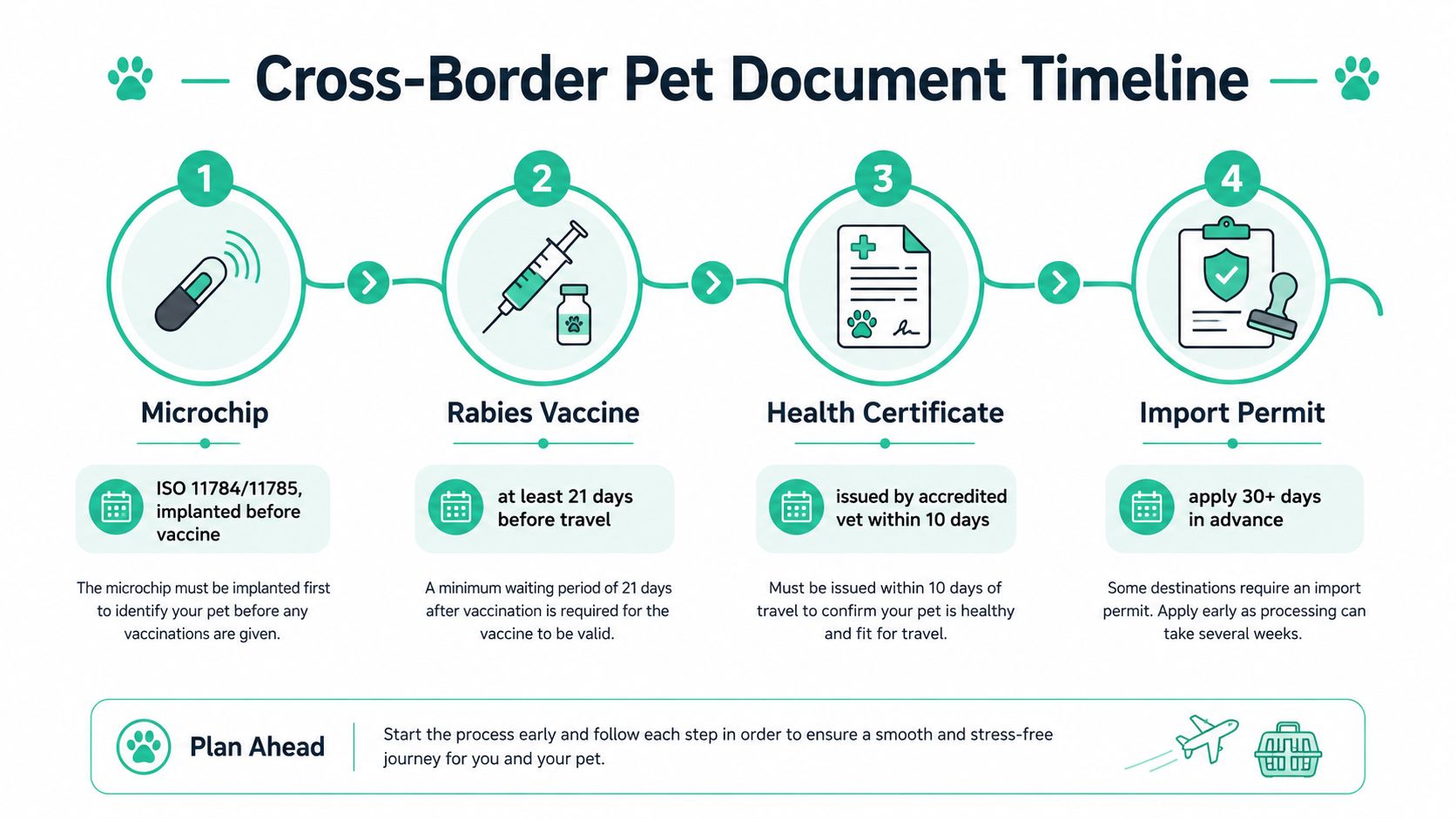
The document stack makes more sense when you build it in the same order the pet's identity and health are established. First comes the microchip, then the rabies certificate, then the health certificate, and finally any route-specific forms or endorsements. That order matters because later paperwork often depends on the earlier records being already in place.
Start with identity, then health, then route-specific paper
A pet's microchip is the anchor. For international transport, the chip should meet ISO 11784/11785 standards so the identity on the paperwork matches the animal at check-in and at the border. If the chip was placed after vaccination in a route that expects the opposite sequence, that can create avoidable confusion later.
The next piece is the rabies vaccination certificate, which must be aligned with the destination's timing rules. That certificate isn't just a shot record, it's the paper trail that shows the pet was vaccinated at the right time for the trip. After that comes the Canadian International Health Certificate, which Canada's travel guidance says should be printed on legal paper, 8.5" x 14", not standard letter size.
If you're organizing a stack of scanned records, clean file handling saves time. Put the microchip record, rabies proof, health certificate, and any supporting test results into a single packet so no one has to hunt through email threads at the last minute.
Working habit: keep one master folder for the pet and one final folder for the trip. The master folder holds everything, the trip folder holds only the documents the airline or border staff need to see.
Some routes also need additional live-animal or export certificates, and some countries require a rabies titer blood test, such as a FAVN test, completed well before departure. Endorsement can also take time, especially when an official stamp or government review is part of the process. For a plain-language look at how the core certificate fits into the travel file, this international pet health certificate guide is a good companion.
Who signs what
A regular veterinarian can handle many clinical parts of the process, but export cases sometimes need a CFIA-accredited veterinarian to complete or endorse the official travel paperwork. That distinction matters because the document may be medically valid without being officially accepted for the route. The job is not just to print a form, it's to make sure the form is the one the route requires.
If you're dealing with multiple pages, keep the file legible and complete. Missing signatures, missing dates, or pages in the wrong order can create delays that are hard to fix on the day before departure. The quieter the document trail looks, the better.
Airline Carrier Rules and the Engineering Behind the Crate
A lot of pet travel problems start with a crate that looked fine at home and failed at the airport. That's because airline acceptance is partly about the animal and partly about the box the animal is in. The container has to protect the pet, fit the airline's rules, and match the size and strength expectations in IATA Live Animals guidance.
What the pet has to be able to do inside the container
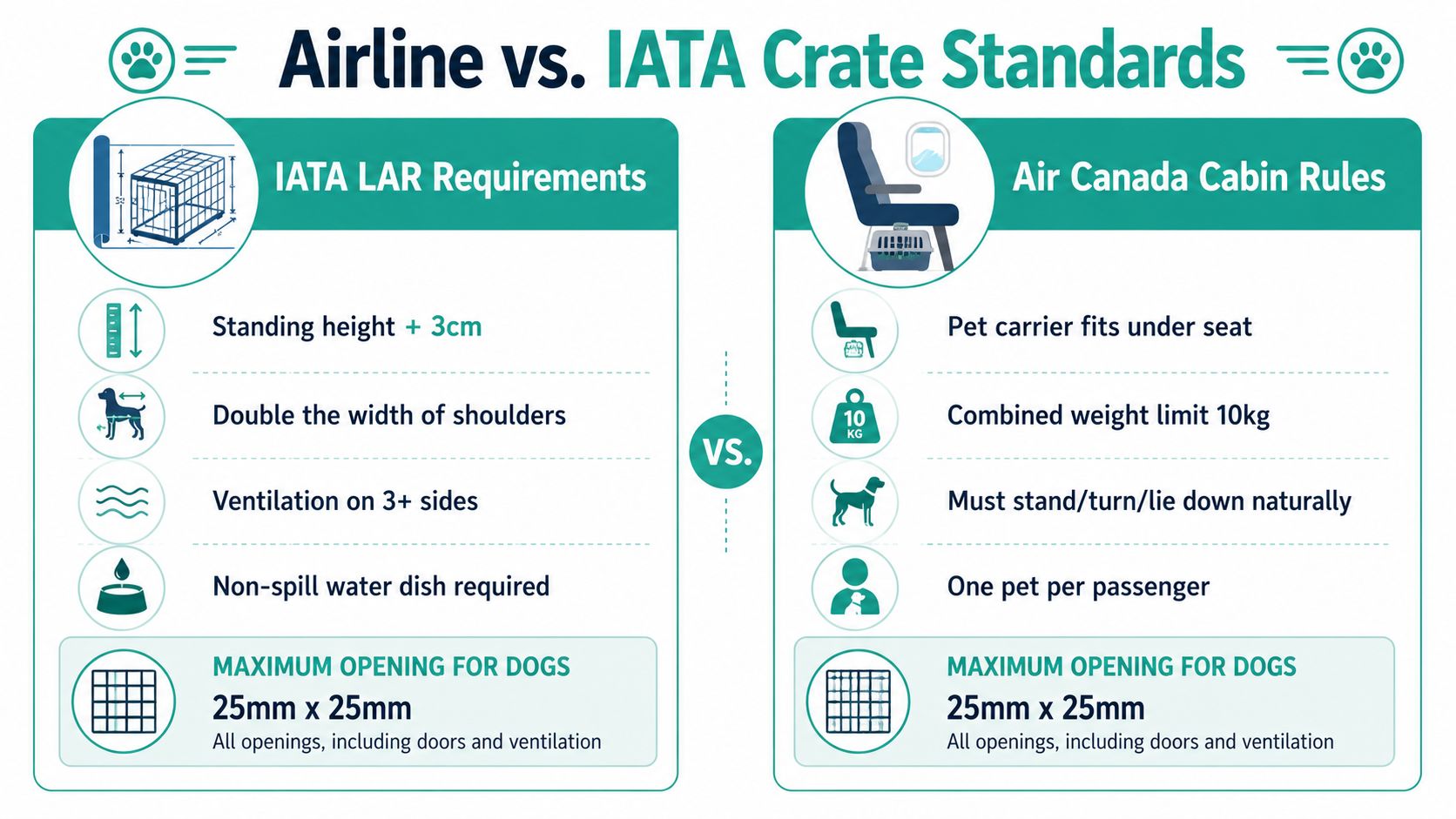
The core test is simple. The pet must be able to lie down, turn around, and stand in a natural position inside the container. If the crate is too short, too narrow, or too flimsy, it can fail before the trip even starts. For dogs, the IATA opening rule allows openings no larger than 25 mm x 25 mm, and for cats the maximum opening is 19 mm x 19 mm. Those limits help prevent paws, noses, and escape attempts from becoming injuries.
The engineering matters because a container isn't just a travel accessory, it's part of the live-animal transport safety system. IATA also requires container features that make it nose- and paw-proof, with stronger construction for international transport. That's why a crate that looks sturdy can still be rejected if the openings, materials, or internal size miss spec.
Cabin, checked baggage, and cargo are not the same thing
Air Canada's cabin rule is separate from the wider freight standard. In the cabin, only one cat or small dog per passenger is allowed, and the carrier must be soft-sided and able to fit under the seat. Air Canada's listed maximum dimensions are 27 cm high x 40 cm wide x 55 cm long for a soft-sided carrier, or 23 cm x 40 cm x 55 cm for a hard-sided carry-on use case, and the pet must be able to stand, turn around, and lie down or the airline can refuse transport.
The mode matters because each mode changes the rule set. Cabin travel is about under-seat fit and passenger handling. Checked baggage uses the aircraft's controlled animal handling process. Manifest cargo has its own booking and handling path, and it's usually used when the pet is too large or the route is too complex for cabin carriage.
If the pet and carrier are too heavy for the cabin, the flight team may move the booking to another mode or deny cabin acceptance. Animals over 14 kg must be crated individually under IATA rules, while up to two compatible adults of comparable size and up to 14 kg each may share one container if the conditions fit. That detail is easy to miss, and it changes how families and shippers size the travel plan.
Building a Reverse Timeline From Travel Date
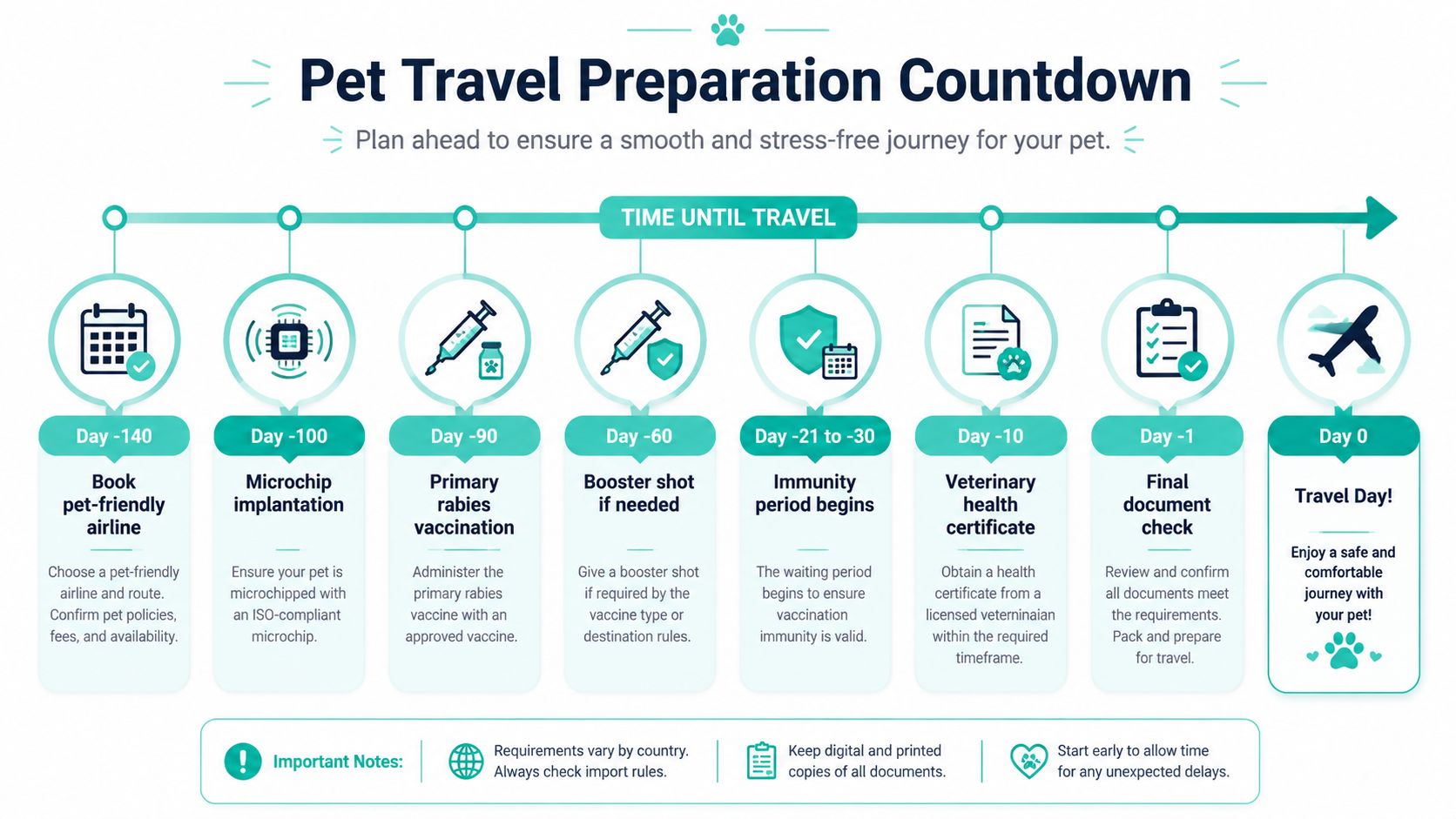
The cleanest way to plan pet transport is to work backwards from the flight date. Start with the day the pet needs to leave, then count back to the appointment dates that can't move. That keeps you from booking a flight before the clinic has room to do the work, which is one of the most frustrating mistakes people make.
Count back from the flight, not forward from today
The first anchor is the microchip implantation. That has to happen early enough that every later document can reference the same identity. Next comes the primary rabies vaccination, followed by the waiting period that many routes require before the pet can travel. In the infographic below, that is shown as a 21 to 30 day immunity window, which is a practical planning lane even when the exact rule varies by destination.
The next time-sensitive step is the health certificate exam, often issued close to departure. For exports, the appointment window is commonly tight, and the document may need endorsement after the clinic visit. A few days of buffer help because weekends, office closures, and courier delays can eat up your margin faster than you expect.
A practical planning rhythm
A six-month runway gives a family room to choose flights, complete veterinary steps, and recover if one document needs rework. A six-week runway is tighter, and it means the booking and clinic steps need to move in lockstep. If a route requires a rabies titer or official endorsement, the buffer gets smaller fast.
Simple rule: book the veterinary path before you lock in the trip, not after. Flights can be changed, but missing a medical timing window is much harder to fix.
The final week is for assembly, not discovery. That means checking signatures, matching names and microchip numbers, and making sure every page is in the final packet. The calmer the last seven days are, the more likely the airport handoff is to go smoothly.
Welfare and Fit-to-Fly Decisions Beyond Paperwork
A pet can have perfect paperwork and still be a poor travel candidate. That's the part many owners don't hear enough. The Canadian Veterinary Medical Association says transport decisions should include pre-transport assessment, ventilation, temperature, food and water access, and whether the animal is fit to travel, not just whether the forms are complete. Their position statement also lists conditions that can make an animal unfit, including laboured breathing, severe wounds, late-stage pregnancy, and recent birth.
The health check has to answer a bigger question
Brachycephalic pets, older pets, pregnant animals, and medically fragile pets need extra care. A vet isn't being difficult when they slow the process down. They're checking whether the trip adds a risk the pet doesn't need to take. If a dog already struggles in warm weather or a cat is recovering from illness, the travel file may be technically complete and still not be the right call.
Canadian veterinary concern about imported dogs backs that up. In recent research, 48.9% of surveyed veterinarians said they had concerns about imported dogs, and among those who commented, the most common specific worry was physical transport conditions at 42.9%, especially overcrowding and lack of food and water during travel, using the figures in the referenced study on imported-dog concerns. That tells you this is not a fringe issue. It's a live welfare concern in everyday practice.
What to ask your clinic
Use simple questions and ask them early. The point is not to force travel, but to see whether the pet is a sensible candidate right now.
Is my pet stable enough for this route? Ask about breathing, hydration, age, pregnancy status, and recent procedures.
Will the carrier or flight mode stress my pet too much? Short-faced breeds and medically fragile pets may need a different plan.
What signs would make you advise against travel? A clear no is useful, because it lets the family change plans before costs pile up.
Do we need a recheck close to departure? Many pets change between the first planning visit and the final certificate exam.
If the answer is “not now,” that's not a failed trip, it's a useful decision. A pet that stays safe at home has won the argument.
Verification, Fraud Risk, and What Happens at the Border
There's a part of pet travel that consumer checklists often skip, and that is document verification. The CFIA says Canada and its international partners have seen more detection of non-compliance in companion animal movements, including fraudulent certification, and they are working together on that issue. In practice, that means a certificate is not treated as a harmless formality if anything in the file looks inconsistent.
Border checks are real checks
CBSA officers can inspect animals and may refuse entry, confiscate, or detain a pet if the animal is undeclared, lacks required permits or certificates, is suspected of being sick or infected, or is transported in a non-humane way. A missing form, a mismatched microchip record, or a carrier that does not fit the animal can all turn into border problems, because the inspection is about both paperwork and welfare.
The risk rises when the origin is already viewed through a biosecurity lens. In the peer-reviewed study cited earlier, 23% of imported dogs came from 55 high-risk rabies countries, and the top exporting countries were the United States, Ukraine, and Mexico. That does not mean every pet from those routes is a problem. It means authorities are sorting cases by risk, not just by signatures and stamps.
Why clean files matter more than ever
A tidy document packet does two jobs. First, it gives the border officer or airline staff a clearer path to verify the story in front of them. Second, it gives the clinic an audit trail if a certificate is questioned later.
That is why file integrity matters in the same way operations teams care about record keeping in other cross-border workflows, including fast cross-border payouts with USDC. The details are different, but the verification logic is similar. If one field does not match another, someone has to stop and check.
For route-specific pet guidance, this page on entering Canada with pets helps owners see how entry-side checks fit into the bigger picture. If a certificate looks incomplete, inconsistent, or out of sequence, the border process can slow down quickly. Clean files do not guarantee a smooth passage, but they remove a lot of easy reasons for delay.
A Practical Mental Model and Common Questions
Think of the process as identity, timing, container, welfare, and verification. If those five pieces line up, the trip has a real chance of going smoothly. If one of them is off, the whole plan can wobble, even when the rest looks fine.
A few quick questions come up over and over. How early should you start? As early as you can, especially if the route needs endorsements or lab work. What changes for exotic pets? The paperwork can become more individualized, and Canada's CITES process requires one application form per pet for personal non-commercial travel, with incomplete applications not accepted. Does the Canadian International Health Certificate work for every direction? No, the route matters, and the paperwork changes by situation. Can practice teams keep documents audit-ready? Yes, by using a single workflow with dated records, clear file names, and a final review before submission.
For current rules, keep the official CFIA, CBSA, Air Canada, and IATA resources close, because pet travel rules can shift and snapshot guidance can age quickly. The safest trip is the one that's checked against the latest official source before the pet ever leaves home.
If you're planning international pet transport to or from Canada, Passpaw helps veterinary teams and pet owners organize health certificate workflows, keep documents in order, and reduce avoidable back-and-forth. Visit Passpaw to see how the process can be managed with clearer timelines, cleaner files, and less guesswork.

More articles
From regulatory changes to best practices for veterinarians and pet owners, our resources keep you ahead of the curve.