Are you a team member in a veterinary practice?
Are you a pet parent planning a trip with your furry pal?
Is a CVI the Same as a Health Certificate? A 2026 Guide
A CVI and a health certificate are the same document in the usual U.S. pet travel sense. Most standard domestic CVIs are valid for 30 days, but the main complication is that the term people use, the format accepted, and the exact requirements can change fast depending on where the animal is going and whether the trip is domestic or international.
That’s why this question keeps tripping people up. A pet owner hears “you need a health certificate,” the clinic team says “we’ll issue a CVI,” and everyone wonders if they’re chasing two different forms. In day-to-day practice, they’re usually talking about the same piece of paperwork. In real travel planning, though, the destination rules are what matter, and those rules can make the process feel like a different animal entirely.
CVI vs Health Certificate The Pet Travel Paper Chase
The most common version of this conversation goes like this: a client books travel for a dog, calls the clinic, and asks for a health certificate. The veterinarian checks the destination requirements and says the pet needs a CVI. The client pauses, because it sounds like the request just changed.
It usually didn’t.
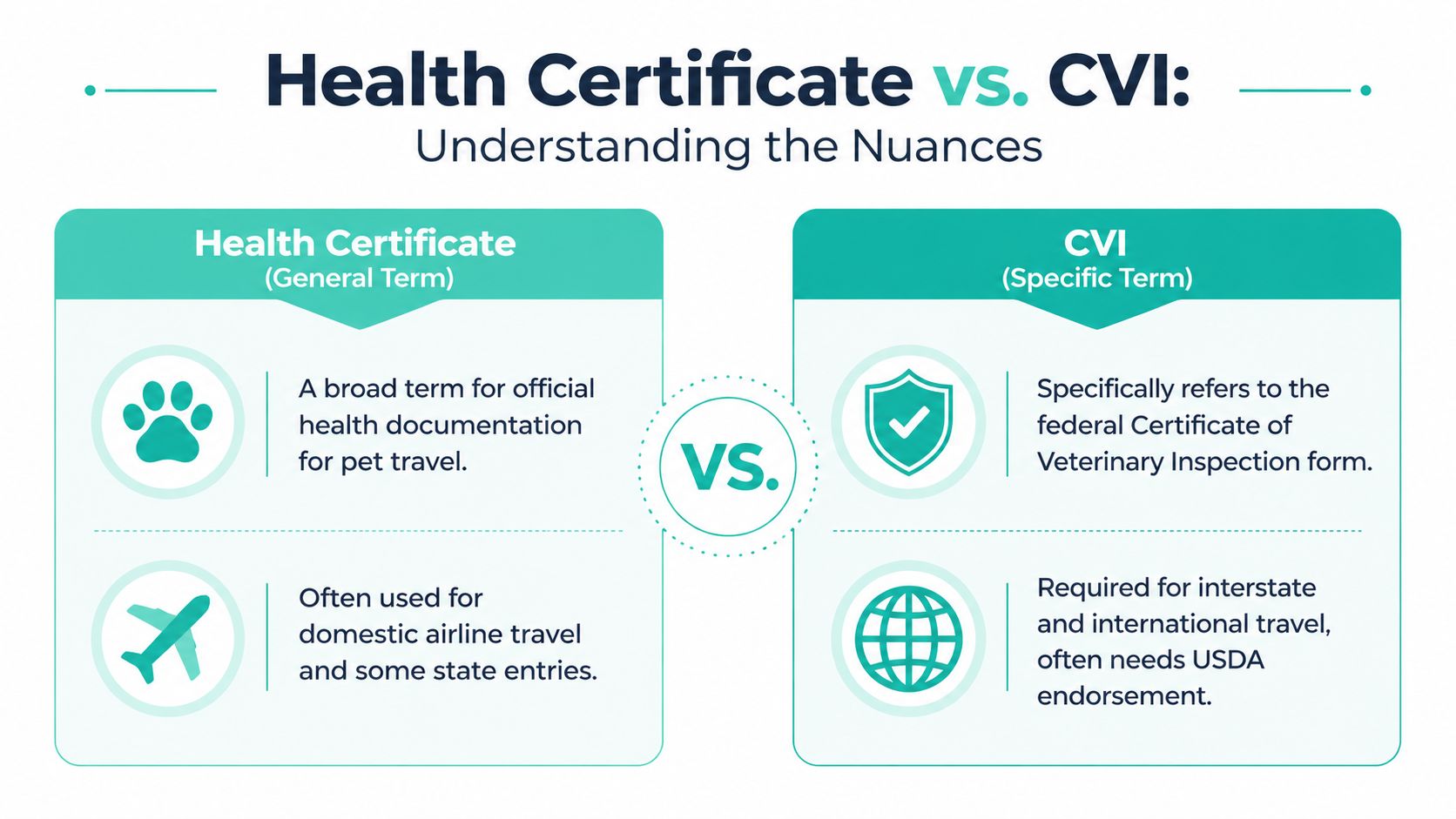
In practice, “health certificate” is the broader everyday phrase, while “CVI” is the formal regulatory term many vets and state officials use. That overlap is what causes the confusion. The terms point to the same official document, but the travel context determines how simple or messy the process becomes.
Here’s the quick side-by-side view generally needed first:
Question | Short practical answer |
|---|---|
Is a CVI the same as a health certificate? | Yes, in standard U.S. use they are functionally the same document. |
Who issues it? | A federal, state, tribal, or accredited veterinarian, depending on the movement rules. |
What is it for? | To confirm the animal was inspected and met movement requirements. |
How long is it usually valid? | 30 days in most standard domestic situations. |
Why does it still feel different in practice? | Because states, countries, airlines, and events may ask for different formatting, timing, tests, or endorsements. |
What’s changing right now? | More jurisdictions are moving toward electronic CVIs, which changes workflow for clinics and owners. |
A lot of pet travel stress comes from treating the name of the document as the main question. It isn’t. The better question is, “What does this destination accept, and when does it need to be issued?”
That’s also why general travel advice often falls short. A road trip with a dog, a horse crossing state lines, and an international cat export may all involve what people casually call a health certificate, but the practical path is not identical. If you want a broader primer on travel logistics around the document itself, Passpaw’s pet travel articles are a useful starting point.
Practical rule: Don’t argue with the terminology. Confirm the destination, travel date, species, and whether the receiving authority wants a domestic CVI, an international health certificate, or both plus extra steps.
Defining the Core Pet Travel Document
A client calls on Tuesday. They are flying out Friday with a dog, the airline asked for a health certificate, and the owner assumes any veterinarian can sign one. That is where confusion usually starts. A Certificate of Veterinary Inspection, or CVI, is the document many owners mean when they say health certificate, but the document carries legal and regulatory weight that a casual label does not.
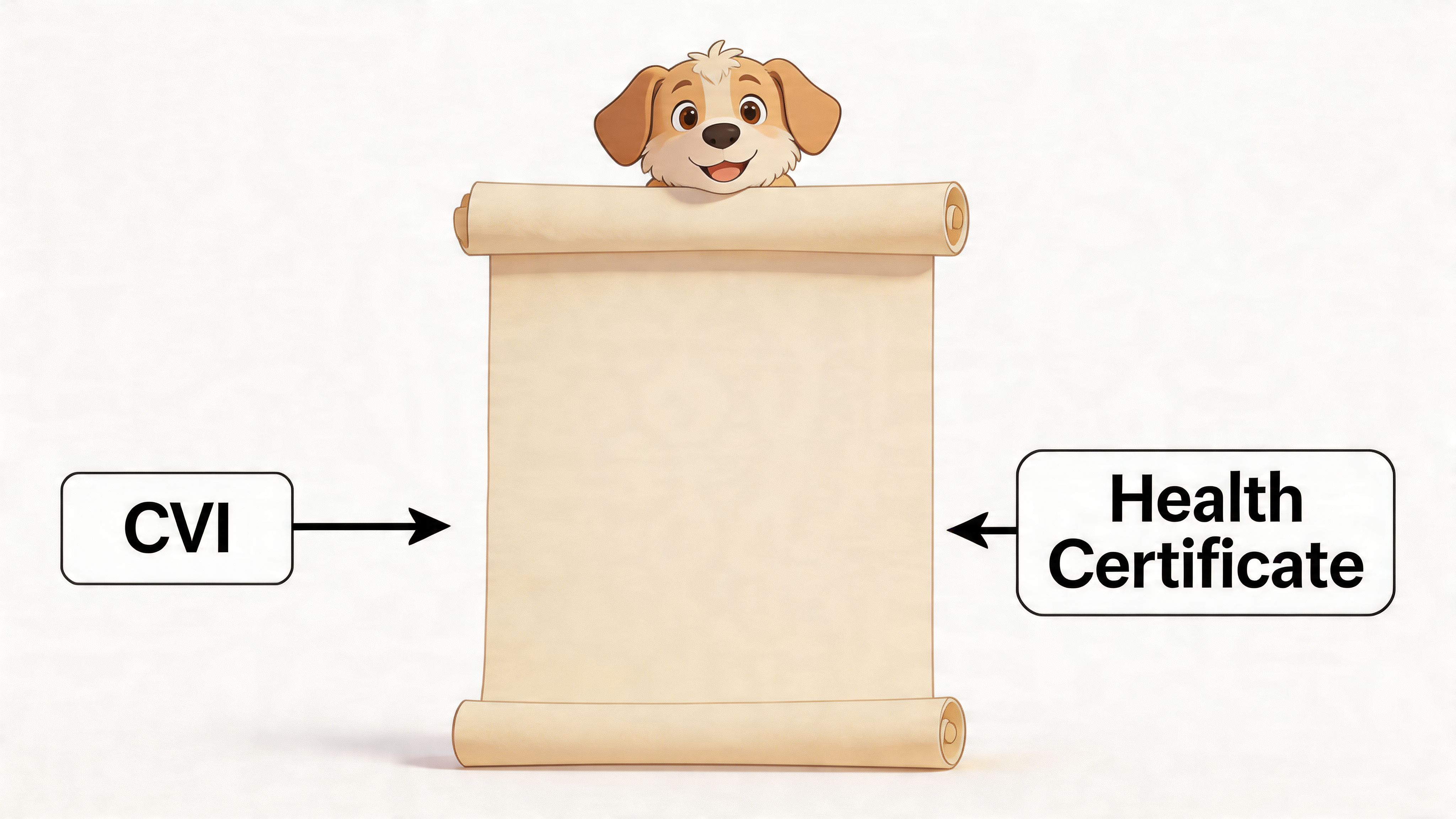
In practice, the document serves one main purpose: it records that a veterinarian inspected a specific animal for a specific movement under a specific set of rules. That distinction matters. A travel certificate is not just proof that a pet looked healthy in the exam room. It is part medical record, part regulatory document, and part movement authorization.
What the document actually does
A properly issued CVI or health certificate confirms that the animal was examined recently and had no signs of contagious disease at the time of inspection. It also ties the animal’s identity to the trip details and any required vaccination, testing, or treatment records.
For owners, the question is usually whether the pet will be allowed to board or enter. For regulators, the document exists to reduce disease spread and track animal movement. Both goals matter, but clinics run into problems when the first goal gets all the attention and the second gets ignored.
That is also why the wording on the form, the species listed, and the destination information cannot be treated as clerical extras. If any of those pieces are wrong, the certificate may not work for the trip it was issued for.
Why the signer matters
The veterinarian’s signature is only valid if that veterinarian has the authority required for that route. For many domestic movements, that means an accredited veterinarian. For some movements, especially international ones, additional review or endorsement may be required.
Last-minute scheduling gets difficult in real clinics. The exam may be simple. The paperwork may not be. Staff need the destination, travel date, mode of travel, species, age, and any carrier or import rule before the appointment is even booked.
For pet owners who want the clinic-side basics explained in plain language, this vet health certificate guide is a useful reference.
A CVI is one animal, one exam, one route, and one compliance decision documented on paper or in an approved electronic system.
Why the document feels different now
The biggest shift in recent years is format. More states and animal health agencies are pushing clinics toward electronic CVIs, often called eCVIs, instead of handwritten or manually completed paper forms. That change matters in day-to-day practice because it affects who can issue the document, how quickly it can be transmitted, and whether the receiving jurisdiction will accept it without follow-up.
From a workflow standpoint, eCVIs usually improve legibility and reduce missing fields. They also create new points of failure. A clinic may need approved software, staff training, and enough lead time to complete the certificate correctly. Owners who are used to hearing “just get a health certificate” often do not realize the form may now have to be entered into a state-approved system rather than signed on the spot.
That practical gap is why the terms sound interchangeable but can feel very different once travel planning begins.
Where Terminology and Requirements Diverge
People asking “is a cvi the same as a health certificate” are usually sensing a real-world difference, even when the formal answer is yes. The difference isn’t the name. The difference is jurisdiction, validation, and timing.
A domestic interstate movement can be fairly direct. An international trip often adds another layer of country-specific requirements, endorsements, and timing pressure. That’s why the two terms can feel different in practice.
The biggest practical split
The AVMA notes in its guidance on Certificates of Veterinary Inspection that domestic interstate CVIs are typically valid for 30 days, but that window can shrink to 72 hours during disease outbreaks. It also notes that if a trip exceeds 30 days, a new CVI may be needed at the destination for return travel.
That’s the point where owners often say, “But I already have the certificate.” They do. It just may no longer be valid for the next leg of travel.
Side-by-side practical comparison
Travel situation | How the document is usually discussed | What matters most |
|---|---|---|
Interstate U.S. travel | Often called either a health certificate or CVI | State entry rules, timing, species-specific requirements |
Long domestic trip | Still the same type of document | Whether the return falls outside the standard validity window |
Travel during an outbreak response | Same underlying document | Shortened validity, sometimes as little as 72 hours |
International travel | Commonly called an international health certificate | Country requirements, official validation path, supporting records |
Why this creates workflow problems
In clinic operations, timing is usually the trap. Owners assume the exam date can be booked whenever there’s an opening. It can’t. The appointment has to line up with the travel date, the destination’s acceptance window, and any required supporting documents that must already be complete.
For longer itineraries, there’s another headache. A certificate that gets a pet to the destination may not automatically solve the return trip. That’s especially important for snowbird travel, extended stays, competition circuits, and relocation plans that stretch beyond the baseline domestic validity window.
If the trip lasts longer than the certificate’s valid period, the return leg becomes a separate compliance event, not just the second half of the same plan.
Why the words still matter a little
The terms are interchangeable at the foundation level, but they signal different habits in conversation. Pet owners usually say “health certificate.” Regulatory offices and many veterinarians often say “CVI.” International travel teams may use “health certificate” while talking about a more complex package that includes the certificate plus destination-specific extras.
So yes, the names refer to the same core concept. But the useful question isn’t which label is correct. It’s which requirements package applies to this movement.
That’s why destination-first planning works better than terminology-first planning. For teams dealing with cross-border trips, international pet health certificate guidance is often more useful than debating the label on the form.
Key Information Every Health Certificate Needs
Once the right certificate type is identified, the next challenge is accuracy. Health certificates are not forgiving documents. A missing detail, a mismatched ID, or incomplete vaccine information can turn a routine travel plan into a scramble.
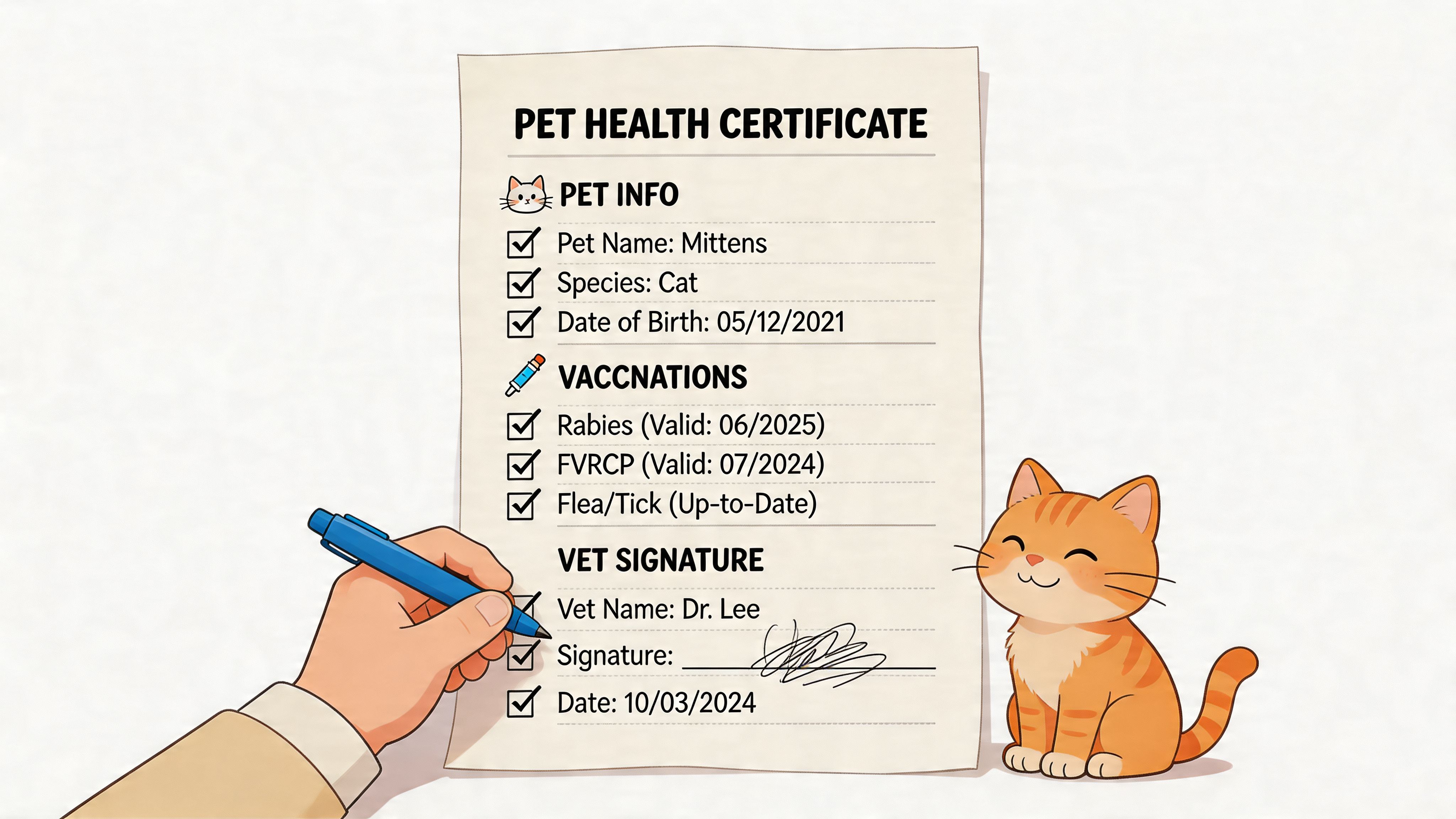
The American Kennel Club’s state CVI resource explains that these documents are disease-control instruments, not just travel passes and must include details such as animal identification, rabies vaccination information, date of vaccination administration, and veterinarian signature in applicable situations. It also notes that for horses, CVIs must include Coggins test results for equine infectious anemia, and that the issuing veterinarian is responsible for sending copies to origin and destination state animal health officials through this state CVI requirements resource.
The fields worth double-checking
When I review a certificate before final release, these are the details I treat as high-risk:
Animal identification: Species, breed, sex, color, age, microchip or other identifying information must match the rest of the record.
Rabies details: If rabies vaccination is relevant for the destination, the certificate needs the vaccine information exactly as required.
Owner and destination details: Small address errors can create big travel problems, especially when paperwork has to match booking records.
Veterinary signature and credentials: The issuing veterinarian’s official details need to be complete and properly recorded.
Required test information: For equine movement, that includes the negative EIA result often identified as a Coggins test when required.
Why these details matter
Every field exists for a reason. Identification ties the certificate to a specific animal. Vaccine and test fields support disease control. Signature and credential information establish that an authorized professional issued the document.
That’s also why free-text improvisation doesn’t work well. Generic notes like “vaccines current” or “healthy for travel” may sound fine in conversation, but they don’t substitute for destination-specific required fields.
A certificate should read like a verified record, not a summary memo.
A simple review routine that works
Before finalizing any certificate, clinics and owners should both review the same set of basics:
Match the pet to the record. Check name, species, and identifying details first.
Check dates carefully. Vaccination dates, test dates, exam dates, and travel dates all need to line up.
Confirm destination spelling and route details. This is especially important if connecting travel or relocation paperwork is involved.
Review supporting documents together. Rabies certificates, lab reports, and prior records should support what appears on the certificate.
If you work with APHIS forms or domestic travel paperwork often, this APHIS 7001 health certificate overview helps clarify how the document set fits together.
Navigating Common Health Certificate Hurdles
Most rejected or delayed travel paperwork doesn’t fail because the pet is unhealthy. It fails because the process was treated as simple when it wasn’t. The certificate may be the same core document, but the pathway around it keeps changing.
The most disruptive change right now is the shift toward electronic CVIs, often called eCVIs.

The paper assumption is becoming risky
The Texas Animal Health Commission states in its Texas CVI guidance for veterinarians that as of 2026, Texas requires eCVIs for all imports, with paper CVIs becoming fully obsolete by 2027. That matters far beyond Texas, because it shows how fast state rules can move from “paper is still okay” to “electronic is required.”
For clinics, this creates a workflow issue. A paper-based process that worked fine last year may now be the weak link. For owners, it means asking “Do I have a certificate?” is no longer enough. The better question is, “Is this the format the destination currently accepts?”
Common trouble spots I see most often
Booking the exam too early: Owners hear “valid for travel” and assume earlier is safer. It isn’t if the certificate expires before the travel window closes.
Using the wrong format: A valid paper document may still be unusable if the destination has shifted to electronic submission requirements.
Forgetting the return leg: This catches long trips all the time. Outbound approval doesn’t guarantee return compliance.
Treating every state the same: Interstate movement is not one-size-fits-all, especially when disease conditions change.
What works better
A good process starts with the destination, not the form drawer. Confirm the current rule set first. Then schedule the exam inside the right timing window. Then verify whether the certificate must be issued or transmitted electronically.
For clinic teams, a shared checklist and date-based review system helps a lot. For owners, sending the itinerary, destination, and any airline or event instructions before the appointment prevents a lot of tail-chasing.
Paperwork problems usually start before the exam. They start when no one confirms the exact destination requirement early enough.
The main lesson is simple. Don’t assume last year’s process still works this year. The digital shift is real, and it’s happening state by state rather than through one neat national system.
How Modern Tools Make Pet Travel Paw-sible
A common clinic scenario looks like this. The pet is examined on time, vaccines are current, and the owner has the itinerary in hand. The problem starts after that. Someone pulls an old form, the destination has shifted to an electronic submission process, and the certificate has to be redone under deadline.
That is why digital tools matter in pet travel work. The weak point is often document control, not the medical exam itself. Dates, species details, microchip numbers, consignor information, destination rules, signatures, and submission steps all have to line up. If one field is wrong or one date falls outside the allowed window, the certificate may be unusable.
The USDA says in its VSPS Interstate Module handout that electronic CVIs save time compared to paper forms, are easier to read, help state officials track movements across state lines, and are free to all users including accredited veterinarians and relevant officials.
What digital workflow fixes
Paper failures are predictable. Handwriting is misread. A scan cuts off the endorsement block. A staff member works from the wrong saved version. None of that improves patient care, but it can still delay travel.
A good electronic system catches preventable errors before issuance. For example, if a CVI request shows an exam date that falls too far ahead of the travel date, the system can flag it before the veterinarian signs an expired certificate. The same applies when a required field is blank, the animal ID does not match the rabies record, or the destination now expects electronic transmission rather than a paper copy in the owner’s folder.
That is the practical advantage. Fewer after-the-fact fixes.
Why supporting tools matter too
Travel records rarely arrive in one clean packet. Clinics and travel teams often work from vaccine certificates, lab results, prior permits, airline instructions, and PDFs exported from several different systems. Pulling the right data out of those files takes time, and manual re-entry is where names, dates, and microchip numbers drift.
A practical resource like this guide for efficient PDF data extraction is useful for teams trying to standardize intake and reduce copy errors. That work happens before certificate issuance, but it directly affects whether the final document is accurate.
Clean input matters.
If the source records are inconsistent, the veterinarian ends up spending time reconciling paperwork instead of reviewing the actual travel requirements.
What actually works in practice
The best setups are not flashy. They do a few operational things consistently:
Match exam dates to travel dates so staff can see timing problems before the appointment is booked.
Show current destination rules inside the workflow instead of relying on memory, old templates, or last year’s process.
Store prior certificates and supporting records together so return trips and repeat travelers do not start from zero.
Produce legible, consistent records for owners, receiving officials, and any state or federal review.
For clinics, that usually means fewer rechecks, fewer correction calls, and less time spent chasing paperwork across email, fax, and scanned attachments. For owners, it means clearer expectations about what is still missing and what has already been issued.
If your clinic or travel team wants a simpler way to manage international pet paperwork, Passpaw is built for that job. It helps organize destination requirements, validate documents in real time, prioritize tasks around travel dates, and keep pet owners informed without turning every certificate into a custom fire drill.

More articles
From regulatory changes to best practices for veterinarians and pet owners, our resources keep you ahead of the curve.