Are you a team member in a veterinary practice?
Are you a pet parent planning a trip with your furry pal?
Health Certificate for Export to China Guide
You've found the flight, checked whether your dog or cat can travel in the cabin, and started a folder for the paperwork. Then you notice the health certificate window, the rabies records, the antibody test, the government endorsement, and the arrival rules. Suddenly, the trip feels less like a holiday plan and more like a puzzle with a very furry piece missing.
A successful health certificate for export to China depends on coordination, not on completing a simple checklist from top to bottom. The rabies titer may remain valid for much longer than the final veterinary certificate, while the clinical examination and certificate must be timed close to your arrival. Treat the process as a backward-planning exercise, and the paperwork becomes much easier to manage.
Understanding China Pet Entry Requirements
The departure country or region determines which entry pathway your pet may use. China distinguishes between designated and non-designated origins, and that classification can change the identification, testing, port, and post-arrival requirements. Confirm the pathway before paying for flights or scheduling appointments, because a cheaper itinerary can become costly if the port does not accept your documentation.
Pets from non-designated countries or regions generally need an electronic microchip, an official rabies vaccination and quarantine certificate, and a rabies-antibody test completed by a laboratory recognized by China Customs. The antibody result must be at least 0.5 IU/mL. If the pet does not qualify to avoid extended quarantine, it may need to stay in a Customs-designated facility for 30 days, including any detention period. See China's official entry guidance for dogs and cats for the applicable rules and port conditions.
The main documents
Your file should tell one consistent story from the first scan to arrival:
Identification: Record the pet's electronic microchip number accurately and confirm that it remains readable.
Rabies history: Match vaccination dates and product details across the certificate and supporting records.
Antibody evidence: Where required, use a titer report issued by a laboratory recognized by China Customs.
Clinical examination: Have a veterinarian examine the animal close to arrival and document the findings.
Official certificate: Obtain the health certificate from, or have it endorsed by, the exporting country's competent animal-quarantine authority.
The certificate may need to include the pet's species, sex, age or date of birth, coat color, microchip number and implantation location, vaccination details, examination date, and health findings. One missing digit or conflicting date can slow clearance even when the animal is healthy. Compare every document before submission, especially if records came from different clinics or countries.
Practical rule: The arrival date controls everything. The titer window is the widest, while the certificate window is the narrowest.
Designated and non-designated routes
A designated origin or eligible simplified route may reduce testing or quarantine requirements, but eligibility depends on the pet's circumstances and the current rules. Confirm the route with the relevant authority, your veterinarian, airline, and receiving contact in China before booking a non-refundable itinerary. Port choice matters too, since an entry point may have its own inspection or facility arrangements.
For U.S. travelers, this guide to moving to China from the United States can help organize country-specific planning questions. Ask two practical questions: which route does the pet qualify for, and what documents prove that qualification?
The health certificate for export to China is one part of the entry file. It cannot replace the microchip record, rabies history, titer report, or arrival plan. If those records disagree, officials may hold the animal for further checks. A clean, readable file gives Customs a consistent account of the pet's identity, medical history, and eligibility.
Setting Up Microchips and Core Vaccinations
The medical record should begin with identity. Before arranging the final examination or antibody test, ask your veterinarian to scan the electronic microchip and write the number exactly as it appears. Keep the number in a working document, then compare it against every later form rather than relying on memory or a handwritten note.
China requires the animal to be identifiable through an electronic chip when the simplified entry conditions don't apply, as described in Shanghai's government guidance on bringing pets into China. A chip that can't be read, or a number copied incorrectly, can undermine the records built around it.
Build the record in the right order
Ask the clinic to record the following during the early visit:
The complete microchip number.
The implantation date and location, if available.
A fresh scan confirming that the chip can be read.
The pet's description, including species, sex, age or date of birth, and coat color.
The rabies vaccination history, including dates and product information recorded by the veterinarian.
The important point is not to create a neat file after the fact. It's to make the source records accurate before the titer sample and final certificate depend on them. If a pet has older vaccination documents from another clinic or country, ask the current veterinarian to review them early. Unclear dates or descriptions are much easier to resolve before the travel window becomes tight.
You can also read about microchip preparation for international pet travel when discussing identification options with your veterinarian. The clinic should confirm that the chip used for your pet can be read and documented for the destination pathway that applies.
Why sequence matters
For a pet traveling from a non-designated country or region, the rabies antibody sample must be collected on the same day as, or after, the second rabies vaccination. A sample collected earlier may fail the timing requirement, even if the laboratory result itself looks strong. That makes the vaccination history more than background information. It determines whether the blood test can support the export file.
Don't schedule the blood draw because the calendar has an open appointment. First confirm which vaccination event qualifies, then make sure the veterinarian records the date clearly. If the pet's history is complicated, have the clinic map the sequence in writing.

Keep one source of truth
A practical record can be a secure digital file backed by paper originals. Use the same spelling of the pet's name, the same microchip number, and the same date format on each document. If the veterinarian corrects a record, update the working file immediately and flag any older copy that should no longer be used.
The most common early mistake is treating identification and vaccination as separate tasks. They are connected. The chip identifies the animal, the rabies record establishes the relevant medical history, and the antibody report later links immunity evidence to that same animal. Get the foundation right, and the final certificate has a much better chance of matching the pet standing at the inspection desk.
Navigating the Rabies Titer Test Process
A pet can have a valid vaccination record and still miss the China entry schedule if the rabies titer is planned in isolation. Treat the export file as a backward-planning puzzle. The blood draw, laboratory report, titer validity period, final examination, certificate, and arrival date must all fit together. One loose date can leave you with a compliant test that no longer supports the travel documents.
For pets from non-designated countries or regions, China requires a rabies-antibody result of at least 0.5 IU/mL. The blood sample must be collected on the same day as, or after, the second rabies vaccination. China Customs must recognize the testing laboratory, so confirm that status before choosing a clinic or laboratory based only on convenience. The official guidance on rabies antibody testing for pets entering China provides the applicable threshold and conditions. As noted earlier, verify the route and current entry requirements with the veterinarian or shipper.
Read the result in context
A report at the stated minimum may meet the published threshold, but the issuing laboratory's format still matters. Check that the report clearly states the result, units, pet identification, and collection date. Where clinically appropriate, a veterinarian may recommend aiming for a result comfortably above the minimum to reduce administrative uncertainty. That choice does not replace the official requirement and should not prompt unnecessary vaccination without veterinary advice.
The test must also be scheduled around the intended arrival date. A high result is not useful if the sample was collected at the wrong point in the vaccination sequence or if the report cannot be tied to the animal named on the export certificate.
Use the longer window carefully
The antibody report is generally valid for one year from blood collection, according to published Chinese pet-entry requirements. That period gives you room to manage a changing departure date, while the final examination and health certificate have a much shorter operating window.
Plan backward from arrival:
Record | Planning question |
|---|---|
Rabies vaccination | Was the qualifying vaccination completed and documented? |
Blood sample | Was it collected on or after the second qualifying rabies vaccination? |
Laboratory report | Is the laboratory recognized, and does the report identify the correct pet? |
Titer validity | Does the report still cover the planned arrival date? |
Health certificate | Will the examination and certificate fall within the required arrival window? |
A postponed flight can separate these dates. The titer may remain valid while the certificate becomes too old, or the certificate appointment may be available after the titer no longer covers the revised arrival date. Recheck every window after a schedule change rather than assuming one valid document keeps the others valid.
Audit the laboratory report
When the report arrives, compare it with the vaccination record before sending the file for endorsement. Confirm the pet description, microchip number, blood-collection date, laboratory name, test result, and units. If anything differs, ask the clinic to resolve it with the laboratory. Do not cross out or hand-edit the report yourself.

The rabies titer test guide for dogs can help you review the sequence with a veterinary team, particularly when a pet has changed clinics or has records from multiple countries. Keep the report, vaccination history, and planned arrival date visible together. That alignment prevents a valid titer from being rejected because it no longer matches the final certificate.
Timing the Final Veterinary Clinical Examination
The final examination should be scheduled by counting backward from arrival in China, not forward from the day you first start preparing. For U.S. exports, the health certificate must be issued by a USDA-accredited veterinarian within 14 days of the pet's arrival in China and electronically endorsed through the USDA export-certification system, according to USDA APHIS guidance for pet travel from the United States to China.
That window is narrow enough to punish casual scheduling. A certificate issued too early may not cover arrival, while an appointment booked too late may leave no practical time for review, correction, endorsement, or airline confirmation.
Work backward from arrival
Put the arrival date at the top of a planning sheet. Then mark:
Arrival in China: The date that controls the certificate window.
Final clinical examination: A veterinary appointment close enough to satisfy the 14-day requirement.
Certificate preparation: Time for the veterinarian to enter the pet's identity, vaccination details, titer information, examination date, and health findings.
Government endorsement: Time for the competent authority to review and endorse the submission.
Airline confirmation: Confirmation that the endorsed documents and pet booking are accepted for the selected routing.
This isn't a neat line of tasks because several actions overlap. The veterinarian may need the original vaccination certificate and laboratory report before preparing the final document. The airline may ask for paperwork while the government endorsement is still pending. A flight change can force you to check the certificate date, titer validity, airline acceptance, and port plan again.
The certificate appointment belongs on the calendar only after the arrival date and supporting records have been checked together.
Prepare for the clinical visit
Bring the complete supporting file to the appointment. Include the microchip information, vaccination certificates, titer report where required, and any earlier records the veterinarian used to confirm the rabies history. Ask the clinic to scan the chip again and compare the displayed number with the number on the laboratory report.
The veterinarian's examination should produce a clear record of the pet's identity and health findings. Make sure the description is specific enough to distinguish your pet from another animal in the same shipment. A vague description can make document matching harder, particularly when several pets are traveling through the same practice or shipper.
Don't ask the veterinarian to issue the certificate just because you want to have it “out of the way.” The document's value depends on being current at arrival and consistent with the supporting evidence. Fresh paperwork is helpful only when the rest of the file is ready to support it.
Build in a flight-change decision
Before finalizing the appointment, ask what happens if the airline moves the flight. The right response depends on how the new arrival date affects the certificate window, the titer report, the rabies vaccination status, the endorsement, and the entry port. Your veterinarian or shipper may need to advise whether a corrected certificate or a new examination is appropriate.
This is why a backward-planned schedule works better than a linear checklist. The last veterinary visit is not the finish line. It is the point where earlier records, the arrival date, the government review, and the airline plan must all agree.
Securing Official Endorsements and Document Accuracy
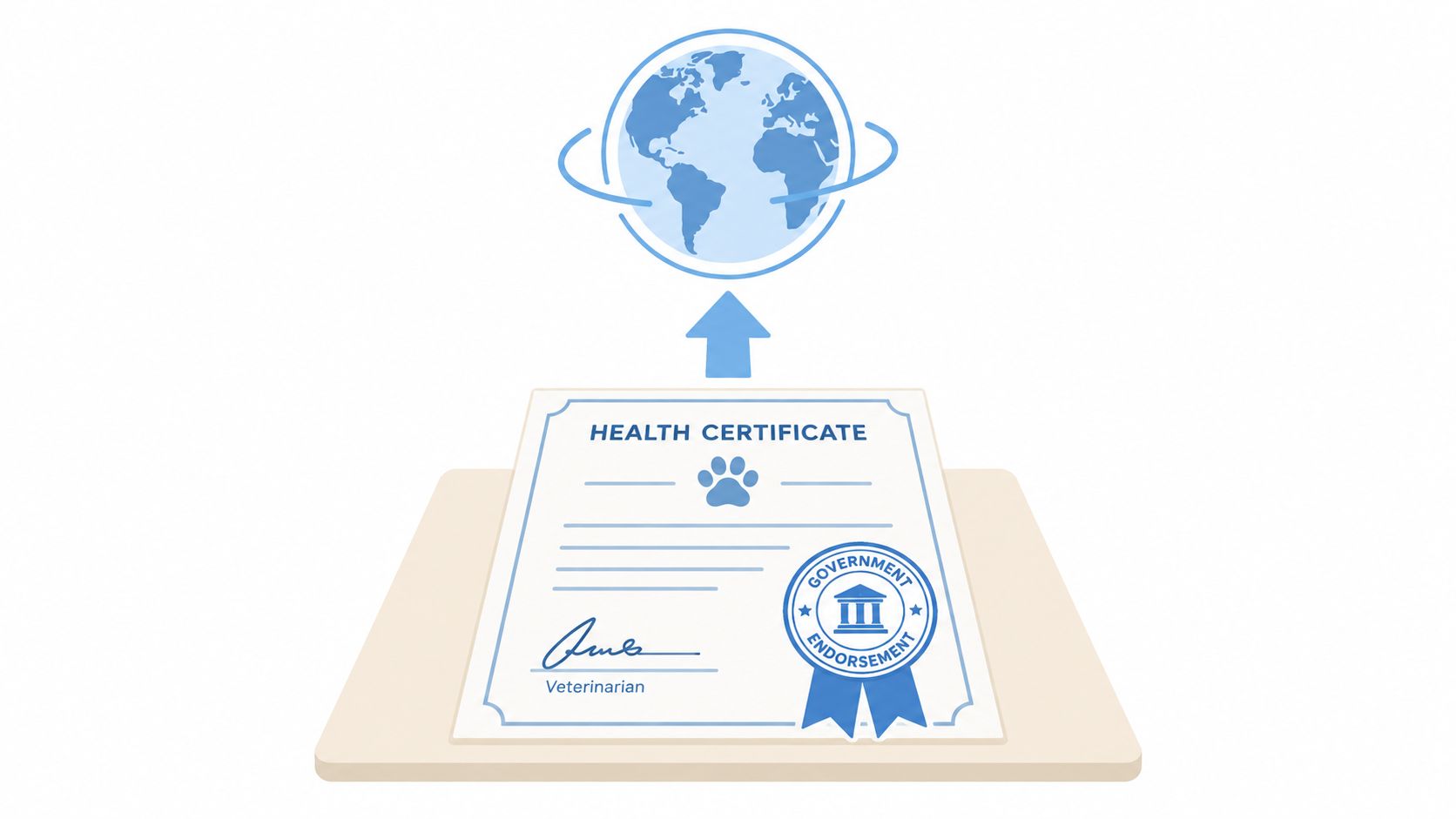
A signed veterinary certificate can still be incomplete for international export. The competent government authority in the exporting country may need to review and endorse it before China accepts the document. For U.S. travelers, USDA APHIS handles the export-certification endorsement workflow described earlier.
Treat endorsement as a scheduling constraint, not a final administrative chore. Work backward from the planned arrival date, allowing time for the veterinary certificate, government review, airline requirements, and any corrections. The 14-day clinical examination window and the 1-year validity of the rabies titer can overlap, but they do not solve the same problem. If one window expires while another remains valid, the file may still fail inspection or trigger quarantine procedures.
Ask the USDA-accredited veterinarian who prepares the certificate how the submission will be made, which supporting records are required, and who will monitor the review. Confirm the expected handling of corrections before the appointment. A clear owner for each step prevents a paperwork pup from slipping through the cracks.
Proofread as one connected file
Identity matching is the main document check. Compare the microchip number, implantation date, pet description, vaccination details, blood-collection date, laboratory name, and result across the complete file, following the Chinese entry guidance cited earlier in this guide.
Use a side-by-side review rather than checking each page in isolation:
Microchip: Compare every digit, including leading or trailing digits.
Pet description: Check species, sex, age or date of birth, and coat color.
Vaccination: Match dates and recorded product information.
Titer report: Match the blood-collection date, laboratory name, result, and units.
Certificate: Confirm that the veterinarian copied the same information into the official form.
A typo is not a medical diagnosis, but it can make the records appear to describe different animals. Officials may reject the file, request clarification, or require quarantine checks when the identity trail does not line up.
Coordinate the endorsement
Ask whether the submission will be electronic or handled through another approved process. For U.S. exports, the USDA-endorsed pet health certificate process explains the preparation and review steps for a submission packet.
Keep the itinerary visible to the veterinarian, shipper, airline, and government office. Each party may control a different part of the schedule. If one person changes a pet description, date, routing detail, or entry point without updating the rest of the file, conflicting versions can result.
Whichever routing an owner chooses, including flying pets on private jets, the endorsed certificate must describe the correct animal and support the applicable China entry pathway.
Before departure, request a final copy review. Check that the endorsed certificate is legible, all pages belong together, and the supporting originals are ready. A phone copy may help with reference, but it may not replace documents required for inspection. Confirm which items must be printed, which must remain original, and which officials may retain on arrival.
Your Ultimate Pet Travel Checklist and Departure Tips
Departure day should feel uneventful. Put the finished file together early enough that you can still correct a mismatch without chasing a laboratory, veterinarian, government office, and airline at the same time.
Use a physical folder for originals and a separate digital backup for reference. Keep the originals accessible during check-in and arrival, rather than burying them in checked luggage or a carrier pocket you can't reach easily.
The document check
Review the packet in this order:
Health certificate: Confirm that the final document is issued within the applicable arrival window and has the required official endorsement.
Rabies certificate: Carry the current original vaccination record with the details used on the export certificate.
Titer report: Include the original laboratory report when the route requires antibody testing.
Identity records: Check that the microchip number and pet description match on every page.
Travel details: Make sure the pet's name, your itinerary, airline booking, and entry port are consistent with the submitted plan.
Copies and backup: Keep readable copies separately from the originals, but don't treat copies as a substitute when an original is required.
At the airport and on arrival
Arrive with enough time to speak with the airline about the pet's documents and handling instructions. Keep the certificate packet dry, flat, and easy to open. Your pet may be calm, nervous, sleepy, or convinced that the carrier is a personal insult, so reduce the number of decisions you need to make at the counter.
Check that the selected arrival port can handle the quarantine or inspection pathway that applies to your pet. If the pet doesn't qualify for the simplified route, entry may be limited to a port with the required quarantine facilities. Confirm this before travel, not after the aircraft lands.
The final review should answer four questions:
Does the certificate describe this exact pet?
Do the rabies and titer records support the same timeline?
Is the certificate valid for the arrival date?
Does the itinerary use an eligible entry port and approved airline arrangement?
If the answer to any question is unclear, pause and ask the responsible professional to resolve it. A calm delay before departure is far easier than trying to untangle a document problem at customs. With a coordinated file, your dog or cat can arrive with paperwork that is as orderly as a well-packed treat bag.
Passpaw helps veterinary practices and pet travel teams manage destination-specific health-certificate workflows, collect records, validate details, prepare forms, and organize USDA submission materials when endorsement is needed. If you're coordinating a health certificate for export to China, visit Passpaw to see how the platform can help keep dates, documents, and client communication in one workflow.

More articles
From regulatory changes to best practices for veterinarians and pet owners, our resources keep you ahead of the curve.