Are you a team member in a veterinary practice?
Are you a pet parent planning a trip with your furry pal?
Moving to China from USA: The Essential Guide
Moving to China from the US is a huge life change, and it all starts with a solid plan. From getting the right visa to gathering stacks of paperwork, a successful move comes down to breaking big tasks into smaller, manageable steps. You really need to start thinking about this at least six months before you even think about boarding a plane.
Your Pre-Move Checklist for China
Taking the leap and moving to China is an incredible adventure, but it’s one that needs a lot of prep work to make sure everything goes smoothly. I always tell people to think of it like a long-term project with clear phases. It helps you stay organized and keeps the last-minute panic at bay.
The real key? Start early. Tackle the big, important stuff first, like legal paperwork and major logistics. Getting this right from the beginning sets the stage for everything else to fall into place.
Even with all the global shifts, China is still a massive draw for foreign talent. The number of foreign residents definitely dipped for a bit, but it's bouncing back as work and business opportunities pull people in. In fact, in 2024, China saw 64.9 million trips by foreign nationals, a jump of over 82% from the previous year. It’s a dynamic, evolving environment and a fascinating time to make the move for your career.
Building Your Relocation Timeline
A realistic timeline is your best friend in this process. Seriously. I recommend working backward from your target moving date. Set up a simple calendar or spreadsheet to track key deadlines for your visa, document authentication, and booking flights.
6-9 Months Out: This is the time to start looking into visa requirements. If you have a job lined up, your employer should be starting the work permit process for you right about now.
4-6 Months Out: Begin gathering all your essential documents. We're talking passport, university degree, and your criminal background check. Document authentication can be a slow process, so don't put this off.
3-4 Months Out: Once you have your work permit notice in hand, you can formally apply for your Z-Visa at a Chinese embassy or consulate. This is also a great time to start looking at housing options online to get a feel for the market.
I know making a detailed, written checklist can feel like a chore, but it's the single best way to manage the dozens of small tasks involved. It turns a mountain of stress into a series of achievable steps.
Essential Documents and Digital Access
Getting your paperwork sorted is a must-do. First, check your passport. Make sure it has at least six months of validity left beyond your planned stay and plenty of blank pages. You'll also need original copies of your university degree and a freshly authenticated criminal background check.
While you're building out that checklist, don't forget about your digital lifeline. A lot of Western websites and apps are blocked in China. Do yourself a favor and research the best VPN for China options before you go. It’s a good way to help ensure you’ll have access to the global internet.
Don't Forget Your Four-Legged Family
Bringing a pet? That’s a whole separate adventure and one you need to start planning months in advance. This isn't something you can scramble to do at the last minute.
The requirements are very specific, involving certain vaccinations, microchipping, and health certificates that have to be completed within a very precise timeframe. Don't let your furry friend's paperwork get lost in the shuffle; make it a top priority from day one. For a much deeper dive, check out our guide on the ins and outs of international pet travel.
Navigating Visas and Work Permits
Let's be honest: the visa process for moving to China from the USA can feel like a maze. It’s full of unexpected turns, but you can absolutely get through it without pulling your hair out. The trick is to understand exactly what’s needed and follow every step carefully.
For most Americans moving for work, the Z-Visa is your golden ticket. This is the standard work visa that lets you enter the country and then apply for your official Residence Permit. Your future employer in China will get the process started, but it's on you to gather and provide all the right documents.
This high-level infographic shows how the visa process fits into your overall timeline for getting your documents ready.
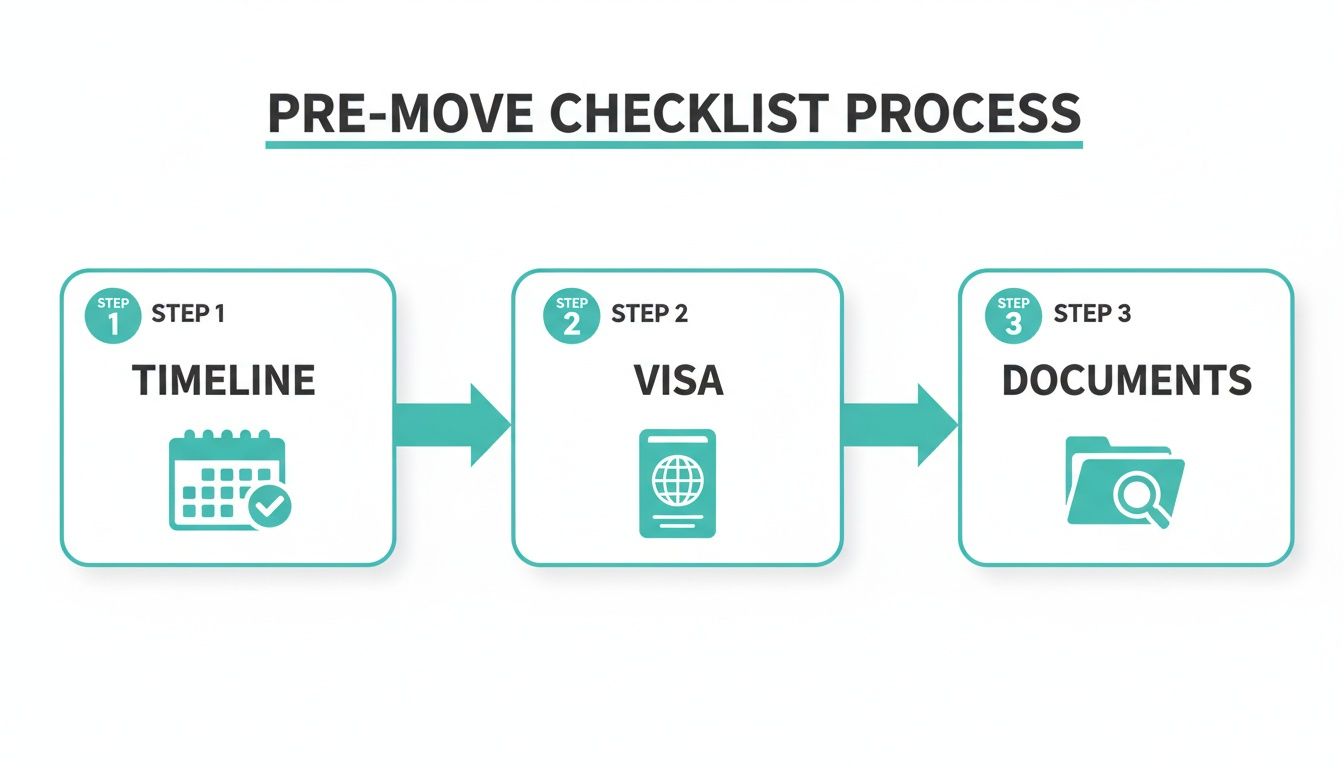
As you can see, getting your visa is a critical middle step. It depends on having your timeline and documents perfectly sorted out beforehand.
Understanding The Z-Visa Process
Your Z-Visa journey starts long before you ever see a Chinese embassy. It actually begins with your employer in China, who needs to apply for a Foreigner's Work Permit Notice for you. Think of this document as your official invitation to apply for the visa itself.
Once that notice is in your hands, the ball is in your court. You'll need to collect a very specific list of documents for your application. Don't take this part lightly—missing or incorrect paperwork is the number one reason applications get delayed or rejected.
A common pitfall is underestimating the timeline. From gathering and authenticating documents in the U.S. to finally getting the visa stamp in your passport, the whole thing can easily take two to three months. Build this buffer into your plans.
To make things a bit clearer, here’s a quick checklist of the essential documents you’ll need for the Z-Visa application.
Key Documents for a Chinese Work Visa (Z-Visa)
Document | Key Requirement | Common Pitfall |
|---|---|---|
Valid Passport | Must have at least 6 months of validity left and 2 blank pages. | Forgetting to check the expiration date until the last minute. |
Work Permit Notice | The official document secured by your employer in China. | Assuming this document is the visa itself; it's just the permission to apply. |
Visa Application Form | Filled out online; all details must match your other documents exactly. | Typos or inconsistencies between the form and your passport. |
Passport-Style Photo | Must meet strict size, background, and date requirements. | Using an old photo or one that doesn't meet the specific consulate guidelines. |
University Degree | Must be authenticated by the state and the Chinese consulate. | Not starting the multi-step authentication process early enough. |
Criminal Background Check | Also requires full authentication, just like your degree. | Getting a local or state-level check when a federal one might be needed. |
This table covers the basics, but always double-check the most current requirements with the Chinese embassy or consulate handling your application, as rules can and do change.
The Authentication Hurdle
This is where many people get tripped up. Two of your most critical documents—your university degree and a criminal background check—have to go through a formal, multi-step authentication process. This isn't just about making a few copies; it’s a government-level verification chain.
Here’s what that typically looks like:
Notarization: A local notary public has to notarize the document first.
Secretary of State Certification: Next, the Secretary of State's office in the state where the document was issued has to certify it.
Chinese Embassy/Consulate Legalization: Finally, the correct Chinese embassy or consulate in the U.S. gives it the final stamp of approval.
This process is slow and unforgiving. Each step has to be done perfectly before you can move to the next. Starting this the moment you accept your job offer will save you a world of stress later.
It’s also a good reminder that every official document for an international move needs careful handling. For instance, figuring out how to get a USDA-endorsed pet health certificate for your furry family members involves its own complex validation process. The lesson? Paperwork is king.
Managing Your Finances and Banking
Getting your money sorted out is one of the first, and most critical, things you'll do after landing in China. How you get paid, buy your groceries, and pay your rent all hinges on this. It's a completely different system from what you're used to in the USA, but trust me, once you get the hang of it, you'll wonder how you ever lived without it.
Before you even pack your bags, give your US banks a call. A quick heads-up about your move can save you a massive headache by preventing them from freezing your accounts for "suspicious activity" when you swipe your card overseas. It’s also smart to ask about their international wire transfer policies and foreign ATM fees.
Opening a Local Chinese Bank Account
Once you're in China and have your Residence Permit in hand, your very next stop should be a bank. This isn't optional, especially if you're working here. It's how your salary will be paid and how you'll manage day-to-day life.
Walking into a massive bank like Bank of China, ICBC, or China Merchants Bank might feel a little overwhelming at first. The good news is the process is usually pretty straightforward. If your Mandarin isn't quite there yet, try to bring a Chinese-speaking friend or colleague along. English-speaking staff aren't always available, particularly outside of the main city branches.
You'll need a few things to get set up:
Your Passport: Make sure it has your valid visa and Residence Permit inside.
Proof of Address: This can be your apartment lease or the registration form you get from the local police station.
Your Chinese Phone Number: This is a must-have for account verification and security.
The whole thing usually takes about an hour. You'll sign some forms, choose a PIN, and walk out with a brand-new bank card and access to their mobile banking app. Don't hesitate to ask questions—it’s important you understand everything.
It's fascinating to think that while you're starting a new chapter in China, the flow of people goes both ways. By 2023, the Chinese immigrant population in the U.S. had grown to roughly 2.4 million people, doubling since the year 2000. This constant exchange really underscores the deep, ongoing connections between our two countries. You can find more details on this trend over at migrationpolicy.org.
Embracing the World of Mobile Payments
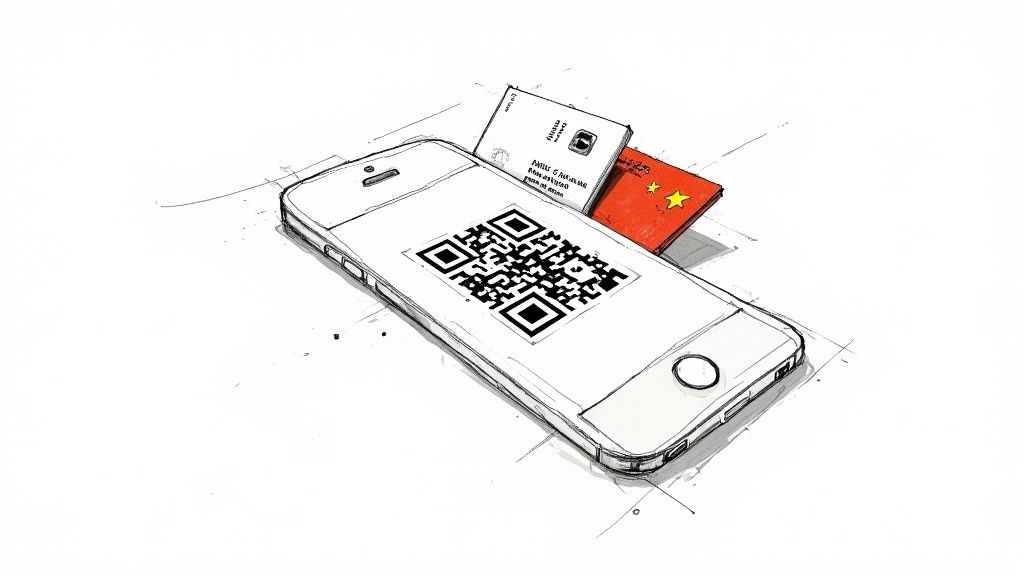
If there’s one thing to understand about daily finances in China, it's this: cash is no longer king. The entire country runs on mobile payments. You’ll quickly learn that everything, from a snack at a street stall to a purchase in a high-end mall, is paid for by scanning a QR code with your phone.
The two giants in this space are Alipay (from Alibaba) and WeChat Pay (built into the mega-app, WeChat). Getting these apps set up is the final, crucial piece of the puzzle. Once your Chinese bank account is open, you can link your new card to both apps in just a few minutes.
My advice? Set up both Alipay and WeChat Pay. While nearly every place accepts both, you’ll inevitably run into a small shop or restaurant that only takes one. Having both means you’re always covered.
Making the switch to a virtually cashless life can be a bit of a shock at first, but the convenience is incredible. No more fumbling for change or carrying a thick wallet. Your phone is all you need, making everyday transactions ridiculously efficient. Welcome to the future.
Finding a Home in Your New City
Once you've landed and started to get your bearings, the real adventure begins: finding a place to live. Hunting for an apartment when moving to China from the USA can feel like a bit of a whirlwind, but with some insider knowledge, you can land a great spot without pulling your hair out. This is the step that makes it all start to feel real.
Right off the bat, you have a big decision to make. Do you hire a real estate agent or try to navigate the market yourself using local apps? There are good arguments for both, and the best choice really comes down to your Mandarin skills and how comfortable you feel jumping into the local scene.
Should You Use a Real Estate Agent?
For most expats, especially if it's your first time in China, hiring an agent is the smartest move. They know the neighborhoods, have access to listings that never make it online, and can be your advocate in a market that has its own unique rules. A good agent is worth their weight in gold for bridging the language gap, negotiating rent, and making sure you don't get lost in the fine print of a Chinese rental contract.
Of course, that expertise comes with a price tag. The standard agent fee is usually 35% to 50% of one month's rent, which you, the tenant, will pay. It’s a one-time hit, but it's a significant one you need to have ready in your budget.
Here’s a pro tip: don't just stick with one agent. Unlike in the States where listings are often exclusive, different agents in China can have completely different sets of properties. Meeting with a few is a great strategy to broaden your options and find that perfect apartment.
Now, if you're the adventurous type and your Mandarin is solid, you can definitely go it alone. Apps like Lianjia (链家) and Anjuke (安居客) are the go-to platforms for browsing listings directly from landlords. You'll save a chunk of change on the agent fee, but be prepared to put in a lot more legwork.
Understanding Rental Costs and Deposits
The payment structure for renting in China is probably the biggest surprise for Americans. Landlords almost always expect a hefty upfront payment before they’ll even think about handing over the keys.
The most common system is called 付三押一 (fù sān yā yī). It means you pay three months' rent in advance plus a one-month security deposit. You read that right—that's four months' rent due all at once. Some landlords might be open to a "pay one, deposit one" deal, but that's much less common, particularly for foreigners.
Let's break down what you should budget for:
Monthly Rent: This varies massively. A modern one-bedroom in downtown Shanghai could easily top $1,500 USD, while a similar place in a Tier 2 city might be less than half of that.
Security Deposit: This is almost always equal to one month's rent.
Agent Fee: If you use one, expect to pay 35-50% of one month's rent.
So, for an apartment renting for $1,000 a month, you could be looking at an initial cash outlay of $4,500 or even more. Make sure you have these funds ready to go.
What to Look for During an Apartment Viewing
When you're walking through potential apartments, you've got to be your own inspector. It’s easy to get distracted by a great view, but the little details are what will make or break your daily life. This isn't a time to be polite and quiet.
Actually turn on the shower and sinks to check the water pressure. Ask about heating and air conditioning, and then test them. This is huge. In northern China, central heating is standard but only runs during set winter months. In the south, you'll be relying on individual AC units for both cooling and heating, so you need to know they work well.
And don't forget the utilities. In many buildings, you prepay for electricity and water with a top-up card. You’ll also want to ask how to get internet set up—the agent or landlord can usually point you toward the main providers like China Telecom or China Unicom. Taking the time to get these details right ensures finding your new home is a success, not a catastrophe that haunts you later.
Bringing Your Pet to China
Moving to a new country is a huge undertaking, but the thought of leaving your pet behind is often unthinkable. Bringing your furry best friend to China from the USA takes some serious planning, but seeing them settle into your new home makes every bit of paperwork worthwhile.
This isn't just about booking a ticket for your pet. It's a series of time-sensitive veterinary steps that have to be followed to the letter. Getting it right ensures a safe, smooth journey for a member of your family.

China has very specific rules for importing cats and dogs. Typically, you're limited to one pet per passport holder, and they must travel with you as accompanied baggage. The process can feel a bit overwhelming, but breaking it down makes it manageable.
Core Requirements for Pet Entry
To get your pet into China without a hitch, you need to check a few critical boxes. Each one has its own timeline, so staying organized is the key to avoiding any last-minute drama at the border.
First, your pet needs an ISO-compliant microchip. This is a 15-digit chip that acts as their permanent ID. If your pet has an older, non-compliant chip, you might need to implant a new one or carry your own scanner.
Next up is vaccinations. Your pet will need two rabies vaccinations. The first shot has to be given at least 30 days before the second one. The second shot, in turn, must be administered within one year of your travel date. All of this has to be perfectly documented on their vaccination records.
The International Health Certificate
This is the single most important document in the entire process. The International Health Certificate, sometimes called a "pet passport," is an official form that must be filled out by a USDA-accredited veterinarian. It's their official declaration that your pet is healthy and meets China's import rules.
This is far more than a simple wellness check form. The vet has to record everything with precision—microchip number, vaccination dates, and the results of a clinical exam. Once the vet signs off, the form has to be sent to your state's USDA office for an official endorsement stamp.
The timing here is everything. The final health exam and the USDA endorsement must happen within 14 days of your pet's arrival in China. This tight window leaves very little room for error.
This is where things can get stressful for both pet owners and even experienced veterinarians. Making sure every detail is perfect on such a tight deadline is a real pressure cooker. To make this much simpler, our pet travel planner for moving from the United States to China offers clear, step-by-step guidance. Platforms like Passpaw are built to help vets manage these complex documents, ensuring everything is accurate and on time.
To help you visualize the timeline, here’s a quick overview of the key steps and when you need to complete them.
Pet Import Timeline to China From the USA
Step | When to Complete | Key Detail |
|---|---|---|
Microchip Implantation | 3+ months before travel | Must be an ISO-compliant, 15-digit chip. |
First Rabies Vaccination | 2-3 months before travel | Administered after microchipping. |
Second Rabies Vaccination | 1-2 months before travel | Must be at least 30 days after the first shot. |
Book Flight | 1-2 months before travel | Confirm airline pet policy and book pet as accompanied baggage. |
Final Vet Visit & Health Certificate | Within 14 days of arrival | Vet completes the International Health Certificate. |
USDA Endorsement | Within 14 days of arrival | The certificate must be stamped by the USDA after the vet visit. |
Travel to China | Departure Day | Arrive with all original, endorsed documents. |
This timeline is a guide, but remember that every pet's situation is unique. Starting early and double-checking every detail is the best strategy.
Navigating Quarantine on Arrival
When you land in China, your pet and their documents will be inspected by customs officials. The good news? Thanks to recent policy updates, pets with a valid microchip and all the correct paperwork can often skip the mandatory 30-day quarantine. That's a huge relief for pet owners!
However, this quarantine exemption is only available at certain major airports, like Shanghai, Beijing, and Guangzhou. You should confirm the rules for your specific port of entry, as policies can vary. One small mistake on the paperwork could unfortunately send your pet to a government quarantine facility—a stressful and expensive outcome nobody wants. Proper preparation is the paw-sitive way to ensure a happy, immediate reunion.
A Few Common Questions Answered
Even the most buttoned-up relocation plan comes with a few “what ifs.” It’s completely normal. Here are some quick answers to the questions we hear most often from people making the move from the US to China.
What Is the Cost of Living Like in China?
This is a big one, and the honest answer is: it completely depends on where you land. If you’re heading to a major international hub like Shanghai or Beijing, the cost of living can easily rival New York or Los Angeles, especially when it comes to rent for a Western-style apartment.
But once you step outside those Tier 1 cities, you'll feel your wallet relax. Everyday expenses like groceries, a ride on the subway, or grabbing dinner at a local spot are significantly more affordable than back in the States. Housing will almost always be your biggest line item.
Is It Hard to Make Friends and Meet People?
Not at all, but you do have to put yourself out there. Most big cities have incredibly active expat communities with social groups for just about every hobby imaginable—hiking clubs, sports leagues, book clubs, you name it.
And don't hesitate to connect with your Chinese colleagues and neighbors! Many locals are genuinely welcoming and curious about American culture. Showing a real interest in their language and customs is the fastest way to build solid friendships and feel truly connected to your new home.
How Necessary Is It to Learn Mandarin?
Look, you can survive with English inside the expat bubbles of the big cities. But learning even just a little bit of Mandarin will radically improve your day-to-day life. Knowing the basics for ordering food, telling a taxi driver where to go, and simple greetings opens up a whole new world.
You don't need to be fluent overnight, but making an effort goes a long way. It shows respect and makes daily life much smoother, especially when you venture outside the main city centers.
Locals really appreciate the effort, and it can turn a simple transaction into a friendly, memorable interaction.
Can I Still Access Websites Like Google and Facebook?
Websites you use every day—like Google, Facebook, Instagram, and YouTube—are blocked in China. To get around this, you might need a Virtual Private Network (VPN). It may be a good idea to research, purchase, and install a reliable, paid VPN service before you get on the plane. Setting one up once you’re already in the country can be a massive headache.
What Should I Do if My Pet's Paperwork Has an Error?
Finding a mistake on your pet’s travel documents can send anyone into a panic. First, take a breath. Then, contact your USDA-accredited veterinarian immediately. Correcting documentation isn’t just a quick fix; it often means re-issuing forms and getting a brand new USDA endorsement, so time is absolutely of the essence.
To get ahead of any potential issues, you and your vet should review our detailed guide on the veterinary international health certificate. It’ll help you both ensure every single detail is purr-fectly in place from the start.
Moving your best friend shouldn't be the most stressful part of your relocation. At Passpaw, we give veterinarians the tools to manage and validate international pet travel documents, making the process straightforward and efficient for everyone. Learn how we can help at https://passpaw.com.

More articles
From regulatory changes to best practices for veterinarians and pet owners, our resources keep you ahead of the curve.