Are you a team member in a veterinary practice?
Are you a pet parent planning a trip with your furry pal?
Launch Your Global Pet Travel Agency: A 2026 Guide
USD 2.4 billion in 2024, projected to reach USD 3.9 billion by 2030 at an 8.9% CAGR. That's the size of the opening for anyone serious about building a global pet travel agency, according to Grand View Research's pet travel services market report.
This business looks warm and fuzzy from the outside. In practice, it runs on timing, document control, partner coordination, and calm communication when a client is one missed form away from a grounded schnauzer. If you want to start an agency that lasts, you need more than a love of animals. You need a system.
The good news is that demand is real, pet owners are motivated, and modern workflow tools make it far easier to build a solid operation than it was a few years ago. The hard part is that one-size-fits-all processes don't travel well. Every destination, airline, veterinarian, and customs checkpoint can change the game.
The Booming Business of Moving Best Friends
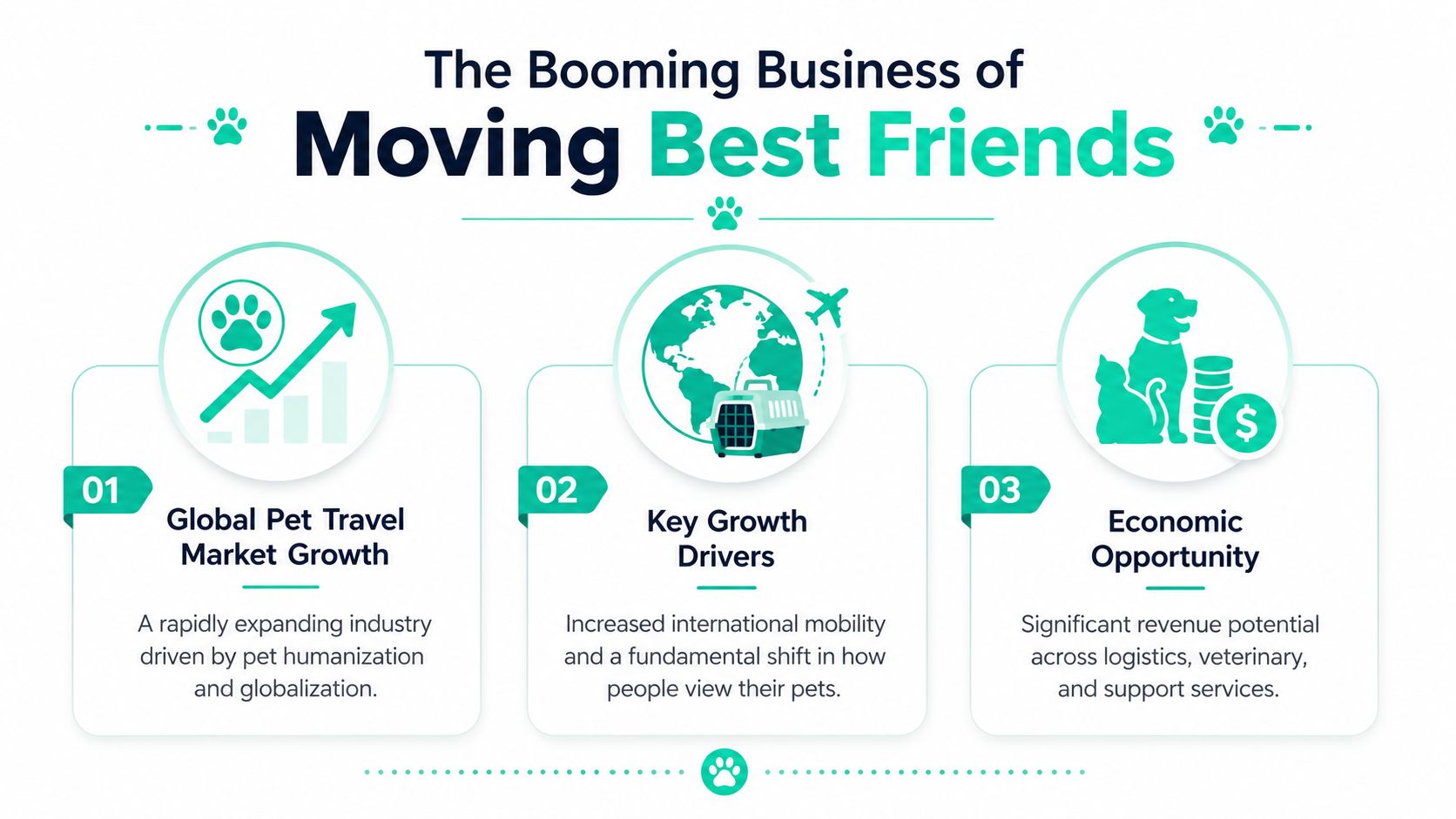
Pet travel is growing fast enough that founders should treat it like an operations business from day one, not a boutique concierge service built on memory and goodwill alone. As noted earlier, the market is expanding. What matters here is what that growth changes: more demand, more route complexity, more anxious clients, and less room for sloppy execution.
A global pet travel agency sells confidence under deadline. Its core product is a controlled process that keeps medical paperwork, airline rules, owner communication, and handoffs aligned from booking to arrival.
Why owners buy help instead of handling it alone
Clients rarely come to an agency because they cannot book a ticket. They come because one missed endorsement, one wrong crate size, or one untranslated document can derail the trip. The emotional stakes are high, and the process punishes small mistakes.
That changes how a smart agency should be built. Clear timelines matter. Checklists matter. Status visibility matters. A modern operator uses a rules engine and workflow system, not a patchwork of inbox threads and spreadsheets, because scale breaks manual coordination quickly. Tools such as Passpaw's guide to international pet travel requirements help teams standardize country rules early, before a case turns into a scramble.
Owners usually pay for help for four practical reasons:
They want one accountable point of contact. A veterinarian, airline, customs office, and destination contact may all play a role, but the client wants one person owning the plan.
They want risk reduced. Entry refusal, quarantine surprises, and expired documents are expensive mistakes.
They want trade-offs explained. Direct flight versus lower fare. In-cabin versus manifest cargo. Faster route versus safer timing buffer.
They want less mental load. Pet travel often happens during a relocation, military move, or family transition that is already stressful.
Translation and document legalization also become sticking points on some routes. Agencies that prepare for that early save clients time and avoid late-stage surprises, especially when owners need a complete guide to apostille and translation for supporting paperwork.
What makes this business attractive
The upside in this field comes from specialization and repeatability. Founders can start with document review, airport-to-airport planning, or a narrow corridor such as US to EU relocations. They do not need a giant service menu on day one. They need a service they can deliver consistently.
That is the trade-off new operators need to understand. High-touch service wins trust, but custom work on every file kills margin. The agencies that last build standard operating paths for common move types, then reserve human judgment for exceptions.
This is also why technology matters early. Traditional operators spend too much time chasing forms, checking country rules by hand, and updating clients manually. A tech-enabled agency can centralize task tracking, document status, deadline alerts, and partner communication in one workflow. That makes the business easier to run and much easier to scale.
Start narrow. Build a process that holds up under pressure. Then add routes, partners, and premium services once the machine works.
Navigating the Global Regulatory Maze
Regulations are where good intentions go to die. If you want to run a reliable global pet travel agency, you need a method for handling compliance that works across destinations without pretending every country plays by the same rules.
The cleanest way to think about it is through three pillars: the health certificate, the import permission layer, and the destination-specific extras.

Start with the health certificate
The health certificate is the anchor document in most international pet moves. It's also where timing mistakes happen fast.
Most countries worldwide mandate that a pet's international health certificate must be officially completed and approved by the relevant government authority within exactly 10 days of the pet's arrival; if this strict 10-day window is missed, the entire document becomes invalid, according to Passpaw's summary of international pet travel requirements.
That single rule should change how you build your workflow. You don't schedule veterinary work when it's convenient. You schedule backward from travel and arrival dates, then confirm endorsement timing before anyone books the final route.
The second layer is import approval
Many owners think vaccination records are enough. They often aren't.
Some destinations require a rabies antibody titer test to show the vaccine produced an adequate immune response. Many also require an Import Permit, which functions like a pre-approved authorization before travel can be finalized. If your agency doesn't check for these early, you can end up with a valid flight plan and an invalid entry plan.
A practical intake review should always ask:
What country is the pet entering?
Is an import permit required before booking?
Is a titer test required, and if so, what lead time does that create?
Does the destination require government endorsement, translation, or extra authentication?
When translation or official document authentication enters the picture, it helps to keep a reliable reference on hand. For supporting paperwork that may need legalization in cross-border situations, this complete guide to apostille and translation is a useful operational resource.
Destination rules break cookie-cutter processes
A beginner mistake is building one generic checklist and applying it to every route. That's how pets get delayed, owners panic, and your inbox starts barking at midnight.
Use a destination-first system instead:
Compliance area | What to verify |
|---|---|
Health certificate timing | Validity window and endorsement timing |
Vaccination record | Required vaccines and date alignment |
Additional testing | Titer tests or other destination-specific checks |
Import clearance | Permit requirements and approval sequence |
Language and document format | Whether translated or authenticated copies are needed |
The agency's real product isn't paperwork. It's judgment about sequence.
That's why research discipline matters. A strong operator maintains a current rules database, verifies details before each trip, and avoids casual assumptions like “we did France last month, so Spain must be similar.” Close is not compliant.
For route planning, build your process around one trusted requirements source per trip. A good starting point is this international pet travel requirements guide, then confirm any route-specific needs with the relevant authorities and travel partners before finalizing the move.
Building Your Pack A Network of Partners
A global pet travel agency is only as reliable as the people it can reach on short notice. You can have polished branding, tidy forms, and a clever CRM. None of that helps when a certificate needs correction today, a crate measurement has to be reconfirmed, or customs needs one missing detail before release.
Your partner network is a working asset. Treat it that way.
The three partners you need first
The first is the USDA-accredited veterinarian or equivalent travel-savvy veterinary partner. This person doesn't just sign forms. They shape timelines, catch medical mismatches, and often determine whether a file moves smoothly or stalls.
The second is the pet shipper or air logistics specialist. You need someone who understands live-animal booking rules, airline restrictions, and how to communicate clearly when the itinerary shifts.
The third is the destination-side customs or entry support contact. This might be a broker, local relocation partner, or ground handler. When a pet lands and something needs clarification, local knowledge saves hours.
What a good partner relationship looks like
New agencies often collect names instead of building operating relationships. That's not enough. You need response expectations, escalation paths, and clarity on who owns which part of the file.
Look for partners who show these habits:
Clear communication: They answer in plain language, not vague “should be fine” messages.
Repeatable process: They use checklists, scheduling discipline, and documented handoffs.
Comfort with edge cases: They don't freeze when a route changes or a form needs revision.
Respect for timing: They understand travel windows and don't treat pet travel paperwork like routine admin.
A strong network also helps you decide what not to offer. If you don't yet have trusted destination support in a region, don't pretend otherwise. Say no, or subcontract carefully.
Relationships rescue trips
A connected agency can recover from problems that would sink a solo operator. A vet who understands travel timing may squeeze in a certificate appointment that saves a departure. A shipper can flag an airline mismatch before a booking is paid. A local broker can sort out an arrival query before it turns into an overnight hold.
Field note: The best partner calls are boring. Everyone knows the file, the deadlines, and the next action. Chaos usually starts where assumptions begin.
If you're building service lines around transport support, it helps to understand how clients think about escorted and managed options. This overview of pet courier services is useful for shaping that part of your offer.
Designing Your Services and Pricing Models
Pricing is where many new pet travel agencies lose margin and client trust at the same time. The usual mistake is simple. They price the visible tasks and ignore the actual work behind the file: deadline control, client updates, vet coordination, airline rule checks, and the cost of fixing avoidable errors.
A strong offer is easy to understand, easy to quote, and profitable to deliver. If a client cannot tell what they are buying, or your team cannot scope it quickly, the service menu needs work.
Build services around client involvement, not around your internal tasks
Clients do not shop for "document review" or "timeline tracking" in isolation. They buy outcomes. Usually that means one of three things: a second set of expert eyes, active compliance management, or full trip coordination.
That distinction matters because it keeps your offer clear while still giving you room to handle route-specific differences.
Package | Best for | What's included |
|---|---|---|
Doc Check | Confident travelers | Destination rule review, paperwork checklist, document screening, written next steps |
Managed Compliance | Busy owners | Vet coordination, deadline tracking, certificate support, permit handling, client updates |
VIP Very Important Pet | Full-service clients | End-to-end planning, booking coordination, travel monitoring, arrival-side support |
This structure also makes sales easier. A client can recognize their situation quickly, and your team can quote from a controlled framework instead of rebuilding the proposal from scratch each time.
For a modern agency, packaged services also make automation possible. Platforms such as Passpaw work best when your offers map to repeatable workflows, required documents, and clear handoff points. If every file is sold as a one-off custom job, software cannot reduce much admin load.
Price the file you are actually managing
Pet travel pricing should reflect labor, risk, and communication volume. A straightforward domestic move with an organized client is not the same product as an international relocation with permit timing, multiple parties, and a narrow travel window.
Use a pricing model that accounts for:
Route complexity: Import rules, sequencing requirements, and destination-specific approvals
Communication load: How often the client will need updates, reassurance, and document review
Third-party coordination: Time spent with clinics, airlines, brokers, and destination contacts
Urgency: Short lead times increase the chance of rework and consume more staff attention
Exception risk: Breed restrictions, route changes, missing records, or expired vaccines
One practical model is a fixed agency fee by package, plus clearly named variable charges for urgency, permit handling, and transport coordination. That keeps the quote stable enough for clients to trust and flexible enough for you to protect margin. Agencies that want a cleaner way to model service value can use this pet travel practice revenue calculator to set pricing logic before volume increases.
Keep third-party costs separate from your agency fee
Many agencies create avoidable friction by mixing clinic fees, government charges, courier costs, and airline charges into one number, then struggle to explain changes later.
Separate the quote into plain categories:
Agency fee: Planning, compliance work, coordination, and client communication
Veterinary fees: Exams, treatments, lab work, and health certificate appointments
Government or import fees: Permit charges and official processing costs
Transport costs: Airline, crate, ground transport, and related handling fees
Clients handle expensive moves better when the quote is specific. They push back when the total changes and no one can explain why.
Design pricing for scale, not just for the first sale
A service menu should help your team quote faster, train faster, and spot bad-fit inquiries earlier. It should also show where technology carries the load. If your pricing model depends on a senior staff member manually interpreting every route and every exception, growth will stall.
The better approach is to standardize the common work, isolate the exceptions, and use software to keep compliance steps and document status visible across the whole file. That is how a small agency avoids becoming an inbox full of custom quotes, follow-up reminders, and margin leaks.
Mastering Your Operational Workflow
Smooth operations don't happen because your team cares. They happen because the workflow tells people what to do, in what order, and by what deadline. If you're building a global pet travel agency, your operations need to be sturdy enough for repeat business and flexible enough for route-specific changes.
The core workflow should run from intake to arrival confirmation without relying on memory.
Map the journey before you take bookings
Start with a standard intake process. Collect species, breed, age, origin, destination, target travel date, owner contact details, current vaccination records, and any prior travel documents. If you skip detail here, it comes back later as rework.
This visual captures the shape of a good operating flow.
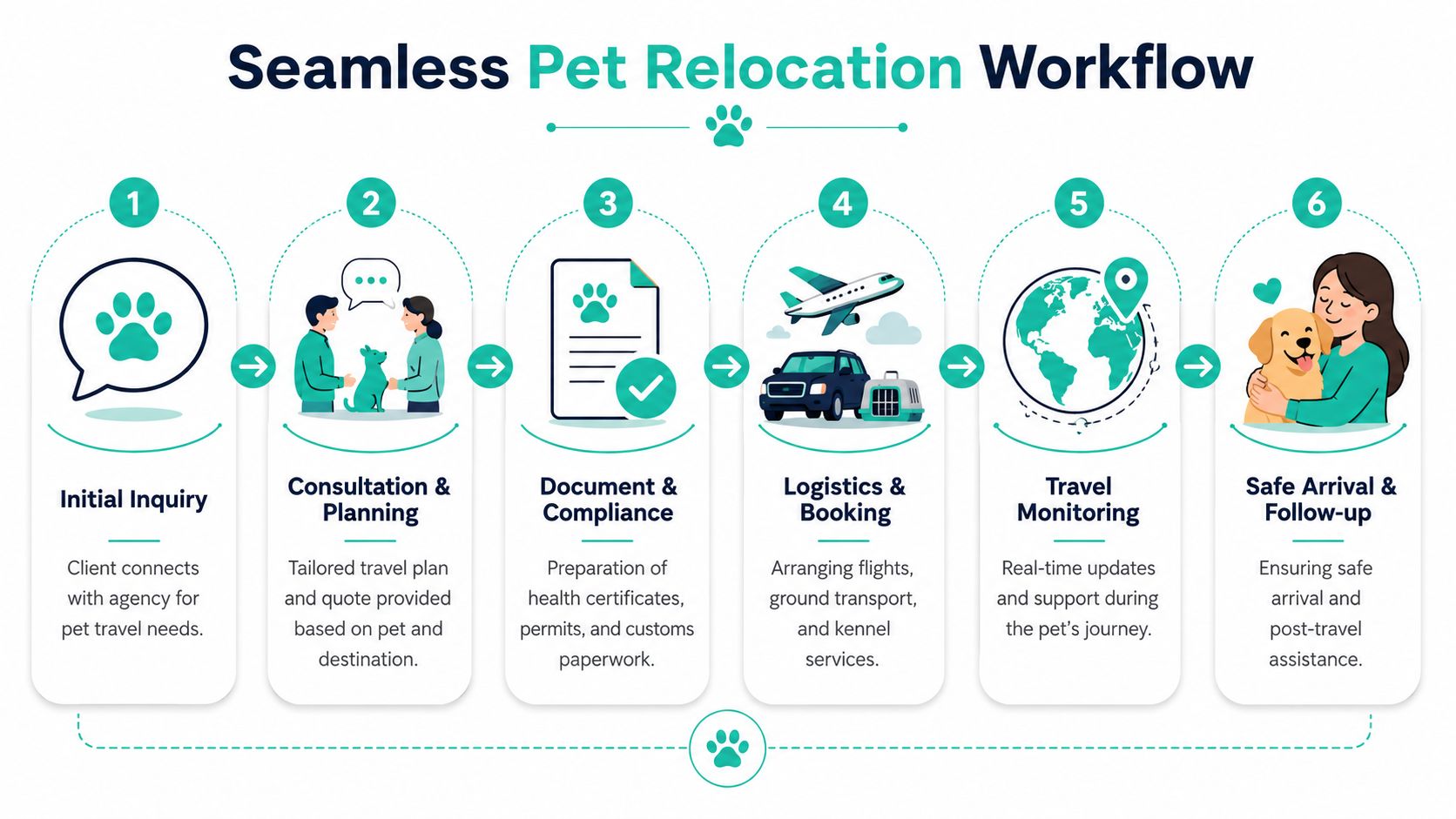
After intake, move each file through fixed checkpoints:
Route review based on destination and travel mode.
Document gap check to see what's missing or expiring.
Veterinary scheduling aligned to the travel timeline.
Booking coordination only after document timing is viable.
Pre-departure confirmation with client and partners.
Arrival follow-up to close the file and record lessons learned.
Keep one source of truth for documents
Document sprawl kills efficiency. If half the file lives in email, another part in text messages, and the rest in a shared drive with odd filenames, you'll lose time and eventually miss something important.
For U.S.-origin travel, one document sits at the center of many files. For pets leaving the United States, the USDA APHIS Form 7001 (United States Interstate and International Certificate of Health Examination for Small Animals) is the primary document required, and it must be officially endorsed by the USDA to be valid for entry into most countries, as outlined in Passpaw's guide to the USDA pet travel certificate.
That means your workflow should include a dedicated checkpoint for:
Form readiness: Is the underlying medical record complete and current?
Signature path: Who completes it, reviews it, and sends it for endorsement?
Date control: Do the appointment date, endorsement window, and travel date line up?
Client confirmation: Has the owner reviewed names, dates, and destination details?
Communication should be proactive, not reactive
Clients get anxious when they don't know what's happening. Most status emails can be prevented with a predictable update rhythm.
A simple communication cadence works:
Stage | Client message |
|---|---|
Intake complete | Summary of route, likely requirements, next documents needed |
Vet scheduled | Date, purpose, and what to bring |
Docs in review | What's being checked and any risks to timing |
Pre-travel | Final checklist, handoff instructions, day-of plan |
Arrival | Confirmation and any next-step reminders |
A calm client usually means your process is visible to them.
That's the operational sweet spot. Your team has a checklist. Your partners know the handoff points. The client knows what comes next. Fewer surprises. Fewer frantic calls. More room to scale without chasing your tail.
Scaling Your Agency With Smart Automation
Pet travel volume is rising, but headcount usually is not. Agencies that keep relying on inbox triage and spreadsheet reminders hit a ceiling fast. The first cracks show up in missed document requests, preventable deadline errors, and staff spending half the day answering status questions instead of moving files forward.
Automation fixes a specific scaling problem. It gives your team a consistent way to move every case through intake, compliance review, partner coordination, and client communication without rebuilding the process from scratch each time.
The first systems to automate are the ones that create delay or rework when a person misses a step.
Good starting points include:
Task routing: Queue files by travel date, endorsement window, species, and destination risk.
Document intake: Collect records through structured forms and checklists instead of long email chains.
Requirement checks: Compare each itinerary against current destination rules before a coordinator starts final review.
Client updates: Trigger routine progress messages at predefined milestones so staff are not writing the same email 30 times a week.
Teams also need to be realistic about where software helps and where it does not. A platform can flag a missing rabies certificate or an endorsement timing issue. It cannot calm a nervous owner whose pet was just rebooked through a different airport, and it should not make judgment calls on unusual routes without human review.
For that reason, I set automation up in layers. Intake should capture clean data. Compliance tools should surface timing conflicts and missing documents. Communication tools should keep the client informed without pulling coordinators into constant back-and-forth. Staff still own the exceptions, partner escalations, and final quality control.
A centralized platform matters because pet travel work is not just document storage. It is deadline management, rule checking, task ownership, and visibility across the whole file. Passpaw is built around those operational choke points, which is why it is useful for agencies that want one place to manage international health certificates, destination requirements, and client communication instead of stitching together generic tools.
A simple operating split keeps automation practical:
Layer | What software should do | What staff should do |
|---|---|---|
Intake | Capture structured client, pet, route, and document data | Review unusual submissions and correct bad inputs |
Compliance | Surface deadlines, missing items, and route-specific rule conflicts | Confirm route logic and approve final file quality |
Communication | Send milestone updates, reminders, and document requests | Handle exceptions, anxious clients, and final decisions |
This management model also changes how you hire. New coordinators can learn the workflow faster when the system tells them what is due next, what is blocked, and what needs escalation. Owners and practice managers get cleaner oversight too. They can see where files stall, which destinations create the most rework, and where staffing pressure is building.
That is the same reason larger clinics and agency teams invest in scalable veterinary services for growing practices. Growth stops being a staffing question alone. It becomes a systems question.
There is also a back-office side to scaling. Once volume rises, agencies often need tighter internal documentation, vendor agreements, and approval flows. Tools like LegesGPT's AI assistant for contracts can reduce admin drag without turning coordinators into full-time paperwork managers.
The agencies that grow well stay personal because their operations are controlled, visible, and repeatable. That is what modern automation is supposed to do. It reduces avoidable chaos so your team can spend its time on the cases that need expert judgment.

More articles
From regulatory changes to best practices for veterinarians and pet owners, our resources keep you ahead of the curve.