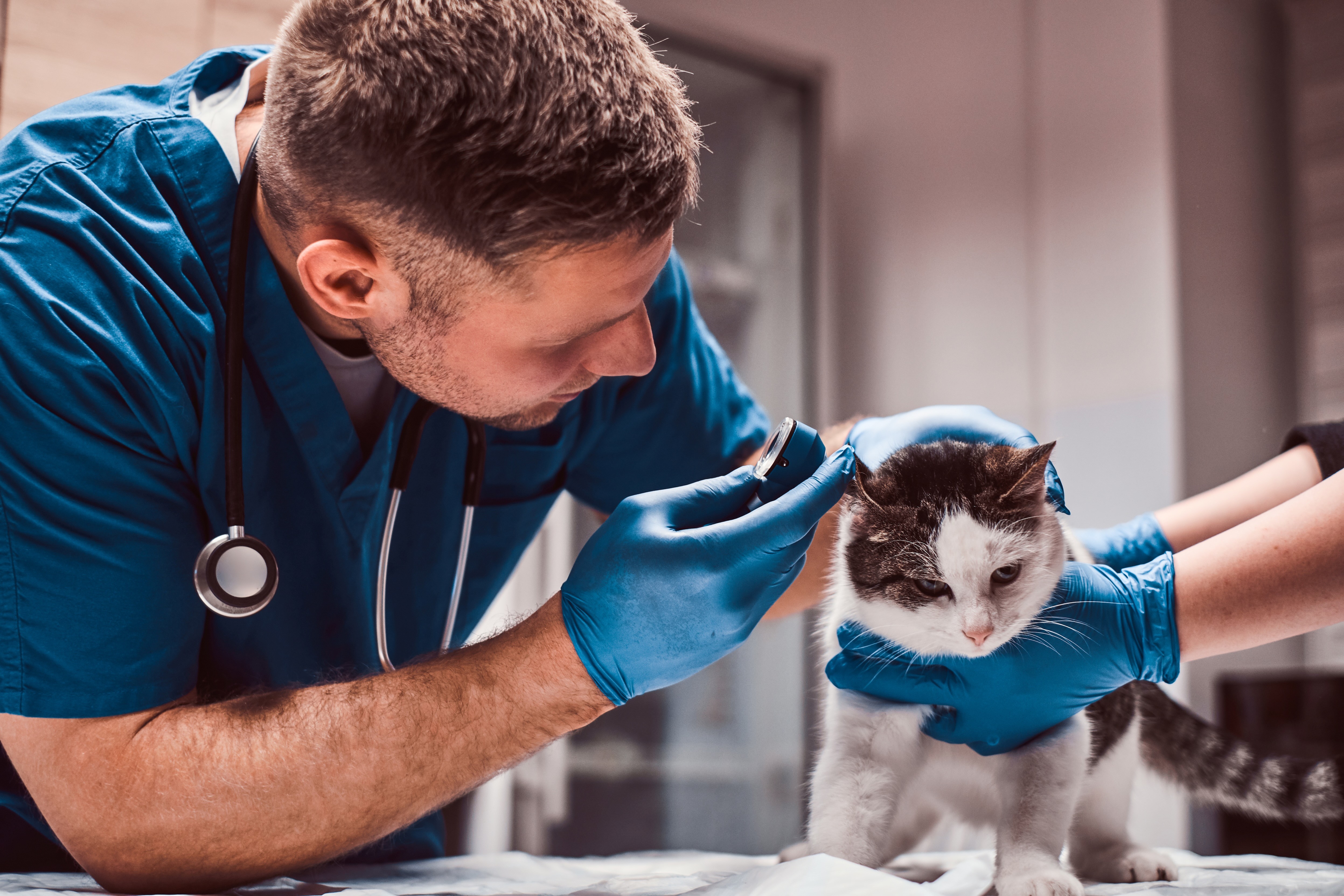
Are you a team member in a veterinary practice?
Are you a pet parent planning a trip with your furry pal?
Global Health Link for Pet Travel: A Practical Guide
The usual advice is to check your destination's pet-entry rules and book a vet appointment. That's a start, but it misses the stop most likely to disappear from a checklist: the connection between flights. A transit country can create a paperwork problem even when you've prepared carefully for the final destination.
Treat the whole itinerary as the unit of planning. Your pet's records, appointments, flight connections, and return journey need to fit together before you commit to tickets.
What Global Health Link Means for Pet Travel
Global health link isn't an official government term, product, or single system. You don't need to find a government portal with that name. In pet travel, it's a useful way to describe the connected chain between a pet's microchip, vaccination record, veterinary health certificate, and route requirements.
Think of a bicycle chain. Each link connects to the next, and a weak link can stop the ride. You might not notice the weakness while the bike is standing still. In the same way, a missing connection between records may become obvious only when someone checks the pet for travel.
This use of the phrase is different from World Health Organization statistics about human health. Population health reports don't tell you which certificate your dog needs for an airport connection.
Start with the route: A destination checklist answers where your pet is going. A travel chain also accounts for how your pet gets there and comes home.
The USDA APHIS pet-travel FAQ explains that requirements differ by destination, animal type, and transit country, that there's no single international pet passport or standardized certificate, and that an EU transit stop on the way to a non-EU destination can require a separate transit health certificate.
Make the connection visible
Say a cat travels to a non-EU destination through an EU airport. Don't assume the final destination's paperwork settles the connection. Record the transit stop as a separate item for review.
That route-first approach gives each later task a purpose: calculate timing, connect identity to vaccination, arrange the right certificate, and check acceptance before travel.
Destination Timing Rules at a Glance
Certificate windows and rabies timing by route
Route | Certificate or entry window | First rabies vaccine timing | Extra check |
|---|---|---|---|
Non-EU to EU | Official veterinarian's certificate issued close to arrival under the applicable EU entry window | The EU pet-travel guide sets a minimum vaccination age of 12 weeks and a wait of at least 21 days after primary vaccination | Microchip implanted before rabies vaccination |
Great Britain to EU | The GOV.UK animal health certificate guide gives a 10-day entry window, counting issue day as day 1 | Wait 21 full days, counting the day after vaccination as day 1; the same GOV.UK guide supports onward EU travel for up to 6 months, subject to destination rules | Confirm the certificate remains suitable for onward travel |
Great Britain entry | Arrive within the Great Britain pet health certificate's official arrival window | Confirm the rabies schedule for the departure country with Great Britain's authorities | Certificate signed, stamped, and dated by an authorized official veterinarian |
US entry, dog from high-risk country | Specialized CDC documentation may be required; vaccination must remain valid at entry | The CDC dog-import FAQ describes a general wait of at least 28 days after a first or lapsed vaccination | Check vaccination location and recent country-risk exposure |
US entry, dog from low-risk country | CDC Dog Import Form generally required | Confirm the applicable CDC pathway rather than applying the high-risk vaccination schedule automatically | The CDC US-entry guide bases requirements on vaccination location and countries visited during the previous 6 months |
USDA commercial import | Certificate includes vaccine manufacturer, lot number, expiration date, and validity period | Commercial-import guidance specifies vaccination at least 30 days before entry and a minimum vaccination age of 84 days | Apply the strictest applicable requirement and check vaccine validity at arrival |
EU transit stop | Separate transit health certificate may be required | Use the transit country's applicable vaccination rule | Check the connection, not just the final destination |
The commercial-import figures in this table belong to the separate USDA commercial pathway described alongside the CDC guidance, not to every pet dog entering the United States. Don't transfer a rule from one category to another just because both involve dogs.
These entries reflect the official guidance available for this guide. Governments can change requirements without notice, so confirm your pathway directly before booking.
Count days using the authority's method
A certificate clock and a vaccination clock may start differently. Count the issue or vaccination day as the starting day only when the relevant authority tells you to. If several requirements apply, satisfy the strictest applicable combination rather than choosing the easiest deadline.
For a hypothetical Great Britain-to-EU trip, say a puppy receives its primary rabies vaccination on 1 March. Using the full-day counting method in the GOV.UK guide, plan the earliest departure for 23 March, after the waiting period has finished, and arrange certificate issuance inside the applicable pre-travel window.
Keep departure and arrival separate on your calendar. An overnight journey or changed connection can alter which appointment dates work. A guide to common application deadlines can help you organize these different clocks.
Separate documents by purpose
Must have: Documents required by the relevant authority for that animal and route.
Recommended: Supporting records that help staff resolve questions, such as readable copies of earlier vaccination records.
Airline-specific: Forms or formats requested by the carrier, even when they aren't government entry documents.
A missing timing value isn't permission to travel immediately. It means you need confirmation from the authority responsible for that pathway. For an unfamiliar destination, uncertain transit arrangement, or required rabies blood test, ask the veterinarian to build a route-specific plan rather than treating this table as a complete clearance checklist.
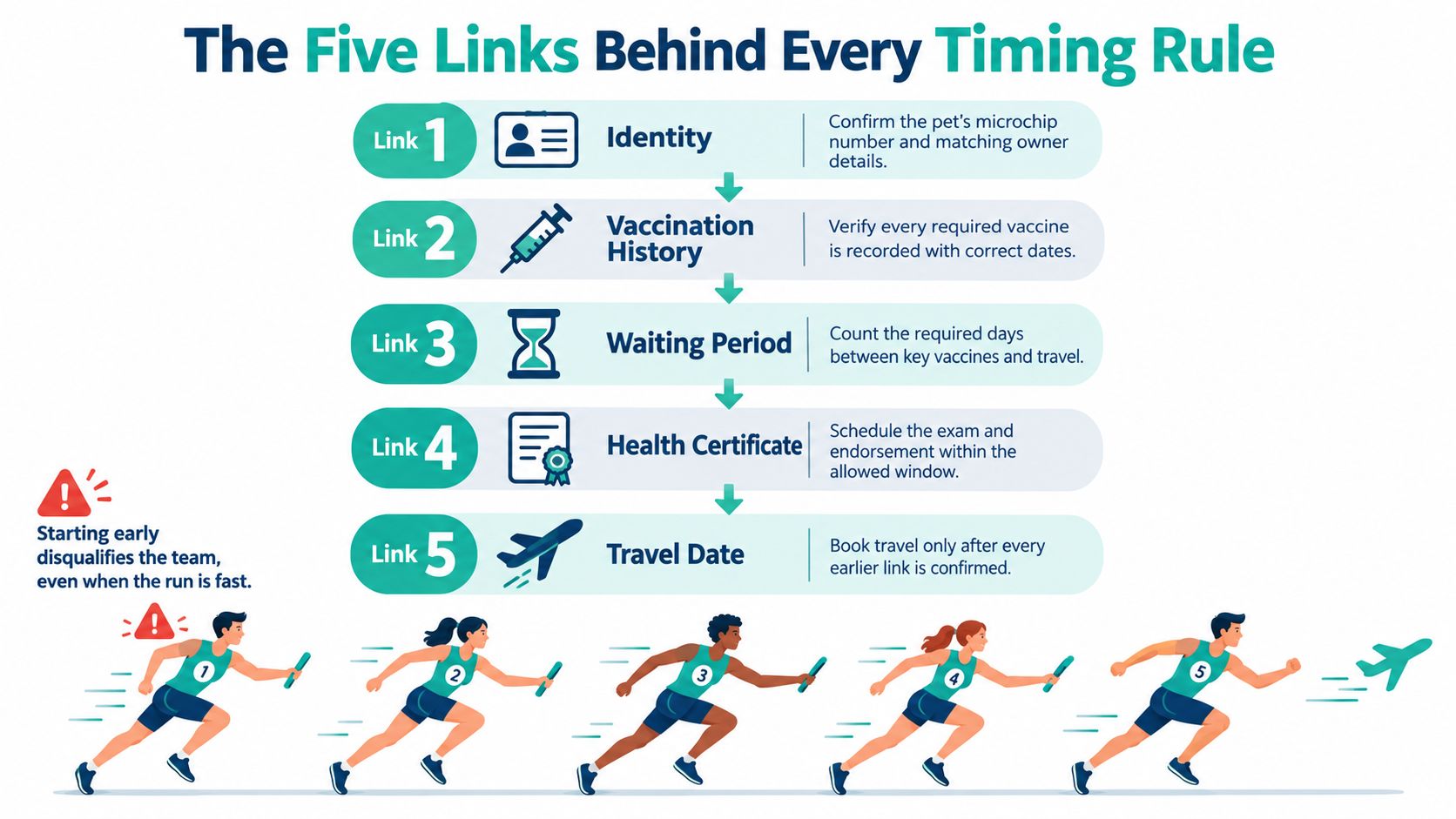
The Five Links Behind Every Timing Rule
Pet-travel preparation works like a relay race. Each runner must receive the baton before starting. A fast finish doesn't repair an early start, just as a complete certificate doesn't necessarily repair records created in the wrong order.
Connect the records in order
Identity comes first. Scan the pet's microchip and compare the displayed number with the records. A number copied neatly onto a form isn't enough if staff can't read the chip or the digits don't match.
Vaccination follows identification. The record needs to connect the vaccine to the animal being presented. If identification happened later, the veterinarian should review whether that vaccination supports the intended travel pathway.
Age and waiting time establish eligibility. The EU pet-movement guidance requires identification before rabies vaccination, a minimum age of 12 weeks for primary vaccination, and at least 21 days after completion of the primary protocol before travel.
The certificate has its own clock. For entry from a non-EU country, that EU guidance calls for an official veterinarian to issue the animal health certificate within 10 days before arrival. Schedule this task around arrival, not just around the owner's preferred appointment day.
The route completes the chain. Check whether every border and connection accepts the document set you've assembled. A properly ordered medical record still needs to match the journey.
Read the dates, not just the boxes
Say a puppy was vaccinated on 1 March, but its microchip was implanted on 10 March. Those are hypothetical dates, but they show the problem clearly: the vaccine came before identification. Even if every field is filled in, the sequence may not support EU travel.
Do not change a date just to make the form fit. Ask the veterinarian to review the original records and decide whether another vaccination and a revised travel plan are needed.
Before endorsement, review the chain as a sequence:
Identity: Confirm the chip number and implantation record.
Vaccination: Check the administration date and vaccine expiry.
Eligibility: Verify age at vaccination and completion of the applicable wait.
Certification: Compare the issue date with the planned arrival.
Route: Resolve destination and transit requirements.
A filled box shows that someone entered information. A chronology check shows whether the information connects.
That distinction is the foundation of a reliable practice workflow.
How to Build a Pet Travel Chain in Your Practice
Give every case a named coordinator and a shared record. The coordinator doesn't replace the veterinarian's judgment. They make sure missing information, upcoming deadlines, and unanswered questions reach the right person.

Turn the itinerary into assigned tasks
Gather identity and vaccination records because missing originals can hold up review. Request the microchip record, complete rabies history, owner details, and readable supporting documents rather than relying on a photograph of a vaccination reminder.
Scan the chip and compare its implantation date with the rabies record, because a matching number alone doesn't establish the correct sequence. Flag any vaccine-before-chip case for the veterinarian instead of allowing it to move automatically toward certification.
Confirm age and calculate the earliest eligible travel date so the owner doesn't book before the pet qualifies. Record how you counted the waiting period and ask another staff member to check the calculation when the itinerary is tight.
List the destination, every layover, and the return route because a flight connection can add a document task. Ask whether the pet will change airports, leave the transit area, or travel under a different carrier's arrangements, then seek official clarification where needed.
Build the deadline calendar from the applicable rules because appointment availability doesn't determine certificate validity. Give each task an owner, a due date, and a status, and distinguish the earliest permitted action from the latest acceptable completion date.
Confirm the issuing veterinarian's official authority and inspect signatures, stamps, and dates because an otherwise complete document may be unsuitable without them. The GOV.UK Great Britain pet health certificate guide requires arrival within 10 days of issue and a certificate signed, stamped, and dated by an authorized official veterinarian.
Submit through the appropriate official system because preparation and official submission are different responsibilities. With Passpaw, submissions go through the practice's own USDA Veterinary Export Health Certification System (VEHCS) account or an equivalent system; we don't submit certificates on a veterinarian's behalf.
Share the dated timeline with the owner because staff and travelers need the same current plan. Confirm that the owner can access the final documents and knows whom to contact if the airline changes the itinerary.
Make completion easy to verify
A finished case should have a concise cover sheet showing each link, its date, who checked it, and any unresolved condition. Keep the underlying records attached so another team member can verify the summary without rebuilding the case from emails.
Use clear status labels such as awaiting owner record, veterinary review needed, submitted, and final documents received. Avoid marking a case complete merely because someone uploaded a draft.
A consistent documentation life cycle helps staff distinguish a working file from the version the owner should carry. Archive replaced versions without leaving them in the owner's final travel folder.
Common Breaks in the Chain and How to Repair Them
A document can be medically accurate and still be refused for an administrative reason. The vaccine may be current, but the traveler may hold an outdated form, lack an endorsement, or present a format the carrier won't accept.
Assign responsibility before a problem appears. Someone needs to verify travel history, prioritize cases by departure, follow up with the laboratory, and confirm which documents the owner will present.
Symptoms, causes and fixes for broken pet travel chains
Symptom at check or border | Likely cause | Fix |
|---|---|---|
Certificate rejected at border | Certificate issued too early for arrival | Recalculate the issue-to-arrival window and arrange reissue inside it |
Rabies vaccine recorded but not accepted | Microchip implanted after vaccination | Check original dates and ask the veterinarian whether revaccination and a new timeline are needed |
Eligible travel date is later than expected | Pet too young at vaccination or waiting period counted incorrectly | Recalculate eligibility and move the flight if necessary |
Document valid but refused by airline | Carrier requires another form or format | Confirm acceptance before the veterinary visit and obtain the appropriate form |
Problem at a transit stop | Only the final destination was checked | Map every stop and obtain any required transit certificate |
Rabies blood test result arrives too late | Testing began without enough margin | Confirm laboratory turnaround, start early, and identify a suitable backup laboratory |
Repair the process as well as the document
Rule transitions make version control especially important. The CDC Dog Import Form instructions describe a transition after July 31, 2025, when certain USDA-endorsed export certificates issued after that date weren't accepted for re-entry for some US-vaccinated dogs and a separate CDC certification process became necessary.
The lesson isn't to assume every returning dog needs the same replacement. It's to check whether the document matches the dog's current entry pathway.
Keep evidence of what was checked, when it was checked, and who resolved the question.
Digital reminders help staff notice approaching deadlines. They don't settle an unclear interpretation or make an old form acceptable. When guidance changes, pause affected cases, ask the responsible authority for clarification, and record the answer before proceeding.
Prepare a workable fallback
Give owners a clear explanation of what can still change. A delayed result may mean moving travel, not paying for faster paperwork. Switching laboratories may not help if the required testing process or waiting period can't be shortened.
Review documentation gaps before the final appointment rather than at check-in. Build buffer days into the plan, identify an acceptable backup laboratory, and confirm airline document acceptance before the veterinary visit. Owners with limited appointment access or inflexible tickets need that warning early.
Manual Checks Versus a Platform Like Passpaw
The global health link is a way of working. A platform such as Passpaw provides software to support much of that work, but a careful manual process can also be suitable.
Manual chain versus platform-supported chain
Aspect | Global health link as a habit | Platform such as Passpaw |
|---|---|---|
Core role | Staff check that each record connects to the next | Software collects inputs and tracks tasks and deadlines |
Rule checking | Staff review official sources for each trip | A rules engine supports checks; staff confirm changes flagged from listed official sources |
Who submits and signs | Veterinarian submits, signs, and remains party of record | Veterinarian retains those responsibilities; Passpaw doesn't submit on the veterinarian's behalf |
Client role | Owner gathers records and confirms travel details | Client enters information, uploads documents, and completes pre-travel tasks |
Limits | Relies on available staff time and attention to changes | No veterinary, legal, or immigration advice and no guaranteed endorsement timeline |
Choose for the work your team actually has
A practice handling occasional straightforward trips may work well with a controlled checklist, shared calendar, and official-source review. That approach needs a named case owner and a backup staff member who can understand the file without asking its original coordinator.
A practice managing overlapping routes may benefit from shared records and date-based task priorities. The useful question isn't whether software is more modern. It's whether the team can reliably see what's missing and what must happen next.

Understand the support and its limits
We collect pet and travel information, check vaccination records against destination requirements, prioritize tasks by travel date, and keep clients involved in preparation. Our proprietary rules engine supports that process, and we regularly monitor USDA APHIS Pet Travel and relevant foreign government sources. Staff should confirm a flagged change before applying it to a case.
Our role doesn't replace official review. The veterinarian remains the submitter, signer, and party of record for all health certificates. We don't sign, certify, or endorse veterinary documents, and we don't guarantee USDA endorsement or its timing.
When evaluating document validation software, look at how clearly staff can distinguish a missing field from a case needing professional review. An alert should prompt a useful action, not encourage staff to accept a result without checking its basis.
Choose according to trip volume, available staff time, and the complexity of the routes you serve. If your team can't name the next deadline for every active pet-travel case, a shared tracker is worth considering.
Confirm Your Route Before You Book
Take a paws before you book. A tentative itinerary is easier to change than a paid journey built around an unworkable appointment schedule.
Name the whole route: List the destination, every transit stop, and return travel.
Confirm directly: Check requirements with each destination's authorities, the relevant airline, and any applicable embassy or consulate.
Work backward: Use the strictest applicable requirements to identify eligible travel dates and the permitted certificate appointment window.
Make a go-or-no-go decision: Move the trip if age, vaccination, testing, or waiting requirements won't be satisfied.
Book the right appointment: Schedule certification inside its permitted window, not just as early as possible.
For the human side of preparation, the overseas travel advice from Translate AI can help you organize your own international journey alongside the pet's separate paperwork.
Keep the responsibilities distinct. We don't provide veterinary medical advice, legal advice, immigration advice, or travel-logistics services, and users must confirm destination requirements directly with the appropriate authorities and carrier.
If the route crosses multiple countries, or your pet's rabies history is unclear, speak with the veterinarian before booking any flight.
Passpaw helps veterinary practices and pet owners organize records, track preparation tasks, and identify missing information across the pet-travel chain. Visit Passpaw to explore support for keeping your pet's documents and travel timeline connected.

More articles
From regulatory changes to best practices for veterinarians and pet owners, our resources keep you ahead of the curve.