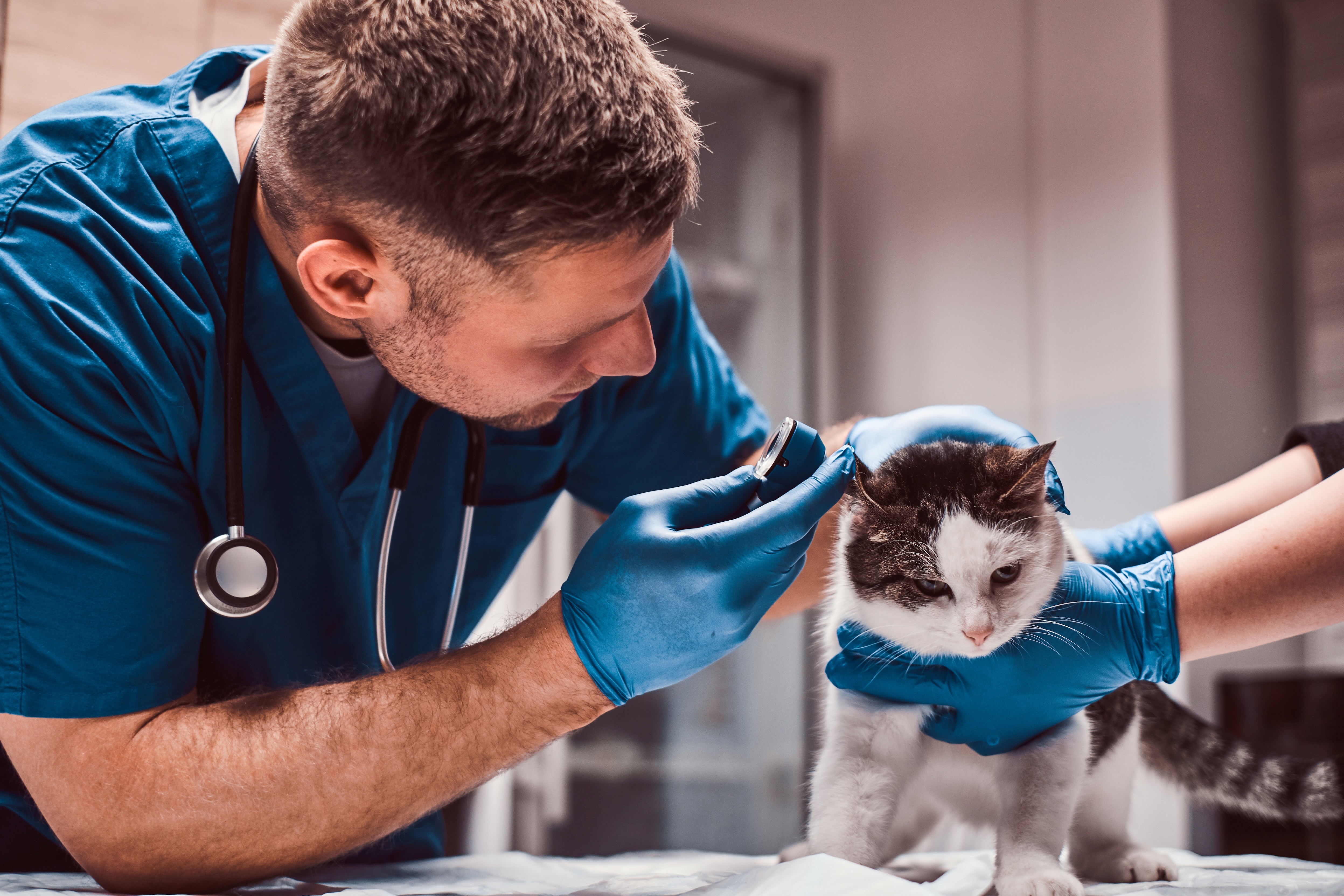
Are you a team member in a veterinary practice?
Are you a pet parent planning a trip with your furry pal?
Document Validation Software for Vet Clinics
The appointment is finished, but the paperwork isn't. A family is preparing to fly with their dog, the international health certificate is on the printer, and one final check remains. The microchip number looks almost right, the rabies date may be outside the destination's accepted window, and the pet's name appears differently on another record. One small typo can send everyone back to the examination room, the inbox, or the airline desk.
That's where document validation software can help. For a veterinary practice, it isn't just a tool for reading PDFs. It's a structured second set of eyes that compares pet travel documents with patient records and destination requirements, then sends uncertain cases to a person who can make the final call.
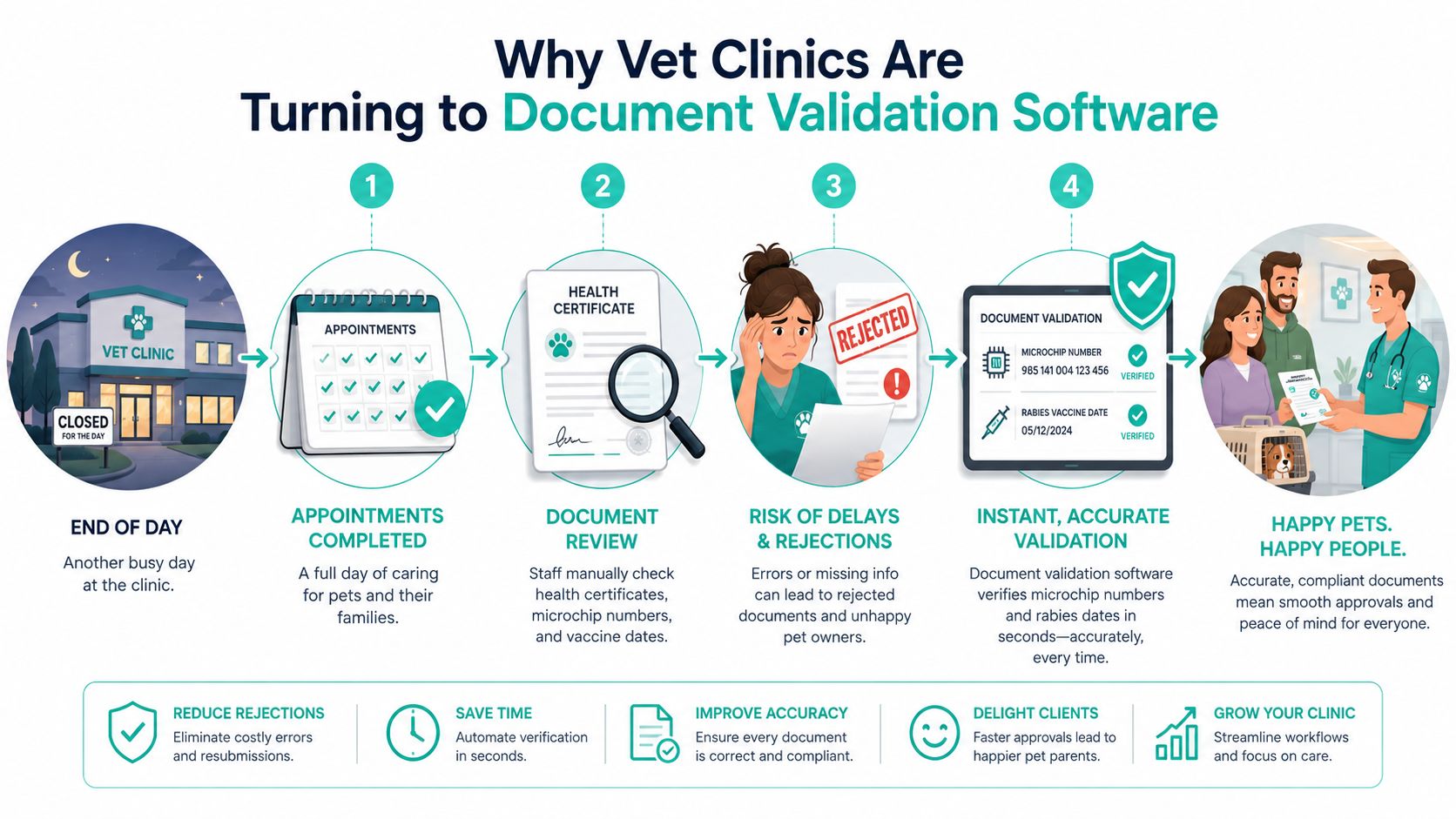
Why Vet Clinics Are Turning to Document Validation Software
At the end of a busy day, a technician may be checking a health certificate while answering a client call and preparing the next morning's appointments. The pet's family is already thinking about flights, carriers, and airport timing. Meanwhile, the clinic still needs to confirm names, dates, signatures, microchip details, and supporting records.
A missed digit in a microchip number can create a serious administrative headache. So can an old rabies date, a missing stamp, or two versions of a certificate moving through separate email threads. Paper forms, scanned files, handwritten changes, and documents returned for correction make it easy for a tired reviewer to lose track of which version is current.
Practical rule: The more documents a case has, the more useful a repeatable review process becomes.
Document validation software brings those loose pieces into one workflow. It can read information from uploaded documents, identify missing fields, compare details across records, and flag inconsistencies for review. The software doesn't decide whether a pet is medically fit to travel, and it shouldn't replace veterinary judgment. Its job is narrower and very useful, it handles repetitive checks before they become last-minute problems.
A growing administrative need
Document verification has moved well beyond a back-office niche. One document verification market forecast estimates a global market of about USD 5.05 billion in 2025, rising to USD 6.03 billion in 2026 and USD 11.5 billion by 2030. Another forecast cited in the same market discussion places the market at USD 8.2 billion in 2024 and USD 24.8 billion by 2034.
Those forecasts cover broad identity and document workflows, not veterinary practices alone. They do show why clinics are seeing more software designed to authenticate records, compare fields, preserve review history, and manage online submissions. The same basic need appears in a pet travel case: staff must turn several pieces of evidence into one dependable file.
Practices building a dedicated travel service can also review this overview of why pet travel is a smart business strategy for veterinary practices. The calmer the paperwork process becomes, the less time the team spends chasing preventable corrections.
What Document Validation Software Actually Does
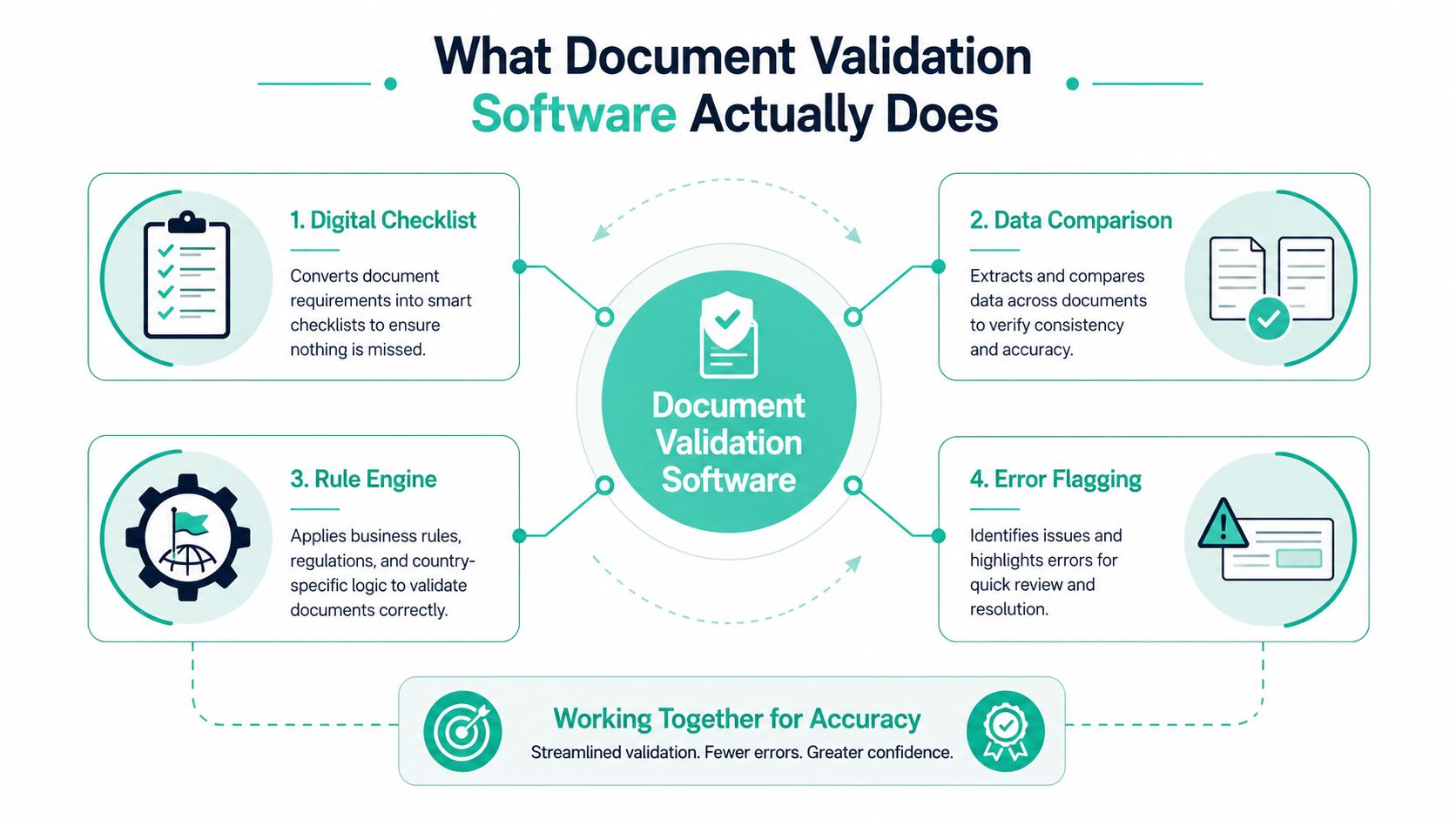
Think of document validation software as a digital checklist that can compare information. A normal checklist might remind a technician to look for a microchip number. Validation software can also read that number, compare it with the practice record, check whether the field is present, and flag a mismatch.
For an international pet travel case, the workflow often follows a clear sequence.
First, capture and extract the record
The clinic uploads a scan, photograph, PDF, vaccination record, or health certificate. Optical character recognition, or OCR, turns visible text into usable data. The system may extract the pet's name, owner details, microchip number, vaccination dates, destination, travel date, and issuing veterinarian.
OCR has deep roots. In 1914, physicist Emanuel Goldberg built a machine that could read characters and convert them into telegraph code, and he later developed a 1931 electromechanical “Statistical Machine” for searching microfilm archives through optical code recognition, as described in this history of document identification and verification.
Then, apply rules and comparisons
The software checks required fields, document formats, dates, and relationships between records. It might identify an incomplete section, a duplicate document, an unsupported file type, or a vaccination sequence that needs attention. For passport-style documents, ICAO Doc 9303 illustrates the same principle through MRZ validation, checksum checks, and comparisons between document zones and digital seal data.
A useful system doesn't treat every warning as an automatic rejection. It places uncertain items in a review queue, where an authorized team member can open the original file, check the patient record, and decide what happens next. The decision, reviewer, time, and evidence can then remain attached to the case.
For clinics comparing workflows across professions, this explanation of AI document review for lawyers offers helpful context on how document tools can support review without removing human oversight. Veterinary teams can apply the same general idea to travel records, with rules specific to animal health documentation.
A clinic may also use a dedicated documentation tools workflow to keep forms and supporting records together. The important point is that validation isn't the same as editing a PDF. It's a process for checking whether the information is complete, consistent, and ready for a human decision.
How Vet Practices Benefit from Pet Travel Validation
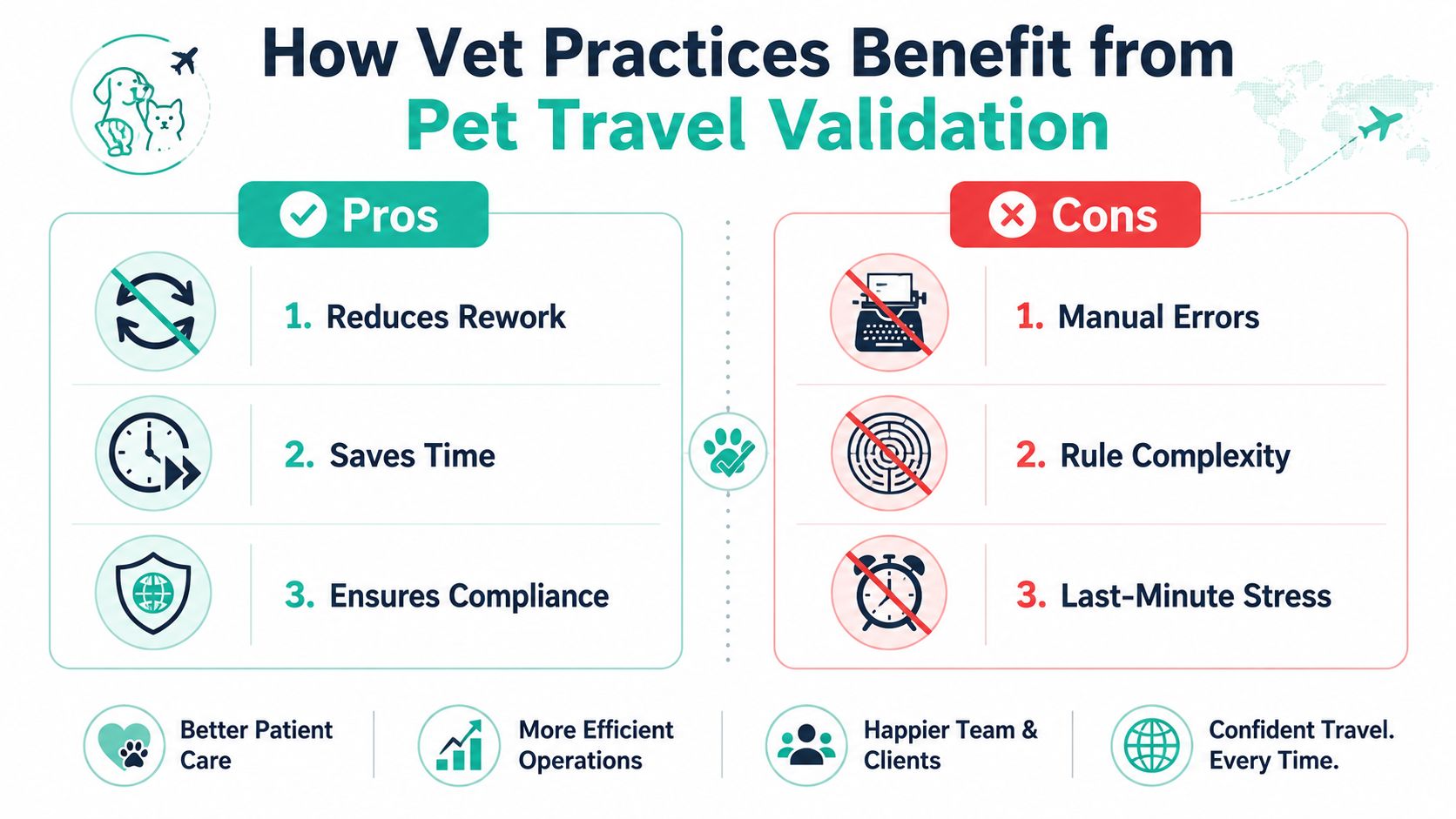
The clearest benefit appears when a clinic catches an error before submission. A wrong microchip digit or a date outside a destination's accepted window can lead to a corrected certificate, another client conversation, and renewed review of the whole case. Early flags keep staff focused on the actual issue instead of reopening every page.
Validation also gives different team members a shared process. A practice shouldn't depend on one experienced technician remembering every step for every destination. A rule-based workflow can guide reception staff, technicians, and veterinarians through the same review path while still allowing a qualified person to resolve exceptions.
Four practical improvements
Less avoidable rework: Staff can address missing names, dates, stamps, signatures, or barcodes before the document reaches the next party.
More consistent reviews: Each case follows documented checks, even when the destination, certificate type, or supporting evidence changes.
Faster client updates: A visible status can show whether the case needs a clearer scan, a missing record, or professional approval.
Stronger case history: The clinic can retain supporting evidence, revisions, reviewer actions, and approval records in one place.
That structure matters in a multi-veterinarian practice. If a client calls while the original reviewer is off duty, another team member can see what has been checked and what still needs attention. The family gets a useful answer instead of “the person who handles those forms is away.”
Automation also has limits. It can compare a rabies date with a rule or spot a mismatch between a certificate and a patient record, but it can't independently determine medical suitability or settle every ambiguous border question. A veterinary professional still needs to interpret unclear evidence and approve the final outcome.
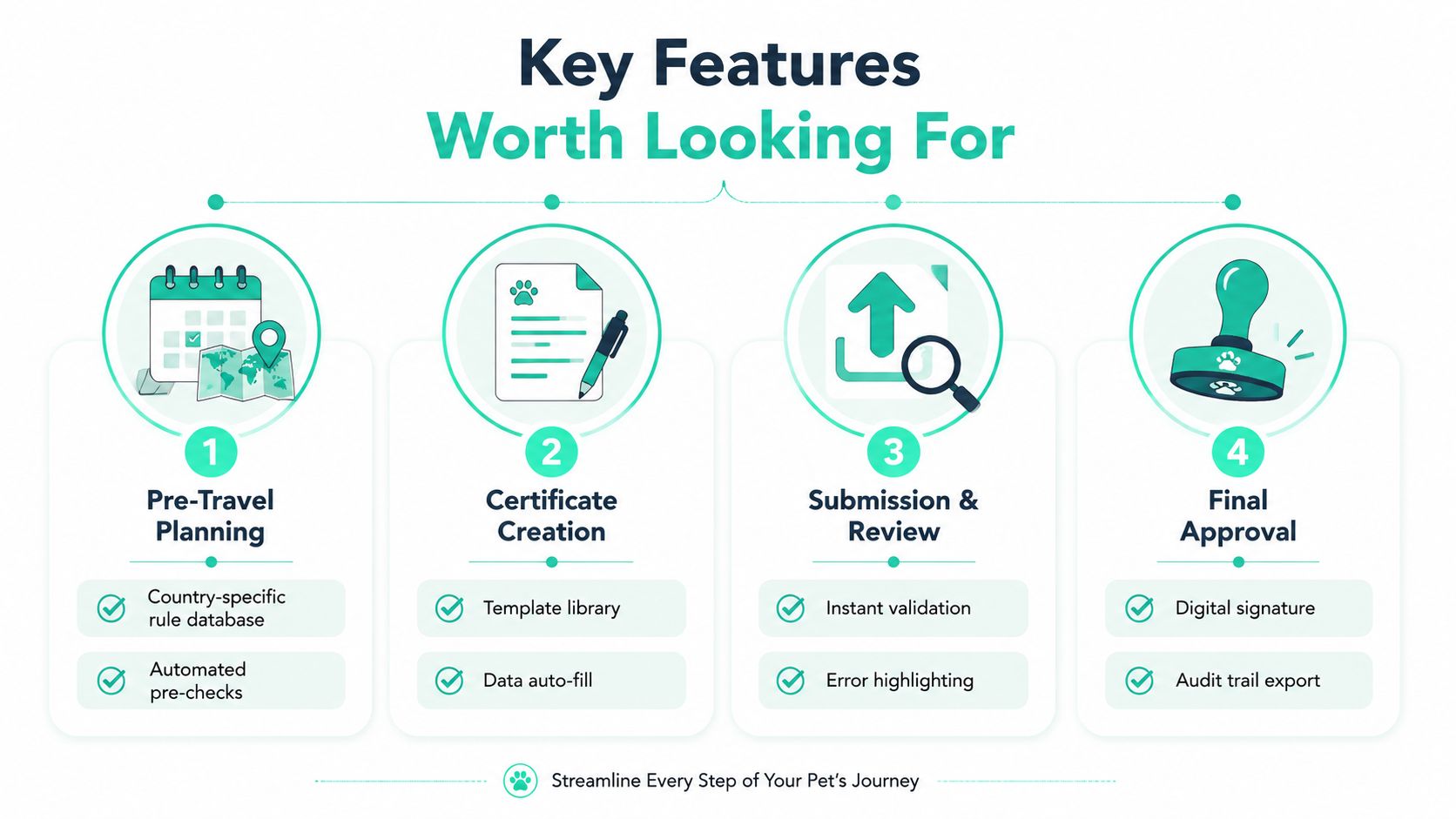
Key Features Worth Looking For
A clinic manager comparing vendors should start with the moments where paperwork usually goes sideways, not with a long list of impressive technical terms.
Pre-travel planning
Look for destination-specific rules that can guide checks for rabies timing, microchip formats, export certificate templates, and USDA endorsement routing. The system should make it clear which rule set applies to the case and when staff need to confirm an update.
A useful planning view connects the destination, travel date, pet record, and required documents. It should help staff notice a timing problem early, while there's still room to contact the client and arrange the next clinical or administrative step.
Certificate creation
Templates and automatic data entry can reduce repeated typing. The software should pull known information from vaccination records or the practice management system, then leave staff to confirm the details rather than re-enter every field.
Check whether it can match the owner's information across the pet record and submitted travel documents. Names, dates, and identification numbers deserve special attention because a document may look polished while carrying one incorrect character.
Submission and review
The review screen should show exactly what triggered a warning. “Document failed” isn't enough. Staff need to know whether the problem is a missing signature, an unreadable scan, a field mismatch, or a date that needs confirmation.
OCR accuracy matters here. A 2026 OCR benchmark summary states that dependable verification generally needs field-level accuracy above 98%, with leading engines reaching roughly 99.0% to 99.6% on structured documents and about 96.0% to 98.0% on unstructured documents. Those figures are benchmark ranges, not a promise for every clinic scan, so ask vendors how their system handles glare, handwriting, blur, and mobile-camera images.
Final approval and governance
Prioritize audit trails, multi-user queues, approval roles, and exportable review records. Confidence routing can be useful too. One documented pattern uses green for 0.85 or higher, yellow from 0.65 to under 0.85, and red below 0.65, with a default passing threshold of 0.9, as outlined in this confidence score guidance.
Another reference treats OCR confidence as high at 86% or above and region confidence as high at 95% or above, while noting that OCR confidence is calculated per character. Blue Prism's Decipher documentation explains why one uncertain character can lower a field's overall score.
Finally, ask about vendor support, regulatory updates, integrations with your PIMS, and interface simplicity. If reception staff need a lengthy manual to upload a certificate, the workflow has already missed the kennel door.
Spotting Errors a Human Eye Might Miss
Consider a dog travelling from the United States to the United Kingdom. During review, the rabies certificate date appears to come three days before the microchip implantation date. A person scanning several pages may notice both dates without immediately comparing their order. A rule-based system can connect the fields and issue a correction prompt before the certificate moves forward.
That doesn't mean software always wins. Suppose the microchip number is correct, but the clinic's system displays it with spacing or punctuation that differs from the document format. An overstrict rule may flag the record even though a trained reviewer can confirm that the underlying number matches.
The best workflow treats automation as a filter, not a judge.
Human review still matters: A clear warning tells the team where to look. It doesn't tell the veterinarian what professional decision to make.
Document Element | Manual Review | Validation Software |
|---|---|---|
Microchip number | A reviewer compares digits across records and may overlook one character | Extracts the value and flags a mismatch or unreadable character |
Rabies date | The reviewer checks the date against the relevant record and destination rule | Compares dates and can identify an order or timing concern |
Pet and owner names | Staff scan several documents for spelling differences | Matches fields across uploaded records and highlights variations |
Signature or stamp | A reviewer confirms that the expected area appears complete | Checks for a required element and routes unclear evidence for review |
Barcode or MRZ data | Manual checking can be slow or unavailable on a poor scan | Reads available machine-readable data and compares it with visible fields |
Unusual formatting | A human may recognize an acceptable variation | Software may produce a false positive if rules are too rigid |
Forgery detection also needs careful testing. A 2026 unified benchmark evaluated 14 methods across eight datasets covering text tampering, receipt forgery, and identity-document manipulation. Its practical lesson applies to pet paperwork: a vendor should test clean documents, hand-edited files, AI-generated samples, mobile-camera scans, latency, false positives, and evidence quality, not just one easy document template.
What Implementation Looks Like Day to Day
Implementation usually starts with the clinic's working materials. The vendor helps configure letterhead, certificate templates, destination rule sets, user roles, and connections to the practice management system. Doctors, technicians, and reception staff should each have permissions that match what they do.
Training works best when it uses real clinic cases. One person might upload a vaccination record, another might resolve a warning, and a veterinarian might approve the final file. A small group of staff champions can then answer routine questions as colleagues build confidence.
A steady rollout
During the early phase, many practices run paper and digital review in parallel. That gives the team a chance to compare results, identify confusing prompts, and correct imported patient data before the software becomes the main path.
After the first cases, the daily rhythm becomes simple. Staff upload or create the document, review the highlighted fields, request anything missing, and route the case to the right approver. The practice can keep a documentation hub so staff know where current forms, instructions, and supporting records belong.
Ask vendors how they handle downtime, data migration, backups, and changes to USDA or destination-country requirements. You'll also want a clear process for regulatory updates, because a clinic shouldn't discover a changed rule only after a client's certificate is returned.
A realistic adoption plan can reach a confident, paper-light workflow within two to four weeks, depending on the clinic's data quality, integrations, staff availability, and case volume. The calendar matters less than the handoff. Someone must own setup, someone must monitor warnings, and a qualified reviewer must remain responsible for final approval.
Weighing the ROI for Your Practice
The financial case starts with honest costs. A clinic may pay a monthly subscription per user, face setup fees, and spend staff time learning the new workflow. Data cleanup and integration work can also make the first phase feel slower before the process settles.
The return comes from the work the team no longer repeats. A validated certificate can reduce time spent searching through email chains, correcting copied fields, requesting replacement documents, and explaining preventable delays to anxious families. It may also free staff to handle clinical tasks or additional travel appointments, but the value depends on how the practice schedules and prices that time.
A grounded way to calculate value
Track the practice's current process before choosing a target. Record how long staff spend preparing and reviewing each certificate, how often corrections require another client contact, and how many cases wait for one specific team member.
Metric | Manual Process | With Validation Software |
|---|---|---|
Data entry | Repeated typing from records and scans | Extracted fields are checked before approval |
Error handling | Problems may appear after submission | Warnings surface during review |
Staff time | Experienced employees carry much of the process | Tasks can be shared through queues and roles |
Client communication | Updates often depend on email follow-up | Status and missing-item requests can be organized |
Record history | Versions may sit across paper files and inboxes | Review actions and supporting documents stay connected |
Capacity | Travel cases compete with routine administrative work | A structured process can support more predictable scheduling |
Avoid promises of guaranteed revenue. A practice handling only occasional international cases may take longer to recover subscription and setup costs. A clinic with frequent exporters may see a stronger return sooner, especially if it reduces rework and protects appointment capacity. The right breakeven calculation should use your own case volume, staff rate, correction time, and travel service pricing, not a generic industry promise.
For a practical starting point, use the pet travel practice revenue calculator to model the service around your clinic's actual workflow. Then test the result against a short pilot and review whether staff are consistently using the checks.
Document validation software works best with clear team habits. It won't replace a veterinarian's judgment, fix poor source records by itself, or remove every unusual destination question. It can, however, make the routine parts visible, repeatable, and easier to manage.
Passpaw helps veterinary practices manage international pet travel documents with tools for uploaded-record validation, destination-specific checks, task prioritization, and client communication. If your team is spending too much time chasing mismatched names, dates, stamps, or barcodes, visit Passpaw to see how a more organized validation workflow could fit your clinic.

More articles
From regulatory changes to best practices for veterinarians and pet owners, our resources keep you ahead of the curve.