Are you a team member in a veterinary practice?
Are you a pet parent planning a trip with your furry pal?
Dogs in Paris: Your Essential 2026 Travel Guide
You're probably here with the same lovely idea most dog owners have at some point. A morning walk past shuttered cafés, a stop for coffee on a terrace, your dog curled under the chair while Paris wakes up around you.
That dream is real. So are the little surprises nobody puts on the official checklist.
Dogs in Paris are part of daily life, but the city doesn't always make that life easy. Rules are strict in some places, vague in others, and the biggest stress points are often the practical ones. Where can your dog stretch their legs? Will a train allow your dog on board? Are small shops welcoming, indifferent, or firmly non-dog? Those are the details that decide whether your trip feels smooth or scruffy around the edges.
A good Paris trip with a dog usually comes down to two things. First, get the paperwork right before you leave. Second, understand the local rhythm once you arrive. Paris rewards calm, prepared dog owners. If your dog is settled, clean, leashed when expected, and easy to manage in tight urban spaces, the city can be a joy.
Dreaming of Paris with Your Canine Companion
The version people imagine first is easy to love. You and your dog walking along the Seine, pausing at a corner café, then heading back through a handsome neighborhood street with a baguette tucked under your arm and a wagging tail at your side.
That version can absolutely happen.
What catches travelers off guard is that Paris is both welcoming and demanding. It isn't a wide-open, off-leash kind of city. It's a dense, shared-space city where dogs are common, but courtesy matters more than spectacle. A dog that does well in Paris usually isn't the one with the cutest travel gear. It's the one that can settle under a table, ride calmly in a carrier or on a short lead, and handle busy sidewalks without fuss.
Paris works best for dogs that can switch from strolling mode to café mode without drama.
That's why standard government guidance only gets you halfway there. Entry documents matter, of course. But so do the soft skills. Can your dog wait while you order? Can you pivot quickly if a food shop won't allow entry? Can you build in enough bathroom breaks before using public transport?
What makes Paris special for dog owners
A big part of the charm is how normal dogs feel here. You'll see them woven into neighborhood life rather than treated like an event. That's appealing if you want your trip to feel local instead of staged.
Still, there's a trade-off.
What feels magical | What needs planning |
|---|---|
Walkable neighborhoods | Busy pavements and close quarters |
Terrace culture | Inconsistent indoor access rules |
Public transport access | Specific transit rules for larger dogs |
Everyday dog visibility | Very limited dedicated off-leash space |
The right mindset before you book
Treat Paris as a city for well-managed dogs, not endlessly free-roaming ones. If you plan with that in mind, the city becomes much easier to enjoy.
A little preparation goes a long way. Or, to keep it on brand, the trip is far more paws-ible than it first appears.
Preparing Your Dog's Parisian Passport
The paperwork side is where most trips go right or wrong. Not because it's impossible, but because timing matters and breed rules can stop a trip before it starts.
Start with your veterinarian early. Even when your route seems simple, the sequence of pet travel documents rarely feels simple at the last minute. You want enough time to confirm identification details, vaccination status, and the final health paperwork without rushing anyone.
The documents that deserve your attention first
Most owners do best with a simple order of operations:
Confirm your dog's microchip details
Make sure the chip can be read and that the number matches every document exactly. Tiny admin mismatches cause oversized stress.Review rabies vaccination status
Don't assume a vaccine is fine just because your dog is generally up to date. Travel paperwork depends on specific records being complete and clearly documented.Book the health certificate appointment early enough
This is the document people tend to underestimate. It has to line up with your departure timing, your destination, and your vet's workflow.Check whether your route adds any extra requirements
Direct travel and multi-leg travel don't always feel the same in practice. Airline handling, airport procedures, and timing windows can all affect how much cushion you need.
If you want a plain-English overview of the broader process, this guide on how to get a pet passport is a useful starting point.
The breed issue you should check before spending more money
One rule deserves attention before you buy flights, reserve lodging, or plan anything else. A major compliance pitfall involves Category 1 and Category 2 breeds, including examples such as Pitbulls and Rottweilers, which are legally barred from import into France. Attempting to bring these breeds can result in immediate confiscation, which makes pre-travel verification essential, as noted in Bonjour Paris's guide to dog rules and travel in Paris.
That point isn't there to scare anyone. It's there to save you from building an entire trip around a route that won't work.
Practical rule: Check breed restrictions before you check airfare.
What works well in real life
The smoothest cases usually share the same pattern. The owner starts early, the vet has enough lead time, and every document gets reviewed as a set instead of one by one. That matters because pet travel paperwork isn't just a pile of forms. It's a chain. If one link is unclear, the whole thing feels shakier than it should.
What doesn't work is piecemeal prep. One call to the airline. Another to the clinic. A screenshot from somewhere. An old vaccine record in a different folder. That's how people end up chasing details during the final week.
A calmer approach is to keep one travel file with your dog's microchip info, vaccine records, flight details, and final health documents together. Digital and printed copies both help. Paris may be stylish, but this part of the trip rewards boring organization.
Jet-Setting with Your Pooch Travel Day Tips
Travel day isn't when you want to make fresh decisions. Your dog will read your mood fast, so the kinder plan is to remove as many moving parts as possible before you leave home.
Choose your airline based on pet handling comfort, not just ticket price or departure time. Some dogs do well in cabin under the seat. Others will travel in an approved carrier through a different process. Either way, read the airline's pet rules carefully and call if anything is unclear. For Air France travelers, the current Air France pet policy guide is a practical place to compare expectations before the day gets hectic.
Pack a dog go-bag you can reach quickly
Keep these items where you can grab them without unpacking everything at the airport:
Water and a collapsible bowl for check-in waits and post-security breaks
Absorbent pads and cleaning wipes for delays, accidents, or crate refreshes
Medication in original packaging if your dog takes anything regularly
A comfort item like a familiar blanket or toy that smells like home
Paper copies of documents in a folder, even if you also have them on your phone
A small portion of food or treats for after major travel moments, not during stressful transitions
What helps dogs stay calm
Routine helps more than gadgets. Feed lightly if your vet recommends that approach for travel, allow a proper toilet break before leaving for the airport, and give your dog enough time to sniff and settle rather than hustling them through every step.
At security, expect a little awkwardness. Collars, leads, and carriers can turn a simple checkpoint into a juggling act. Move slowly. Ask staff what they want you to do before you start unzipping bags and unclipping leads.
Bring one spare lead in your carry-on. It's one of those tiny items you'll never need, until you absolutely do.
What usually goes wrong
Most bad travel-day stories aren't dramatic. They're usually about poor pacing. A late departure from home. No extra wipes. A dog that hasn't had one calm pause in hours.
Your goal isn't perfection. It's steadiness. If your dog can move from home, to airport, to aircraft with as few surprises as possible, you're already ahead of the game.
Bonjour Paris Arrival and Getting Around
Landing in France with a dog often feels anticlimactic in the best way. After all the prep, the first task is usually simple. Keep your documents together, stay organized, and be ready to present your pet paperwork if asked at customs. Calm handling matters here just as much as correct paperwork.
Once you're through the airport, the main Paris question begins. How are you getting into the city, and how easy will that first transfer be with a dog, luggage, and a tired travel brain?
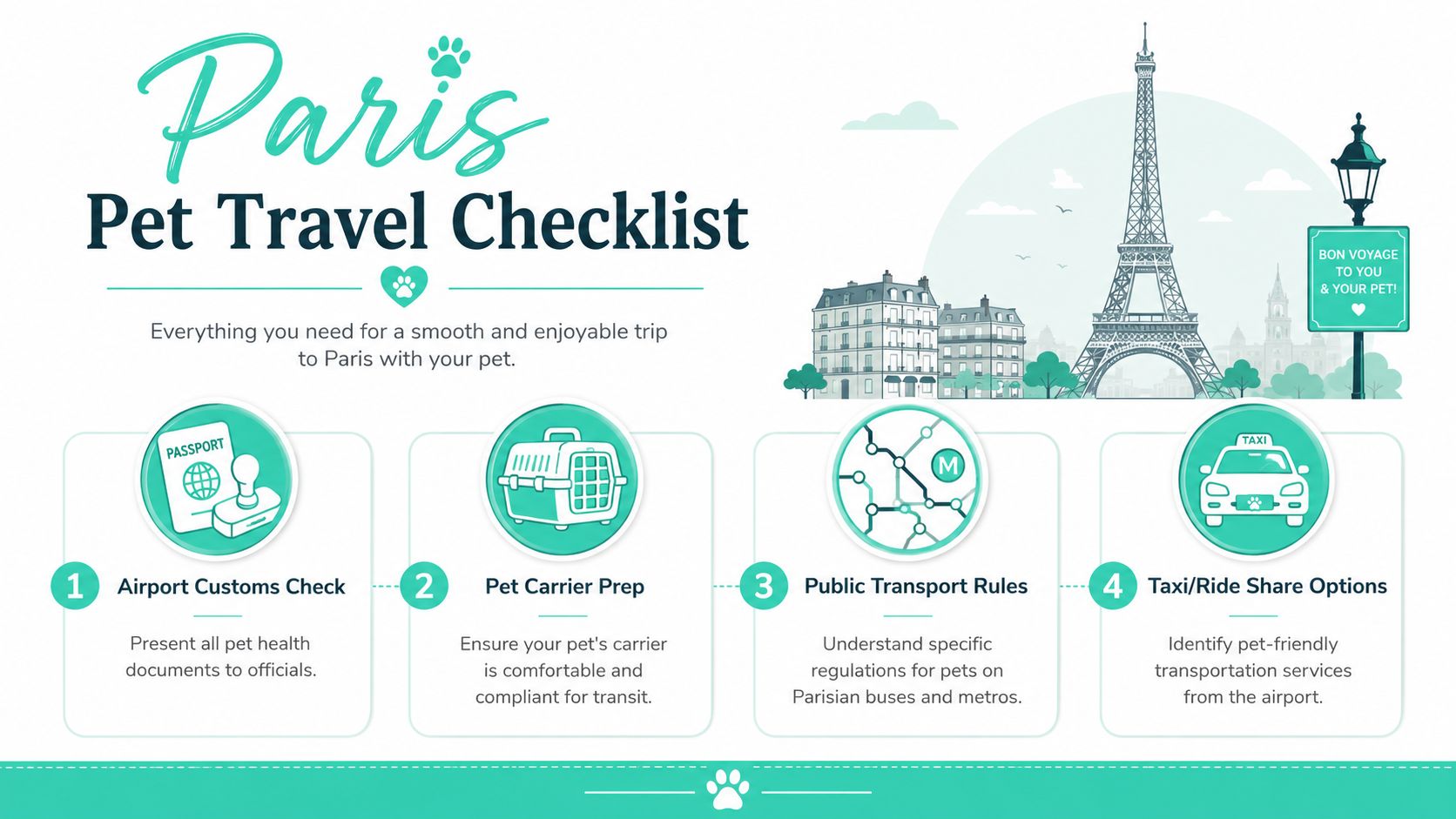
Your first hour in the city
If your dog has just finished a long trip, don't try to be heroic. The smartest move is often the least glamorous one. Get to your accommodation with as little friction as possible, let your dog decompress, then tackle the Métro map later.
That's also when phone data becomes more than a convenience. Being able to check directions, message a host, and confirm pet-friendly transport on the fly saves a lot of hassle. For that reason, many travelers find an eSIM for Paris travel useful before they even leave the airport.
If you're still deciding where to stay, this guide to dog-friendly lodging can help you filter out places that look charming online but are awkward in practice with a dog.
Public transport rules that matter in real life
Paris public transport is manageable with dogs, but the details matter. On Paris's RER commuter trains, dogs too large for a carrier must have their own child's fare ticket, be leashed, and wear a muzzle. Smaller dogs in carriers can travel for free on the entire public transport network. That operational detail comes up often enough that it's worth planning for before your first station run.
A few habits make the whole experience easier:
Board during quieter times if you can. Tight rush-hour platforms are hard on nervous dogs.
Use a short lead, not a retractable one. Paris stations aren't built for sprawl.
Keep the muzzle accessible if your dog is too large for a carrier and using the RER.
Know your exit before boarding. Staircases, ticket gates, and transfers can get fiddly with luggage.
What works and what doesn't
What works is treating transit as a controlled, short-duration task. Enter, ride, exit. Keep it boring.
What doesn't work is assuming every rail trip will feel forgiving. If your dog is overwhelmed, a taxi or ride share may be the kinder option for that leg. Paris can be very dog-compatible, but not every moment needs to be a proving ground.
Parisian Etiquette for Your Four-Legged Friend
Paris has a strong dog culture, but it also expects owners to be tidy, alert, and realistic. Many visitors get tripped up by this. They assume “dogs are common” means “dogs are welcome everywhere in the same way.” It doesn't.
The city's density is part of the reason. Paris has the world's highest canine density at an estimated 2,857 dogs per square kilometer, and that concentration helps explain why rules are enforced firmly, including a €68 fine for not picking up dog waste, according to this report on Paris's canine density.

Café manners and shop ambiguity
Many owners love terrace culture for a reason. A well-behaved dog under an outdoor café table often fits naturally into the setting. Indoors, things get murkier. Food shops and restaurants can be inconsistent, and visitors often run into mixed signals about whether a small leashed dog is fine, whether a carrier is expected, or whether entry depends entirely on the staff on duty.
That means your best etiquette tool is flexibility.
If a place feels uncertain, ask first. If the answer is hesitant, don't push. Paris rewards easygoing owners far more than argumentative ones. A polite retreat to a terrace table nearby is usually the better call.
A dog-friendly city still has plenty of dog-unfriendly moments. The trick is not taking them personally.
Leashes and the off-leash reality
This is one of the least glamorous truths about dogs in Paris. Despite a high dog population, Paris has a critical lack of dedicated, enclosed off-leash dog parks. Most public gardens require dogs to be leashed, forcing owners to seek out small, often unenclosed squares for their pets to play, as described in this account of the tough life of dog owners in Paris.
That changes how you should plan your days.
Expectation | Better Paris strategy |
|---|---|
A big off-leash run before lunch | A structured walk with sniff breaks |
Spontaneous park play | Short lead walks in dog-tolerant areas |
Reliable enclosed dog parks | Assume options are limited |
One long outing | Several smaller outings |
Daily habits that help you blend in
Carry waste bags every time. Not most times. Every time.
Keep your dog close on pavements where scooters, bikes, and pedestrians all share space.
Practice a calm settle before your trip. That single skill pays off in cafés, lobbies, and station platforms.
Watch entrances carefully. A boutique may welcome dogs, while the bakery next door may not.
The best compliment your dog can earn in Paris is that nobody notices them much at all. Quiet, clean, and composed beats flashy every time.
A Dog's Guide to Parisian Services
Once you're settled, it helps to know where to turn if something small goes sideways. Maybe you run out of food. Maybe your dog needs a nail trim after too many pavement walks. Maybe you just want the comfort of locating a nearby vétérinaire before you need one.
The easiest approach is simple. Save the address of a local vet near your accommodation, find the nearest pet supply shop, and ask your host or lodging manager which groomer or clinic locals use. Neighborhood advice is often more useful than broad internet lists.
Three phrases worth knowing
A few plain terms go a long way:
Vétérinaire means veterinarian
Animalerie means pet supply store
Toilettage refers to grooming
If your dog needs more than routine support, specialist transport can also matter. For owners comparing hands-on travel help, pet courier services are worth understanding before a complex move or longer relocation.
One local gap to plan around
Paris can be wonderfully walkable, but it's not a city with abundant enclosed dog run options. That means service planning matters more than people expect. If your dog relies on regular high-energy exercise, think ahead about how you'll replace that routine with structured walks, sniff-heavy outings, and calm indoor recovery time.
If you host guests in pet-friendly accommodation yourself, it's smart to spell these realities out clearly. A thoughtful welcome guide can reduce confusion for visiting owners, especially around walks, pet supplies, and building etiquette. This piece on monetizing your guest stays has useful ideas for turning practical local info into a better guest experience.
Paris with a dog is absolutely doable. It just works best when you treat the city as it is. Elegant, busy, compact, and a little particular. Learn the rhythm, keep your dog comfortable, and the trip becomes memorable for all the right reasons.
If you're planning international pet travel and want a simpler way to keep documents, deadlines, and destination requirements organized, Passpaw is built to make that process easier for pet owners and the professionals helping them.

More articles
From regulatory changes to best practices for veterinarians and pet owners, our resources keep you ahead of the curve.