Are you a team member in a veterinary practice?
Are you a pet parent planning a trip with your furry pal?
Your Guide to the Air France Pet Policy
Figuring out travel plans is one thing, but adding your furry family member to the mix brings a whole new set of questions. Luckily, Air France makes it pretty simple. For small cats and dogs, you can bring them right into the cabin with you, as long as their combined weight with their carrier is under 8 kg (about 17.64 lbs). If your pet is larger, they’ll travel safely in a climate-controlled area in the aircraft's hold.
Your Pet Travel Options with Air France
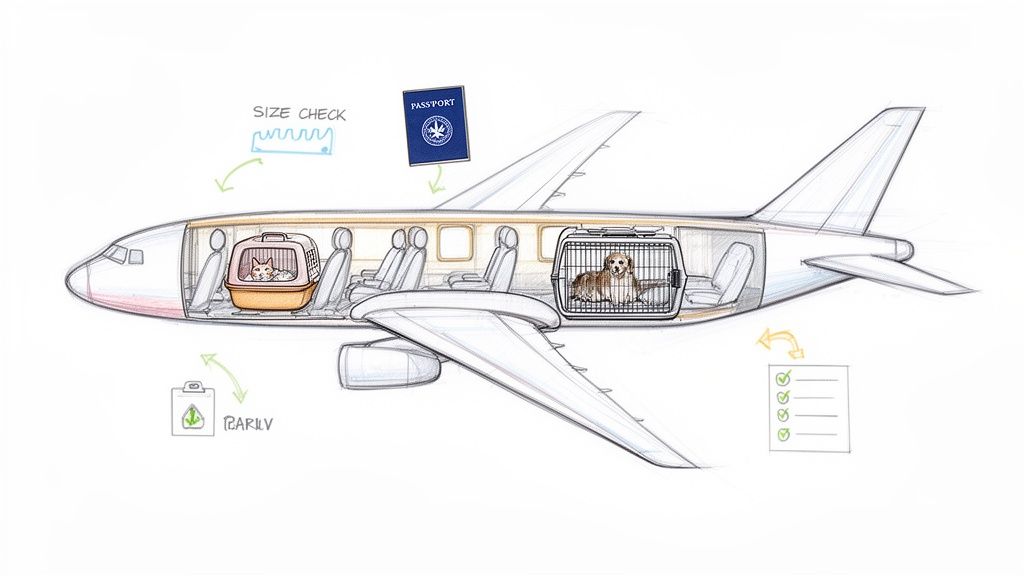
When you're flying with a pet on Air France, you have two main paths: in the cabin or in the hold. The deciding factor almost always comes down to the size and weight of your pet. Getting this first step right is the key to a smooth journey for both of you.
Knowing which option is right for you from the start helps you prepare correctly. It affects everything from the type of carrier you need to the specific documents you'll need to gather. For example, cabin travel needs a soft, flexible carrier, while hold travel requires a much stronger, IATA-approved plastic crate.
Air France Pet Travel Options Quick Summary
To make things even clearer, here’s a quick side-by-side look at the most important details for each travel option. Think of it as your cheat sheet to get started.
Travel Option | Weight Limit (Pet and Carrier) | Maximum Carrier Size | Example Fee (International) |
|---|---|---|---|
In the Cabin | Up to 8 kg (17.64 lbs) | 46 x 28 x 24 cm | €125 - €200 |
In the Hold | 8 kg to 75 kg (165 lbs) | Varies by aircraft | €200 - €400 |
This table shows how the costs and carrier rules change depending on where your pet travels. Keep in mind these fees are just examples; your final cost will depend on your specific route. For a wider view on getting ready for your trip, this comprehensive guide on how to travel with pets is a fantastic resource for planning stress-free journeys.
Why Booking Early Is So Important
This isn't just a friendly suggestion—it’s very important. Air France has a strict limit on how many animals can be on any given flight to ensure the safety and comfort of all passengers, human and animal alike. If you wait too long to book your pet's spot, you might find there's no room left. That's a ruff situation no one wants to be in.
This simple flowchart helps you see where your pet will likely travel based on that all-important combined weight.
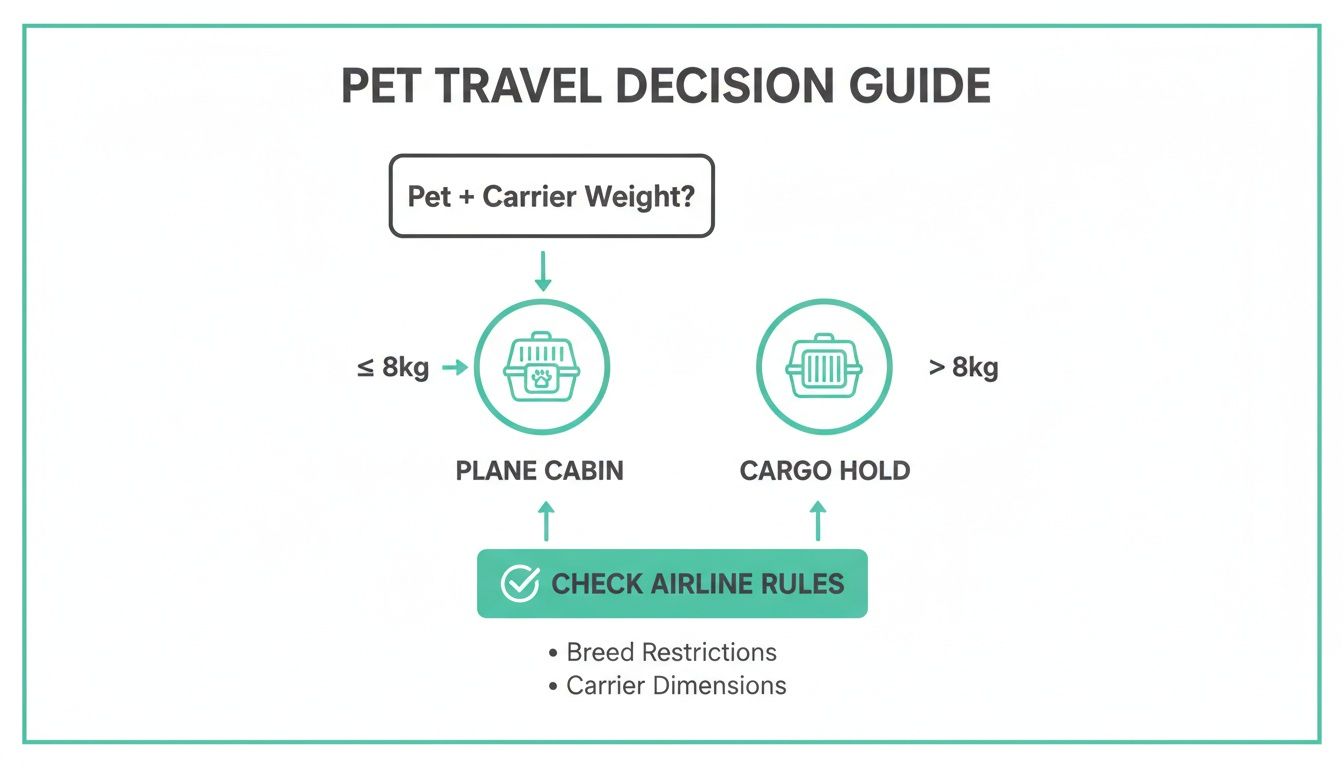
As you can see, that 8 kg mark is the hard line that determines your pet's travel plans. It's a key part of the Air France pet policy, put in place for both safety and practical reasons. If you need help sorting out the paperwork, especially if you're flying out of the US, our guide for pets traveling from the United States to France breaks down every step.
In-Cabin Travel for Your Furry Co-Pilot

For most of us, the only way we’d consider flying with our pets is if they’re right there with us. Air France gets it, which is why they allow small dogs and cats to travel in the cabin. This means your best friend can stay with you the whole flight, safely tucked under the seat in front of you.
But getting your pet a boarding pass for the cabin means following some very specific rules. It's not as simple as just buying a ticket; you have to meet their requirements exactly.
The 8 Kilogram Rule Explained
This is the big one. The most important rule for Air France's in-cabin pet policy is the weight limit: your pet and their carrier combined cannot weigh more than 8 kg (that's about 17.64 lbs).
This number isn't random. It’s a carefully decided limit to make sure the carrier can slide safely under the seat without getting in the way. Think of it like your personal carry-on, but for your most precious cargo. Just as your roller bag has to fit in the overhead bin, your pet’s carrier has to fit in its spot for safety during takeoff, landing, and any bumps along the way.
A quick tip: always weigh your pet inside their carrier before you leave for the airport. It’s the best way to avoid a stressful, last-minute surprise at the check-in counter. If you're close to the limit, maybe hold off on that pre-flight treat!
Carrier Requirements for Cabin Comfort
You can't just use any old bag. Air France is pretty specific about the type of carrier allowed in the cabin, and for good reason—it’s all about your pet's comfort and the safety of everyone else on board.
Here’s what your carrier needs to have:
Soft-Sided Design: The carrier must be a soft, flexible bag. This is a must, as it allows the bag to gently squish to fit under the seat.
Maximum Dimensions: It can’t be larger than 46 x 28 x 24 cm (about 18 x 11 x 9 inches). These sizes are key to making sure it fits properly.
Ventilation and Security: The bag must be well-ventilated so your pet has plenty of fresh air, leak-proof in case of an accident, and secure enough that there’s no chance of an escape.
Your pet's carrier is their safe space for the entire journey. From the moment you board the plane until you’re back inside the airport terminal at your destination, your pet must remain completely inside the carrier.
Picking the right carrier is a huge part of setting your trip up for success. For more info, check out our guide on how to choose the best airline travel pet carrier to make sure you’ve got all your bases covered.
Who Can Fly in the Cabin
Air France is specific about which animals get a seat in the cabin. This option is only available for small dogs and cats.
There’s also a strict age requirement. For most international flights, your pet has to be at least 15 weeks old. This rule is tied to rabies vaccination rules, which often need a waiting period to make sure the shot is fully effective before travel.
Booking Your Pet’s Spot
Getting a spot for your pet in the cabin isn't something you can do at the last minute. Air France allows only a handful of pets on each flight, and these spots are in high demand—they fill up fast.
You can't add your pet to your booking online. Once you've booked your own ticket, you must call Air France customer service directly to request approval for your pet. My advice? Do this immediately after booking your own flight.
Have your pet's breed, their weight (in the carrier!), and the carrier dimensions ready when you call. Having that information ready will make the process much smoother and get you one step closer to a stress-free travel day.
What About Larger Pets? Understanding Hold Travel
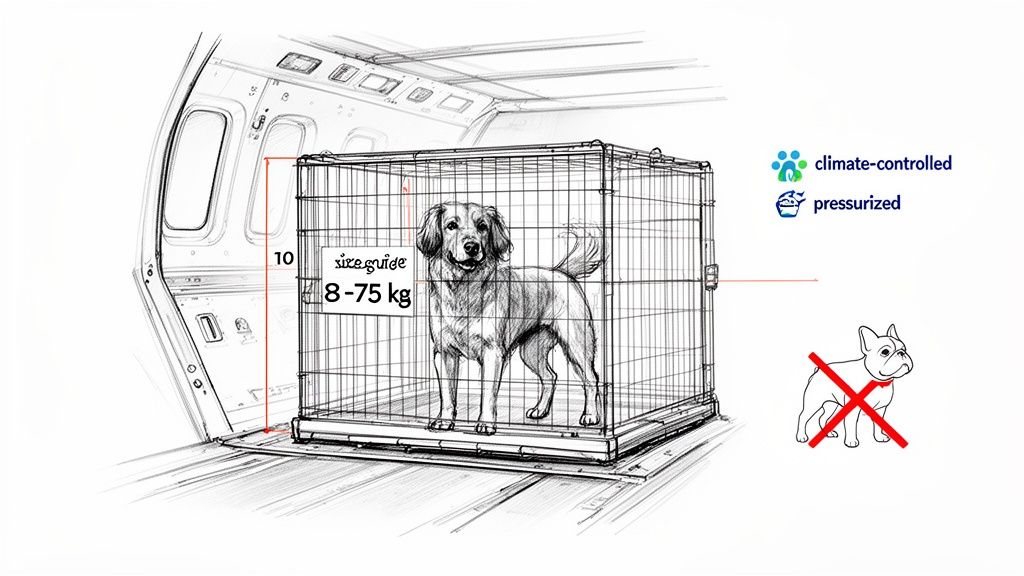
If your four-legged friend is a little too big to fit under the seat, that doesn't mean they have to stay home. Air France has a special solution for larger pets: traveling safely in the aircraft's hold. This is the required option for any pet and carrier with a combined weight between 8 kg (17.64 lbs) and 75 kg (165 lbs).
I know what you might be thinking. The hold sounds scary. But it’s not just a luggage area; it's a special section that’s pressurized and climate-controlled, just like the passenger cabin. This helps your pet travel in a stable and comfortable environment for the entire journey.
The Right Crate Makes All the Difference
Choosing the right travel crate isn't just a suggestion—it's a firm rule. Air France requires an IATA (International Air Transport Association) compliant crate for any pet traveling in the hold. These crates are specially designed to be strong, secure, and safe for air travel.
Think of it as your pet’s personal flight suite. It must be a hard-sided model, usually made of hard plastic or fiberglass, and held together with actual metal nuts and bolts. Plastic clips that can snap under pressure are not allowed.
Your crate must have these features:
A Secure Lock: The door has to be metal and have a central locking system that can’t be accidentally pushed open from the inside or outside.
Proper Ventilation: To keep the air flowing, the crate needs ventilation on at least three sides.
A Solid Roof: No doors, hatches, or other openings on the top.
No Wheels: If your crate has wheels, you’ll need to remove them or tape them so they can’t roll.
Sizing is very important here. Your pet needs to be able to stand up without their head touching the top, turn around comfortably, and lie down in a natural position. When in doubt, it’s always better to go a little bigger.
Breed Restrictions for Hold Travel
While Air France welcomes most pets, their top priority is the health and safety of every animal. For this reason, some breeds are not allowed to travel in the hold due to health risks associated with air travel.
This rule mainly applies to brachycephalic, or snub-nosed, animals. Breeds like French Bulldogs, Pugs, Boxers, and Persian cats can have trouble breathing in the air, even in a pressurized environment. The unique structure of their faces makes them more likely to have breathing problems.
Air France's policy on snub-nosed breeds isn't about being picky; it's a protective measure. The airline puts animal welfare first and will not put these pets in a potentially risky situation.
If you're at all unsure about your pet's breed, double-check with Air France when you book. It's far better to get confirmation early than to face a heartbreaking surprise at the airport.
What to Expect with Hold Travel
The check-in process for hold travel is pretty simple, but it does require some planning. Pets weighing between 8 kg and 75 kg (including their carrier) travel as checked baggage. You can bring up to three animals per passenger, as long as there's enough space in the hold. For more details on this, you can check out how Air France accommodates pets on BringFido.com.
On flight day, you'll check in your pet at the counter, much like you would with any oversized luggage. The airline staff are trained to handle animal transport and will make sure your pet’s crate is secured and loaded onto the plane with care. It's designed to be as stress-free an experience as possible for your furry family member.
How to Book Your Pet's Ticket
Booking a spot for your pet on an Air France flight isn't as simple as clicking an "add pet" button while you're booking online. It's a bit more hands-on, and for good reason. Airlines have strict limits on how many animals can be on each flight to ensure the safety and comfort of everyone—both two-legged and four-legged passengers.
This means you need to be strategic and act fast. If you're flying during a busy season or on a popular route, those limited pet spots disappear quickly. Waiting until the last minute is not a good idea, so let's get you ready to make that call.
The Booking Process Step-by-Step
Think of this as a two-part mission. First, you secure your own ticket. Second, you immediately call to reserve a spot for your furry co-pilot. Waiting is not your friend here; the sooner you call, the better your odds.
Here’s the best way to book it:
Book Your Own Flight First: Head over to the Air France website or use your travel agent to book your ticket. You'll need your booking reference number to add your pet.
Call Air France Immediately: The moment you have your confirmation, pick up the phone and call Air France customer service. Don't wait. This is the most important step, as pet spots are given out on a first-come, first-served basis.
Provide All Necessary Information: The agent will need specific details about your pet. Having everything ready beforehand makes the call go smoothly and quickly.
Information to Have Ready for Your Call
To make the process as easy as possible, get these details together before you call. It’s like having a mini-resume ready for your pet's travel application.
Your Booking Reference: This is the magic number that connects your pet’s reservation to yours.
Pet's Breed and Type: Be clear whether you have a dog or a cat and what breed they are.
Combined Weight: You'll need the total weight of your pet plus their carrier, preferably in kilograms.
Carrier Dimensions: Know the exact length, width, and height of your pet’s carrier.
Once the agent confirms your pet’s spot, always ask them to send a written confirmation. An email is your proof and gives you peace of mind that everything is officially locked in.
So, why the rush? Air France allows a maximum of only six animals in the cabin per flight. This number doesn't change with the size of the plane or the class you're flying in, which makes these spots very popular on busy routes. This strict limit is a key part of the Air France pet policy and makes early planning absolutely essential.
Managing all of this on top of your own travel plans can feel like a lot. To keep all your tasks, deadlines, and documents organized in one place, you might want to use a special tool. Our pet travel planner can help you map out every step, from booking the flight to managing health certificates.
Navigating Pet Travel Documents and Health Rules
You’ve successfully booked your pet's flight with Air France—that’s a huge win! But you're not done yet. Now comes the part that can be tricky even for the most organized travelers: the mountain of paperwork and health requirements.
Think of this as your pet’s personal passport control. Every single document needs to be perfect for them to get the green light for takeoff. A missing signature or a timeline that’s off by a single day can lead to serious delays or, in a worst-case scenario, your pet not being allowed to travel at all.
While the Air France pet policy is your main guide, remember it works together with the import laws of your destination country. You have to satisfy both.
The Basic Trio: Microchip, Vaccinations, and Health Certificate
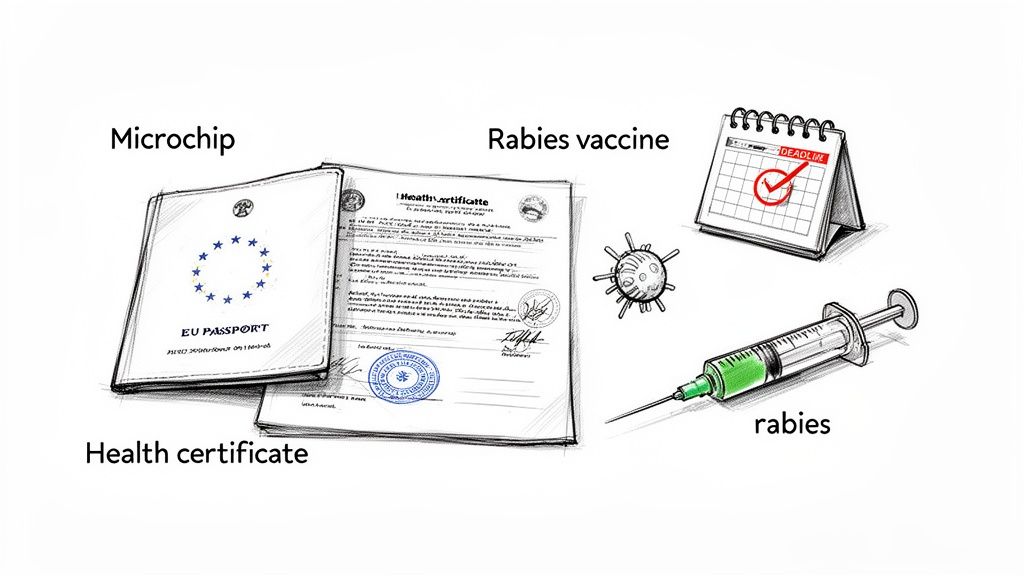
Before your pet goes anywhere, they have to meet a few key international standards. These three items are the absolute building blocks of your pet’s travel file, proving their identity and that they are healthy enough to fly.
A Compliant Microchip: This is your pet’s permanent ID. It should be an ISO-compliant, 15-digit microchip that standard scanners can read. This is always step one, as the chip number has to be on all their other health documents.
Up-to-Date Rabies Vaccination: After the microchip is in, your pet needs a valid rabies shot. For most international travel, the vaccine has to be given at least 21 days before you fly, and your pet must be at least 12 weeks old when they get it.
Official Health Certificate: This is the document where an accredited veterinarian officially states your pet is healthy and fit for travel. Timing is everything here. For example, if you're flying to the European Union, the certificate usually has to be issued within 10 days of your arrival.
These steps have to be done in order. The microchip goes in before the rabies vaccine, and both are done long before the vet issues the final health certificate. Get the order right, and you're well on your way.
Understanding the EU Pet Passport
If you're already living in the European Union or a few other participating countries, you might have an EU Pet Passport for your dog or cat. This little blue booklet is very convenient, putting your pet's microchip info, vaccination history, and health checks into one standard document.
For anyone traveling between EU member countries, the passport often takes the place of a separate health certificate for every trip. But—and this is a big one—if you're flying into the EU from a country like the United States, you’ll need an official health certificate endorsed by a government body like the USDA-APHIS.
A common mistake is thinking a standard health certificate from your local vet is enough for international travel. For the EU and many other places, you need a specific, multi-page government form completed by a USDA-accredited veterinarian and then officially endorsed. It's a completely different document.
Destination-Specific Rules Are Key
While Air France has its own rules, the airline must also enforce the pet import laws of your final destination. This is where things can get really complicated, as every country has its own unique set of requirements. We're talking about anything from specific parasite treatments to required quarantine periods.
It is your responsibility as the owner to research and meet these destination-specific rules. Forgetting a required tapeworm treatment before entering the UK, for instance, could get your pet denied entry on arrival. The stakes are high.
This is exactly why specialized tools are so valuable. Trying to keep track of different timelines, forms, and endorsements is enough to make anyone’s head spin—pet owners and veterinary clinics alike. A platform designed to manage pet travel compliance makes sure no detail gets missed, turning a confusing process into a clear, manageable checklist. It’s the best way to make sure your paperwork is purr-fect and ready for a smooth journey.
Your Air France Pet Policy Questions Answered
Even after reading all the rules, it's totally normal for a few more questions to pop up. Let's be honest, traveling with a pet has a lot of moving parts, and sometimes you just need a straight answer. We've pulled together some of the most common questions we hear about the Air France pet policy to give you that extra bit of clarity.
Think of this as your quick-reference guide. We've laid it out in a simple question-and-answer format so you can find what you need without digging through pages of fine print. Let's get into those lingering questions.
Can I Bring Two Small Pets in One Carrier on Air France?
This is a great question, especially if you have a bonded pair. The short answer is: yes, sometimes! Air France might allow two small animals, like two cats or two tiny dogs, to share a single carrier in the cabin.
But, and this is a big "but," there are strict conditions. The total weight of both pets plus their carrier can't be more than the 8 kg (17.64 lbs) limit. They also have to be able to stand up, turn around, and lie down comfortably together. Their well-being is the top priority, so you can't just squeeze them in.
You must get pre-approval for this directly from Air France when you call to reserve your pet's spot. The airline has the final say, so getting that confirmation in writing is your best bet for a stress-free check-in.
What Happens If My Pet and Carrier Are Slightly Over the 8 KG Weight Limit?
The 8 kg limit for in-cabin pets is not flexible. It's one of the strictest parts of the Air France pet policy, and it's there for safety reasons—the carrier has to fit securely under the seat in front of you. If you show up at the check-in desk and you're even a little bit over that weight, your pet will not be allowed to fly in the cabin.
Your main option at that point is to see if they can fly in the aircraft hold instead. This isn't a guarantee, though. It all depends on whether there's space available and if your pet is even allowed to fly in the hold (for example, snub-nosed breeds are not allowed).
This kind of last-minute switch would also mean you'd need an IATA-compliant, hard-sided travel crate ready to go, which is completely different from a soft in-cabin carrier. To avoid this nightmare scenario, weigh your pet inside their carrier several times before you even think about leaving for the airport. Don't let a few ounces derail your entire trip.
Are There Country-Specific Restrictions I Should Know About?
Yes, and this is where many travelers get confused. Following Air France's rules is only half the battle. You also have to meet all the pet import requirements for your destination country, and these can be very different.
For example:
The United Kingdom: The UK has very strict rules and does not allow pets to arrive in the cabin on commercial flights. They must be booked as manifest cargo, which is a separate, more complex process.
Tapeworm Treatment: Many countries, including the UK, Ireland, and Finland, require that dogs get a specific tapeworm treatment from a vet within a very precise time window before landing.
Health Certificate Timing: The window for your vet to complete the health certificate can be tight. For travel to the EU, it's usually within 10 days of arrival, but other countries have their own timelines.
Ultimately, it’s your responsibility as the owner to research and meet these destination-specific rules. Getting it wrong could mean your pet is denied entry or, worse, put into a long and expensive quarantine.
How Can I Prepare My Pet for a Flight in the Hold?
Making sure your pet is comfortable in the hold is all about preparation. Starting well before your travel day will make a world of difference for their well-being.
The first step is to get them comfortable with their IATA-approved travel crate weeks, or even months, ahead of time. You want them to see the crate as a safe den, not a scary box. Start by feeding them their meals in it, and put their favorite toys or a blanket that smells like you inside. It's all about building a positive association.
On the day of the flight, here’s a quick checklist:
Give them a light meal and some water about four hours before you leave for the airport.
Take them for a good, long walk and a final potty break right before you head to the check-in counter.
Make sure the crate has a water dish attached that can be filled from the outside without opening the door.
It's widely suggested that you do not sedate your pet. Medications can affect their ability to regulate their body temperature and keep their balance during the flight.
By taking these steps, you're helping your pet become a well-prepared and comfortable traveler.
Trying to juggle airline rules and complex health documents can feel like a full-time job. Passpaw was built to simplify this entire process for veterinary practices and pet owners. Our platform helps manage the necessary paperwork, track critical deadlines, and ensure every detail is right for your journey, so you can focus on the adventure. Learn how Passpaw makes pet travel compliance easier.
More articles
From regulatory changes to best practices for veterinarians and pet owners, our resources keep you ahead of the curve.