Are you a team member in a veterinary practice?
Are you a pet parent planning a trip with your furry pal?
Documentation Update for Pet Travel: A Complete Guide
A suitcase is open, the airline confirmation is on the kitchen table, and your pet is already wondering why everyone is acting strange. Then you find the travel paperwork and notice that one date, endorsement, or vaccination detail no longer matches the trip. That's when a routine journey can turn into a frantic search through emails, clinic records, government pages, and airline policies.
A documentation update is more than replacing an old file. For pet travel, it means checking that the right records, certificates, approvals, and health details all match the pet, destination, and travel date. The process becomes much calmer when owners and clinics treat paperwork as a living record instead of a document that gets prepared once and forgotten.
The Moment You Realize the Paperwork Is Out of Date
The Martinez family thought they were nearly ready for their move to Lisbon. Their suitcases were open, the moving company had confirmed collection, and Biscuit, their ten-year-old beagle, was sleeping beside a pile of travel supplies. Then the family found his rabies certificate.
The date was wrong by six months.
At first, everyone assumed it was a simple filing mistake. Then the questions arrived. Was the vaccination still valid? Did Biscuit need another appointment? Would the airline accept the certificate? Did Portugal require a different form? Could a government endorsement still be completed before departure?

The family searched late into the evening, while their clinic received urgent messages and the airline sent a stern reminder about pet-entry paperwork. Nobody had intentionally ignored Biscuit's records. The paperwork had aged while the family focused on housing, flights, and the move itself.
Why this scene is so common
Pet travel documentation has several moving parts. A vaccination date can affect certificate timing. A certificate may need official endorsement. A destination can change its entry process, while an airline can apply separate carrier rules. Each item may be accurate on its own, yet the complete travel file can still contain a gap.
That's why a documentation update should be treated as a scheduled workflow, not an emergency repair. A clinic team needs to know which pets are traveling, where they're going, and when they're leaving. Owners need a clear view of what has been completed and what still depends on another step.
Practical rule: If a document is tied to a travel date, give it an expiration watch before the trip becomes urgent.
A useful compliance resource such as avoid audit pitfalls with this guide can also help teams think about document history, responsibility, and evidence. The same habits matter in pet travel. Keep the current version easy to identify, preserve older records, and record why a change was made.
Biscuit's family didn't need more panic. They needed one trusted record, a clear checklist, and someone accountable for the next action. That's the calmer path through international pet paperwork.
What a Documentation Update Really Means in Pet Travel
A pet travel documentation update works like renewing a passport. Identity details, validity periods, and destination requirements must be checked together. The “passport” is a connected set of health and entry records, so changing one item can affect the rest of the file.
For the pet, the refresh may include:
Health certificate timing: For travel from a non-EU country to the EU, a pet usually needs an EU animal health certificate issued by an official state veterinarian in the departure country no more than 10 days before arrival. The certificate is valid for travel between EU countries for 6 months or until the rabies vaccination expires, whichever comes first, according to Your Europe's pet travel guidance.
Rabies and microchip sequence: EU rules require a dog, cat, or ferret to be microchipped before rabies vaccination. A primary rabies vaccination becomes valid only after at least 21 days, and the pet must be at least 12 weeks old when the vaccine is given, as explained by the European Commission's travelling pet rules.
Official endorsements: A health certificate may need USDA APHIS review or endorsement, depending on the route and destination. For dogs traveling to or returning from a high-risk rabies country, USDA guidance requires a Certification of U.S.-Issued Rabies Vaccination completed by a USDA-accredited veterinarian and submitted before the dog leaves the United States, as described in USDA APHIS export guidance.
Supporting records: Updated rabies titre results, microchip information, import permits, and destination-specific forms may all need to match the same pet identity.
Routine refreshes and triggered changes
Some updates follow a routine schedule. An annual booster, a new laboratory result, or a replacement certificate can start the process. Others follow a rule change, disease alert, or different airline requirement.
The practical test is whether every record still describes the same journey. An update is a coordinated refresh tied to one pet, one destination, and one departure plan. If the microchip number differs between the certificate and vaccination record, issuing another form alone will not fix the mismatch.
Owners often begin with the medical record, so it helps to understand what pet vaccinations cost. The clinic can then connect that record to the destination's paperwork timeline. Passpaw supports a calmer, version-controlled workflow by tying the current documentation set to the pet's travel date, making it easier for the owner and clinic team to see what is complete, what changed, and what needs attention next.
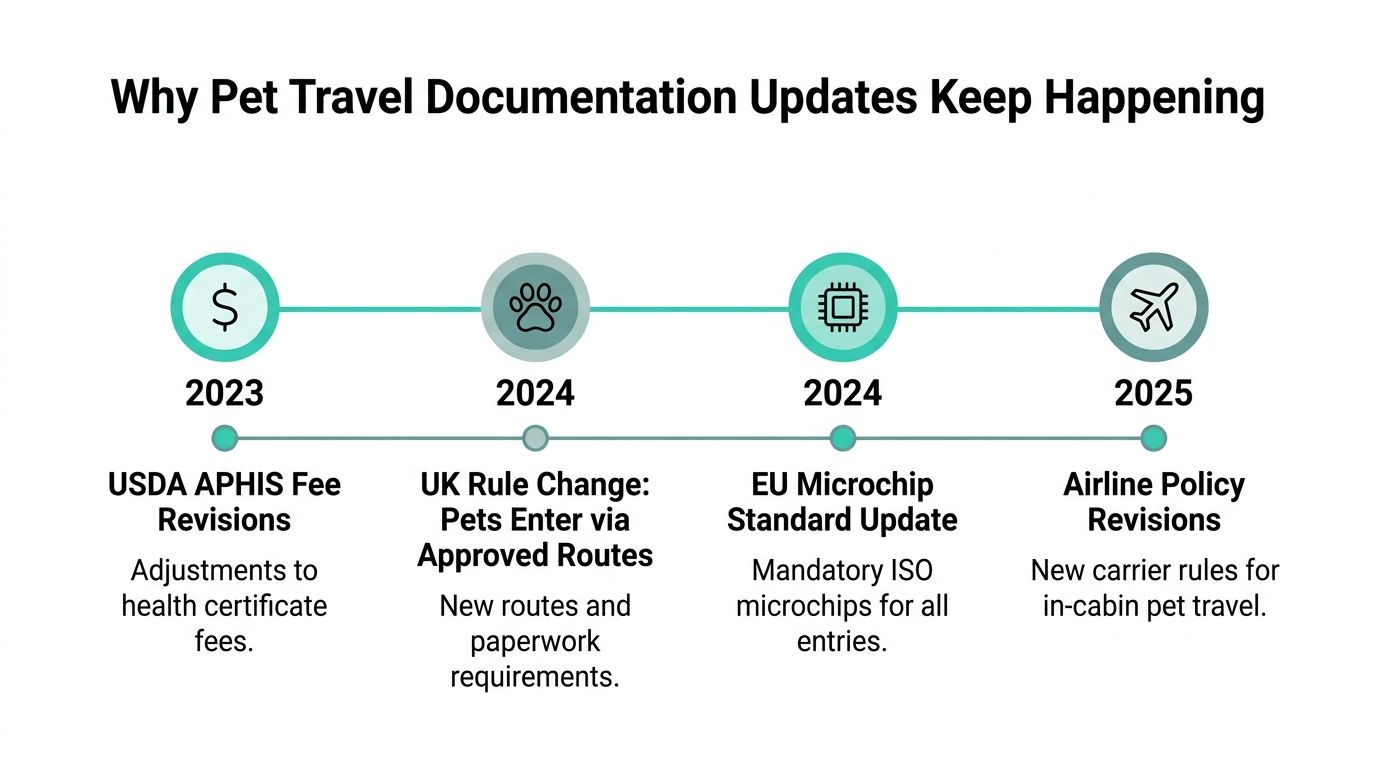
Why Pet Travel Documentation Updates Keep Happening
Rules change because the system is responding to new information, administrative needs, health risks, and transport conditions. The changes can feel random to an owner, but they usually fall into a few recognizable groups.
Government forms and administrative revisions
USDA APHIS may revise forms, submission details, or fees. A clinic that keeps using an old template can spend time correcting fields that were changed elsewhere. The safe response is to check the current official instructions for the destination and route, rather than assuming last season's form is still accepted.
Destination countries can also revise entry rules. A country may change approved routes, documents, quarantine conditions, or the evidence it wants to see. A pet owner who checks only the airline's website may miss a government requirement, while a clinic that checks only a familiar certificate may miss a destination-specific condition.
Health timing and disease alerts
Vaccination timing creates another reason for updates. The date a vaccine is given, the pet's age, the microchip sequence, and the required waiting period can affect whether a record supports the intended journey. That's why a vaccination record shouldn't be reviewed in isolation.
Disease alerts can cause faster changes. New World screwworm concerns, for example, prompted Mexico to United States import changes in 2024. The lesson isn't that every trip will face the same rule. It's that health authorities can adjust entry requirements when conditions change, and a previously correct document may need a fresh review.
Airline policies add another layer
Airlines can revise carrier policies, seasonal restrictions, accepted carriers, cabin arrangements, or check-in procedures. Government approval doesn't automatically answer every airline question. Owners and clinics need to verify both tracks.
A practical monitoring rhythm helps. During active planning, the clinic can monitor USDA APHIS notices and destination bulletins, while the owner watches personal milestones such as vaccine due dates and passport expiration. Both sides should complete a final pre-travel verification before the certificate window opens.
The paperwork has a shelf life because the information around it has a shelf life. Treating each update as a response to a specific trigger makes the process easier to understand and less likely to become a last-minute scramble.
How Vets and Owners Can Track and Verify Updates
A dependable system has two tracks. The clinic watches external rules and professional notices. The owner watches the pet's records, dates, booking details, and travel plans. Neither side can safely carry the whole process alone.
The clinic-side check
Veterinary practices should begin with primary sources. For United States routes, that includes USDA APHIS pet travel notices and the relevant official destination guidance. The clinic can also check destination-country consulate bulletins and confirm the airline's current pet policy.
A secondary website may help explain a rule in plain language, but it shouldn't replace the official source. Be cautious with screenshots from unverified Facebook posts, PDFs with mismatched header and effective dates, and broker pages that don't identify veterinary authorship or link clearly to the underlying authority.
The owner-side check
Owners can keep a simple travel record with the pet's microchip number, vaccination dates, laboratory results, certificate status, destination, airline, and departure date. During active planning, a weekly review is useful. A deeper verification cycle should begin 90 days before the trip, leaving time to correct identity mismatches or schedule appointments.
When a rule looks unusual, verify it in a repeatable order:
Find the official document. Locate the government page or PDF that contains the requirement.
Check the effective date. A document's publication date may differ from the date its rule begins.
Match the route. Confirm that the guidance applies to the departure country, destination, transit points, and type of travel.
Ask the issuing office. If a certificate or endorsement requirement seems inconsistent, the clinic can contact the relevant USDA office for clarification.
Verify the microchip rule. Check whether the destination requires a particular standard and confirm that the number appears consistently across records.
For owners arranging unusual transport, Passport to Adventure's pet jet guide can provide useful planning context, but the clinic and official authorities should still verify the actual entry documents. For a focused look at record checks, see Passpaw's documentation verification guide.
The goal isn't to collect every opinion online. It's to identify the current rule, confirm that it applies to this journey, and preserve the evidence used for the decision.
How Passpaw Streamlines the Documentation Update Workflow
Manual workflows often begin with a spreadsheet. One row contains the pet's name, another contains a vaccine date, and a separate email thread holds the airline's response. A clinic staff member may keep a PDF in a shared folder while the owner has a different copy on a phone. The process can work, but version confusion enters easily.
A version-controlled platform such as Passpaw keeps each pet's record tied to a specific destination and travel date. When a country requirement changes, the affected profile can be flagged for review rather than waiting for someone to notice the change during a final appointment.
Manual Workflow vs Passpaw Workflow
Task | Manual Process | Passpaw Process |
|---|---|---|
Record ownership | Staff and owners divide information across spreadsheets and email | One pet profile connects the clinic team and owner |
Version control | People must identify the newest attachment themselves | The current document is surfaced as the working version |
Requirement review | Staff compare forms and rules manually | Uploaded documents can be checked against entered pet information and current requirements |
Missing steps | Gaps may sit inside an email thread | Endorsement or approval tasks can be surfaced for review |
Urgency | Staff sort spreadsheets by hand | Records can be prioritized by departure date |
Communication | The clinic emails the owner, then waits for a reply | Clinic staff and the owner can receive workflow updates in parallel |
Repeated edits | The same details may be entered in several places | A single update can be applied across the relevant workflow |
This matters most when a certificate has several dependencies. A change to the destination rule may affect the form, endorsement sequence, supporting record, and owner deadline. The workflow should show those relationships instead of leaving a staff member to reconstruct them from messages.
Passpaw is a cloud-based option that supports document validation, task prioritization by travel details, workflow guidance, and communication between veterinary practices and clients. It doesn't replace professional judgment or official verification. It gives the team a structured place to apply that judgment and maintain a clear record of the current status.
Practices comparing platforms can also review Passpaw's documentation tools. The useful question isn't whether a tool creates another checklist. It's whether the checklist stays connected to the pet, the trip, the latest document version, and the person responsible for the next step.
Best Practices and Common Pitfalls for Every Trip
A good travel file should be easy to review when everyone is calm. Use the following checklist as a repeatable starting point, then confirm the exact destination rules with the clinic and official authorities.
A reusable preparation checklist
Start early: Open the travel file around the 90-day planning window and record the destination, route, airline, and departure date.
Check the microchip first: Confirm the chip number and destination standard before relying on a later vaccination record.
Map the vaccine timeline: Record the vaccination date, waiting period, titre requirements where applicable, and any expiry that could affect the journey.
Schedule endorsement carefully: USDA guidance notes that, after an accredited veterinarian signs a health certificate, the owner may have a limited window, such as 30 days, to obtain USDA endorsement and complete travel before the destination stops accepting that certificate. Confirm the exact window for the route using USDA's pet travel process overview.
Keep two copies: Store digital copies in two separate locations and carry a printed backup packet with the pet's travel documents.
Review the whole set: Compare names, microchip numbers, dates, signatures, destination, and certificate status across every record.
Pitfalls with a practical fix
Last year's certificate: Start a new destination check instead of assuming the old document still applies.
Travel-agent hearsay: Ask for the official government rule or airline policy, then have the clinic review the medical implications.
Flight before entry rules: Confirm the destination and transit requirements before booking a non-refundable itinerary.
One-size-fits-all thinking: An EU certificate doesn't automatically satisfy a non-EU destination. Match the form to the actual route.
Ignoring laboratory timing: If a titre laboratory changes its turnaround time, rebuild the schedule rather than trusting the original plan.
Forgetting short layovers: Check whether a transit country requires a permit or additional documentation even when the pet isn't staying overnight.
For more help identifying missing records, use this guide to documentation gaps. A small review before booking can prevent a much larger correction near departure.
Why One-Time Compliance Is Not Enough
A family can complete every form correctly and still face trouble on a later trip. Pet travel records work more like a vehicle inspection schedule than a finished receipt. Dates expire, routes change, and authorities revise entry requirements, so the file needs another look before each journey.
Consider two owners on a similar route. One brings year-old paperwork and may face a rejected certificate, denied boarding, or a rushed USDA re-endorsement request. The other checks the current route requirements, confirms the pet's records, and leaves time to correct gaps. The difference comes down to one habit: treating the documentation update as part of trip planning.
A completed file answers what was true when it was prepared. A current file answers what supports this journey now.
A useful workflow assigns each trip its own review point. The clinic watches certificate expiration, checks the destination and transit requirements, and records why a change was made. That reason might be a policy update, a clarification, or a correction to the pet's underlying record.
This history gives the clinic and owner a shared explanation when a form is replaced or a vaccine date changes the schedule. It also turns scattered email decisions into a traceable record tied to the pet's travel date. Passpaw's documentation life-cycle guidance explains how to maintain records as working assets rather than treating paperwork as finished once signed.
Your Next Steps for Stress-Free Pet Travel
Pet owners, veterinary practices, and travel professionals each have a clear role.
For pet owners
Audit your pet's current profile. Check the microchip number, rabies record, laboratory results, certificate status, destination, and airline. Set a calendar reminder for the 90-day pre-travel review, and verify destination requirements before booking flights.
For veterinary practices
Assign a documentation champion who monitors USDA APHIS alerts and destination updates. Standardize health certificate templates by destination, keep a visible owner for each pending task, and make sure the clinic and client can see which version is current.
For travel agents and relocation specialists
Add a pre-booking compliance call to every itinerary involving a pet. Ask for the destination, transit points, travel date, and clinic contact before confirming plans. Partner with a veterinary practice that uses a version-controlled workflow, so changes don't disappear inside scattered emails.
A documentation update isn't a one-time hurdle. It's a repeatable part of responsible pet travel, and each review gives Biscuit and every other traveling companion a better chance of reaching the next destination without paperwork drama.
Passpaw helps veterinary practices and pet owners manage current travel documents, validate records against pet details, prioritize tasks by travel date, and keep communication connected to the same workflow. Visit Passpaw to explore a calmer way to manage documentation updates for your next pet journey.

More articles
From regulatory changes to best practices for veterinarians and pet owners, our resources keep you ahead of the curve.