Are you a team member in a veterinary practice?
Are you a pet parent planning a trip with your furry pal?
Pet Travel Document Validation Process Made Easy
The flight is close, the carrier has sent another document reminder, and your clinic has a health certificate waiting for a final review. The pet's name looks right, the rabies record is attached, and the owner is confident everything is ready. Then someone notices that the microchip number on the certificate differs from the vaccination record, or that the airline's deadline is earlier than the destination country's deadline.
That's where a careful document validation process earns its keep. Pet travel paperwork isn't just a stack of forms to complete. Each field connects to an identity check, a health requirement, a timing rule, or an official endorsement. A small mismatch can mean a delayed flight, a refused check-in, or a pet and owner separated from their travel plans. A clear workflow, supported by the right technology, helps teams catch these problems before the airport does. For background on planning the paperwork, review these international pet documentation requirements.
Preparing for Takeoff Without the Turbulence
At a busy veterinary clinic, an international health certificate rarely arrives in isolation. A technician may be confirming a microchip number while the veterinarian checks vaccination timing, the owner searches for a missing itinerary, and a pet shipper asks whether the government endorsement has been completed. Everyone is working toward the same departure date, but each person may be looking at a different part of the journey.
The pressure increases when the rules don't line up neatly. The airline may want a certificate within a narrow window, while the destination authority may require additional treatments, translations, or laboratory evidence. The form may be medically accurate but still unusable if a signature is missing, a field is unreadable, or the wrong version was submitted.
Practical rule: Validate the document against the pet, the route, the issuing professional, and the timing. A form can be complete in appearance and still fail one of those four tests.
A sound workflow begins before the final certificate is signed. First, collect the route, travel date, airline, owner details, and the pet's permanent identification. Then compare every document against those facts and record unresolved items instead of relying on memory. This is especially important because pet travel paperwork can involve more than one document, including vaccination records, laboratory results, permits, and endorsements.
The purpose isn't to create extra bureaucracy. It's to prevent a last-minute discovery that forces a new appointment or makes the pet miss the planned departure. Manual review remains essential, but a structured process makes it repeatable, and smart automation can help teams focus their attention where judgment matters most.
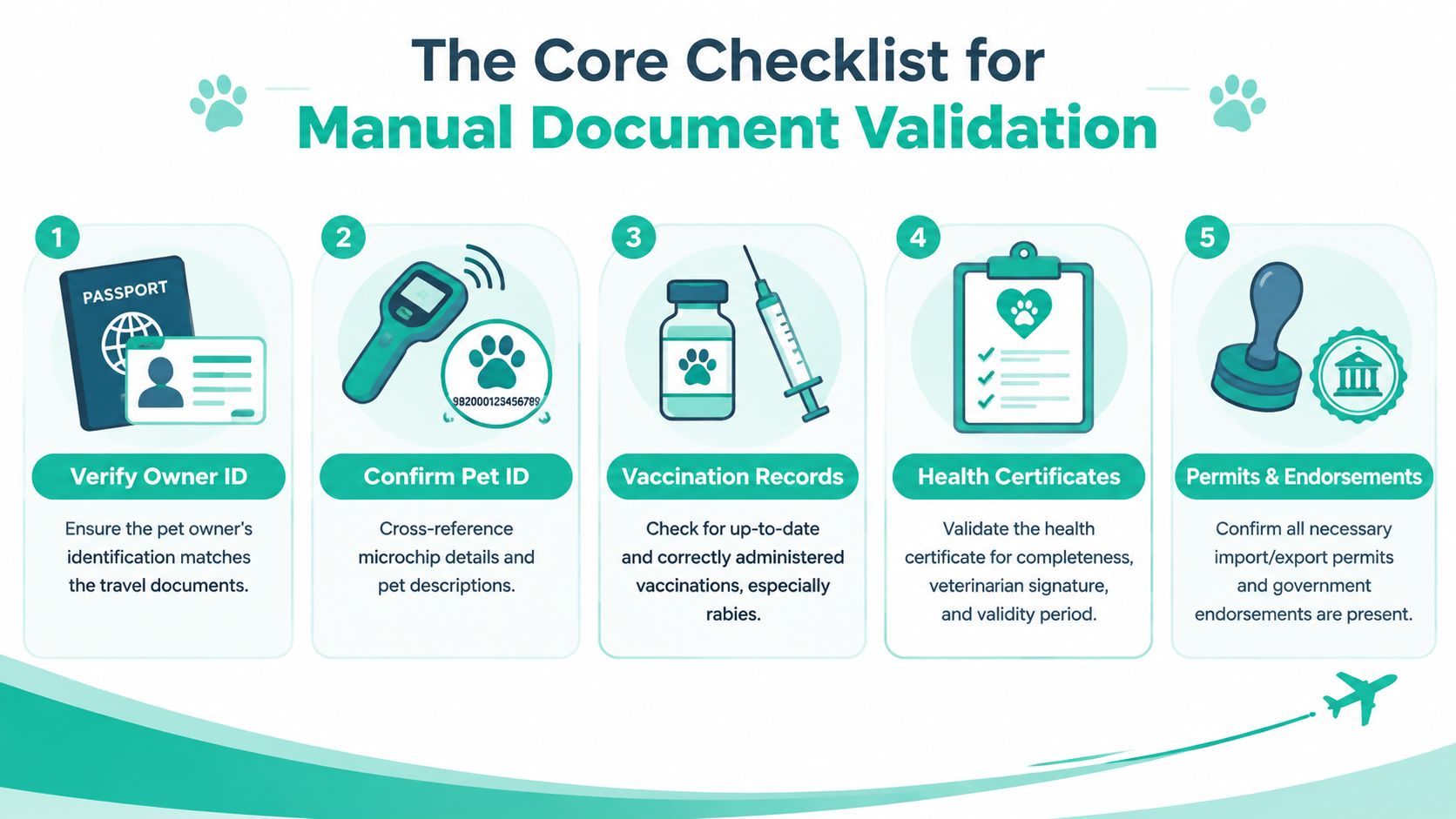
The Core Checklist for Manual Document Validation
Manual review works best when every reviewer follows the same order. Use the checklist below as a practical pass, and write down any discrepancy before asking the veterinarian or owner to correct it.
Pet information
Start with the animal's identity. Compare the microchip number, species, breed or type, sex, colour, age or date of birth, and descriptive markings across the health certificate, vaccination record, laboratory report, and owner's application.
The microchip is often the anchor that connects the paperwork to the animal presented for travel. A single transposed digit can break that connection. Don't assume a matching name is enough, because names can be duplicated or recorded differently. If the country requires an ISO-compliant microchip, confirm that the relevant requirement has been addressed rather than treating the identification field as a simple text entry. Destination rules may also call for vaccination details, parasite treatments, or serologic titer tests, as described in the CDC guidance on traveling with pets.
Owner and veterinarian details
Check the owner's name and identification against the travel booking and any import or export permit. Look for spelling differences, missing document numbers, and inconsistent addresses where the form requires them.
For the veterinarian, confirm the name, accreditation details, practice information, signature, date, and official stamp or endorsement fields. A signature placed in the wrong box can be treated differently from a signature that clearly validates the intended section. Make sure every scan is legible, especially seals, handwritten entries, and dates.
Travel information
Review the origin, destination, transit points, travel date, airline, and route. Date formats deserve special attention. A day-month entry can be mistaken for a month-day entry, creating an error in vaccination timing or certificate validity.
For pets traveling from the U.S., airlines often require a health certificate no older than 10 days, even when the destination country permits a longer period. Most destinations also require a USDA-APHIS-endorsed Form 7001 issued by a federally accredited veterinarian, so the review must account for airline rules and destination rules together. See the U.S. State Department guidance for pets and international travel.
Health information
Confirm that vaccinations, especially rabies, are recorded with the correct product, date, validity information, and veterinarian details. Check parasite treatments and laboratory results where the route requires them, and verify that the sample, pet identity, and result belong together.
Most critical detail: Never validate a document by looking at it alone. Cross-reference each important field against another trusted record.
Finally, check permits, translations, government endorsements, and attachment names. A useful document photo checklist can help staff identify poor scans, cropped pages, and unreadable entries before submission.
Why Pet Travel Documents Get Rejected
Rejection usually follows a pattern. The paperwork may contain no obvious typo, yet it can still fail because two legitimate requirements conflict or because the reviewer applied the right rule to the wrong stage of the journey.
The airline and destination authority are separate sources of requirements. A country may allow a certificate to remain valid for a longer period, while the airline applies its own shorter acceptance window. If the team checks only the destination rule, the pet may still be stopped during check-in.
Validity windows become even more complicated when a certificate serves several purposes. For travel from Great Britain to the EU, an Animal Health Certificate is valid for 10 days after issue for entry, then 6 months for onward travel within the EU and 6 months for re-entry to Great Britain, according to the UK government's Animal Health Certificate guidance. Those are different stages, not competing interpretations of one deadline.
The failure points behind the form
A reviewer should ask why each document might be refused, not merely whether it looks finished.
Identity mismatch: The microchip, pet description, or owner details differ between records.
Timing error: A vaccination, blood sample, treatment, or certificate falls outside the required window.
Missing authority: The veterinarian's accreditation, government endorsement, stamp, or permit isn't present or readable.
Incomplete evidence: A required translation, laboratory result, treatment entry, or attachment is absent.
Poor document quality: A scan cuts off a page edge, hides a signature, or makes a seal impossible to read.
Rule conflict: The airline, transit location, and final destination apply different requirements.
The common documentation gaps in pet travel often become visible only when the entire journey is reviewed as one record. A certificate can pass a basic completeness check while failing on sequence, timing, or identity.
The practical response is to record the rule used for each decision. Note the source, the relevant travel stage, the document affected, and the person responsible for correction. That record gives the next reviewer context and prevents the clinic from solving the same problem from scratch.
Validation is also an acceptance gate, not a guarantee that every underlying fact is correct. Eurostat's methodology describes validation as a check that a combination of values belongs to an acceptable set. A negative outcome guarantees that the data is incorrect, while a positive outcome indicates plausibility rather than certainty, as outlined in the Eurostat validation methodology. That distinction matters when a record passes a format check but still needs professional review.
Streamlining Validation with Automated Tools
A document can look complete and still fail at check-in because one field conflicts with the pet record or a deadline was calculated from the wrong travel date. Automation helps by repeating these comparisons consistently, while the veterinarian decides whether the evidence is clinically and procedurally acceptable. A system can compare uploaded records with entered pet information, identify missing fields, flag mismatched values, and keep unresolved tasks visible.
A central digital record also prevents staff from searching across email attachments, shared folders, and paper files. The team can see the pet, route, documents, open questions, and travel date in one place. Passpaw provides real-time validation for uploaded pet travel documents, checking them against entered pet information and destination-specific requirements. Clinics assessing different document validation software options should compare not only extraction accuracy, but also how exceptions reach a qualified reviewer.
What automation should catch
The useful role of automation is to expose the reason a record needs attention. It should help staff identify:
Unreadable or incomplete pages: A missing corner, blurred seal, or absent attachment can prevent an authority or airline from accepting the certificate.
Field mismatches: Comparing names, microchip details, dates, and document identifiers can reveal an identity problem before departure.
Requirement gaps: Certified translations, parasite treatments, ISO-compliant microchips, or serologic titer tests may apply to the route. The CDC's pet travel information shows why reviewing one page in isolation can miss a destination requirement.
Deadline risks: A task tied to the wrong certificate or airline window can make an otherwise valid document unusable.
Low-confidence cases: Unclear handwriting, unusual layouts, or conflicting information should send the file to a person rather than receive an automatic pass.
Extraction is only one part of the workflow. Teams must know how staff review, correct, and audit extracted fields. The overview of AI for logistics document automation helps explain extraction workflows, while pet travel teams should require visible exceptions and traceable decisions.
An approval label can create false confidence if the original file and comparison source remain hidden. Retain the original, display the source field used for each match, record corrections, and require human sign-off for unclear or high-risk cases. NIST's Digital Identity Guidelines illustrate why automated validation must account for both incorrect acceptance and unnecessary rejection. A sound process makes those outcomes visible so reviewers can adjust the decision instead of trusting a single score.
Pro Tips for a Flawless Validation Workflow
A dependable clinic process is built around ownership, timing, and visibility. The following practices help turn individual checks into a workflow that can survive staff absences, changing itineraries, and last-minute corrections.
Give every case one source of truth
Choose one record as the authoritative case file. Store the owner's identification, pet details, itinerary, uploaded documents, corrections, and approval status together. Tell the client which version is current, and avoid making final decisions from an old attachment sitting in an inbox.
Use a standard checklist for every route, then add destination-specific items. This gives new staff a repeatable starting point without forcing experienced staff to remember every exception.
Use a second reviewer for the final pass
A two-person review is most useful at the final approval stage. The first reviewer checks the records and resolves ordinary gaps. The second reviewer compares the pet identity, dates, signatures, endorsements, and route without assuming that the first review was correct.
This isn't about distrusting colleagues. Fresh eyes are more likely to notice a reversed date, a missing page, or a microchip digit that blends into a handwritten entry.
Keep clients involved
Send owners a plain-language list of what they must provide, what the clinic will complete, and what may change if the itinerary changes. Ask them to report route changes, flight changes, and updates to the pet's identification or health records promptly.
Clear communication prevents a common failure pattern, where the clinic believes a document is final while the owner is still waiting for a permit or translation.
Validate through the document's lifecycle
A one-time review at upload isn't enough for pet travel. Destination rules, travel dates, and document status can change after submission, so a modern workflow needs ongoing monitoring. This lifecycle approach is also highlighted in guidance on document verification in 2026.
Recheck the case after a material change, before final issuance, and close to departure. Don't re-review every field blindly. Reopen the fields affected by the change, then confirm that dependent requirements still align.

Protect records and learn from exceptions
Limit access to documents according to each team member's role, especially when files contain identity information. Guidance on preventing unauthorized document access can help practices think through permissions, sharing, and retrieval.
Finally, review rejected or corrected cases during team meetings. Record the cause, the missed signal, and the process change. A documentation-error study involving 202 cases and 1,240 events found that humans captured 98.10% of events but still had an overall documentation error rate of 17.01%; the published study also reported a 27.31% error rate for Pre-Procedure Verification and 20.30% for Out of OR timestamps. The practical message for veterinary teams is that a complete record can still be wrong, so high-risk checkpoints deserve focused validation.
Conclusion Making Every Trip a Walk in the Park
A reliable pet travel document validation process connects four questions. Is this the right pet? Is the information accurate and legible? Does it satisfy the airline and destination requirements? Will it remain valid throughout the relevant stages of the journey?
Manual review answers those questions through professional judgment and careful cross-checking. Automation adds consistency by comparing records, surfacing missing evidence, tracking deadlines, and routing uncertain cases to people. Neither approach works well alone when the itinerary is complex, but together they can make a stressful task far more manageable.
The result is more than a tidy file. It's a calmer conversation with the owner, fewer avoidable surprises at check-in, and a journey that starts on the right paw.
Passpaw helps veterinary practices manage international pet health certificates with document validation, destination-specific checks, task tracking, and client communication in one workflow. Visit Passpaw to see how it can support your clinic's pet travel paperwork from first upload through final review.

More articles
From regulatory changes to best practices for veterinarians and pet owners, our resources keep you ahead of the curve.