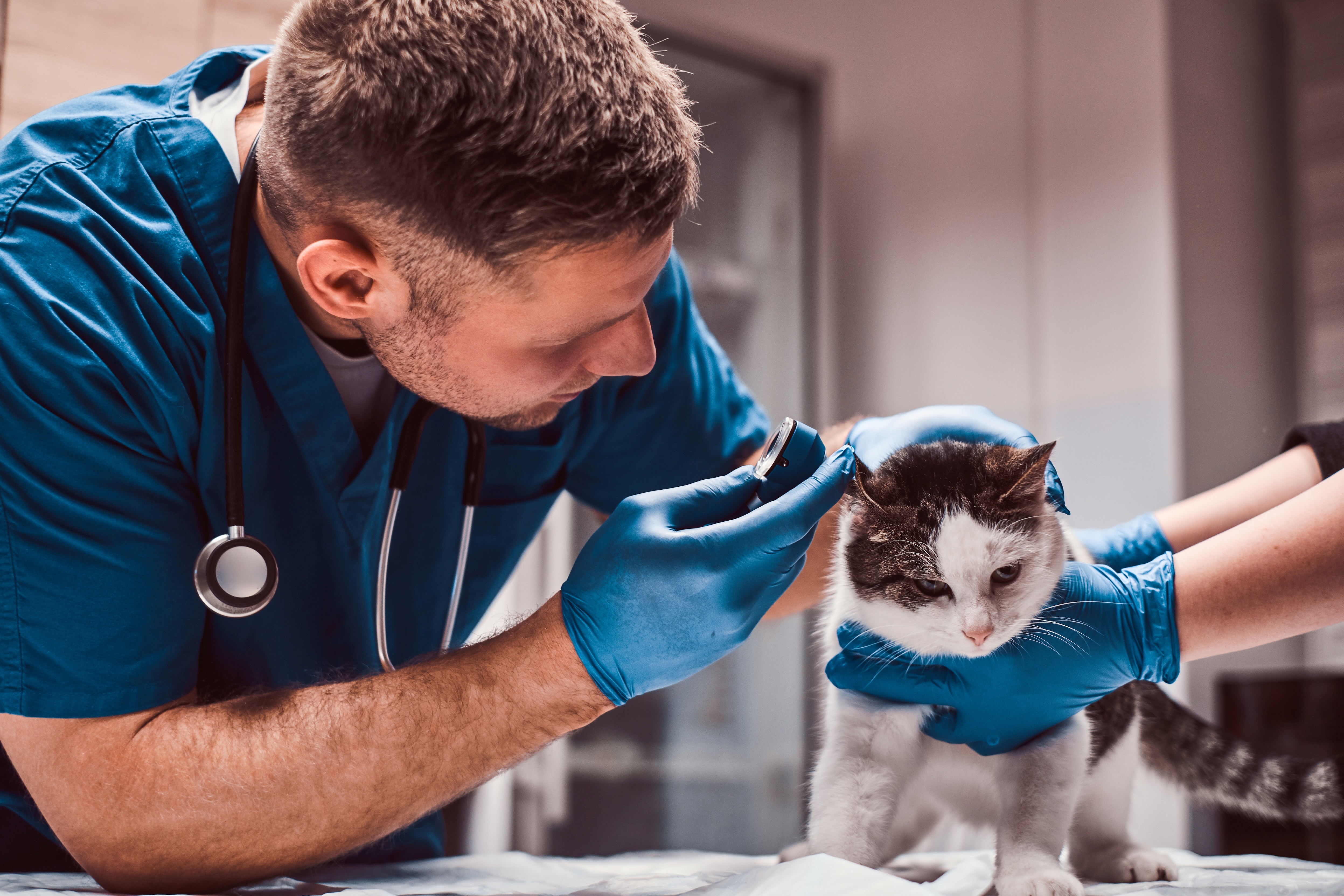
Are you a team member in a veterinary practice?
Are you a pet parent planning a trip with your furry pal?
Document Authentication Near Me: Pet Travel Guide
“Document authentication near me” sounds like a simple local search. For pet travel, it often sends owners to the wrong first appointment. A nearby notary may witness a signature, but international pet documents usually depend on a destination-specific chain involving a veterinarian, government endorsement, and sometimes consular authentication. The safest starting point is the country where your pet will arrive, not the office closest to your home.
Why Document Authentication Near Me Is the Wrong Starting Point
The most common assumption is that a local notary or certification office can solve the entire problem. That assumption can lead to a wasted appointment. A notary may prepare or witness a document, but a notary doesn't issue a USDA endorsement, decide whether a destination accepts digital certification, or replace a required embassy step.
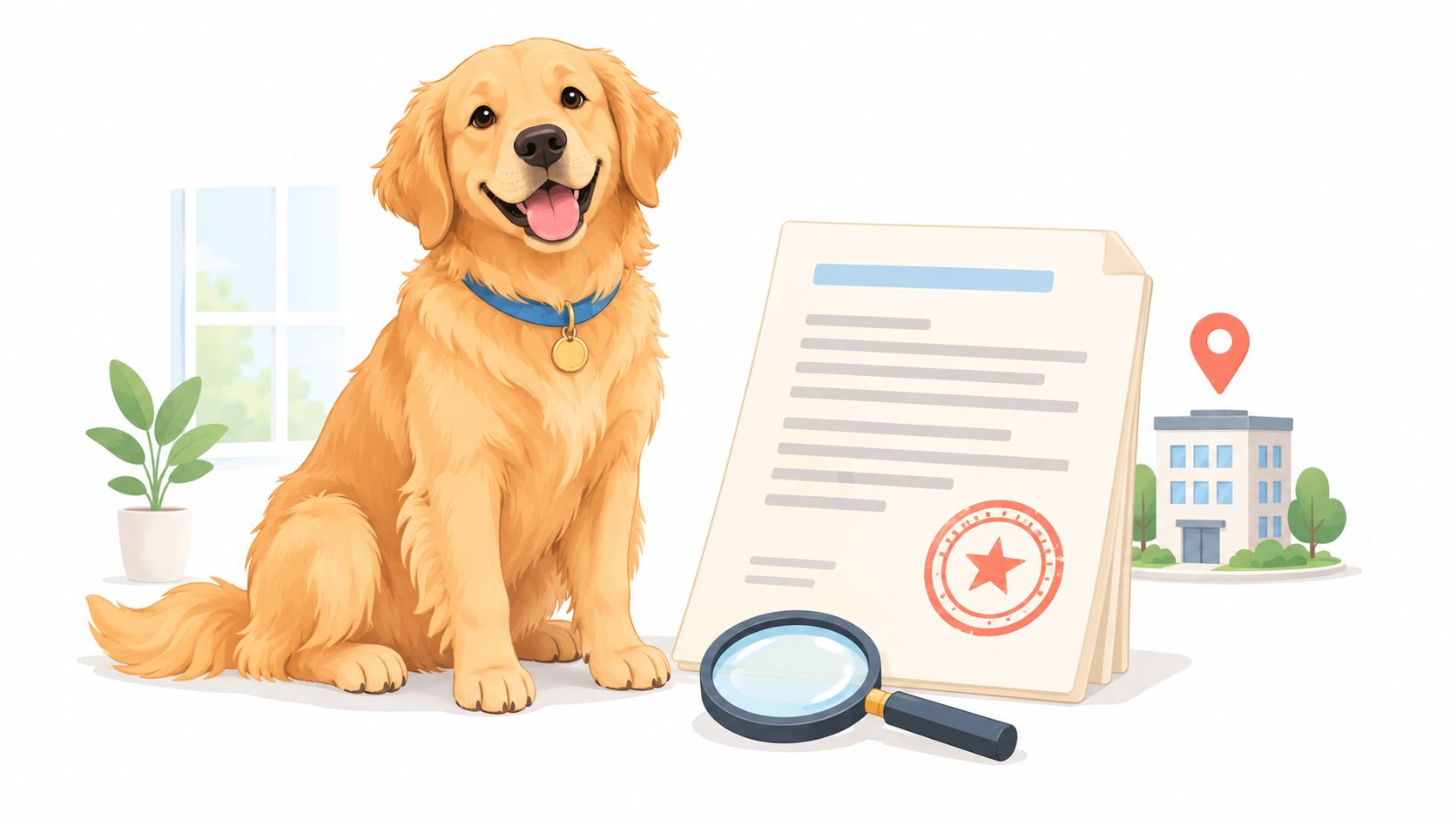
The modern international authentication system was established by the Hague Convention of 5 October 1961, formally titled the Convention Abolishing the Requirement of Legalisation for Foreign Public Documents. For participating destinations, the convention replaced a long chain of government offices, embassies, and consulates with a standardized certificate called an apostille. The Hague Conference on Private International Law lists 130 Contracting Parties and says that several million apostilles are issued globally each year (HCCH Apostille Convention).
An apostille has a focused job. It verifies the authenticity of the signature, the official capacity of the signer, and the identity of a seal or stamp. It doesn't verify the factual content of the document. In a pet-health file, that means an apostille doesn't prove that a rabies vaccination occurred or that a microchip number is correct. It confirms the authority behind a signature or seal.
The stamp and the health certificate are different things
A pet's health certificate begins with an authorized veterinary professional. Authentication comes later, if the destination requires it. Confusing those roles is like asking a leash to perform a physical exam. Both belong in the travel kit, but they do different jobs.
Before searching for a nearby provider, review Passpaw's pet travel documentation requirements and identify the document your destination requires. For broader background on authentication workflows, a guide to document authentication for corporate teams can also clarify how signatures, seals, and government certificates relate to one another.
Researching Destination Requirements Before You Search Locally
Start with three facts: where the document was issued, where the pet is going, and which authority the destination accepts. These details determine whether you need an apostille, another authentication certificate, consular legalization, or a veterinary process that doesn't use a standard apostille at all.
The 1961 Hague Convention created a simpler route for public documents sent between participating countries. Government guidance explains that an apostille is intended for a public document used in a country within that framework. If the destination isn't participating, the document may need a certificate of authentication followed by additional embassy or consular steps (Washington Secretary of State apostille guidance).
Check the destination before booking anything
Use the destination government's current guidance, USDA APHIS resources, and the relevant embassy information. Requirements can differ even when two countries appear to use similar paperwork.
Ask these questions before you schedule a local appointment:
Which authority issues the certificate? Is it a USDA-accredited veterinarian, an official state veterinarian, or another authority?
Who endorses it? Does USDA APHIS need to review the certificate after the veterinary visit?
What format is accepted? Can the destination accept digital endorsement, or does it require an ink signature and embossed certificate?
What supporting records are needed? These may include vaccination records, laboratory reports, or an import permit.
What timing rule applies? Check the certificate's validity against arrival, departure, and airline requirements.
Rules can change, so don't rely on an old checklist from a friend or a generic search result. The right local service is the one that fits the destination's chain, not the one with the shortest drive. Passpaw's international travel documents guide can help organize the questions before you contact a provider.
Navigating the Veterinary and USDA Endorsement Chain
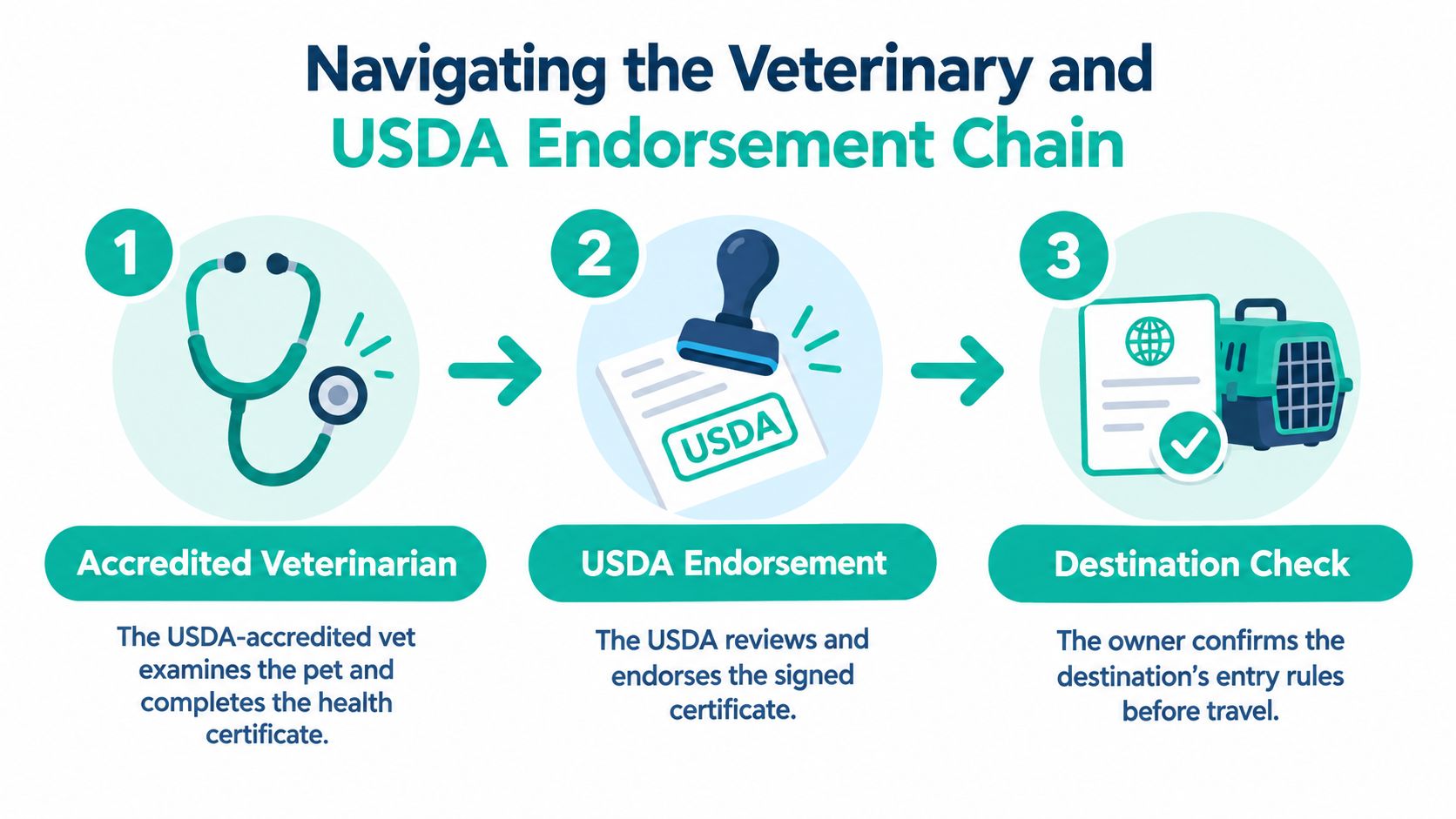
For a pet traveling from the United States, authentication is a staged process rather than one convenient stamp. First, confirm the destination rules and whether authentication is required. Then arrange the veterinary certificate, gather supporting records, submit the packet for USDA APHIS endorsement when required, and check whether the destination also asks for Department of State authentication (USDA APHIS pet travel process).
Stage one starts with an accredited veterinarian
A USDA-accredited veterinarian examines the animal and completes, signs, and dates the health certificate. The certificate may need vaccination records, laboratory reports, and an import permit. The veterinarian's signature establishes the veterinary part of the file, but it doesn't automatically create government endorsement.
Keep the details consistent across every page. The owner's name, pet's identity, microchip information, vaccination dates, test dates, and travel dates should match. A small mismatch can send the packet back for correction, which may affect timing.
Stage two is government endorsement
USDA APHIS reviews and endorses the signed certificate through VEHCS or an applicable paper process. USDA describes endorsement as a separate countersignature and stamped or embossed validation. A local notary can't replace that federal step.
Some destinations require the original endorsed hard copy to accompany the animal. Others accept a digitally endorsed certificate. The destination controls the answer, so ask your veterinarian whether the final document must be printed, mailed, carried, or uploaded.
For a practical explanation of this sequence, see how to get a USDA-endorsed pet health certificate. Treat the packet like a relay race. The veterinarian starts it, USDA may carry the next leg, and the destination's rule determines what must cross the finish line.
Timing Risks and How Local Services Actually Help
Local help matters, but timing matters first. A nearby office cannot rescue a document set that reaches the right desk on the wrong day.
Pet travel paperwork runs on overlapping clocks. An airline may want a health certificate issued within 10 days of travel, while the destination may use a different validity window or require endorsement by a separate deadline. The same trip can also involve mailing time, review time, and the possibility of corrections. The U.S. State Department pet travel guidance explains why these timelines need close attention before you book appointments.
USDA also warns that incomplete or incorrect submissions can slow endorsement, and its professional guidance says the full process can take weeks to months depending on the destination. That creates the main risk. A certificate can be medically correct and still become unusable because it was issued too early, sent in the wrong format, or returned for a small mismatch.
Build the schedule backward
Start with the arrival date. Then work backward through each gate in the chain: the destination's certificate window, the veterinary exam, any lab work, USDA submission, possible State Department authentication, embassy review, shipping, and the airline's document check. The order matters. Pet paperwork works like refrigerated medicine. Good handling is not enough if the timing window expires.
That is where local services can help in a practical way. A veterinarian, pet travel agency, courier, or document service earns its keep by keeping the sequence intact. Ask whether the provider understands the destination's format, whether original paper documents are needed, and how corrections are handled if one page comes back.
Practical rule: Fast service does not fix a certificate that was issued too early, endorsed in the wrong format, or submitted with missing information.
Keep one written timeline with the owner's name, travel date, document status, and next action for each step. Mark any item that must stay in original hard copy. If something needs correction, confirm what must be repeated before anyone books another visit. That small habit can prevent the kind of last-minute scramble that leaves pets, owners, and clinic staff panting for all the wrong reasons.
Building a Reliable Document Workflow with Passpaw
A nearby notary will not rescue a pet document that enters the process in the wrong order. A reliable workflow starts earlier. It treats the file like a chain of custody, where each document has a source, a reviewer, a deadline, and a final form that must match the destination's rules.
Passpaw is a cloud-based platform for managing international pet health certificates. It can check uploaded pet-travel documents against the pet details and destination requirements entered by the user, and it helps practices organize forms and submission packets. That makes it useful before government review, while the destination authority still decides what it will accept.
Keep one clear record of responsibility
Good workflows reduce panic because everyone knows their job. One shared record should show the destination, departure date, pet identity, required tests, certificate type, endorsement route, delivery format, and current status. If a correction appears, the team can see who needs to act next instead of hunting through email threads and attachments.
A useful record assigns each action clearly:
The owner confirms the destination rule. That includes format, timing, supporting documents, and any airline requirements.
The veterinarian examines the pet and prepares the certificate. The practice checks identity details, dates, signatures, and required clinical records.
The endorsement packet is assembled. The file includes the certificate and any vaccination, laboratory, or permit documents required for that destination.
The government submission is tracked. The team records whether the process uses paper or VEHCS.
The final document format is confirmed. The owner knows whether to carry an original endorsed certificate or use an accepted digital version.
For destinations that accept digital endorsement, USDA's Veterinary Export Health Certification System, or VEHCS, lets accredited veterinarians complete and sign certificates electronically, submit them, and receive the endorsed certificate online through the USDA process for USDA APHIS accredited veterinarians. Other destinations still require paper handling, ink signatures, or embossed originals, so the workflow has to match the country before anyone assumes a local document service is the final step.
Teams that want broader process ideas can review ways to optimize document workflows. For pet travel, the practical goal is traceability. A clear record shows what has been checked, what is still open, and which authority makes the final decision. Passpaw's documentation hub can support that kind of organized, destination-specific process.
Final Checklist for a Stress-Free Journey
A smooth trip depends on preparation more than proximity. Before the final submission, compare the destination rules with the exact certificate in hand. Make sure the owner details, pet name, microchip number, vaccination dates, laboratory results, and travel dates agree across the packet.
A short final review can catch problems while there is still time to correct them:
Destination: Confirm the current government and airline requirements.
Veterinarian: Verify that the required veterinarian is authorized and that the certificate is complete, signed, and dated.
Endorsement: Check whether USDA APHIS review is required and whether the destination accepts digital endorsement.
Original documents: Confirm whether an endorsed paper certificate must accompany the pet.
Timing: Compare every validity window with the arrival and departure dates.
Corrections: Ask whether a change requires a new examination, signature, test, or endorsement.
For example, a family may find a nearby notary quickly but still need an accredited veterinary examination and government endorsement afterward. A destination may accept an electronic return through VEHCS, while another may require ink and embossing. The correct workflow depends on the destination, so a local search should support the plan rather than define it.
Your pet doesn't need to understand apostilles, endorsements, or validity windows. Your job is to make the paperwork boring, complete, and ready at the right time. With a destination-specific checklist and a tracked document chain, the journey can feel manageable for both of you.
Passpaw helps veterinary practices and pet owners organize international health certificates, validate document details, and track destination-specific requirements around travel dates. Visit Passpaw to create a clearer workflow before your pet's next international trip.

More articles
From regulatory changes to best practices for veterinarians and pet owners, our resources keep you ahead of the curve.