Are you a team member in a veterinary practice?
Are you a pet parent planning a trip with your furry pal?
Customer Communication Techniques That Actually Work
A client calls at 4:15 p.m. on Friday. Their dog is due to fly on Sunday, the health-certificate endorsement slot is full, and nobody can immediately say which document is missing. The owner is worried, the front desk is juggling other calls, and the veterinary team is trying to research destination rules while keeping the practice moving.
That is where customer communication techniques either protect the relationship or make the situation worse. Speed matters, but speed without structure creates mixed messages. Personalization matters, but personal details handled carelessly can reduce trust. The right channel matters, but a perfect message sent through the wrong channel may still go unread.
The practical answer is a repeatable workflow. Use it to acknowledge the first inquiry, classify the case, choose the channel, give one clear next step, escalate at the right moment, and confirm what happens next. The five-part framework below, followed by channel rules, ready-to-use scripts, teach-back, and a weekly team rhythm, gives your staff a playbook they can use today.
When a Panicked Pet Parent Calls on a Friday Afternoon
At 4:15 p.m., the phone rings again. A client is on hold while a coordinator checks whether the dog's paperwork can still move through the USDA endorsement process before Sunday. The appointment slot is full. One team member searches an email thread, another checks the travel date, and two people exchange the kind of quiet, confused look that tells you nobody owns the answer yet.
The client doesn't hear that internal confusion. They hear silence.
The core problem isn't always a lack of effort. It's what happens when emotion, deadlines, and incomplete information collide. One person may promise a callback, another may send a general email, and a third may ask the owner to repeat details already provided. Each message makes sense in isolation, but the case feels unmanaged from the client's side.
Customers increasingly interpret prompt replies as signs of reliability and service quality. A 2022 summary of customer-service research reported that one-third of customers expected a service-email answer within one hour or less, while a SuperOffice study of 1,000 companies found an average response time of 12 hours and 10 minutes, more than twelve times longer than that expectation (customer-service response-time research). You don't need a complete answer to respond quickly. You need to show that the case is active.
Practical rule: A fast acknowledgment is not a resolution. It is a promise that someone is taking ownership.
A useful automated acknowledgment can confirm receipt, name the pet, repeat the travel date, and state when a human will review the case. Teams that want to reduce repetitive intake work can also review this guide to automating clinic workflows with TOOLii, then decide which messages should remain human-led.
The playbook is simple: Acknowledge, Classify, Action, Escalate, Confirm. Apply those five moves to every case, then adjust the wording, urgency, channel, and level of human support to match the client's situation.
The Five-Part Messaging Framework That Keeps Cases Moving
The framework works because it stops staff from jumping straight to advice before they understand the case. Each step has a job.
Acknowledge the person and the request
Start by showing that the message reached a real workflow.
“Thanks for contacting us about Luna's travel to Chicago. I've received your request and noted the planned travel date.”
The common mistake is sending a generic receipt that doesn't identify the pet, destination, or concern. Personalization should reduce repetition, not expose information the client didn't expect you to use.
Classify the case
Decide whether the inquiry is informational, document-related, or deadline-critical. Ask for the missing fact that changes the classification, such as the destination, travel date, airline, or document status.
“Is Luna traveling domestically or internationally, and what date is shown on the booking?”
Don't treat every message as equally urgent. A general question about a future trip needs a different response from a missing certificate before departure.
Give one action
Name the next action, the owner, and the expected completion time.
“Please upload Luna's vaccination record through the secure portal. I'll review it and reply with the next document needed.”
The most common failure is giving a list of six tasks when the owner is already anxious. Give the next one or two actions first. Add detail after the client knows what to do.
Escalate when the case can't wait
Escalate missing certificates, conflicting destination requirements, unclear airline instructions, and imminent travel. Tell the client what changed and who is taking over.
“Your travel date makes this deadline-critical, so I'm sending the case to our travel-document coordinator now. We'll confirm the available path after the document review.”
Escalation without context feels like a transfer. Include the case summary so the client doesn't have to start again.
Confirm the shared understanding
Close with a written recap. Ask the client to confirm the outstanding item or restate the plan when the instructions are complex.
“To confirm, you'll upload the rabies record today, and we'll review it before advising on the next step.”
The mistake is skipping confirmation because the message appears simple. The final check is what turns a conversation into an accountable workflow.

The same framework in two real situations
Routine case. A client is moving a cat domestically with six weeks of lead time. The coordinator can reply by email, explain the usual record requirements, and invite the owner to upload documents when ready:
“Thanks for contacting us about Pepper's domestic move. Your travel date gives us time to review the requirements carefully. Please send the booking details and current vaccination record when available. We'll reply with any remaining items after review.”
The tone is calm because the classification is informational and there's room to investigate.
Deadline-critical case. A dog is relocating internationally in 48 hours and the rabies titre is missing. The message needs to compress time without making unsupported promises:
“Thanks for contacting us about Max's international departure. Because travel is in 48 hours and the rabies titre record is missing, this is deadline-critical. Please send the full travel itinerary and every available rabies document now. I'm escalating the case for urgent review and will confirm the next available step after checking the records.”
The wording is shorter, the channel should be immediate, and the action is singular. Use the framework as a sequence, not a menu. Don't stop after acknowledgment or action. Confirm the loop every time, even when the case seems straightforward. For related guidance on keeping veterinary conversations clear and consistent, review veterinary client communication practices.
Choosing the Right Channel for Every Message
Channel choice is part of the message. Email says, “You'll want a record of this.” SMS says, “Please notice this soon.” A phone call says, “This needs discussion.” A secure portal says, “This contains information that should be handled carefully.”
Use each channel for its strength:
Email works best for detailed explanations, written summaries, costs, appointment information, and decisions the client may need to revisit.
SMS suits short, time-bound nudges, such as “Please check your portal today” or “We need the airline itinerary before review.”
Phone is the right choice for distress, disagreement, complex exceptions, or a conversation where tone could be misunderstood in writing.
Secure client portals should carry health records, travel documents, and sensitive application details. Keep the status visible in the same case record so staff can see what happened across channels.
A 2025 TP Global Insights Survey collected feedback from more than 57,000 consumers across 19 sectors in 11 countries. Customers who could use preferred channels showed a 4% increase in satisfaction, a 4% increase in loyalty, and a 12-percentage-point increase in advocacy (TP's global customer insights survey). The lesson isn't to offer every channel independently. It's to keep one application record consistent when a client moves from portal to email, chat, or phone.
Channel Selection by Message Type
Message Type | Primary Channel | Backup Channel | Expected Response |
|---|---|---|---|
Booking confirmation | SMS | Within the stated business response window | |
Lab result delivery | Secure portal | Phone | After the record is ready for review |
Delay notice | SMS or phone | As soon as the delay is known | |
Denial explanation | Phone | Email summary | Prompt human contact, followed by written recap |
Fee discussion | Phone or email | Secure portal | Before the client must make a decision |
Use a clear decision rule. If a message will change the client's plan within 24 hours, default to phone or SMS. If it changes a long-term plan, default to email. If it contains medical or regulatory detail, default to the secure portal, with a phone call when the client needs help understanding the implications.
Small teams often solve channel gaps by assigning intake and follow-up to a dedicated remote customer service specialist. That can work, but only if the specialist has access to the current case record and knows when to hand a conversation back to the veterinary team.
Channel consistency also depends on the tools behind it. A client shouldn't receive one deadline in an email and another in a text. Review customer communication management tools with one requirement in mind: every channel must point back to the same status, documents, and next action. Digital-first isn't automatically better. A 2025 veterinary-sector survey found that 77% of pet owners considered text or online chat important, yet only 38% had used those channels with a veterinary clinic (veterinary client convenience research). Traditional contact still matters when the case is sensitive or confusing.
Scripts for Delays, Denials, and Awkward Conversations
Reactive scripts fail when they sound copied, defensive, or vague. “We're waiting on another department” may be accurate, but it leaves the client asking what they should do and whether anyone is watching the deadline.
Good scripts contain three moves: acknowledge the impact, name the current problem, and give the next action. Adapt these templates to the facts in the case.
USDA endorsement delay
Email or SMS body
“Hi Jamie, I'm sorry this has become stressful with Bella's Sunday travel date. The available USDA endorsement slot is currently full, so we can't confirm that the document will move through on the original timeline. I'm checking the available options with our travel-document team now. Please keep your itinerary and all current records together, and I'll update you by [time]. I'll also tell you directly if the travel plan needs review.”
Weak phrasing: “USDA is delayed. There's nothing we can do.”
Client-first swap: “The available endorsement slot is full, and I'm checking the next practical option. I'll update you by [time], even if the answer is still pending.”
Airline health-certificate denial
Email followed by phone
“Hi Morgan, the airline has not accepted the health certificate in its current form. I know that's upsetting after the work you've already completed. I'm reviewing the airline's stated reason with the veterinary team. Please don't change the booking yet. I'll call you by [time] to explain what we know and confirm the next document or decision needed.”
Weak phrasing: “The airline rejected it because it didn't meet their rules.”
Client-first swap: “The airline hasn't accepted the certificate as submitted. We're checking the stated reason and will explain the next available step before you make a booking change.”
Missed vaccination window
“Thanks for sending the vaccination record for Milo. The timing shown may not fit the destination's required window, so we need to review the travel date and record together. Please reply with the exact departure date and upload the complete record. We'll confirm whether the itinerary needs to change or whether another review is appropriate.”
Weak phrasing: “You vaccinated too late.”
Client-first swap: “The record timing may affect the travel plan. Let's check the date and destination requirement together before deciding what needs to happen.”
Price-increase notification
“Hi Taylor, I'm writing before we continue with the next stage of Charlie's application because the service fee has changed. The updated fee is [amount], and it applies to [specific service]. I've included what the fee covers and what remains outstanding. Please reply if you'd like to continue, and we can discuss the available options before any further work is started.”
Weak phrasing: “Prices have gone up. Pay the new fee to proceed.”
Client-first swap: “The fee for the next stage has changed. Here's what it covers, what remains in Charlie's application, and the options available before you decide.”
A conversation becomes harder when the team delays ownership. Apologize as soon as the client experiences an avoidable burden, but don't apologize instead of acting. Pick up the phone when the message involves distress, a disputed decision, or several moving parts. Then send a written recap so nobody has to rely on memory.
Words and Phrases to Use vs. Avoid in Sensitive Messages
Weak Phrasing | Client-First Alternative | Why It Works |
|---|---|---|
“You need to fix this.” | “Please send the missing record so we can review the next step.” | Gives ownership without blame |
“That's not our responsibility.” | “The airline makes that decision, but we can explain the information we have and help you prepare.” | Separates responsibility from support |
“We already told you.” | “I'll restate the current requirement clearly here.” | Reduces defensiveness |
“There's nothing we can do.” | “Here's what we can check, and here's when I'll update you.” | Creates a useful path forward |
Use client communication examples for veterinary teams when training staff, but make the final script fit the actual pet, date, document, and decision. Warmth without facts is empty reassurance. Facts without warmth sound like a rejection notice.
Teach-Back, the Underused Habit That Prevents Costly Mistakes
Teach-back means asking the client to explain the plan in their own words so the team can correct misunderstandings before they become errors. It isn't a quiz, and it isn't “Do you understand?” That closed question measures politeness or confidence, not recall.
Consider a client booking a Tokyo relocation. The coordinator needs to confirm the microchip's ISO compliance, rabies titre timing, and layover rules. Instead of sending a dense paragraph, use three direct questions:
“Please tell me which microchip information you'll confirm and where you'll upload it.”
“What date are you using for the rabies titre, and what document will you send us?”
“What do you understand about the layover part of the itinerary, and which detail still feels unclear?”
The client replies, “The microchip number is probably on the old invoice, the titre can be done after we arrive, and the layover is fine because the airline accepted the booking.”
That answer reveals three misunderstandings. The coordinator can respond:
“Thanks, that helps me see what we need to clarify. Please don't rely on the old invoice until we match the microchip number to the current record. The titre timing needs review before you assume the trip can proceed, and airline booking acceptance doesn't by itself answer every document question for the layover. I'll send a short list of the records we need, and please reply by restating which item you'll obtain first.”
A controlled emergency-department study involving 483 patients found that teach-back increased comprehension scores by 6.3% versus 4.5% in the comparison group and reduced the proportion leaving with at least one comprehension deficit from 49.0% to 11.9% (teach-back comprehension study). The figures come from emergency care, not pet travel, so use them as support for the technique, not as a forecast for your practice.
Metrics that show the habit is embedded
Track these measures over time and set an internal threshold from your own starting baseline:
First-contact resolution: Require the team to define which cases can be resolved without another client chase, then look for a steady improvement.
Rebook rate: Review whether misunderstandings about timing or documents are leading to changed travel plans, and investigate every avoidable rebook.
NPS: Use it as a relationship signal, not proof that instructions were understood. Compare it with operational measures.
Documentation completeness: Check whether required records arrive correctly after teach-back, and raise the internal standard until missing-item follow-up becomes unusual.
Teach-back works when clients can accurately restate the next steps and staff correct errors before submission. Document the correction in the case record, not just in a private note or memory. The documentation workflow for veterinary teams can help staff make that written recap part of the normal process.
Putting It All Together in a Weekly Client Communication Workflow
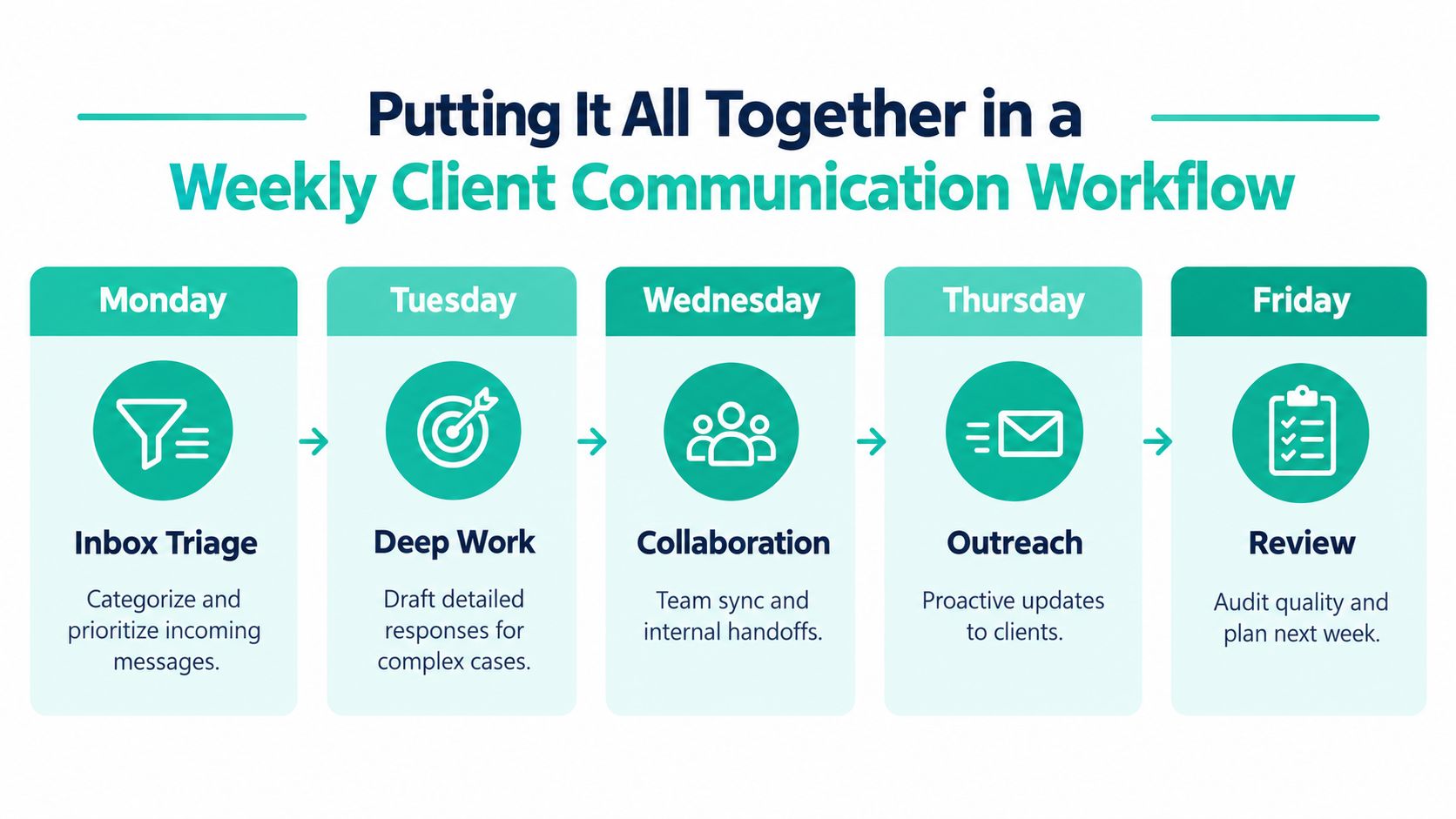
A strong workflow doesn't require a large department. It requires protected time, clear ownership, and one shared case record. Give each weekday a specific communication job so urgent work doesn't consume every hour.
Monday sorts the week
Start with inbox triage. Classify every new case as informational, document-related, or deadline-critical. Route each message to the right channel, identify the next owner, and flag cases where the travel date leaves little room for review.
Tuesday clears complex work
Reserve a focused block for detailed responses. Draft explanations for missing records, conflicting instructions, and cases that need veterinary review. Don't bury the next action inside a long email. Put it near the top.
Wednesday checks active bookings
Review open cases with the team. Use teach-back responses to find clients who believe a booking, airline approval, or old document has solved a requirement. Assign each correction to a named staff member and record the expected update time.
Thursday reaches out before clients chase
Send proactive reminders for documents that are expiring or still missing. Use SMS for a short deadline nudge, the portal for the record request, and email for the written summary. A mail merge tool such as sales follow-ups with Mail Merge for Gmail may help with repeatable outreach, provided staff review each message before it goes out.
Friday measures the handoffs
Pull first-response time, time-to-resolution, the percentage of cases updated before the promised deadline, and re-contact rate. These measures reveal whether the workflow is keeping promises, not merely whether clients liked the final interaction. The response-time benchmark data cited by Ringly supports aiming for faster internal targets, including an automated acknowledgment within minutes and human review within one business hour for active travel cases (customer-service response benchmarks).
Before any external message goes out, run this empathy check:
Name the pet: Have we used the correct name and case details?
Restate the goal: Have we shown that we understand the travel or care objective?
Confirm the next step: Is there one clear action?
Set the expectation: Does the client know who owns the next review?
Give a real time: Have we stated when they'll hear from us?
A weekly rhythm turns good intentions into repeatable customer communication techniques. It also makes gaps visible while there's still time to fix them.
Quick-Start Checklist and Final Reminders
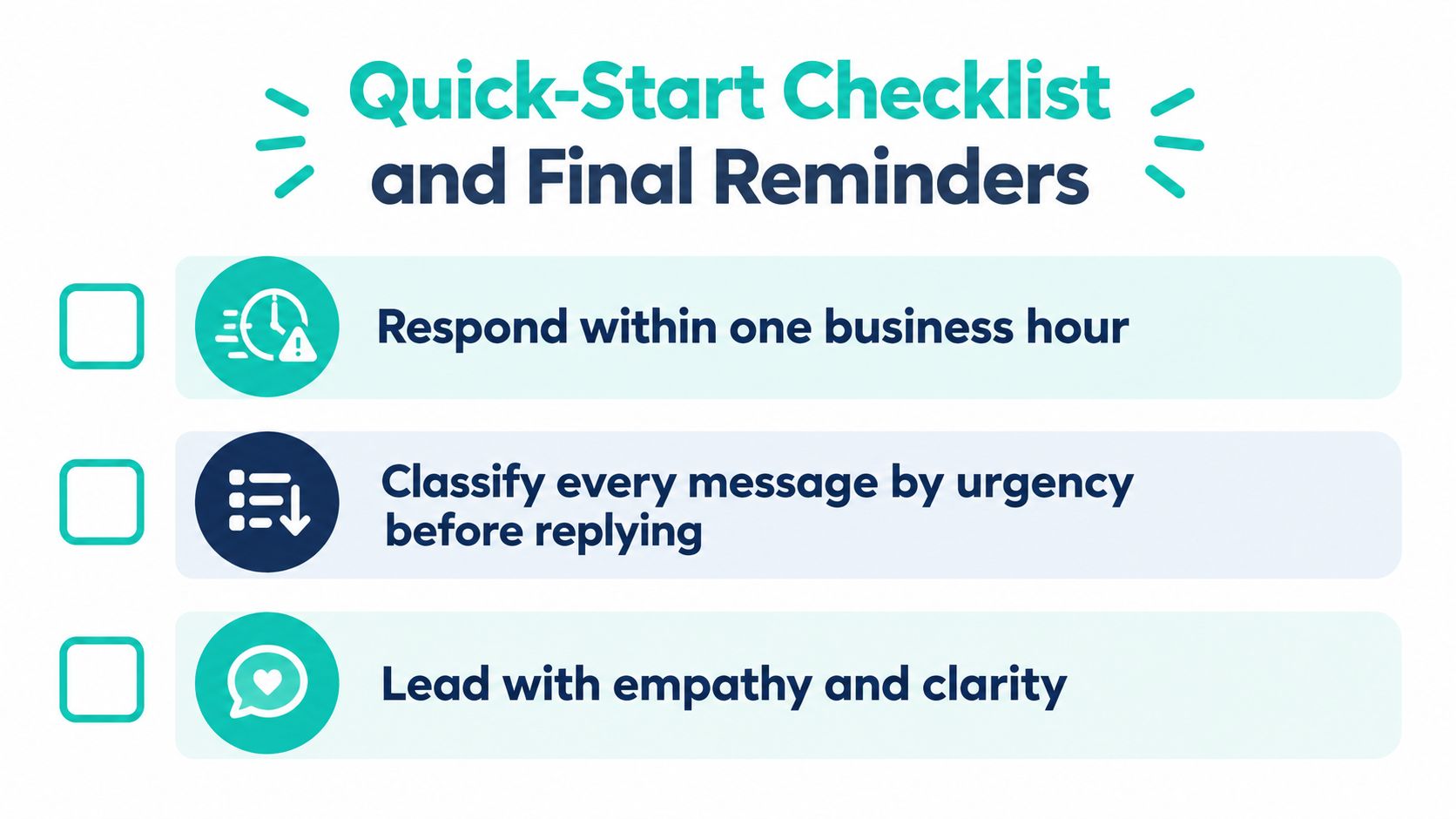
Adopt the habits that remove the most confusion first. Respond within one business hour for active travel cases, even if the first response only confirms receipt and the review time. One-third of customers expected a service-email answer within one hour or less in the research summary cited earlier, so silence is a poor default when a deadline is approaching.
Classify every message before replying. A simple label, informational, document-related, or deadline-critical, tells the team how quickly to act, which channel to use, and whether escalation is needed. Lead with acknowledgment before explaining limits. Match the channel to the message rather than forcing every client into email.
Use teach-back for confirmations involving dates, records, microchips, certificates, or layovers. Ask the client to explain the next step in their own words, then correct the misunderstanding without blame. Log sensitive conversations, especially phone calls, denials, fee discussions, and changes to the travel plan.
A checklist for tomorrow
Acknowledge quickly: Confirm receipt, identify the pet, and state the review time.
Classify clearly: Mark the message by urgency and type before giving advice.
Choose deliberately: Use SMS for time-bound nudges, email for durable summaries, phone for emotional complexity, and the secure portal for sensitive records.
Give one action: Name the next task, owner, and expected completion time.
Close the loop: Send a written confirmation and record the client's response.
Review weekly: Check response speed, resolution time, deadline updates, and re-contact patterns.
Warmth without structure creates chaos. Structure without warmth creates churn. The standard to aim for is both: a calm human response, a clear next action, a suitable channel, and a reliable update when promised. That combination helps anxious owners feel guided rather than brushed aside, even when the answer depends on further review.
Passpaw helps veterinary practices manage international pet-travel applications by collecting trip and pet details, requesting documents, sending deadline reminders, validating records, and keeping clients updated through the application process. Visit Passpaw to see how a shared workflow can make these customer communication techniques easier to run.

More articles
From regulatory changes to best practices for veterinarians and pet owners, our resources keep you ahead of the curve.