Are you a team member in a veterinary practice?
Are you a pet parent planning a trip with your furry pal?
Crate Training Older Dog: A Gentle Step-by-Step Guide
If you're reading this because your dog is no longer a puppy and the crate is still sitting in the garage, you're not behind. You're just starting at the right moment for the dog you have now.
A lot of people try crate training for the first time when life changes. A move is coming up. A new baby is on the way. A house-training issue pops up. Travel suddenly matters. Or the vet says your dog may need a safe recovery space after a procedure. That can feel awkward when your dog is older and already has opinions about where they sleep, how they relax, and what counts as suspicious furniture.
Older dogs can learn this skill. They just need a gentler, clearer process. Good crate work isn't about stuffing a dog into a box and hoping they “get used to it.” It's about teaching them that the crate predicts rest, food, calm, and safety.
Why Crate Train Your Older Dog Now
The hesitation is understandable. Many owners hear “crate” and picture restriction. Dogs often hear “crate” and picture whatever history they've had with doors closing, people leaving, and routines changing. That's why mindset matters so much at the start.
For an older dog, the crate works best when you treat it like a private den, not a storage container for your pet. It becomes a place your dog can retreat to during household chaos, a predictable rest spot during guests or renovations, and a familiar safe zone when everything else feels different. If you're thinking through crate training an older dog, that reframing helps more than any shortcut.
Why this matters beyond the house
A crate-trained senior or adult dog usually handles transitions better because they have one portable space that stays the same. The flooring changes. The hotel changes. The car changes. The vet clinic smells like a thousand nervous paws. The crate stays familiar.
That matters for travel in particular. Dogs who already know how to settle in a crate often cope better with the practical parts of getting from one place to another. The crate stops being “the thing that means I'm trapped” and starts meaning “my resting spot.”
A well-taught crate is less about control and more about giving a dog a place that makes sense when the world doesn't.
What works and what doesn't
What works:
Slow exposure: Letting the dog investigate at their own pace
High-value rewards: Meals, treats, chews, and praise tied to the crate
Short sessions: Ending before stress builds
Consistency: Repeating small wins until the crate feels normal
What doesn't work:
Forcing entry: This can create resistance fast
Using the crate only when you leave: That makes it a predictor of isolation
Treating panic like stubbornness: Distress and defiance aren't the same thing
If your dog is older, don't think of crate training as remedial work. Think of it as life-skills training with a comfort bonus. That's a pretty good deal for both ends of the leash.
Preparing for Crate Training Success
The best crate training starts before your dog steps one paw inside.
For older dogs, comfort isn't a nice extra. It's the foundation. If the crate hurts, startles, slides, or leaves your dog feeling cornered, training stalls before it begins.
Start with your vet
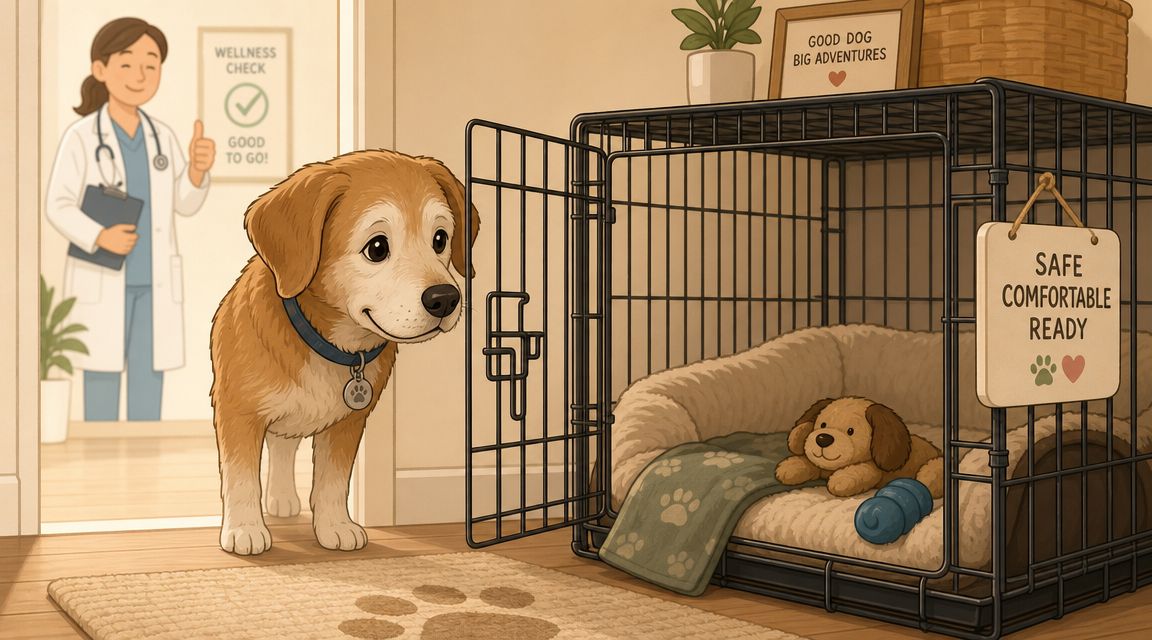
Before you work on behavior, rule out physical reasons the crate may be hard for your dog. Older dogs may have stiffness, joint pain, hearing loss, vision changes, or bathroom urgency that make confinement more stressful than it looks from the outside.
Ask practical questions, not just “Is my dog healthy enough for a crate?” Ask whether your dog seems uncomfortable lying down, getting up, turning tightly, or holding urine for normal stretches. If your dog has arthritis or mobility issues, the crate setup may need lower entry, thicker bedding, and a location where they won't be bumped or startled.
Pick the right crate and the right setup
The crate should be large enough for your dog to stand up, turn around, and lie down comfortably. If it's too tight, your dog may avoid it. If it's too roomy, some dogs struggle to settle because the space feels too open and undefined.
Different crate styles suit different dogs.
Wire crates: Good for airflow and visibility. Helpful for dogs who relax better when they can see the room.
Plastic kennels: Often feel more enclosed and den-like. Some older dogs settle better in the darker, quieter feel.
Soft-sided crates: Best only for dogs already comfortable with crating and unlikely to paw or chew their way out.
The inside matters as much as the frame. Use stable, non-slip bedding. Add a familiar blanket or toy if your dog finds that comforting. Keep the crate away from direct drafts, loud speakers, busy doorways, and slippery flooring at the entrance.
Think ahead if travel is part of the goal
If the crate will eventually be used in the car or on a trip, don't buy only for the living room. Buy with transport in mind. Size, sturdiness, ease of carrying, and ventilation all matter more once the crate leaves the house. A practical guide to choosing a pet crate for travel can help you avoid buying twice.
Practical rule: The easiest crate to train is the one your dog can enter, settle in, and exit without strain.
Set the scene before training starts
Do these first:
Place the crate in a calm area where the family spends time, but not in the busiest traffic lane.
Secure it so it doesn't rattle or shift when your dog steps in.
Leave the door open so the crate doesn't swing and spook your dog.
Bring rewards nearby before each session so timing stays clean and easy.
This prep work isn't glamorous, but it saves a lot of tail-chasing later.
Making the Crate a Happy Place
This is the phase often rushed, and it's the phase that decides whether crate training sticks.
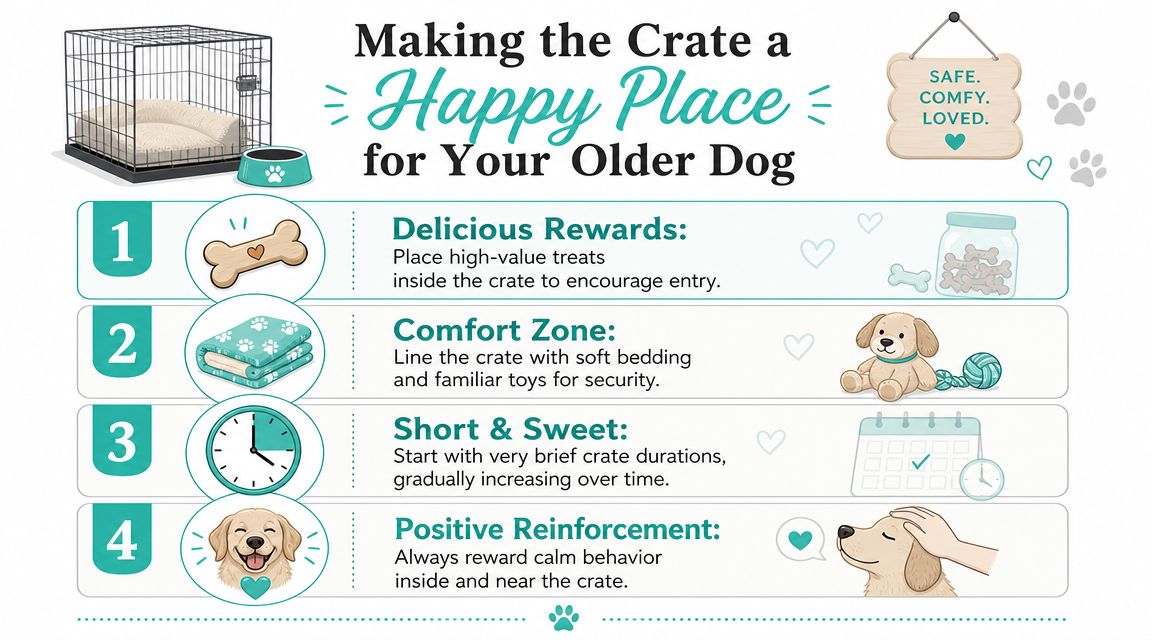
A solid older-dog crate routine starts by turning the crate into a reinforcement zone before you even think about closing the door. That's a best practice supported by Hill's guidance on crate training an older dog, which also notes that you shouldn't move to unsupervised departures until the dog can stay calmly crated for roughly 30 minutes with you mostly out of sight.
Let the dog choose the crate
Don't lure so aggressively that your dog feels tricked. Instead, make the crate area easy to explore.
Start simple:
Toss a treat near the crate, not inside.
Then place one just inside the entrance.
Then a little farther in.
Then all the way toward the back.
If your dog reaches in and backs out, that's fine. If they step in with two paws, also fine. You're not looking for a dramatic breakthrough. You're looking for relaxed repetition.
Some older dogs move fast. Others need several sessions before they feel comfortable entering fully. The slower dog isn't being difficult. They're giving honest feedback.
Turn meals into crate rituals
Feeding in and around the crate often helps because food changes the emotional meaning of the space. Start with the bowl close to the entrance if needed, then gradually move it deeper inside. Keep the door open.
Good options for crate-only rewards include:
Regular meals: Predictable and easy to repeat
Stuffed food toys: Useful for dogs who enjoy licking and chewing
Favorite chews: Best for dogs who can stay relaxed with them
Special treats: Reserve these for crate practice so the crate gets the credit
If your dog chooses to go in, eat, and linger, you're on the right track. If they dart in, grab food, and hurry out, slow down. You need more value and less pressure.
A helpful companion read on behavior shifts during transitions is this guide to signs a dog is adjusting to a new home, because many older dogs need that same gentle read of body language during crate training.
Watch for loose muscles, normal breathing, interest in food, and the ability to pause inside the crate. Those signs tell you the dog is learning, not just tolerating.
Build comfort before closure
Once your dog is walking in willingly, begin rewarding calm behavior inside the crate while the door stays open. Sit nearby. Read, work, or just hang out. Drop treats in for lying down, staying settled, or choosing to remain inside.
In this scenario, many owners accidentally create friction. They wait for the dog to enter, then immediately close the door. The dog learns that going in causes the part they dislike. That's not a lesson you want.
Instead, make the crate the dinner-and-dessert spot of the house for a while. Let naps happen there if your dog chooses. Let chew time happen there. Let calm happen there.
A few things I never rush
With older dogs, I pay close attention to these moments:
The pause at the entrance: Hesitation means I need to lower the difficulty.
How the dog exits: A calm step-out is different from a spring-loaded launch.
What happens after the food is gone: If calm disappears the second rewards stop, the behavior isn't ready for the next step.
Crate training an older dog often succeeds because of patience, not speed. That's the least flashy part of the process, and the most important.
Gradually Introducing Crate Time
Once your dog is entering the crate willingly and relaxing with the door open, you can begin very short door-closed practice. Keep your first sessions almost comically short. That makes success easier.
The staged approach matters. The San Francisco SPCA adult dog crate training guide recommends starting with absences of 1 to 10 seconds, then building to 1 minute, 5 minutes, 10 minutes, and eventually toward a few hours as the dog remains calm.
Start with seconds, not minutes
Close the crate door, give a treat, and open it again before your dog has time to worry. Stay nearby at first. Then repeat.
Don't chase time for its own sake. Chase relaxed behavior. A dog who can do a few seconds calmly is progressing. A dog who can do a minute while panting, pawing, or scanning the room is not ready for longer.
Use these signs to decide whether to move forward:
Ready for more: soft body, quiet waiting, taking treats, lying down
Needs easier reps: whining, tense posture, repeated turning, rushing out when released
Needs a reset: barking, frantic scratching, heavy distress, refusal of food
Sample Crate Training Schedule for an Older Dog
Day(s) | Training Goal | Key Action |
|---|---|---|
Day 1 | Door closes briefly | Close the door for 1 to 10 seconds, treat, then open while your dog is still calm |
Day 2 | Calm with you nearby | Repeat short closures and build toward about 1 minute with you sitting close |
Day 3 | Brief distance | Step a little away, return, and reward calm behavior |
Day 4 | Out of sight for a moment | Leave for about 1 minute, then come back quietly |
Day 5 | Build early duration | Practice 5-minute sessions with a chew or treat scatter |
Day 6 | Extend only if relaxed | Try 10 minutes, keeping your departure and return low-key |
Day 7 and beyond | Add time gradually | Move to longer intervals only when your dog stays settled at the current step |
This isn't a race or a strict calendar. Some dogs move through several rows in a day. Some need to repeat one row for quite a while. Older dogs often do better when you repeat easy wins instead of testing the edge of their tolerance.
Keep departures boring
Your behavior matters almost as much as the crate itself. If you do a long goodbye, hover, apologize, or return with high excitement, you add emotional static around the event.
Try this instead:
Give a simple cue.
Offer a calm reward.
Leave without fanfare.
Return casually.
Release only when your dog is quiet and settled.
Quiet exits and quiet returns help the dog learn that crating is ordinary, temporary, and safe.
What owners often miss
Many dogs are fine with the closed door while you stay visible, but worry starts when you disappear. That's normal. It means your dog has learned one part of the skill, not all of it.
If your dog gets stuck at the “out of sight” stage, shrink the challenge. Step behind a door for a second, return, reward, repeat. Then build up again. Good crate training older dog work often looks boring from the outside. That's usually a good sign.
Managing Setbacks and Common Issues
Every crate training plan hits a bump. The key is reading the bump correctly.
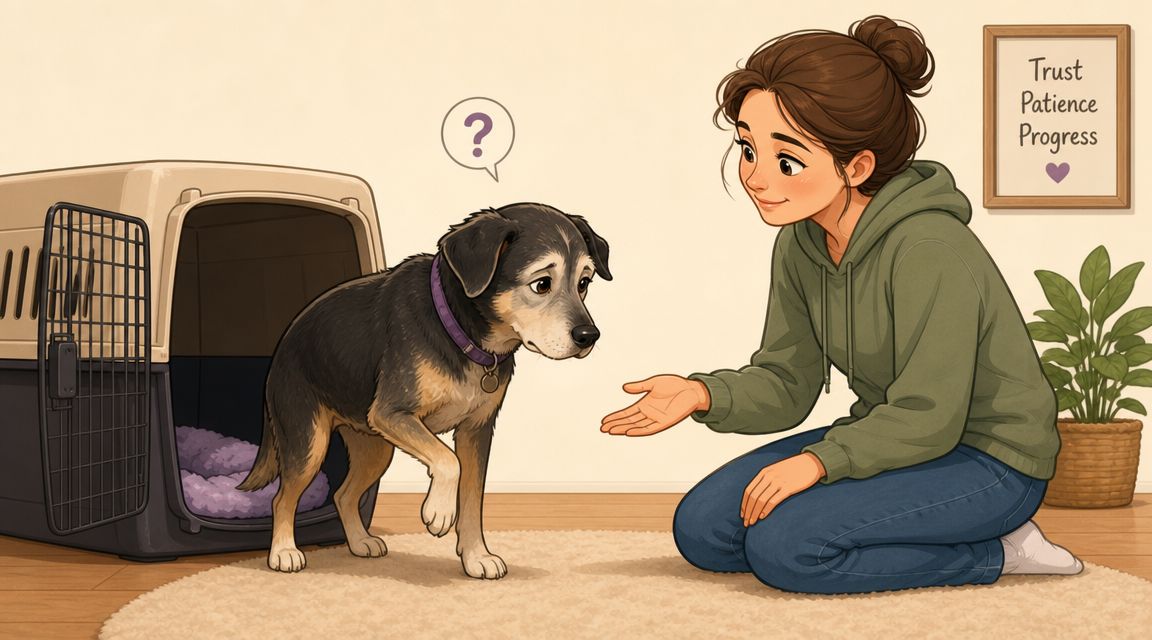
A little protest is different from panic. An older dog may grumble, fuss, or test whether whining gets the door opened. That's training information. Frantic escape attempts, escalating distress, or inability to settle point to a dog who needs the plan made easier and, in some cases, a closer look at pain, fear, or true confinement distress.
When whining starts
Don't snap the door open at the exact moment your dog vocalizes. That can teach them that noise works. Wait for a brief pause, then release if the session is over.
That doesn't mean letting a dog spiral. If the whining builds into clear distress, the session has become too hard. Shorten the time, stay closer, add better rewards, or go back to open-door work.
Try this checklist before each session:
Potty first: Older dogs may need more frequent bathroom breaks
Movement first: A short walk or sniff session helps take the edge off
Chew or food item ready: Settling is easier when the crate predicts good things
Calm human energy: Your dog reads your urgency fast
For some households, practical setup outside the crate matters too. If your dog needs a reliable pre-crate bathroom routine, options like Modern Yard Landscapes' pet solutions may help create a consistent potty area.
Know the daytime limit
Adult dogs should generally not be crated for more than about 4 hours at a time during the day, and for older dogs that limit matters even more because they may need more frequent potty breaks, as noted by Chewy's crate training guidance for older dogs. The goal is comfort, not long-term confinement.
If your daily schedule requires longer stretches, a crate may not be the right standalone management tool. You may need a dog walker, a gated room, a midday break, or a different setup entirely.
If the crate is becoming a storage solution for your schedule, training has drifted off course.
If your dog seems deeply distressed
Step back fast if you see hard panting, frantic scratching, repeated attempts to escape, or a dog who won't touch high-value food they normally love. That's not a sign to “be firmer.” It's a sign the current step is too big.
Some owners also ask about calming aids before travel or vet transport. That's a separate discussion from crate training itself, and medication choices should go through your veterinarian. If you're exploring the topic, this overview on whether to sedate a dog is a useful starting point for the right questions to ask.
Crate Training for Travel and Vet Visits
Home crate training pays off most when life gets messy.
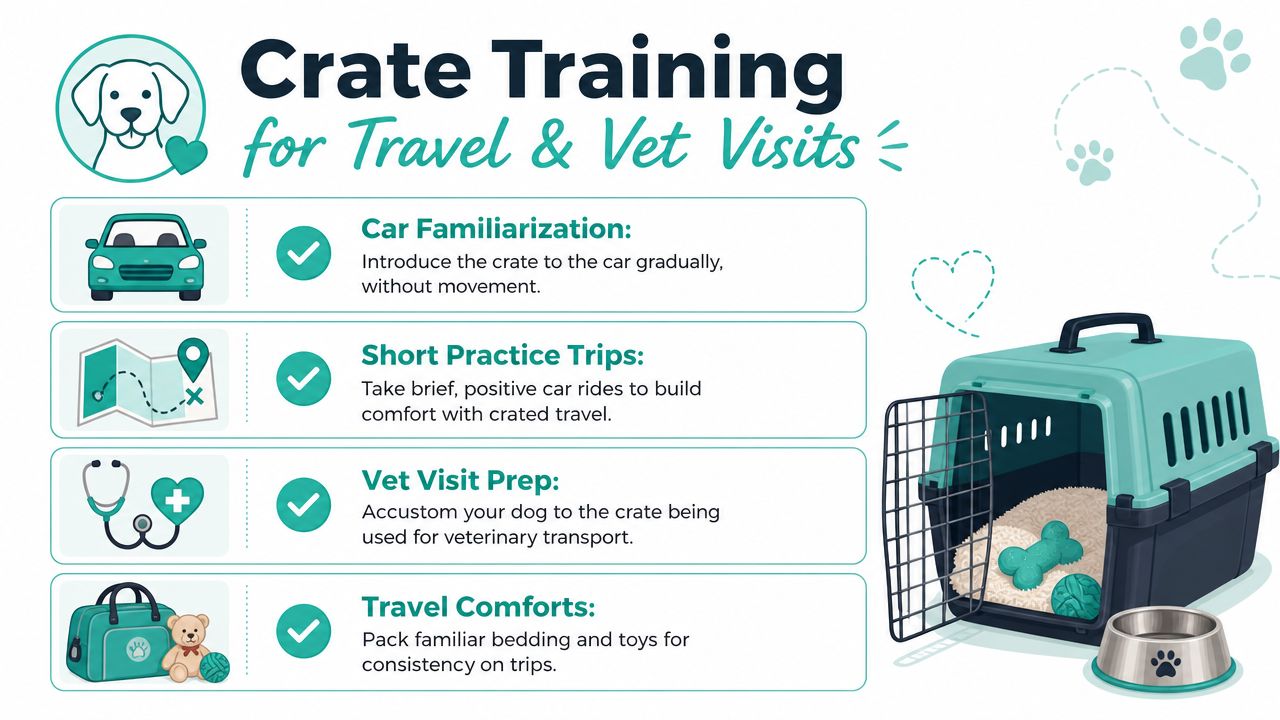
A dog who sees the crate as familiar has an anchor during car rides, hotel stays, temporary housing, grooming appointments, and vet visits. That's especially helpful for older dogs, because new places can feel more tiring and less predictable than they did earlier in life.
Make the crate portable in your dog's mind
Don't assume home success automatically transfers to the car or clinic. Practice in layers.
Put the crate in the car while parked and reward calm behavior.
Take short practice rides before longer trips.
Use the crate for routine vet transport so it doesn't only appear on stressful days.
Bring familiar bedding so the smell says “home,” even when the location doesn't.
If you're preparing for trips, a guide to safe travel tips for dogs can help you think through the bigger transport picture.
Choose the travel crate carefully
For flights, your carrier may need to meet specific airline or IATA-style requirements. For car travel, the crate should be stable and secured so it doesn't slide during turns or sudden stops. Practical details matter here. Door strength, ventilation, and fit in your vehicle can affect both comfort and safety.
If travel is part of your plan, compare options before you buy with this guide to travel crates for dogs.
Crate training older dog work isn't just about managing behavior at home. It's a passport skill. Once your dog learns that the crate means rest and security, you've given them something they can carry into every new place they go.
If you're planning a trip with your dog and want the paperwork side to feel less overwhelming, Passpaw helps simplify the pet travel process so owners and veterinary teams can stay organized, informed, and ready for the journey.

More articles
From regulatory changes to best practices for veterinarians and pet owners, our resources keep you ahead of the curve.