Are you a team member in a veterinary practice?
Are you a pet parent planning a trip with your furry pal?
Cat Travel Plane Guide How to Fly with Your Cat Calmly
You're at the airport with a cat in a soft carrier, boarding passes ready, and one question louder than the terminal announcements: will the airline accept your cat on this flight? The carrier may fit beneath the seat, but that doesn't guarantee a pet space is available. Route restrictions, aircraft rules, paperwork, and a last-minute carrier check can still upset an otherwise careful plan.
Meowing and carrier nerves are common worries, but the bigger practical problem is often approval. Cat travel by plane works best when you confirm the airline's rules and reserve the pet space before buying the ticket, then prepare your cat for the sights, sounds, and handling that follow. The journey starts at home, continues through check-in and security, and ends when your cat has a quiet place to decompress.
Cats are a substantial part of the pet travel picture. A peer-reviewed review estimates that cats account for 22% of pet travelers annually (U.S. Department of Transportation guidance on traveling with animals). That makes feline air travel a regular operational concern, not a niche request.
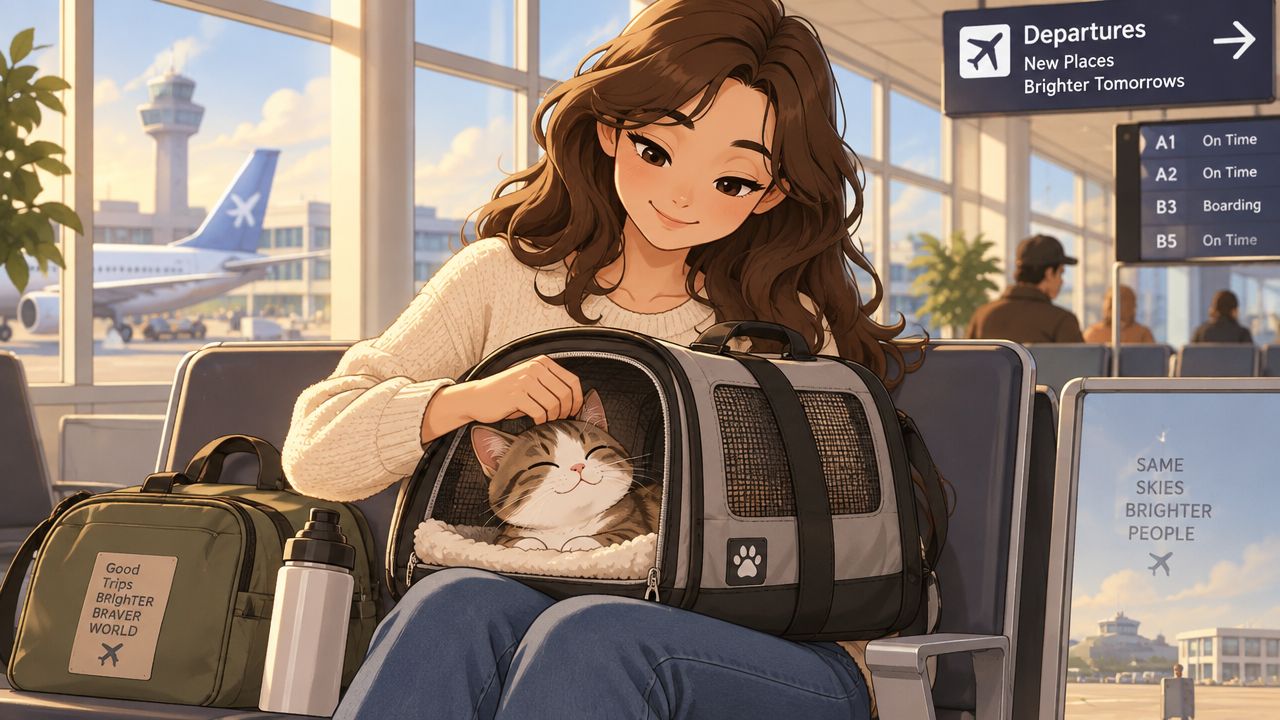
A calm trip begins with a realistic choice between cabin and hold travel, followed by destination checks, veterinary documents, an airline-approved carrier, and gentle conditioning. If you're looking for ideas around comfort, privacy, and a more personalized journey, this guide to flying pets in luxury offers useful context, although private aviation still requires its own operator and destination checks. You can also review these pet travel safety tips before building your plan.
The steps below focus on what matters at the airport. Your goal isn't to make travel perfectly smooth. It's to remove avoidable surprises so your cat can move through the journey with as little fuss as possible.
Introduction to Flying With Your Cat Without the Stress
Start with the flight, not the carrier
Many owners begin by shopping for a carrier. That feels productive, but it can be the wrong first move. The airline decides whether a pet may travel in the cabin, and the available pet spaces can be limited. Some airlines don't accept cabin pets on certain routes or aircraft, while some destinations don't permit pets to enter through the cabin process.
The useful question isn't, “Can cats fly?” It's “Will my cat be accepted on this specific flight?” Major-airline guidance confirms that cabin acceptance depends on airline policy and available space (United Airlines pet travel guidance). Call or use the airline's approved booking channel, confirm the route, ask whether a pet slot is open, and request written confirmation if the airline provides it. Only then should you finalize the ticket.
A carrier that fits under an aircraft seat can still fail if the route doesn't allow cabin pets. Likewise, a cat that meets the airline's general age requirement may be denied if the destination has a different entry process or if the aircraft has no approved space.
Practical rule: Treat pet approval as part of the flight booking, not as an accessory you add afterward.
Make the journey predictable
Your cat doesn't need to understand airports. Your cat needs familiar smells, a secure carrier, steady handling, and a person who doesn't panic when the carrier produces a small opera during check-in. Leave the carrier open at home, add familiar bedding, and let your cat approach it without pressure. Short practice sessions can make the carrier feel less like a trap and more like a portable den.
Paperwork deserves the same calm attention. Airline rules and destination requirements may overlap, but they aren't identical. A health certificate, vaccination record, microchip information, and import documents may each have their own timing or format. Store paper copies with your travel documents and keep accessible digital copies as a backup.
At the airport, keep the carrier closed unless an authorized screening process requires another arrangement. Security screening can be the moment when a frightened cat slips away, so ask staff how they handle animals before opening anything. During flight, the carrier must stay closed and stowed as required by the airline and aviation rules.
The good news is that preparation turns a chaotic day into a sequence of small tasks. Confirm the pet slot, validate the route, prepare documents, test the carrier, and rehearse the routine. Once those pieces are in place, you and your whiskered travel companion can move through the airport with a much steadier rhythm.
Choosing Between In Cabin and Cargo for Your Cat
Your cat may be ready for a flight, yet the booking can still fail at the airline's pet desk. Cabin space is limited, routes can exclude pets, and a carrier that fits one aircraft may not fit beneath another seat. Confirm the pet slot, route eligibility, and carrier dimensions with the airline before paying for the ticket.
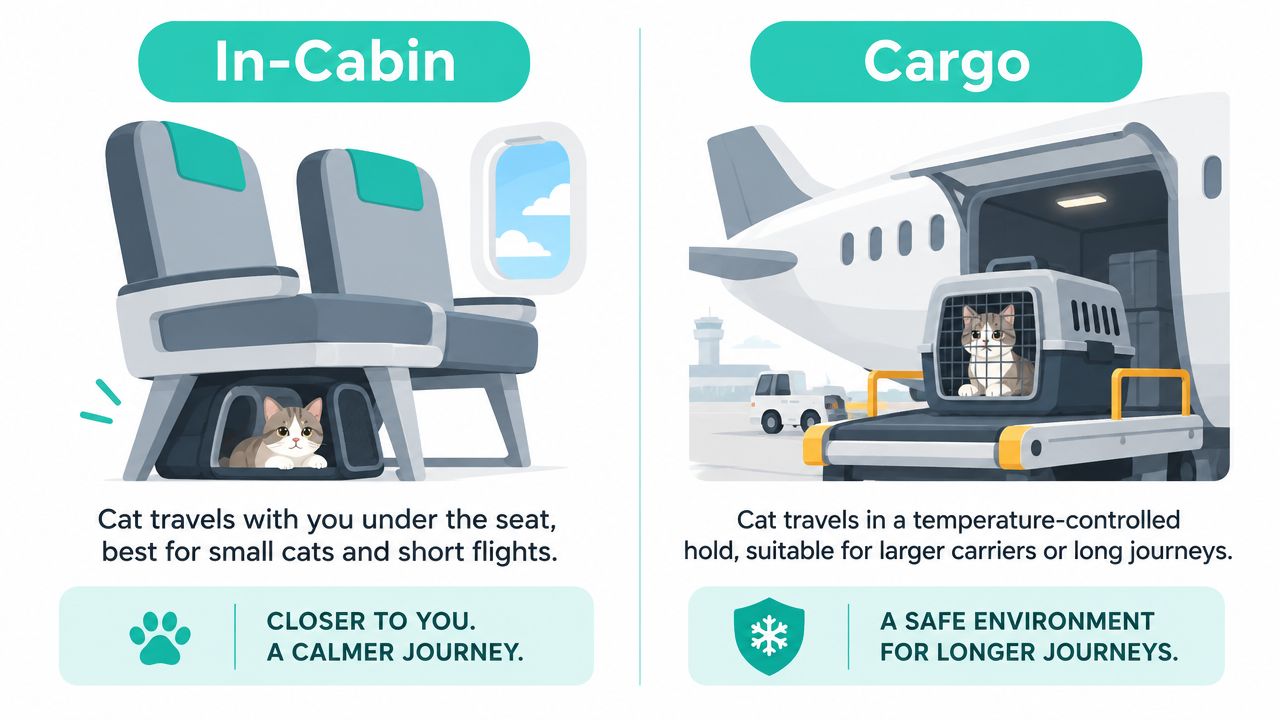
Cabin travel is often the preferred option because you remain near your cat. The FAA treats the pet carrier as carry-on baggage, and it must fit beneath the seat and stay stowed during taxi, takeoff, and landing (Department of Transportation information for flying with a pet). The airline still decides whether pets are accepted in the cabin, which routes qualify, and how many pet spaces are available.
Cargo or hold travel may suit a larger approved carrier, a route that does not accept cabin pets, or an airline that manages animal transport separately from passenger baggage. It can involve different handling arrangements and less owner visibility. Federal guidance notes that many airlines do not allow pets to travel as ordinary checked baggage, so cargo is not an automatic backup. Confirm the exact process with the carrier. For a deeper look at container standards, see this guide to cargo hold travel for pets.
Compare the trade-offs that matter
Factor | In Cabin | Cargo or Hold |
|---|---|---|
Where your cat travels | In a closed carrier beneath the passenger seat | In an approved transport area or hold, subject to airline handling |
Main constraint | Under-seat dimensions and limited pet-space availability | Airline acceptance, route handling, carrier standards, and operating conditions |
Best fit | A cat that fits comfortably in an approved soft-sided carrier and an eligible route | A journey where cabin travel isn't offered or a larger approved container is required |
Owner visibility | You stay nearby during the passenger journey | You may have less direct visibility during transport |
Booking step | Reserve the pet space directly with the airline before ticketing | Confirm the carrier's cargo or special-handling process before purchasing |
Common failure point | Pet slot, route denial, or carrier dimensions | Carrier, temperature, route, or handling restrictions |
Check eligibility before you pay
Age is one clear checkpoint. Federal guidance says dogs and cats must be at least 8 weeks old and weaned for at least 5 days before shipping. American Airlines says cats must be at least 8 weeks old for travel within the United States and Puerto Rico (American Airlines pet policy). A kitten can fit the carrier and still be too young for the planned journey.
Brachycephalic cats require extra screening. Some airlines may refuse animals with breathing-related risks, and American Airlines does not accept brachycephalic cats as checked pets. Cabin approval does not remove every concern, so ask the airline and your veterinarian whether the route and travel method suit your individual cat.
The carrier must also match the airline's process. Check whether the route uses cabin space, cargo handling, or a separate live-animal service, then confirm the required container and check-in location. For cabin travel, reserve the pet space directly and tie the approval to the exact flight. That answer is more useful than a generic “pets allowed” label.
Preparing Documents and Health Certificates the Smart Way
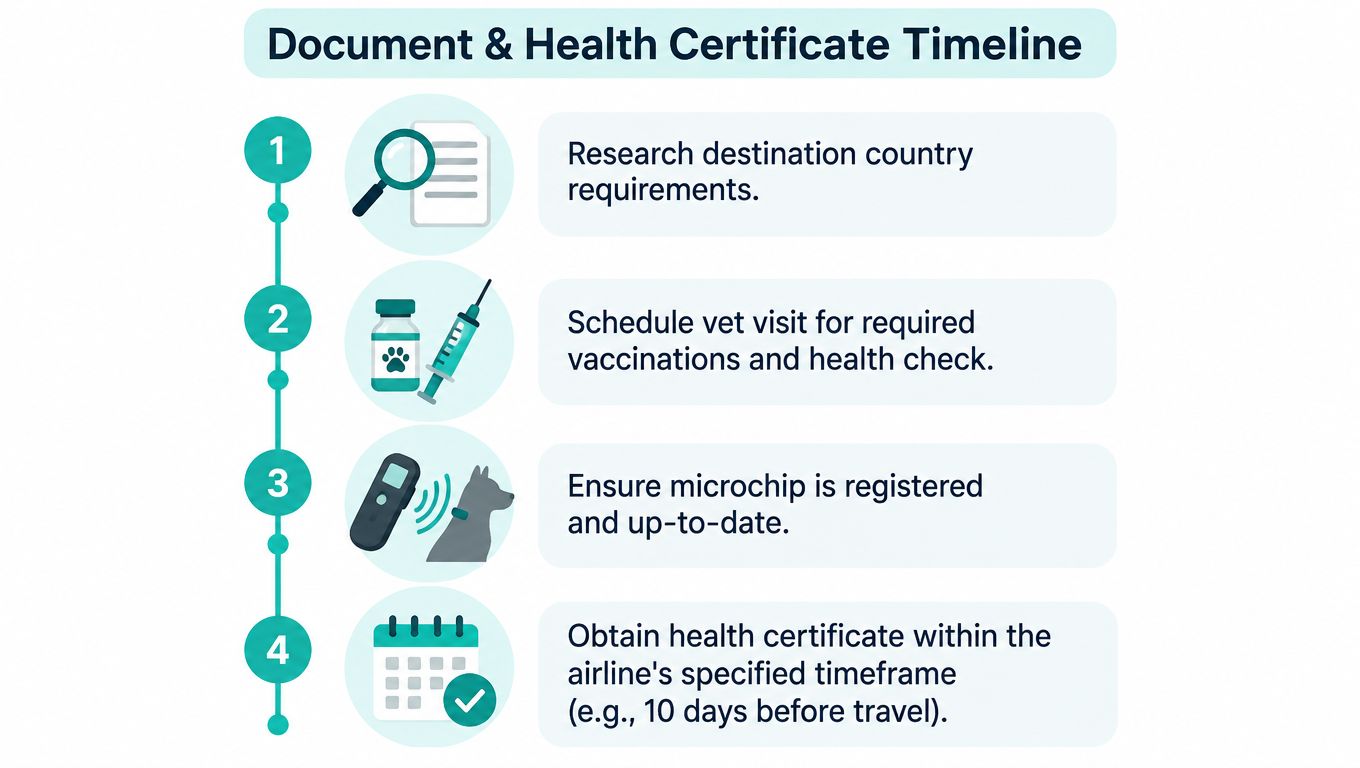
Pet travel paperwork becomes manageable when you separate destination rules, airline rules, and veterinary timing. Start with the destination, including any transit points. A country may require documents that the airline doesn't mention in its general pet policy, while an airline may ask for a certificate or carrier detail that the destination authority doesn't address.
Don't rely on a single checklist copied from another trip. Rules can change, and a route through another country may create another set of conditions. Ask the airline which documents must be presented at check-in, then ask your veterinarian which examinations, vaccinations, certificates, or endorsements apply to the destination.
Build the document trail in order
Research the destination. Write down every requirement for the final country and any transit location. Keep the official wording and note which organization issues or validates each document.
Arrange the veterinary visit. Bring the airline itinerary, destination requirements, vaccination history, and microchip details. Your veterinarian can identify missing steps and advise whether your cat is a sensible candidate for the planned trip.
Check identification records. Make sure the microchip is registered and that your contact information is current. A document is only useful when the details on it match the cat and the owner.
Confirm certificate timing. Some destinations and airlines require a health certificate within a defined window. The practical lesson is simple: don't schedule the appointment so early that the certificate expires before departure, and don't leave it so late that there's no time to correct an error.
Organize copies. Keep originals in a waterproof folder, with digital scans available offline. Put feeding and watering instructions with the transport documents if your cat is traveling through a process that requires them.
Avoid the timing traps
Federal guidance says an animal generally can't be presented for shipping more than 4 hours before departure unless arrangements are made in advance. It also sets feeding and watering schedules based on transit length and requires written instructions to accompany transported animals (federal animal transportation guidance). Confirm how those rules apply to your airline and transport method rather than guessing at the counter.
Temperature is another planning issue. A route that looks straightforward on the calendar may involve a hot departure airport, a cold connection, or a delay on the ground. Ask who monitors the conditions and what happens if the airline pauses animal acceptance.
For international journeys, a veterinary practice may need to coordinate several documents while keeping you updated. A workflow such as Passpaw's veterinary international health certificate guide can help explain the certificate process and keep the required information in one place. Use it alongside direct guidance from the destination authority, airline, and veterinarian.
The safest approach is boring in the best way. Research first, schedule the vet visit with the route in hand, verify identity details, check timing, and carry organized copies. A tidy folder can save more stress than a suitcase full of clever gadgets.
Picking the Right Carrier and Getting It Flight Ready
The carrier has two jobs. It must satisfy the airline's physical rules, and it must give your cat enough room to stand, turn around, and lie down comfortably. Those jobs can conflict, especially when an airline's under-seat height is tighter than your cat's preferred space.
For in-cabin travel, IATA guidance calls for an IATA-compliant container that fits beneath the seat, with the cat remaining inside the closed carrier for the entire flight (IATA pet travel guidance). Air Canada's 2025 policy specifies soft-sided cabin carriers, one cat or small dog per passenger, and enough interior space for the pet to stand, turn, and lie down comfortably. The airline's own policy still controls your booking.
Measure before shopping
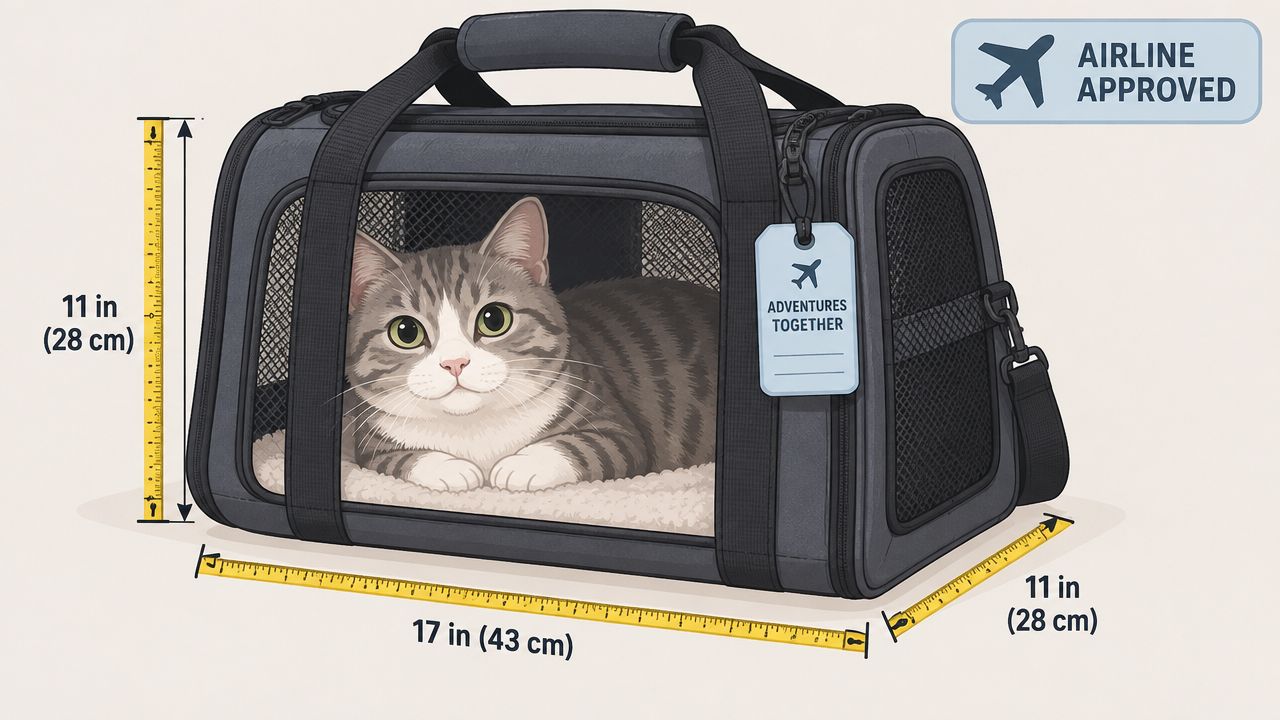
Measure the carrier's outside dimensions, including handles, wheels, pockets, and flexible panels. A soft bag can compress slightly under a seat, but you shouldn't assume the gate agent will accept a bag that exceeds the published limit.
A common U.S. cabin maximum is 18 x 11 x 11 inches, while Southwest publishes 18.5 x 13.5 x 9.5 inches. KLM lists 46 x 28 x 24 centimeters, approximately 18 x 11 x 9 inches, so height can differ even when length looks familiar (airline cat carrier dimensions). Verify the current dimensions with the airline before buying.
Favor secure comfort over clever extras
Look for strong ventilation, reliable zippers, a leak-resistant base, and an absorbent liner that can be replaced without taking the carrier apart. A familiar blanket can make the interior smell more like home, but leave enough usable space for your cat to reposition.
Label the carrier with your name, phone number, destination, and an emergency contact. If the cat is traveling through a hold or shipping process, attach feeding and watering instructions as required by the carrier and government guidance. Don't put loose items inside that could block ventilation or shift against your cat.
A carrier that is one inch too tall for the aircraft's under-seat space may be rejected even if your cat is comfortable inside it. That isn't a problem you can solve at boarding. Ask the airline for the exact dimensions for your aircraft and route, then test the packed carrier against those limits.
Leave the carrier open in a familiar room. Feed treats near it, place bedding inside, and allow your cat to nap there voluntarily. For more detail on construction, sizing, and safe use, see this cat travel crates guide. The carrier should become ordinary household furniture before it becomes airport equipment.
Pre Flight Conditioning and Your Day of Travel Checklist
Carrier practice works best when it starts slowly. Leave the carrier open, reward calm exploration, and let your cat decide how close to get. Once your cat is comfortable entering, close the door briefly, reopen it, and repeat without turning every session into a dramatic event.
Add movement gradually. Carry the closed carrier around the home, stand near normal household sounds, and take short practice rides if your cat tolerates them. Stop before your cat becomes overwhelmed. A bad rehearsal can make the actual airport day harder, so slow progress beats a forced grand finale.
The evening before
Prepare the travel folder, carrier, food, water, litter supplies, cleaning materials, and any veterinarian-approved medication. Check that the pet reservation is attached to the correct flight, and confirm the airport's check-in location and the airline's timing instructions.
Keep the cat's routine as familiar as possible. Offer normal meals according to your veterinarian's advice, and avoid experimenting with new food or calming products on travel day. If medication is being considered, speak with your veterinarian beforehand and follow the prescribed instructions. Don't give a sedative because the carrier feels stressful.
At the airport
Arrive with enough time to handle a counter conversation without rushing. Tell the airline representative that you're traveling with a cat, confirm the pet reservation, and ask whether the carrier will be checked for dimensions or weight. Keep documents together, and don't place the carrier on a luggage conveyor unless airline staff specifically directs you to do so.
Security screening needs a safety plan. Ask the screening officer how to proceed before opening the carrier. If your cat must come out, use a secure harness only if your cat is already trained to wear it, and keep the process controlled. Never assume a frightened cat will stay in your arms because they usually do at home.
Airport routine: Ask first, secure the cat before opening the carrier, and keep the carrier closed again as soon as screening is complete.
During the flight
The carrier stays closed and under the seat as required. Don't unzip it to soothe your cat, offer a snack, or check on a noise. Speak softly through the carrier if your cat responds well, but let the enclosed space do its job.
Use this quick checklist:
Pet approval: Confirm the pet slot and exact flight before ticketing.
Carrier fit: Check the airline's current exterior dimensions, including height.
Documents: Carry originals and accessible digital copies.
Comfort kit: Pack absorbent liners, familiar bedding, food, water, litter supplies, and waste bags.
Identification: Confirm the microchip record, carrier label, and contact details.
Airport plan: Ask about screening before opening the carrier.
Cabin behavior: Keep the cat closed in the carrier and keep it stowed during taxi, takeoff, and landing.
The winning airport strategy is pleasantly uneventful. Fewer surprises mean fewer reasons for you or your cat to lose your cool.
After Landing and Tips for a Smooth Return to Routine
Landing doesn't mean the work is over. Your cat has experienced unfamiliar sounds, movement, smells, and handling, so give them a quiet recovery area before introducing the whole destination. A small room with the carrier, water, litter, familiar bedding, and a hiding place is usually easier to manage than an open hotel room or new home.
Open the carrier only when doors and windows are secure. Let your cat come out at their own pace, and leave the carrier available as a retreat. Some cats will investigate immediately, while others will remain tucked away until the environment feels predictable. Neither response calls for a parade.
Watch, then restore the routine
Offer water and a familiar meal without pressure. Keep the litter tray clean and easy to reach, and return to the usual feeding, play, and rest pattern as soon as your cat is ready. Avoid a crowded welcome, loud music, or immediate introductions to unfamiliar animals.
Monitor behavior that concerns you, especially if your cat seems unable to settle, refuses normal care, or shows signs that worry you. Contact a veterinarian if something seems outside your cat's usual response or if you're unsure what you're seeing. Travel stress can look different from one cat to another, so your cat's normal baseline matters.
A quiet room, familiar smells, and patience are better first steps than enthusiastic sightseeing.
Before the return flight, write down what worked and what didn't. Note whether the carrier was easy to fit, how your cat handled security, which documents were requested, and whether the airline's instructions matched what you expected. Update records early, recheck the route, and reserve the return pet space instead of assuming it carries over automatically.
The best cat travel plane experience isn't the one with the fanciest accessories. It's the one where approval was confirmed, the carrier fit, the documents were ready, and your cat had a calm person nearby from departure to recovery. A little planning keeps the trip on the right track, with fewer surprises and more comfortable whiskers.
For your next cat flight, start by confirming the airline's pet slot and route rules, then organize the health-certificate workflow before you buy the ticket. Visit Passpaw to explore tools for tracking pet travel documents, validating requirements, and keeping veterinary communication organized.

More articles
From regulatory changes to best practices for veterinarians and pet owners, our resources keep you ahead of the curve.